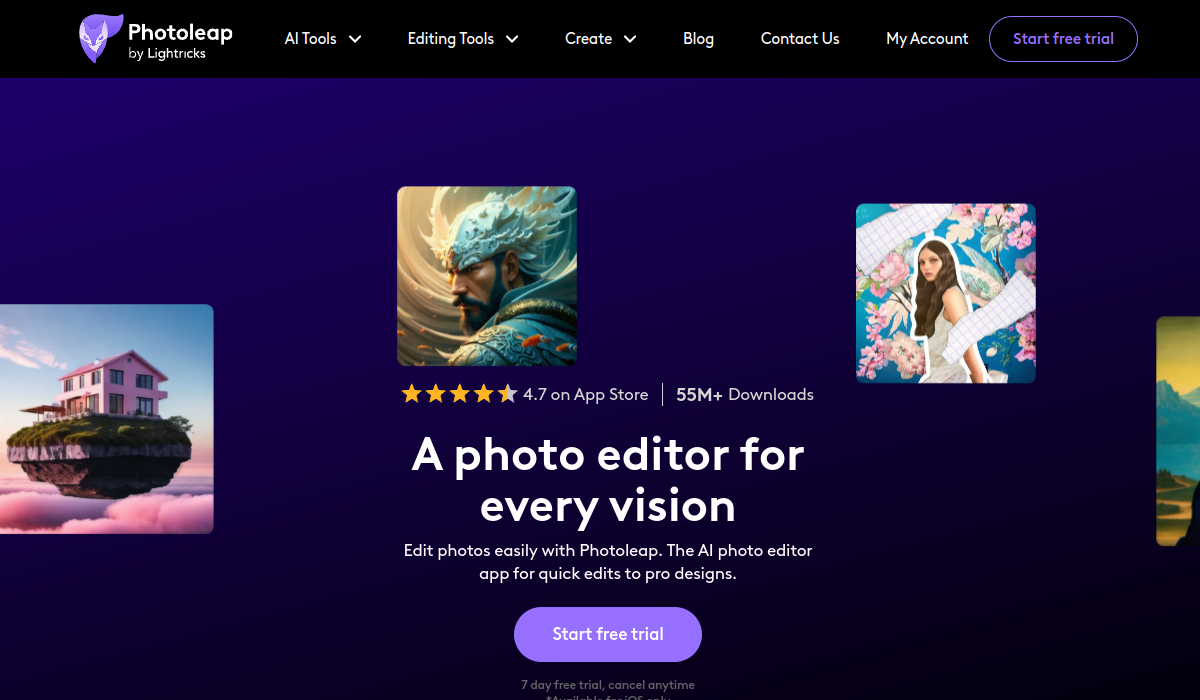
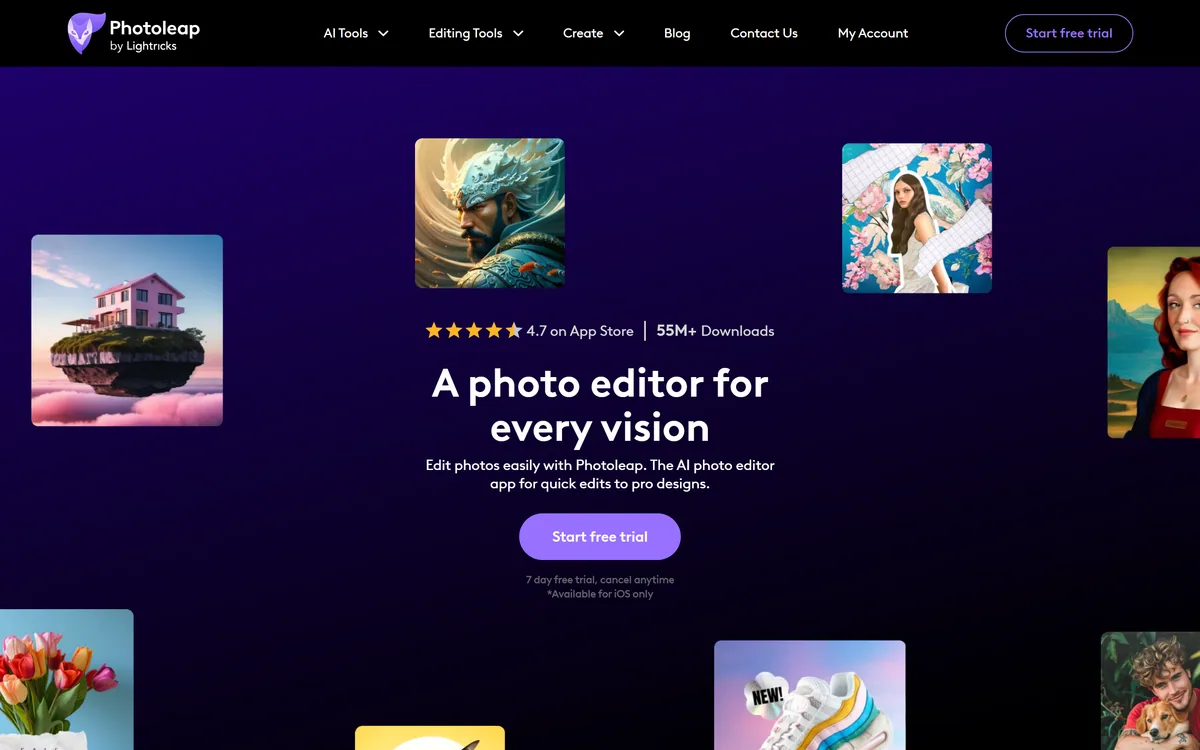
Photoleap is a photo editing app from Lightricks combining one-tap enhancement, object removal and background swapping with generative tools including text-to-image and AI filters. It states 55M+ downloads and a 4.7 App Store rating, and is available for iOS only.
photoleapapp.com5 viewsAdded June 7, 202527K visitors
Phone cameras have got extremely good and phone editing has not kept up. The built-in tools handle brightness and crop; anything beyond that means either accepting the photo as it is or moving it to a computer.
That gap is where mobile editing apps live, and the good ones solve a specific problem: doing in three taps what used to require a selection tool and a steady hand.
Photoleap covers that, and adds generative tools on top — which is a different proposition from correction and worth evaluating separately.
Photoleap's homepage, captured 9 September 2026, showing the photo editor positioning.
Generative tools alongside, including text-to-image and AI filters for creating rather than fixing.
55M+ downloads and a displayed 4.7 App Store rating, which is a large installed base for the category.
iOS only, stated explicitly on the site, with a seven-day free trial.
Made by Lightricks, a company with a long history in mobile creative software.
What Does A One-Tap Edit Actually Change?
Photoleap describes smart one-tap edits for enhancing image quality, removing unwanted objects and swapping backgrounds, with AI doing the heavy lifting.
It is worth being specific about what has actually become easy, because the change is larger than the interface suggests.
Object removal used to require selecting the object precisely, deleting it, and then reconstructing what was behind it — a skilled task that took minutes and looked wrong when done quickly. It now takes one tap and usually looks right.
The reason it works is that removal only has to be convincing rather than correct. Nobody knows what was behind the removed object, so a plausible reconstruction is a complete success — a much lower bar than most generative tasks face.
Background swapping benefits from the same shift, with the caveat that a subject cut from one lighting environment and placed in another rarely matches. Getting that to look right still needs attention to light direction and colour, which no one-tap tool decides for you.
Removal only has to be convincing, not correct. Nobody knows what was behind the object, which is why it became easy first.
Generative Tools Inside A Photo Editor
Alongside corrections, Photoleap offers text-to-image generation, AI filters and what it describes as boundless creative tools for turning ideas into art.
Combining editing and generation in one app is now standard, and the two are genuinely different activities that people confuse.
Editing changes a photograph you took. The result is still a record of something that happened, and viewers read it that way — which is why the standards around it are different.
Generation creates an image that never existed. That is fine for art, memes, backgrounds and social content, and it is not a photograph however photographic it looks.
The blurring matters most where the image is used as evidence of something: a listing, a profile, a report. For creative and social use nobody minds, which is precisely the audience this app is built for.
iOS Only And What That Rules Out
The site states, in a footnote, that Photoleap is available for iOS only.
That is a significant constraint stated quietly, and it removes the app from consideration for a large share of potential users before any feature comparison begins.
It also rules out a specific and common workflow: shooting on one device and editing on another, or starting an edit on a phone and finishing it on a tablet or desktop.
The upside of platform focus is real and worth acknowledging. Building for one platform means using its capabilities properly rather than targeting the lowest common denominator, and mobile editing performance depends heavily on device-specific processing.
The practical advice is simply to check first. An app you cannot install is not a candidate, and platform availability is the kind of detail that gets discovered after ten minutes of reading about features — unlike browser tools such as Photoroom, which sidestep the question entirely.
Check platform availability before comparing any features.
Use one-tap removal freely; it only has to be convincing, not correct.
Match light direction when swapping backgrounds, or the result reads as fake.
Keep generation for creative work, not for images used as evidence.
Edit a copy, since heavy edits are hard to walk back.
Lightricks And Why The Publisher Matters
The site identifies Photoleap as an app by Lightricks, and that attribution carries more information than a brand name usually does.
Lightricks has been building mobile creative software for years across several apps, which tells you two useful things.
The first is durability. Mobile app categories are littered with editors that shipped, got downloads, and stopped being updated when the founders moved on — and an app you build a habit around going stale is a real cost.
The second is craft accumulation. Mobile image editing has hard problems around performance, memory and gesture interaction that take years to solve well, and a company on its several-th app has usually solved them.
The corresponding caution is portfolio strategy. A publisher with several apps allocates attention between them, and any individual app can become the one receiving less — which is worth watching in release notes rather than assuming.
Where Mobile Editing Stops Being Enough
There is a boundary past which a phone is the wrong tool, and it arrives sooner than the marketing suggests.
Precision is the first limit. A finger is a blunt instrument, and edits requiring accuracy at the pixel level are frustrating on a touchscreen regardless of how good the software is.
Colour is the second and more serious. A phone screen is not colour-calibrated, so edits that look right on it may look wrong printed or on another display — which matters for anything professional.
Batch work is the third. Editing forty images individually on a phone is a poor use of an evening, and that is exactly the case catalogue tools handle with rules and batch processing.
Reversibility is the fourth and least discussed. Heavy mobile edits are often destructive or hard to unpick later, so working on a copy is a habit worth keeping — the same discipline that applies to any editing tool, including manual cutout software like Clipping Magic.
Colour work in particular belongs somewhere with real controls. Choosing and checking colours is its own discipline — tools like Khroma exist because contrast and palette decisions have right answers — and judging them on an uncalibrated phone screen is where a lot of mobile editing quietly goes wrong.
Editing Photos Without Overdoing It
The failure with capable editing tools is not incompetence, it is escalation — one adjustment justifies the next until the photo looks processed.
This sequence keeps edits proportionate and reversible.
Work on a copy, since heavy mobile edits are hard to walk back.
Fix exposure and crop before reaching for anything generative.
Remove distractions one at a time, checking each result at full size.
Match light direction and colour temperature when swapping a background.
Compare against the original before saving — escalation is invisible from inside.
Keep generated elements out of anything representing a real product or place.
Key features of Photoleap
One-tap image quality enhancement
Object removal
Background swapping
Text-to-image generation
AI filters and effects
Collage building
Premium effects and advanced editing
A seven-day free trial
Pros & cons
Pros
7
Pairs correction with generation, which covers both common editing needs
One-tap object removal genuinely replaces a skilled manual task
Published by a company with years of mobile creative software behind it
55M+ downloads indicates a large, sustained user base
An accessibility system with screen reader support, which is unusual in this category
Separate Text To Image Terms published rather than buried in general terms
A trial before committing
Cons
7
iOS only, stated in a footnote rather than prominently
Rules out cross-device workflows entirely
Touchscreen precision limits pixel-level editing
Phone screens are not colour-calibrated, so edits may not translate
No batch processing for editing many images at once
Whether processing happens on device or on a server is unstated
A multi-app publisher allocates attention between products
Best For
iOS users who want more than built-in photo editing
Social content creators editing on a phone
People who mainly remove objects and change backgrounds
Anyone wanting generative and corrective tools in one app
Users who value an accessible interface
Photoleap Against Other Editing Apps
Photo tools differ by platform, by subject, and by whether they work on one image or thousands.
Collages, premium effects and advanced editing features
Trial
Seven-day free trial, cancel anytime
Accessibility
An accessibility system with screen reader and keyboard navigation support
Legal pages
Text To Image Terms, CCPA Privacy Notice, Trust Center and accessibility statement
Is Photoleap The Right Photo Editor?
Install the app when
You are on iOS and want more than the built-in editing tools.
Removing objects and swapping backgrounds is most of what you do.
You want generative tools and correction tools in the same place.
Your photos are for social and personal use rather than professional output.
You would rather edit on a phone than move files to a computer.
Use a desktop editor when
You are on Android or need to work across platforms.
Your edits require pixel-level precision that a finger cannot deliver.
Colour accuracy matters, since phone screens are not calibrated.
You are editing dozens of images and need batch processing.
The images represent real products, where generated elements are a problem.
Photoleap: Checked On The Lightricks Page
Last checked . Read from photoleapapp.com in a browser session on the date above, with the screenshot captured alongside.
Described as a creative and powerful photo editing app by Lightricks
55M+ downloads displayed
A 4.7 App Store rating displayed
Smart one-tap edits described for enhancing quality, removing objects and swapping backgrounds
Text-to-image generation and AI filters described as creative tools
Collages, premium effects and advanced editing features described
Stated as available for iOS only, in a footnote
A seven-day free trial offered, cancel anytime
An accessibility system described with screen reader and keyboard navigation support
Footer confirms Text To Image Terms, CCPA Privacy Notice, a Trust Center and cookie preferences
What we could not confirm: pricing after the seven-day trial; which models power text-to-image and the AI filters; whether edits are processed on device or on a server, which affects both speed and privacy; what the Text To Image Terms state about ownership of generated images; how the 55M+ download figure is counted; and whether an Android version is planned. We did not install the app.
More Photo And Design Apps
Adjacent tools for editing, removing and generating images.
Photoroom — product imagery across web and every mobile platform
Photoleap sits in the useful middle of mobile photo editing: more capable than the filters built into a phone, far less demanding than desktop software, and made by Lightricks, which has been shipping this category for years. The pairing of one-tap corrections with genuinely generative tools is the right combination, because most edits are corrections and only occasionally do you want to invent something. The clear limitation is platform — iOS only, per the site — which removes it from consideration for a large share of people and for anyone working across devices. AInexfinder Editor Score: 3.9/5.
Photoleap pricing
AInexfinder does not list plan prices or billing details. For current pricing, plans, and trials, visit the official Photoleap website.
Vendor pricing, credits, and billing policies change over time. Always confirm on the official site before you buy.
Frequently asked questions
What is Photoleap?
Photoleap is a mobile photo editing app from Lightricks combining one-tap enhancement, object removal and background swapping with generative tools including text-to-image and AI filters. It states 55M+ downloads and a 4.7 App Store rating, and is iOS only.
Is Photoleap available on Android?
The site states it is available for iOS only, in a footnote. That is a significant constraint stated quietly, and it is worth checking before comparing any features — an app you cannot install is not a candidate.
Why did object removal become easy?
Because it only has to be convincing rather than correct. Nobody knows what was behind the removed object, so a plausible reconstruction is a complete success — a much lower bar than most generative tasks face, which is why this capability arrived first.
What still goes wrong with background swapping?
Lighting. A subject cut from one environment and placed in another rarely matches, and getting it to look right needs attention to light direction and colour temperature. That judgement is not something a one-tap tool makes for you.
What is the difference between editing and generating?
Editing changes a photograph you took, so the result is still a record of something that happened. Generation creates an image that never existed. That is fine for art and social content, and it is not a photograph however photographic it looks.
When does that distinction matter?
Where the image is used as evidence of something — a listing, a profile, a report. For creative and social use nobody minds, which is precisely the audience this app is built for, so the caution applies to how you use it rather than to the tool.
Does the publisher matter?
More than usual here. Mobile editing categories are littered with apps that shipped, got downloads and stopped being updated. A company several apps into this space has usually solved the hard problems around performance, memory and gesture interaction.
When should I move to a desktop editor?
When you need pixel-level precision a finger cannot deliver, when colour accuracy matters — phone screens are not calibrated — or when you are editing dozens of images and need batch processing rather than doing each one by hand.
How do I avoid over-editing?
Compare against the original before saving. Escalation is invisible from inside a session: one adjustment justifies the next until the photo looks processed. Fix exposure and crop before reaching for anything generative.
Are my edits processed on the phone?
The pages we read do not say, and it affects both speed and privacy. Generative features in particular usually involve a server, so if the photographs are sensitive it is worth checking before uploading anything you would not want leaving the device.
Daniel reviews AI tools the slow way — by actually using them on real projects. His reviews cover what works, what breaks, and who each tool is genuinely a good fit for.
Daniel and the AInexfinder editorial team research Photoleap using public product information, listing evidence, and (when available) hands-on checks. Scores reflect listing completeness and transparency — not paid placement.
Listings may include affiliate or sponsored placements, which are labeled when present. Editorial scores and cons are not sold. See our affiliate disclosure and review methodology.
Pixlr is a browser-based photo editor from Pixlr Pte Ltd with two editors and a generative AI layer — Generative Fill, Expand and Transform, background and object removal, Super Scale upscaling, face swap, plus image, video, and audio generation.
Photoroom is a product visual platform for ecommerce covering background removal, AI product photography, batch editing, an image API, brand kits, marketplace sync and video templates. It states 1M+ businesses, SOC 2 Type 2 and enterprise options including custom models and SLA-backed uptime.
Pebblely generates product photography from a single uploaded image, placing the item into more than a hundred pre-built scene templates, generating in bulk, and resizing for marketplaces and social platforms. It is operated by a Singapore-registered company and states over 25 million images generated.
Pixelcut is an AI photo and video editor built around ecommerce workflows: product showcases, UGC-style ads and consistent AI personas, plus background removal, 16x upscaling, generative fill, magic eraser and batch editing across web, iOS and Android.
Collov AI does virtual staging and interior design from property photographs: furnishing empty rooms in named styles, applying consistent furniture across multiple angles of the same room, removing objects, converting to twilight, changing seasons, and producing 360-degree virtual tours. An API is available.
Deep-Image.ai is an AI image-enhancement and generation platform offering generative upscaling, denoising, sharpening, colour correction, background removal, avatars and text-to-image, with batch processing, vertical tools like Packshot Pro, and an API for automated workflows.