
TTSReader turns text, PDFs, and EPUB files into speech in the browser, with voice and language selection, speed control, text highlighting, and MP3 export — the free tier runs on browser voices with no usage cap.
FreemiumVideo & Audio
Synthflow is an enterprise voice-AI platform for automating phone calls: build agents in a visual flow designer, test them with simulated calls, launch them on Synthflow's in-house telephony and improve them with automated QA, under a Build-Evaluate-Launch-Learn framework.
Phone calls are still how a lot of business gets done, from booking appointments to qualifying leads, and they are expensive to staff. Synthflow is built to automate that work with voice AI agents that handle calls at scale.
It gives enterprises a full lifecycle: design call flows visually, test agents against simulated calls, launch them on Synthflow's own telephony and keep improving them with automated quality checks. It sits alongside other voice-agent platforms like Bland AI, with a heavier emphasis on process and enterprise deployment.
This review covers how Synthflow deploys a voice agent, who it is meant for, how it prices, and the consent rules that come with automated calling.
| What it is | An enterprise voice-AI platform for phone calls |
|---|---|
| Build | Visual Flow Designer with API connections |
| Evaluate | Test Center with simulated calls against KPIs |
| Launch | In-house telephony network |
| Learn | Auto-QA and monitoring of every conversation |
| Claims | 500M+ calls, 99.99% uptime (vendor-stated) |
| Audience | Enterprises with high call volumes |
| Access | Demo-led, with plans by usage |
Synthflow's job is to replace or augment human phone work with voice AI agents that answer instantly, follow business logic and complete tasks, such as booking, qualifying, routing or answering routine questions. For organisations drowning in call volume, the appeal is obvious: no hold music and no missed calls.
What distinguishes it is the emphasis on deployment discipline. Voice agents fail in embarrassing, customer-facing ways when they are rushed into production, so Synthflow wraps building in a repeatable framework that tests agents before they ever speak to a real caller.
It also controls its own telephony, which matters more than it sounds. Latency, call quality and routing are where voice AI often feels robotic or breaks; owning that layer lets Synthflow tune it rather than depending on a third-party carrier.
The honest framing is that Synthflow is a serious enterprise platform with a sensible process, but voice AI is still voice AI: it can misunderstand callers, and the legal duties around automated calling sit squarely with the business deploying it.
Voice agents fail in customer-facing ways when rushed into production; Synthflow wraps building in a framework that tests agents before they speak to a real caller.
Deployment runs through a four-stage framework, on top of Synthflow's own phone network.
You build agents in a visual Flow Designer that defines each step and connects to your APIs; evaluate them in a Test Center that runs simulated calls and measures accuracy, response quality and compliance against your KPIs; launch on Synthflow's telephony; and learn through automated QA and monitoring that feed insights into the next version.
That loop treats voice agents like software releases, which is the right mindset. A calling platform like Aloware supports human-led calling and texting; Synthflow is about agents that handle the calls themselves.
Because Synthflow runs its own telephony network, it controls routing, latency and regional delivery, and it advertises high uptime. That is a genuine advantage for reliability at volume.
The caveat is legal, not technical. Outbound automated or AI-voiced calls generally require prior consent under rules such as the US TCPA, many jurisdictions require call-recording consent, and some require disclosing that the caller is an AI. Those obligations sit with the business deploying agents, not the platform. Sales teams comparing approaches may also look at a parallel dialer like Trellus, which keeps humans on the line.
Synthflow is meant for enterprises and larger operations with high, repetitive call volumes, contact centres, healthcare scheduling, home services, financial services and sales teams, that want to automate calls with a disciplined, tested rollout.
It suits organisations that care about reliability and measurable outcomes, since the test centre, monitoring and owned telephony are built for running thousands of calls rather than a handful.
It is more than a small business or a single founder needs for occasional calls, and it is the wrong fit for anyone unable to manage consent, disclosure and recording rules for automated calling. Its call and uptime figures are vendor-stated.
Synthflow is sold demo-first to enterprises, with pricing that scales with usage and call volume. We do not publish prices, which change; check the site or request a demo.
The value question is cost per resolved call compared with staffing the same volume, including the calls the agent fails and hands to a human. Vendor ROI claims are a starting point, not a forecast for your operation.
Because it is demo-led, the sensible approach is to scope one narrow, high-volume call type, test it against your real KPIs in the test centre, and pilot before expanding.
Because voice agents face real customers, pilot Synthflow on one narrow call type with clear success measures.
Voice AI phone agents
Visual Flow Designer
Simulated-call Test Center
In-house telephony
Auto-QA and monitoring
API integrations
Inbound and outbound calling
Continuous improvement loop
The useful comparison is with other ways to automate or scale phone work.
| Tool | Tool | Approach | Best for |
|---|---|---|---|
| Synthflow | Enterprise voice AI agents | Tested rollout on owned telephony | High-volume call automation |
| Bland AI | Voice AI agent platform | Programmable AI phone agents | Developer-led voice automation |
| Aloware | Cloud contact centre | Human-led calling and texting | Sales and support teams |
| Trellus | Parallel dialer | Humans on calls, AI guidance | Outbound sales reps |
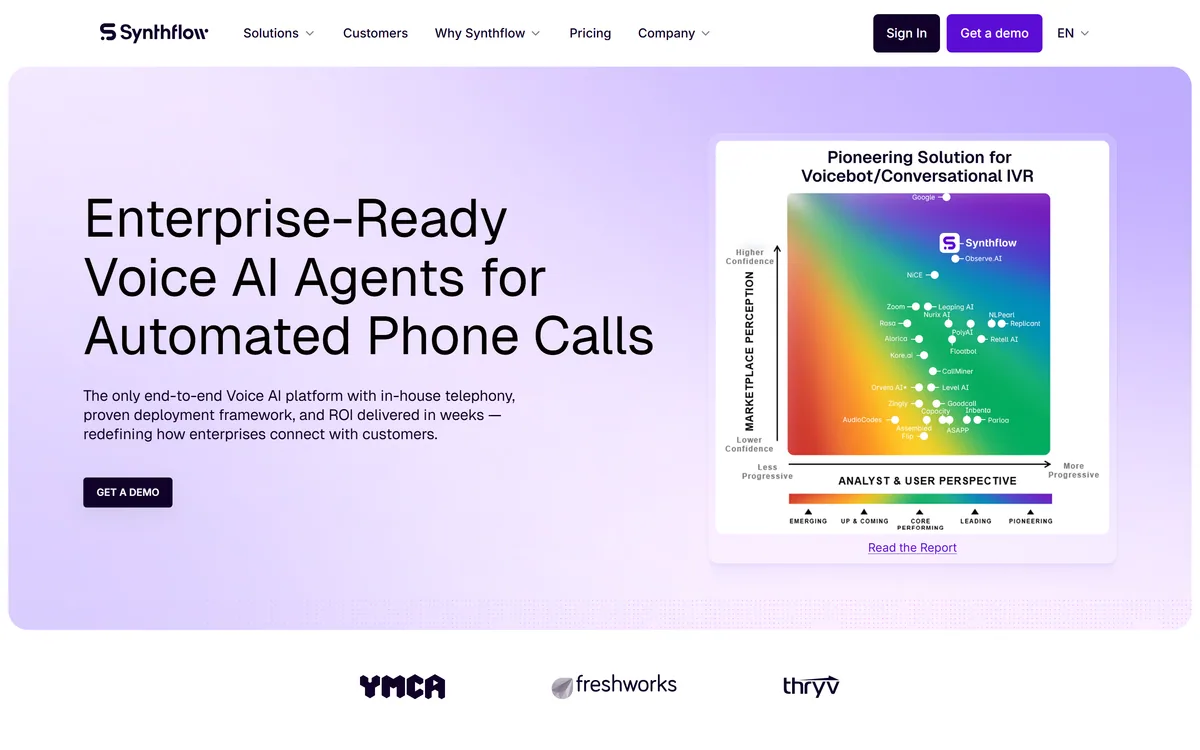
Last checked . Read from synthflow.ai during this check, with the screenshot above captured at the same time.
Automated and AI-voiced calls carry legal duties (consent, recording consent, and in some places AI disclosure) that rest with the business deploying them. Synthflow's performance figures are vendor-stated; verify them in a pilot.
A voice-agent platform, a contact centre and a parallel dialer to weigh alongside Synthflow.
Synthflow earns 4.1 as a serious enterprise voice-AI platform with the right instincts: a Build-Evaluate-Launch-Learn framework that tests agents on simulated calls before real callers hear them, its own telephony for routing and latency, and automated QA on every conversation. It is built for high-volume operations rather than occasional calls, it is sold demo-first, and voice AI can still misunderstand people. Above all, consent, recording and AI-disclosure duties sit with you, so pilot one call type carefully and verify the vendor's figures in your own numbers. AInexfinder Editor Score: 4.1/5.
AInexfinder does not list plan prices or billing details. For current pricing, plans, and trials, visit the official Synthflow website.
Visit official website for pricingVendor pricing, credits, and billing policies change over time. Always confirm on the official site before you buy.
Log in to write a review.
No reviews yet. Be the first to share your experience with Synthflow.
Assigned reviewer
Daniel ReedSenior AI Tools Reviewer
Daniel reviews AI tools the slow way — by actually using them on real projects. His reviews cover what works, what breaks, and who each tool is genuinely a good fit for.
Daniel and the AInexfinder editorial team research Synthflow using public product information, listing evidence, and (when available) hands-on checks. Scores reflect listing completeness and transparency — not paid placement.
TTSReader turns text, PDFs, and EPUB files into speech in the browser, with voice and language selection, speed control, text highlighting, and MP3 export — the free tier runs on browser voices with no usage cap.
VMEG from PixRipple translates and dubs video into 170+ languages using 17,000+ voices, with voice cloning, lip-sync, subtitle generation, batch processing, and API and MCP access for automated localisation.
Respeecher is an enterprise voice cloning and text-to-speech platform used in film, television and games. Its credits include young Luke Skywalker in The Mandalorian and Viktor Vektor in Cyberpunk 2077, and it requires documented performer consent before a voice is used.

ElevenLabs is an AI audio platform covering text to speech, voice cloning, speech recognition, dubbing, music, and conversational voice agents, with a library of 5,000+ voices across more than 70 languages and an API behind every model.

The workspace at www-flux3.com generates 5–20 second AI videos with native audio from text or a starting image, routing across FLUX 3, MiniMax H3, Seedance, Wan 3.0 and Kling 3.0 Pro, at 720p or 1080p with video extension.

Runway is an AI video platform built around generative world models — Gen-4.5, Aleph 2.0, and Act-Two for performance capture — split across Runway Creative for filmmakers, Runway Dev for builders, and Runway Robotics.