
InfluencerMarketing.ai (IMAI) is an end-to-end creator platform combining discovery across a vast influencer database with AI vetting, outreach, briefs, tracking and media-value measurement, plus white-label and newer PR and LLM-visibility modules.
Lumen by Talkwalker
Verified
Talkwalker has become Lumen by Talkwalker, a social listening, media monitoring and benchmarking platform serving a stated 2,500-plus organisations, with published customer outcomes in sentiment management, crisis prevention and product development.
4.2Editor Score
talkwalker.com8 viewsAdded May 9, 202555K visitors
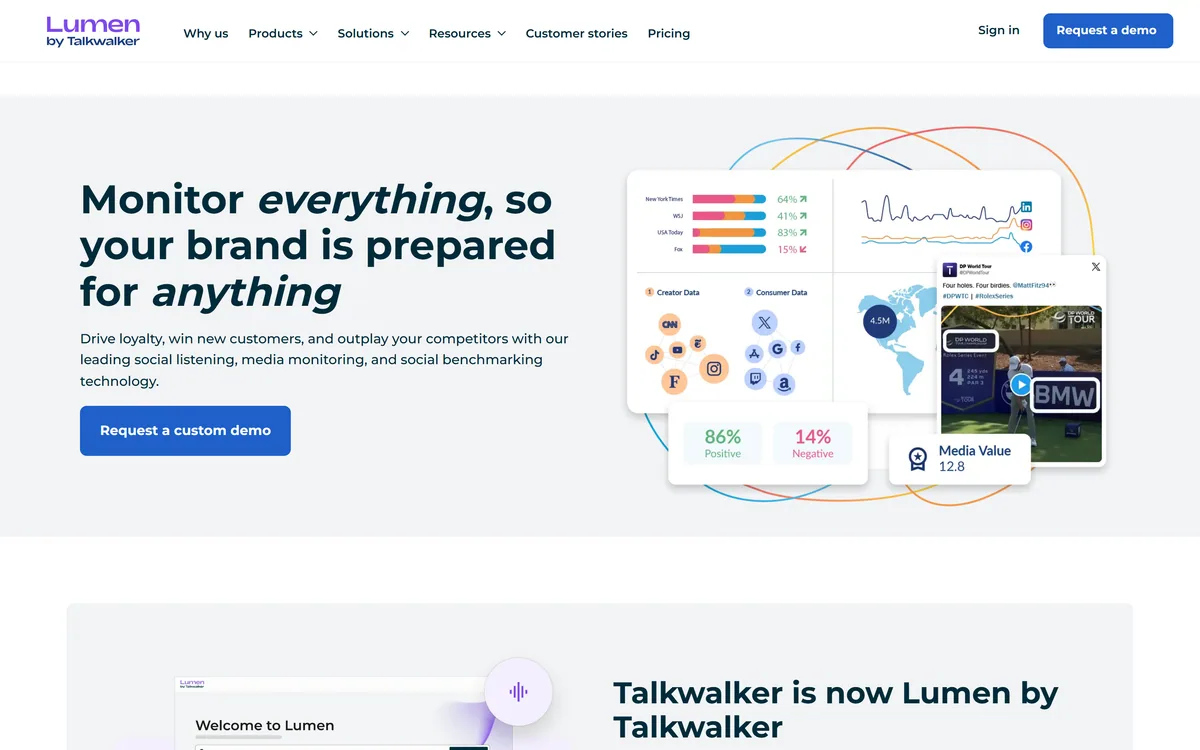
Lumen by Talkwalker: The Rename And What It Signals
The site states it directly: Talkwalker is now Lumen by Talkwalker, reflecting a next chapter as Hootsuite and Talkwalker are brought closer together — the same platform, with same data, same reports, same workflows and integrations.
That reassurance is the correct thing to publish, and it answers the question every existing customer asks first.
Renames in enterprise software usually signal one of three things: a repositioning, a merger, or a product being folded into a larger suite. This one names the second and implies the third, since Hootsuite is a publishing and management platform and Talkwalker is a listening and intelligence one.
Those are genuinely complementary. The awkwardness in social tooling has always been that the team scheduling posts and the team analysing conversation used different systems and rarely compared notes.
For a buyer the practical questions are about roadmap rather than branding. Whether listening remains purchasable independently, how integration proceeds, and what happens to overlapping features are all reasonable things to ask during procurement rather than infer from a homepage.
Renames signal repositioning, merger, or absorption into a larger suite. This one names the second and implies the third — which makes roadmap the real question, not branding.
Sentiment Scores And How Far To Trust Them
One customer result on the page is stated as maintaining 93.7 percent positive sentiment across a multi-year rebrand, and that figure is worth using to explain what a sentiment score is.
Sentiment analysis classifies text as positive, negative or neutral. It works reasonably well on clear statements and badly on the things people actually post.
Sarcasm is the standard example and not the hardest one. A post reading *brilliant, another outage* is negative and lexically positive. Industry vocabulary inverts too — *sick*, *insane* and *ridiculous* are praise in some communities and complaints in others. Comparative posts mentioning two brands are routinely attributed to the wrong one.
Accuracy also varies sharply by language, and most tools are weakest exactly where a brand has least internal visibility.
None of that makes the measure useless, because errors partly cancel across large volumes and the trend line is usually meaningful even when individual classifications are not. The correct use is comparative — this week against last week, this campaign against the previous one — rather than absolute. A figure carried to one decimal place invites more confidence than the underlying method supports. Tools built specifically for open-text analysis, like Thematic, tend to be more explicit about that limitation.
What Does Listening Across AI Channels Mean?
The platform describes monitoring millions of conversations across social, digital and AI channels, spotting emerging trends and surfacing customer insights before competitors do.
The inclusion of AI channels is new and worth unpacking, because it is a different measurement problem from the rest.
Social listening has always worked by collecting posts — items that exist, persist and can be counted. What an assistant says about a brand is none of those things: it is generated on request, varies between askings, and leaves no public record anyone can crawl.
Monitoring it therefore means sampling — asking questions repeatedly and recording the answers — which produces an estimate rather than a census.
That distinction matters when the two sit in one dashboard, because a post count and an assistant-mention rate look similar and mean quite different things. The reason to track it anyway is straightforward: a growing share of people form an impression of a brand from a generated summary they will never attribute to any source, and a brand described wrongly there has no post to reply to.
- Read sentiment comparatively — week on week — not as an absolute score.
- Check language coverage for the markets you actually operate in.
- Treat AI-channel figures as samples, not counts.
- Set alert thresholds before a crisis, not during one.
- Ask what happens to listening as the Hootsuite integration proceeds.
Crisis Detection Before It Becomes A Story
The strongest of the published customer outcomes is also the most specific about mechanism: a business school stated to have maintained high positive sentiment across a multi-year rebrand by using the platform to flag misinformation before it became a media story.
That describes the genuine core value of listening, and it is worth separating from the dashboards.
Reputational damage is a timing problem. A complaint answered within an hour is customer service; the same complaint discovered three days later, after it has been shared and written up, is a crisis with a news cycle attached.
Nothing about the second version is harder to fix than the first — the organisation simply did not know.
What listening buys is the hours between something starting and someone noticing, and that window is worth more than any analysis produced afterwards. The other named results describe scale rather than speed: a telecom provider embedding social intelligence across 1,300 employees in 28 countries, and a beauty brand using trend detection to inform product development. All three are named organisations with described mechanisms, which is a better class of case study than an anonymous percentage. Publishing-side platforms such as Vista Social handle the response once you know, which is the other half of the same job.
Benchmarking Against Competitors
Social benchmarking is presented as a third pillar beside listening and media monitoring — comparing performance against competitors and industry standards.
Benchmarking is the feature that most often justifies the cost internally, for a reason that has little to do with analysis.
Your own numbers in isolation are close to uninterpretable. Engagement fell 12 percent this quarter: that is a disaster if the category grew, a good result if the category fell 30 percent, and noise if it was a seasonal effect that happens every year.
Without a comparison set, every social report is a story someone chose to tell about a number.
Benchmarking also changes the internal conversation from defending a metric to explaining a gap, which is a more productive place to be. The audience framing on the site — PR and communications, social marketing, consumer insights, and agencies — reflects that these are four different jobs sharing one data set. The stated 2,500-plus organisations and the Forrester evaluation referenced on the page place it among the established platforms rather than the challengers. Brandwatch is the closest direct comparison, and the two are usually evaluated together.
Setting Up Listening That Earns Its Cost
Listening platforms are bought for crises and then judged on dashboards nobody opens.
This order keeps the value where it actually is.
- Define what would constitute a crisis before configuring any alert.
- Set thresholds and route alerts to a person, not a shared inbox.
- Build the competitor set first — your own numbers mean little alone.
- Check language and market coverage against where you actually sell.
- Read sentiment as a trend, and never quote a decimal place.
- Review quarterly whether anyone acted on anything it surfaced.
Lumen by Talkwalker: What Is Being Monitored
- A rename, not a replacement — same data, reports, workflows and integrations, per the site.
- Three pillars: social listening, media monitoring and social benchmarking.
- AI channels included alongside social and digital conversation monitoring.
- 2,500-plus organisations stated, with named customer outcomes and a Forrester evaluation.
- Sentiment is an estimate, reliable in aggregate and unreliable on any single post.
Key features of Lumen by Talkwalker
Social listening across public conversation
Media monitoring for press and publications
Social benchmarking against competitors
Monitoring of AI channels alongside social
Audience insights and customer feedback analytics
Alerting for emerging issues
A marketplace of extensions
A developer portal for integrations
Pros & cons
Pros
7- The rename is explained plainly, with an explicit continuity commitment
- Listening and publishing converging addresses a genuine organisational split
- Named customer outcomes describe mechanism, not just magnitude
- Crisis detection is the clearest real value, and the site leads with it
- Benchmarking makes otherwise uninterpretable metrics meaningful
- Coverage extends to AI channels, where brands have least visibility
- Established platform with independent analyst coverage
Cons
7- Sentiment scores are estimates presented with more precision than they support
- Sarcasm, community slang and comparative mentions defeat classification routinely
- Accuracy varies by language, usually worst where visibility is lowest
- AI channel figures are sampled and not directly comparable to post counts
- Roadmap effects of the Hootsuite convergence are not described publicly
- Enterprise platforms need an owner, or the dashboards go unread
- Customer figures carry no stated methodology
Best For
- Communications teams responsible for reputation
- Brands operating across many countries and languages
- Consumer insight teams tracking category trends
- Agencies reporting on client brand health
- Organisations where finding a problem late would be costly
Lumen by Talkwalker Against Other Monitoring
Brand intelligence tools differ by what they collect and what they do next.
| Tool | Collects | Acts | Best for |
|---|---|---|---|
| Lumen by Talkwalker | Social, media and AI channels | Alerts and benchmarks | Enterprise listening and crisis detection |
| Brandwatch | Social and consumer conversation | Analysis and reporting | Consumer research at scale |
| Thematic | Feedback you already hold | Theme extraction | Open-text you collected yourself |
| Vista Social | Your own channels | Publishing and scheduling | Responding and managing accounts |
| Searching manually | Whatever you remember to check | Nothing | Very small brands, briefly |
Lumen by Talkwalker: Reach And Named Results
| Category | Social listening, media monitoring and social benchmarking |
|---|---|
| Name change | Talkwalker is now Lumen by Talkwalker, stated on the homepage |
| Reason given | Bringing Hootsuite and Talkwalker closer together |
| Continuity claim | Same data, same reports, same workflows and integrations |
| Channels | Social, digital and AI channels |
| Adoption | Stated as the first choice of over 2,500 organisations |
| Named outcome | A business school stated to have maintained 93.7 percent positive sentiment through a rebrand |
| Scale example | A telecom provider stated to use it across 1,300 employees in 28 countries |
| Product example | A beauty brand stated to have used trend detection for product development |
| Analyst coverage | A Forrester New Wave evaluation referenced in resources |
| Audiences | PR and communications, social marketing, consumer insights and agencies |
| Company | Copyright shown as Talkwalker 2026, with legal terms, privacy policy and an Impressum |
Does Your Brand Need Social Listening?
Monitor the conversation when
- A reputational problem would be expensive if you found it late.
- You operate in several countries and cannot read every market.
- Product or marketing decisions would change with trend data.
- You need to compare performance against named competitors.
- Someone is accountable for acting on what it surfaces.
Read your own channels when
- Your mentions are few enough to read personally.
- Nobody would act on an alert if one arrived.
- Your audience is entirely in private or offline channels.
- You need publishing and scheduling more than intelligence.
- The budget would come out of actually responding to customers.
More Brand Monitoring Tools
Other ways to understand what is being said about a brand.
- Brandwatch — consumer intelligence at comparable scale
- Thematic — themes from feedback you already collected
- Vista Social — publishing and managing your own channels
- eclincher — social management for larger teams
- MaxAEO — visibility inside answer engines specifically
Lumen by Talkwalker: Read After The Rename
Last checked . Read from talkwalker.com in a browser session on the date above, with the screenshot captured at the same time.
- Page title and homepage banner both stating Talkwalker is now Lumen by Talkwalker
- Reason given as reflecting a next chapter bringing Hootsuite and Talkwalker closer together
- Continuity stated as same data, same reports, same workflows and integrations
- Three products described: social listening, media monitoring and social benchmarking
- Monitoring described as covering social, digital and AI channels
- Adoption stated as the first choice of over 2,500 organisations
- A named business school customer stated to have maintained 93.7 percent positive sentiment through a rebrand
- A named telecom provider stated to use social listening across 1,300 employees in 28 countries
- A named beauty brand stated to have used the platform for trend-led product development
- A named university social media manager quoted on securing budget through insight reporting
- Audience segments listed as PR and comms, social marketing, consumer insights and agencies
- Footer showing a 2026 Talkwalker copyright with legal terms, privacy policy, cookie notice and an Impressum
What we could not confirm: how the rename affects product availability, pricing or roadmap; whether listening remains purchasable independently of Hootsuite; how sentiment is computed or how accuracy varies by language; how AI channel monitoring is sampled; how the 2,500-organisation figure is counted; and pricing. We did not run a search or configure a query.
Editor's Verdict
4.2/5The rename is the first thing to understand, and the company handles it well: same data, same reports, same workflows and integrations, with the new name reflecting Hootsuite and Talkwalker moving closer together. The platform underneath is one of the established names in listening, and the published customer outcomes are unusually specific about mechanism rather than just magnitude. What every buyer should hold lightly is sentiment scoring, which is presented across this category as a measurement and is closer to an estimate — accurate in aggregate, unreliable on any individual post. AInexfinder Editor Score: 4.2/5.
Lumen by Talkwalker pricing
AInexfinder does not list plan prices or billing details. For current pricing, plans, and trials, visit the official Lumen by Talkwalker website.
Visit official website for pricingVendor pricing, credits, and billing policies change over time. Always confirm on the official site before you buy.
Frequently asked questions
Has Talkwalker been renamed?
Yes. The site states Talkwalker is now Lumen by Talkwalker, reflecting Hootsuite and Talkwalker being brought closer together, with the same data, reports, workflows and integrations.
What does the rename mean for existing customers?
The published commitment is continuity. What is not addressed is roadmap — whether listening stays purchasable independently, and how overlapping features resolve — which are reasonable procurement questions rather than homepage ones.
How reliable is sentiment analysis?
Reasonable in aggregate, unreliable per post. Sarcasm, community slang where words like sick mean praise, and posts mentioning two brands are all classified wrongly often enough to matter.
How should I use a sentiment score then?
Comparatively. This week against last week, this campaign against the previous one. Errors partly cancel across volume, so the trend is meaningful even when individual classifications are not.
What does monitoring AI channels involve?
Sampling rather than collecting. Generated answers vary between askings and leave no public record, so a figure is an estimate — which is different from a post count sitting next to it in the same dashboard.
Why bother tracking what assistants say?
Because a growing share of people form an impression from a generated summary they will never attribute to a source. A brand described wrongly there has no post to reply to and no thread to correct.
What is listening actually worth?
Hours. A complaint answered within an hour is customer service; the same complaint found three days later is a crisis. Nothing about the second is harder to fix — the organisation simply did not know.
Why does benchmarking matter so much?
Because your own numbers alone are uninterpretable. Engagement down 12 percent is a disaster if the category grew and a good result if it fell 30 percent, and only a comparison set tells you which.
Who is it built for?
The site names four audiences sharing one dataset: PR and communications, social marketing, consumer insights, and agencies. Those are genuinely different jobs, which is worth knowing when scoping seats.
When is it not worth buying?
When your mentions are few enough to read personally, when nobody would act on an alert, or when the budget would otherwise be spent actually responding to the customers you already hear from.
Reviews
Log in to write a review.
User Reviews
No reviews yet. Be the first to share your experience with Lumen by Talkwalker.
Reviewed by Daniel Reed
Assigned reviewer
Daniel ReedSenior AI Tools Reviewer
Daniel reviews AI tools the slow way — by actually using them on real projects. His reviews cover what works, what breaks, and who each tool is genuinely a good fit for.
Hands-on reviewsProduct testingAI software
Daniel and the AInexfinder editorial team research Lumen by Talkwalker using public product information, listing evidence, and (when available) hands-on checks. Scores reflect listing completeness and transparency — not paid placement.
- Last verified
- Methodology
- How we review AI tools
- Sources used
- talkwalker.com
- AInexfinder listing fields (features, pros/cons, description)
- Public vendor pages when available
- Editorial policy
- Listings may include affiliate or sponsored placements, which are labeled when present. Editorial scores and cons are not sold. See our affiliate disclosure and review methodology.
Related tools

Listomize is an Etsy SEO platform that generates titles, tags, and descriptions within Etsy's own limits, scores listings, optimises 100+ listings from a CSV, tracks competitors and trends, and auto-generates Pinterest pins.
FreemiumBusiness & Marketing

Lahjty (لهجتي) is an Arabic-first marketing platform for MENA campaigns. From one brief it produces dialect-aware ad copy, headlines, campaign images with Arabic text rendered in, dialect-aware voice, and SEO articles grounded in your own brand sources — with a Partner API and an MCP server for teams that want it inside their own workflow.
FreemiumBusiness & Marketing

MaxAEO is an answer engine optimisation platform from HIII PTE. LTD. It tracks how ChatGPT, Gemini, Claude, Perplexity, Copilot, Grok and Google's AI surfaces mention a brand, with sentiment, competitor benchmarking and citation tracing.
Mailjet is a Sinch-owned email platform handling both marketing campaigns and transactional sending from one account. It offers a collaborative drag-and-drop editor, an email API with SMTP relay, AI generation and segmentation, and EU-based data centres.
FreemiumBusiness & Marketing
Outranking is an AI SEO content platform that writes briefs and first drafts and optimises them with real-time scoring, grounding content in live SERP data through its Concepts feature, with keyword clustering, internal linking and content workflows.
FreemiumBusiness & Marketing
Compare:Lumen by Talkwalker vs InfluencerMarketing.aiLumen by Talkwalker vs ListomizeLumen by Talkwalker vs LahjtyLumen by Talkwalker vs MaxAEO
Lumen by Talkwalker alternatives Explore More
Embed this listing on your site
Featured on AInexfinder