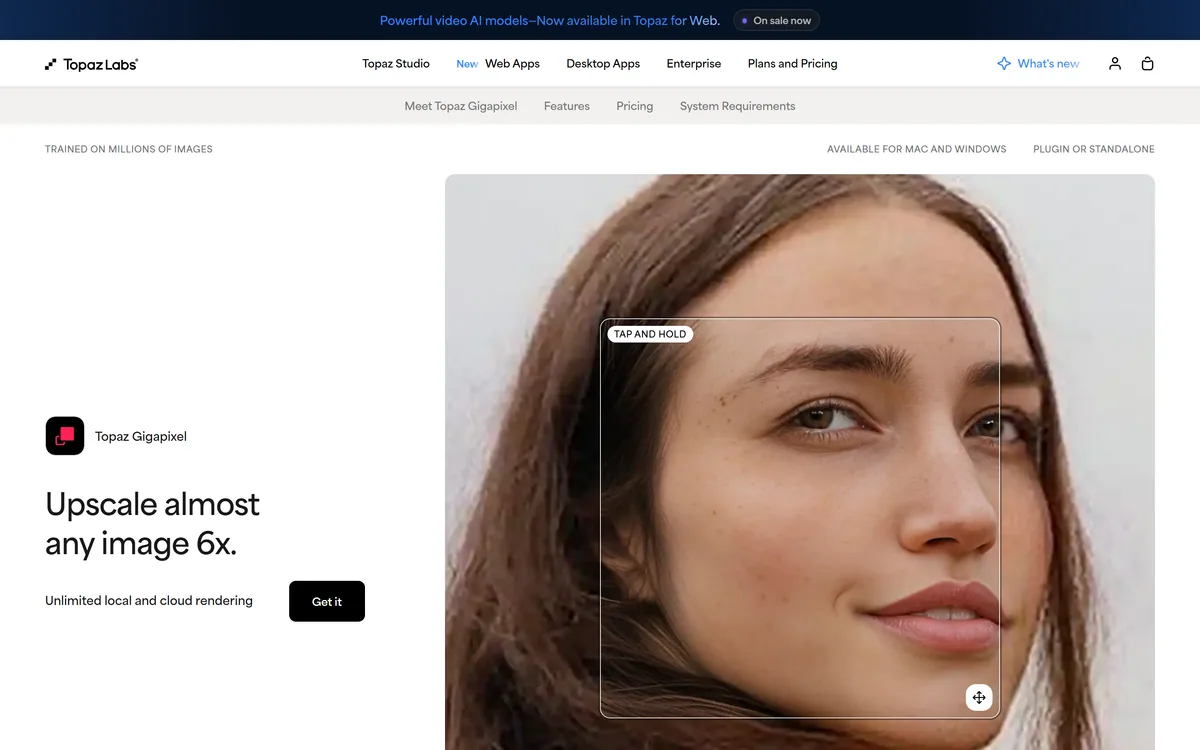
Topaz Gigapixel is the dedicated image-upscaling app from Topaz Labs, enlarging photos up to 6x with multiple enhancement models that add accurate detail, restore and recover faces, running locally or in the cloud on Mac and Windows, as a plugin or standalone.
topazlabs.com7 viewsAdded May 27, 2025572K visitors
Upscaling is where AI quietly earns its keep, and Topaz Gigapixel is the app professionals most often name for it. It is the dedicated upscaler within the Topaz Labs family, focused on one job done to a high standard.
It enlarges images up to 6x using multiple enhancement models that aim to add accurate detail rather than guesswork, with restoration and face recovery, running locally or in the cloud on Mac and Windows. It sits alongside the broader suite reviewed under Topaz Labs and competes with focused enhancers like Aiarty Image Enhancer.
This review covers what Gigapixel adds to an image, who it serves best, how it is priced, and where a lighter tool is enough.
Topaz Gigapixel is the dedicated upscaler in the Topaz Labs family, focused on accurate detail.
Topaz Gigapixel Facts
What it is
A dedicated AI image upscaler
Family
Part of Topaz Labs
Upscale
Up to 6x, with detail-accurate models
Models
Nine enhancement models (vendor)
Also
Restore and recover faces
Runs
Local or cloud, Mac and Windows
Form
Plugin or standalone
Pricing
App purchase, web subscription, cloud credits
Topaz Gigapixel, The Upscaler Brief
Topaz Gigapixel is a dedicated image upscaler: it enlarges photos up to 6x while adding accurate, not invented, detail.
It is part of Topaz Labs: the specialised upscaling app within the broader Topaz family.
Accuracy is the pitch: nine enhancement models aim to add the right pixels, with restore and face recovery.
It runs local or cloud: on Mac and Windows, as a plugin or standalone, keeping files on your machine if you want.
An Image Upscaler Built For Accuracy, Not Just Size
Gigapixel's defining claim is accuracy: 'don't just add pixels, add the right pixels'. Any tool can make an image bigger; the hard part is adding detail that is faithful to the original rather than hallucinated, and that fidelity is what Gigapixel is built around.
It is a single-purpose app, upscaling, done deeply, with nine enhancement models for different kinds of content and nearby jobs like restoration and face recovery. That focus is why it holds a reputation as the standard upscaler among photographers and finishers.
It is important to place it correctly: Gigapixel is the dedicated upscaler within Topaz Labs, which also makes broader photo and video apps. If you want the whole suite, the Topaz Labs listing covers it; Gigapixel is the upscaling specialist.
Any tool can make an image bigger; the hard part is adding detail faithful to the original rather than hallucinated. That fidelity is what Gigapixel is built around.
What Does Topaz Gigapixel Add To An Image?
The value is in the quality of the enlargement and the choice of where to run it.
Upscale, Restore And Recover Faces
Beyond straight upscaling up to 6x, Gigapixel restores old or degraded images and recovers facial detail, using models tuned for the kind of content, so a soft portrait, a low-res product shot and a fine-art scan each get appropriate treatment.
Face recovery operates on images of real people, which is fine for your own or licensed photos but a likeness consideration to keep in mind. For a broader image kit a tool like VanceAI covers more jobs; Gigapixel goes deeper on the one.
Local Or Cloud Rendering, Plugin Or Standalone
Gigapixel runs locally, so your files never leave your computer, ideal for confidential or proprietary material, or in the cloud for convenience and scale, and works as a Photoshop/Lightroom-style plugin or a standalone app on Mac and Windows.
That local option is a genuine advantage for professionals handling sensitive images. A lighter enhancer such as Aiarty Image Enhancer suits simpler needs; Gigapixel's local, plugin-ready workflow is aimed at serious, quality-critical use.
Who Topaz Gigapixel Serves Best
Gigapixel serves photographers enlarging for print or large displays, e-commerce and product shooters rescuing low-res images, archivists and publishers restoring old photos, and AI creators upscaling generated output to usable resolution.
It suits anyone for whom the quality of the enlargement is the point, where a soft or blocky result is not acceptable, and who values keeping files local. The single-purpose focus means it does upscaling better than a general tool that treats it as one feature among many.
It is more than a casual user needs for enlarging the odd phone photo, where a free or built-in upscaler suffices, and if you want video or a full enhancement suite, the broader Topaz Labs products are the better fit than this single app.
How Topaz Gigapixel Charges For Upscaling
Gigapixel is sold as part of the Topaz model: a desktop app purchase, a web-tools subscription, and cloud credits for cloud rendering, with a Topaz Studio bundle if you want everything. We do not publish prices, which change; check the site.
For a photographer, the desktop app bought outright can be the most economical route for heavy local use; for occasional or cloud use, the web subscription and credits may fit better.
The value test is quality on your own hardest images versus a cheaper tool; for work where the enlargement has to hold up at print or display size, Gigapixel's output usually justifies its cost, and for casual use it does not.
A Fast Way To Put Topaz Gigapixel To Work
Because it is all about the quality of the enlargement, trial Gigapixel on your own toughest, most quality-critical images.
Pick your hardest real images: a soft portrait, a low-res product shot, an old scan, a shot for print.
Upscale each and inspect the result at full resolution for faithful, not invented, detail.
Try the restore and face-recovery models on degraded images where relevant.
Decide local versus cloud based on file sensitivity and volume.
If you use Photoshop or Lightroom, test it as a plugin in your actual workflow.
Pass/fail: Gigapixel is worth it if its enlargements clearly beat a cheaper tool on the quality you need.
Use face recovery on images of real people only with the appropriate rights.
Key features of Topaz Gigapixel AI
Image upscaling up to 6x
Detail-accurate enhancement models
Old-photo restoration
Face recovery
Local rendering (files stay on device)
Cloud rendering option
Plugin or standalone
Mac and Windows
Pros & cons
Pros
5
Focused upscaling done to a high standard
Adds faithful detail, not just size
Local option keeps files private
Plugin fits a pro editing workflow
Restoration and face recovery included
Cons
5
Upscaling only; no video or full suite
More than a casual user needs
Face recovery touches likeness
Professional pricing across several options
'Industry-leading' is vendor framing
Best For
Print-grade photo enlargement
E-commerce image rescue
Photo restoration
AI-output upscaling
Local, private processing
Topaz Gigapixel Against Other Upscalers
The useful comparison is with the broader Topaz suite and lighter enhancers.
Last checked . Read from topazlabs.com during this check, with the screenshot above captured at the same time.
A dedicated AI image-upscaling app within Topaz Labs
Upscaling up to 6x with detail-accuracy as the goal
Multiple (nine) enhancement models for different content
Restoration and face recovery
Local or cloud rendering
Plugin or standalone use on Mac and Windows
A Topaz model of app purchase, web subscription and cloud credits
Trained on a stated millions of images (vendor)
No plan prices reproduced here, in line with this site's pricing policy
Topaz Gigapixel is the dedicated upscaler within Topaz Labs; the broader suite is covered separately. Face recovery works on images of real people; use it with appropriate rights. 'Industry-leading' is vendor framing.
Editor's Verdict
4.4/5
Topaz Gigapixel earns 4.4 as the specialist that does one thing, image upscaling, to a professional standard, adding faithful detail rather than invented pixels, with restoration, face recovery and the choice of local or cloud rendering on Mac and Windows. It is the dedicated upscaler within Topaz Labs, more than a casual user needs, and its face recovery touches likeness, but for quality-critical enlargement it is hard to beat. AInexfinder Editor Score: 4.4/5.
Topaz Gigapixel AI pricing
AInexfinder does not list plan prices or billing details. For current pricing, plans, and trials, visit the official Topaz Gigapixel AI website.
Vendor pricing, credits, and billing policies change over time. Always confirm on the official site before you buy.
Frequently asked questions
What is Topaz Gigapixel?
Topaz Gigapixel is the dedicated AI image-upscaling app from Topaz Labs. It enlarges photos up to 6x using multiple enhancement models that aim to add accurate detail rather than guesswork, with restoration and face recovery, running locally or in the cloud on Mac and Windows as a plugin or standalone.
How is Gigapixel different from Topaz Labs?
Gigapixel is the specialised upscaling app within the broader Topaz Labs family, which also makes full photo and video enhancement products. If you want just high-quality upscaling, Gigapixel is the focused tool; if you want the whole suite including video, the Topaz Labs listing covers that.
Does Gigapixel add real detail or invent it?
Its explicit pitch is accuracy, 'add the right pixels', using models tuned to the content so the detail is faithful to the original rather than hallucinated. That fidelity is the whole point, and it is best judged by upscaling your own hardest images and inspecting them at full resolution.
Can Gigapixel run on my own machine?
Yes. It offers local rendering so your files never leave your computer, which is ideal for confidential or proprietary material, as well as a cloud option for convenience and scale. It works as a plugin in editors like Photoshop or as a standalone app on Mac and Windows.
How much does Topaz Gigapixel cost?
It is sold under the Topaz model: a desktop app purchase, a web-tools subscription, and cloud credits for cloud rendering, with a Topaz Studio bundle for everything. We do not publish prices, which change; check the site, and pick the route that matches your usage.
Who is Gigapixel best for?
Photographers enlarging for print or display, e-commerce shooters rescuing low-res images, archivists and publishers restoring old photos, and AI creators upscaling generated output. It suits anyone for whom the quality of the enlargement is the point and who values keeping files local.
Does Gigapixel recover faces?
Yes, it includes face recovery that restores facial detail in soft or low-res images. Because that operates on images of real people, use it with your own or properly licensed photos, and be mindful when enhancing images of other people.
Is Gigapixel overkill for casual use?
For enlarging the odd phone photo, yes, a free or built-in upscaler is enough. Gigapixel earns its cost when the enlargement must hold up at print or display size, when you need restoration or face recovery, or when you want to keep sensitive files on your own machine.
Can Gigapixel upscale AI-generated images?
Yes. AI creators commonly use it to raise the resolution and sharpen the detail of images from generative models for final use. As with any source, run it on your real outputs and judge the result at full size, since quality depends on the input image.
Does Gigapixel handle video?
No, Gigapixel is image-only. For video upscaling and enhancement you need the broader Topaz Labs products, which include dedicated video models. Gigapixel's strength is going deep on still-image upscaling rather than spanning both media.
Daniel reviews AI tools the slow way — by actually using them on real projects. His reviews cover what works, what breaks, and who each tool is genuinely a good fit for.
Daniel and the AInexfinder editorial team research Topaz Gigapixel AI using public product information, listing evidence, and (when available) hands-on checks. Scores reflect listing completeness and transparency — not paid placement.
Listings may include affiliate or sponsored placements, which are labeled when present. Editorial scores and cons are not sold. See our affiliate disclosure and review methodology.
Remini is a photo and video enhancement app from Bending Spoons offering unblurring, denoising, old-photo restoration, face enhancement, colour correction and upscaling, plus AI-generated professional headshots. It runs on iOS, Android and the web, and states 100 million monthly active users.
Topaz Labs makes professional AI image and video enhancement software, upscaling, sharpening, denoising, restoring, stabilizing and frame interpolation, across desktop, web and mobile, with Emmy-winning technology and a long track record, used by photographers, videographers and finishing pros.
GoStudio is an AI photo and video studio offering headshots and personal branding packs, image and video generation, and more than 38 one-click editing tools. It routes across twenty-plus underlying models — including GPT Image, FLUX, Veo and Nano Banana — without asking users to choose between them.
Aiarty Image Enhancer is desktop software from Digiarty that upscales, denoises, deblurs and restores images using several purpose-built AI models. It runs entirely on your own machine with no upload, handles large batches, and reaches 32K output on Windows.
Pet Pic Portraits turns a pet photo into styled artwork — Royal King, Pop Art, Watercolour, Viking, Wizard and more — with an instant preview before ordering. Output is a digital download, a canvas print or framed wall art, and it includes a pet memorial option.