Property development has an expensive habit that everyone in it accepts as normal: most feasibility studies are thrown away.
Visualisation tools such as Interior AI do not help here. A developer looks at a site, an architect spends days producing a massing study and a unit mix, the numbers come back and the scheme does not work. So they try a different configuration, and another few days go by. Most sites are examined once, superficially, because examining them properly costs more than the option is worth.
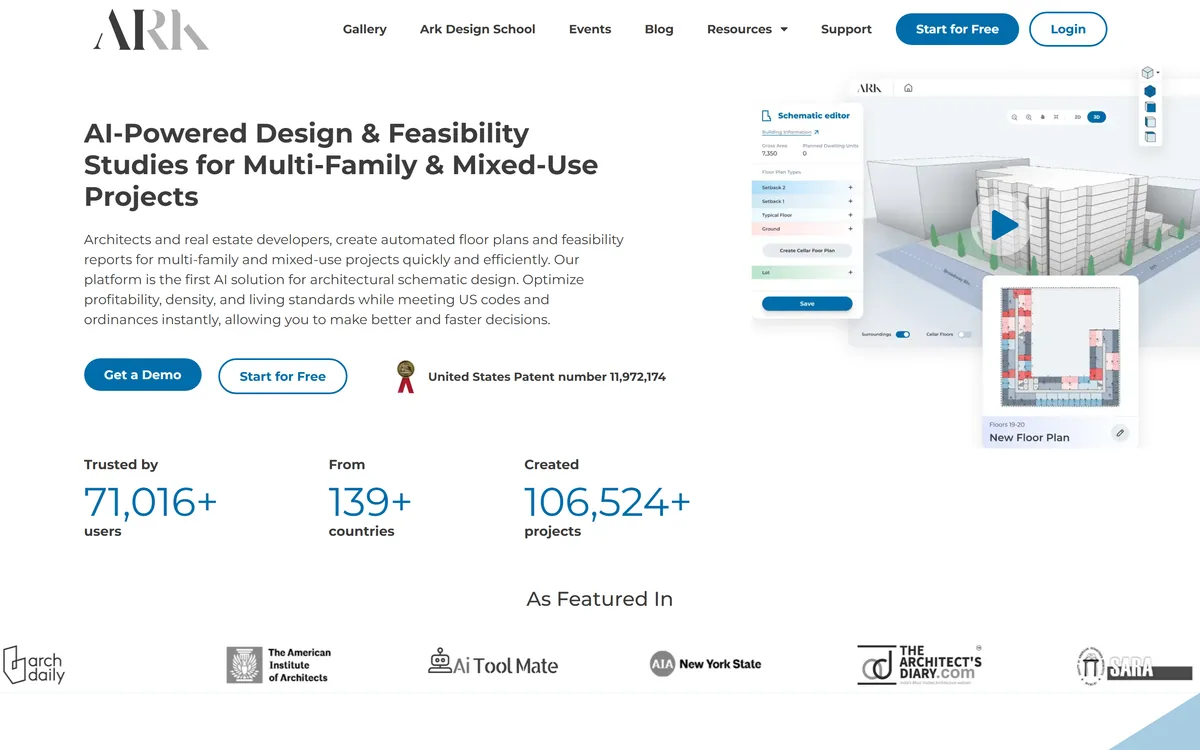
Ark Design AI attacks exactly that. If generating a compliant scheme with a full area schedule takes an afternoon rather than a week, a developer can test twelve configurations instead of one — and testing twelve is how you find the one that works.
What Does Ark Design AI Produce?
- Floor plans and feasibility reports for multi-family and mixed-use projects, generated rather than drawn.
- Unit mix optimisation balancing density, profitability and living standards — the three things that actually determine whether a scheme works.
- Building code and local ordinance checking with instant compliance feedback, for US-based projects.
- Area tables generated automatically, which is the tedious arithmetic underneath every feasibility study.
- Ark Automatic Architectural Design Ltd holds United States Patent 11,972,174, with a subscription sold monthly or yearly.
Why Feasibility Is The Right Thing To Automate
Ark positions itself around AI-powered design and feasibility studies for multi-family and mixed-use projects, and that scoping is well judged.
Feasibility work has a specific character that suits automation. It is highly constrained — the site dimensions, the setbacks, the height limit and the parking ratio are all fixed inputs. It is repetitive, because the same calculations recur on every project. And it is provisional, because most of the output exists to be discarded.
That last quality is the important one, and it is what separates this from generative design in other media such as UXMagic. Automating work that will be built requires a standard of correctness that is very hard to reach. Automating work that exists to answer whether something is worth pursuing requires being right enough to make a decision, which is a much more attainable bar.
Optimising unit mix against density, profitability and living standards is where the actual value sits. Those three pull against one another constantly — more units raises revenue and worsens the living standard, better units reduce the count — and finding the balance is exactly the kind of multi-variable search a computer does better than a person under time pressure.
The result should be understood as a starting position rather than a design. It tells a developer whether a site can work and roughly how, which is the question at that stage.
Automating work that gets built requires being right. Automating work that exists to be discarded requires only being right enough to decide.
Area Tables Are The Unglamorous Win
Automatic area table generation gets a single line on the site and deserves more attention than that.
Area schedules are the arithmetic under every development decision: gross and net areas, efficiency ratios, unit counts by type, saleable versus common area. Every financial model depends on them, and they are produced by hand, revised whenever the plan changes, and are a reliable source of expensive error.
An area schedule that regenerates automatically when the scheme changes removes both the labour and the drift between the drawing and the spreadsheet. Anyone who has found that the financial model was built on a superseded area figure knows why this matters.
It also makes iteration genuinely cheap, which is the point of the whole product. If changing the unit mix means recalculating the schedule by hand, you will do it twice. If it is instant, you will do it twenty times, and one of those twenty is the scheme that works.
How Far Should You Trust Automated Code Checking?
The platform incorporates local building code and ordinances with instant compliance checking for US-based projects. This is the most valuable feature and the one requiring the most care.
The value is real. Building code is enormous, varies by jurisdiction, and knowing whether a configuration complies usually means someone reading the ordinance — which is why schemes get designed and then discovered to be non-compliant late.
The limits deserve stating plainly, because the site does not. Automated checking can verify what is codified and measurable: setbacks, heights, unit counts, parking ratios, egress distances. It cannot exercise the judgement that professional practice requires, it will not know about a local amendment adopted last month unless the data was updated, and it cannot anticipate how a particular plans examiner interprets a discretionary provision.
None of that makes the feature less useful. It makes it a first pass rather than a determination. The right mental model is a spell checker: it catches most errors and finding none does not mean the document is correct.
The professional position is unchanged by any software. Construction documents require a licensed architect or engineer, the seal carries legal liability, and no automated check transfers that. Ark's own audience — architects, firms and developers — will already know this, and the site would be stronger for saying it.
- Treat compliance output as a first pass, not a determination.
- Verify the code version and jurisdiction data are current for your specific site.
- Get a licensed professional's review before anything goes to a planning authority.
- Remember discretionary provisions vary by examiner and cannot be automated.
- Use it to reject unworkable schemes quickly, which is where it is safest and most valuable.
Who Is This Actually For?
The site addresses architects, architectural firms, real estate developers and — through its Design School — students.
Those groups want different things from it, and it is worth being clear which case is strongest.
Alongside listing analysis tools such as Restb.ai, the value for developers is unambiguous: testing more sites and more configurations before committing to an architect. That is a direct saving on option costs and abandoned work, and it is where the product earns its keep.
For architects the case is more interesting and slightly uncomfortable. It automates work firms currently bill for. The optimistic reading, which is probably correct, is that it moves fee-earning time from schematic iteration toward the design judgement clients actually value — and firms that adopt it can run more studies for the same fee, which wins work.
The pessimistic reading is that developers do the feasibility themselves and engage an architect later, compressing early-stage fees. Both are plausible and the industry will find out.
A Design School and certified user programme suggest the company understands adoption depends on the profession rather than on developers alone, which is a sensible read of where the resistance would come from.
Testing It On A Site You Already Studied
The only honest evaluation for a tool like this is a project where you already know the answer, because you can grade the output rather than admire it.
The bar is step three. If it misses a code constraint you know applies, its compliance checking is an aid rather than something to rely on.
- Choose a site you have already run a feasibility study on, ideally one that proved difficult.
- Enter the real constraints — dimensions, zoning, setbacks, height limit, parking requirement — exactly as they applied.
- Compare the generated scheme against what your team produced, and specifically check whether it caught every code constraint you know applies.
- Check the area schedule arithmetic by hand on one scheme. Every financial decision downstream rests on it.
- Now generate five alternative unit mixes and see whether any beats your original on the metrics you care about. That is the actual value proposition.
- Time the whole exercise against what the original study cost in staff days, which is the number that justifies the subscription.
How The Subscription Works
Access is a subscription billed monthly or yearly; amounts are not disclosed on the pages we read.
For this category the comparison is not against other software but against staff time. A feasibility study consuming several days of an architect's time has a cost that a firm can calculate precisely, and the subscription either sits well below that or it does not — which makes the buying decision unusually clear once you have run the test above.
The variable to establish is what a tier covers: how many projects, how many users, and which jurisdictions the code data includes. Code coverage is the one that would quietly undermine the product, since a compliance check is worthless in a jurisdiction the data does not cover.
The patent — United States Patent 11,972,174 — is worth noting as substance rather than marketing. A granted patent means the approach was examined and found novel, which is more than most AI tools can point to.
We do not publish amounts. Confirm jurisdiction coverage for your actual markets before subscribing, since that determines whether the headline feature works for you at all.
Five terms that explain what the software is optimising and why it matters.
- Feasibility study
- An early analysis of whether a site can support a viable scheme. Mostly discarded, which is exactly what makes it the right thing to automate.
- Unit mix
- The combination of apartment types and sizes in a scheme. The single biggest lever on both revenue and liveability, and the thing hardest to optimise by hand.
- Area schedule
- The table of gross, net and saleable areas underpinning every financial model. Tedious to maintain and a common source of expensive error when a plan changes.
- Efficiency ratio
- Net saleable area as a proportion of gross floor area. A few percentage points here can decide whether a scheme is viable.
- Setback and envelope
- The zoning constraints defining where and how high you may build. Fixed inputs, which is why compliance checking against them can be automated at all.
Ark Design AI: Confirmed Facts
| Product type | AI-powered design and feasibility studies for buildings |
|---|
| Project types | Multi-family and mixed-use |
|---|
| Core outputs | Automated floor plans, feasibility reports, area tables |
|---|
| Optimisation | Unit mix against density, profitability and living standards |
|---|
| Compliance | Local building code and ordinance checking, with instant feedback, for US projects |
|---|
| Users addressed | Architects, architectural firms, real estate developers, and students via Design School |
|---|
| Patent | United States Patent 11,972,174 |
|---|
| Legal entity | Ark Automatic Architectural Design Ltd |
|---|
| Pricing model | Subscription, monthly or yearly; amounts not disclosed |
|---|
| Published pages | Gallery, Design School, Blog, Support, Pricing, How it Works, Tutorials, Glossary, Certified Users, FAQ, Privacy Policy, Terms of Use |
|---|
Which Practices It Suits
It pays off when
- You evaluate more sites than you can afford to study properly, which is most developers.
- Your projects are multi-family or mixed-use in the United States, which is what the code data covers.
- Unit mix optimisation is where your schemes live or die commercially.
- You want more feasibility iterations per fee, which is the strongest case for an architectural firm.
- Area schedule errors have cost you before, which they have if you have done this long enough.
It will not help when
- You work outside the United States, where the building code and ordinance data does not apply.
- Your projects are single-family, industrial or specialised typologies outside multi-family and mixed-use.
- You would treat the compliance check as a determination rather than a first pass, which no automated check can be.
- You need construction documents, which require a licensed professional's seal regardless of the software.
- Your work is design-led and bespoke, where optimisation toward standard metrics is beside the point.