- Saleswise is a set of AI tools built specifically for real estate agents — comparative market analysis, virtual staging, marketing flyers and listing copy — rather than a general tool an agent adapts.
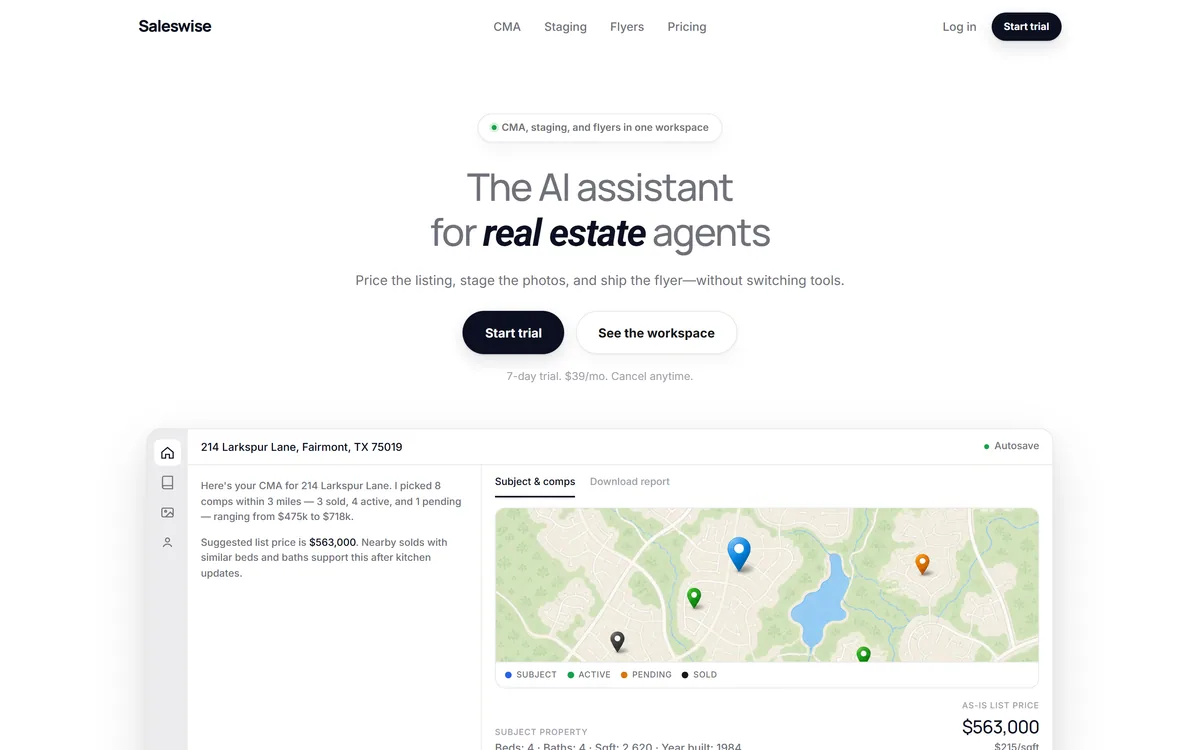
- AI CMA is the anchor feature, pulling active and sold comps onto an interactive map with pricing suggestions and a client-ready report.
- Staging and flyers cover the marketing half, with style selection for photos and formats for just-listed, open house, price-reduced and coming-soon.
- Pricing is deliberately flat: one plan, unlimited usage, and explicitly no per-report, per-image or per-flyer charges.
- A seven-day free trial, cancellable at any time with no long-term contract.
| Category | AI toolkit for real estate agents |
|---|
| Target user | Estate and real estate agents |
|---|
| Named features | AI CMA, Staging, Flyer maker |
|---|
| CMA capability | Active and sold comps on an interactive map, pricing suggestions, client-ready reports |
|---|
| Staging | Virtual staging of listing photos with style selection |
|---|
| Flyer formats | Just-listed, open house, price-reduced and coming-soon |
|---|
| Writing | Listing descriptions, emails and blog posts |
|---|
| Usage policy | Vendor states no per-report, per-image or per-flyer charges |
|---|
| Not published | Comp data sources, CRM integrations, named customers, user counts, or company background |
|---|
| Charging model | A single plan at a monthly recurring rate with unlimited usage, a seven-day free trial, and cancellation at any time with no long-term contract. No prices published here |
|---|
Is This Worth An Agent's Subscription?
An Agent Should Try It If
- You run listing appointments often enough that CMA preparation is real time
- Your brokerage does not already supply CMA software you are happy with
- You list empty properties where staging would change how they photograph
- You would use these tools more if you were not counting per-item costs
- You want month-to-month rather than an annual commitment
- Your brokerage already provides CMA tools included in your fees
- You cannot confirm the comp data covers your market properly
- Staging is your main need, where specialist tools go deeper
- You would present an automated CMA without reviewing the comps it chose
- You need it inside your CRM rather than as standalone documents
Unlimited Usage Is A Behavioural Decision, Not A Pricing One
The most interesting thing about Saleswise is the explicit promise of no per-report, no per-image and no per-flyer charges, and it is worth explaining why that matters more than it sounds.
Metered creative tools change how people use them, and rarely for the better. An agent paying per staged image stages the two photos most likely to sell rather than the eight that would present the property properly. An agent paying per CMA runs one for the listing they expect to win, not for the three prospects they are unsure about.
That rationing is invisible and costly, and it is why credit-metered image tools like GoStudio change behaviour too. The whole point of a listing presentation tool is to use it on every prospect, including the ones you might lose, because the marginal cost of trying should be near zero.
Flat pricing removes the calculation entirely. The agent stops thinking about cost per item and starts using the tool as a default part of the workflow, which is the only way this class of software actually produces value.
It is also a commercially confident position. Unlimited AI image generation and unlimited report building carry real compute cost, and a vendor offering it either has efficient infrastructure or expects average usage well below what the promise implies. Both are normal; neither is a problem for the buyer.
For an agent comparing tools, this is the axis that most affects whether you actually get value, and it is usually buried under feature comparisons.
An agent paying per staged image stages two photos instead of eight. The rationing is invisible, and it is exactly what stops these tools from working.
The CMA Is The Feature That Wins Listings
Of the four tools here, the comparative market analysis is the one attached to money, and it deserves the most attention.
A CMA is what an agent brings to a listing appointment. It sets the recommended price, justifies it with comparable sales, and is frequently the document that decides whether the seller signs with you or the agent who came yesterday. Producing one well takes real time — pulling comps, filtering out the ones that are not genuinely comparable, and assembling something a homeowner can follow.
Automating the assembly is a clear win. Pulling active and sold comps onto an interactive map is both faster and more persuasive than a table, because a seller understands their own neighbourhood visually in a way they do not understand a spreadsheet.
The part that needs judgement is comp selection, and this is where any automated CMA needs supervision. Two houses with the same bedroom count on the same street can differ enormously — one backs onto a railway, one was renovated last year, one sold to a family member below market. An algorithm sees square footage; an agent knows the street.
So the honest workflow is that the tool assembles and the agent curates. Presenting an automated CMA to a seller without reviewing which comps it chose is how an agent ends up defending a price they cannot justify when questioned.
The pricing suggestion should be treated the same way — as an input to your recommendation, never as your recommendation.
Virtual Staging Has Rules The Site Does Not Mention
Staging listing photos with selected styles is offered as a straightforward feature, and there is a compliance dimension worth knowing that the product material does not raise.
Virtual staging alters a photograph of a property a buyer may travel to see and may make an offer on. Because of that, disclosure requirements exist in many places — several US state real estate commissions, MLS rules and advertising standards bodies require virtually staged images to be labelled as such, and rules differ by jurisdiction.
The reasoning is obvious once stated. A buyer scrolling listings should not believe a room contains furniture that is not there, and more seriously should not be misled about the condition of a space. Adding furniture to an empty room is generally accepted with disclosure; removing damage, hiding a stain or altering a fitted feature is a different matter and can cross into misrepresentation.
The practical rules are simple enough: label staged images, stage empty rooms rather than editing occupied ones, never alter anything structural or condition-related, and check what your own MLS and state or national body requires.
None of this is a criticism of the feature, which is genuinely useful — an empty room photographs badly and sells slowly, and staging it physically costs a great deal. It is a criticism of a product page that offers the capability without mentioning the obligation.
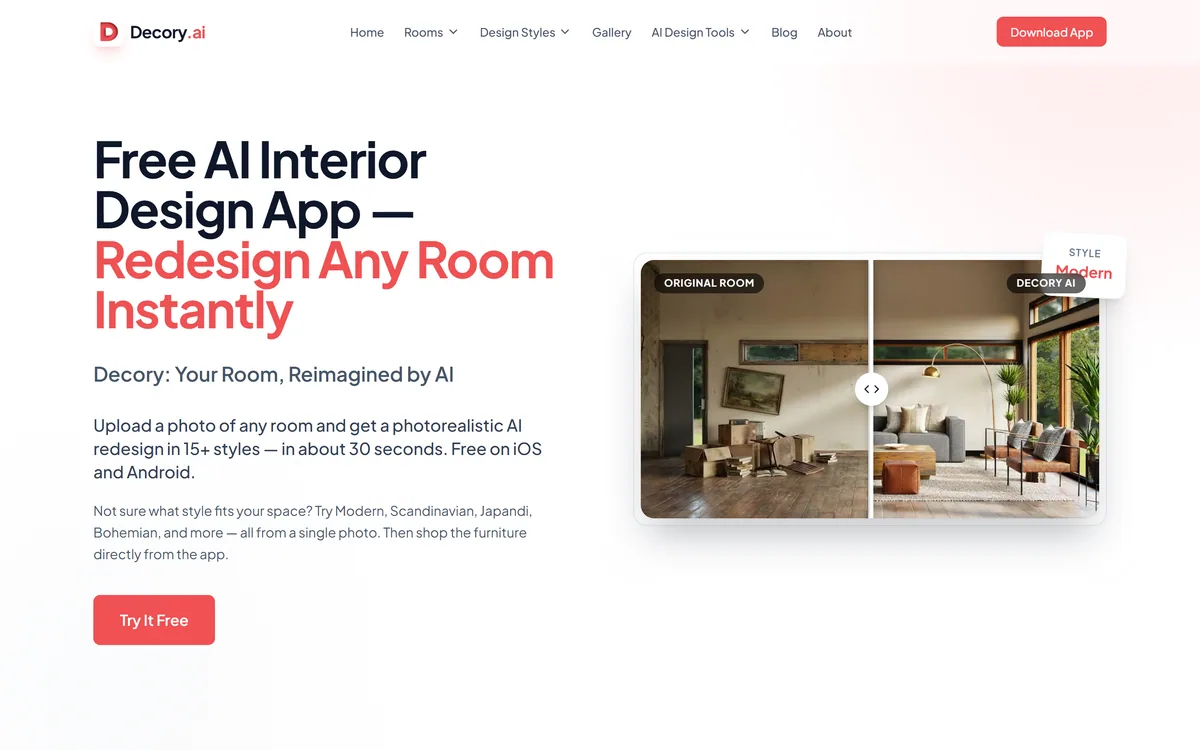
Specialist tools like Virtual Staging AI and REimagine Home go deeper on this specific job if staging is your main need.
- Check your MLS and state or national body's rules on virtually staged imagery before publishing any.
- Label staged photos clearly, even where you are not certain it is required.
- Stage empty rooms rather than editing rooms that contain someone's belongings.
- Never alter condition — damage, stains, damp, structural features stay as photographed.
- Review which comps the CMA selected before you take it to a listing appointment.
One Plan, Unlimited Usage
This site does not publish plan prices. Saleswise's structure is unusually simple and the simplicity is itself the notable part.
There is one plan at a monthly recurring rate, covering all features with unlimited usage, a seven-day free trial, and cancellation at any time with no long-term contract. Explicitly no per-report, per-image or per-flyer charges.
A single tier is a deliberate choice and a good one for this market. Estate agents are individual operators buying their own tools between commissions, and a pricing page requiring them to work out which tier includes staging is friction at exactly the wrong moment.
Month-to-month with no contract also fits how agents actually work. Income is irregular and tied to closings, so an annual commitment is a genuine barrier in a way it is not for a salaried marketing team.
The seven-day trial is short for a tool whose value depends on using it on a real listing appointment. If you take it, line up a genuine prospect first — testing it on a hypothetical property tells you about the interface rather than about the CMA.
The comparison worth running is against your brokerage's existing tools. Many provide CMA software already, and the question is whether Saleswise's version plus staging and flyers justifies a second subscription rather than whether it beats nothing.
What The Site Leaves Unanswered
The public material is thin in several places that matter for a purchase decision, and being direct about them is more useful than assuming.
Where the comp data comes from is not stated. This is the most important gap. A CMA is only as good as its underlying data, and whether that is MLS-sourced, public records, or an aggregator determines both accuracy and coverage in your market. Ask before subscribing.
No CRM integrations are named. Agents live in a CRM, and whether Saleswise pushes into it or produces standalone documents changes the workflow considerably.
No named customers or user counts. The site shows logos suggesting trust by agents at major firms without naming anyone or stating numbers.
No company background. Founding, team and location are not published on the pages reviewed.
For a low-commitment monthly subscription with a trial, none of these are blocking — you can simply try it. But the comp data question is worth asking before the trial rather than after, because it determines whether the CMA is usable in your specific market at all.
- Comp data source not stated — ask before subscribing, it determines CMA accuracy
- No CRM integrations named, so workflow fit is unknown
- Firm logos shown without named customers or user counts
- No founding, team or location details published
- No stated position on virtual staging disclosure requirements