
Zapier's AI layer adds agents and MCP tool access on top of its automation platform, connecting more than 9,000 apps with governed access so teams can mix AI decisions with deterministic rules under central oversight.
Productivity & Automation Review
Dust is an enterprise platform for building and running AI agents on company knowledge, with 70+ connectors, 20+ frontier and open models, a dual-layer permission model, SCIM, audit logs and SOC 2 Type II. It suits enterprise departments that want agents grounded in their own systems, with the caveats that it's a sales-led enterprise product, data governance is central, and its organisation-count figures are vendor-stated.
Very good
Dust earns 4.1 as a serious, well-architected enterprise platform for building AI agents grounded in company knowledge, with 70+ connectors, a choice of 20+ frontier and open models, and the governance apparatus, dual-layer permissions, SCIM, audit logs, SOC 2 Type II, data residency, that an enterprise rollout actually needs. Grounding agents in your own systems with real controls is the right architecture for business use. The duties follow from the power: an agent that reads across your systems is only as safe as its permissions, so governance must be owned and reviewed, not assumed, and data terms confirmed. For organisations that can own that, Dust is a strong choice; small teams or anyone who won't govern it should weigh it carefully. AInexfinder Editor Score: 4.1/5.
Best for: Grounded enterprise agents; Cross-system knowledge
The visit link goes to dust.tt, the official site. Paid placements on AInexfinder are always labelled. How we make money
Most AI assistants are blind to the thing that makes them useful at work: your company's own knowledge. Dust's pitch is to fix that, building agents that read across Slack, Drive, Notion and your other systems, on your terms.
It lets teams build and run AI agents with company context through 70+ connectors and 20+ models, with a permission model, SCIM, audit logs and analytics. It sits among agent platforms like Relevance AI, at the enterprise-knowledge end.
This review covers how Dust runs company agents, which teams it suits, how it's priced, and the data-governance duties that come with a tool that spans your systems.
| What it is | An enterprise platform to build and run AI agents |
|---|---|
| Company | Dust (brand; operator not captured in our read) |
| Core | AI agents grounded in company knowledge and tools |
| Connectors | 70+ (Slack, Notion, Drive, GitHub, Salesforce, Zendesk) |
| Models | 20+ frontier and open models (switchable) |
| Governance | Dual-layer permissions, SCIM, audit logs, SOC 2 Type II |
| Access | Free to try + sales-led enterprise; API and Chrome extension |
| Sensitive | Operates across company systems — data governance central |
Dust's core idea is to make AI useful at work by grounding it in company knowledge. Instead of a blank chatbot, you build agents that pull relevant context across Slack, CRM, docs and other systems through 70+ connectors, so answers reflect your actual processes and data rather than the open internet.
It's model-flexible, 20+ frontier and open models from OpenAI, Anthropic, Google and Mistral that teams can choose between, and ships the surrounding apparatus: a Chrome extension, Frames, a developer platform and an API to build agents into workflows.
Crucially for its buyer, it leads with governance: a dual-layer permission model, SCIM provisioning, audit logs and analytics, SOC 2 Type II, US/EU data residency and custom retention. Its framing, 'use AI on your terms without giving up control of your data' and 'granular enough for your CISO, invisible to everyone else', is pitched at exactly the security review an enterprise rollout triggers.
The honest framing is that Dust is a serious, well-designed enterprise agent platform, and grounding agents in company knowledge with real permission controls is the right architecture for business use. The duties follow from the power: an agent that reads across your systems is only as safe as its permissions, so the dual-layer model and audit logs must be configured and reviewed, not assumed; data residency and retention should be confirmed against your obligations; and the '3,000+ organizations' figure is a vendor claim. Used with governance owned by someone, it's a capable platform.
Dust builds AI agents grounded in your company's knowledge with CISO-grade controls; the architecture is right for enterprise, provided someone owns the permissions and data governance.
Dust pairs company-context agents with model choice and enterprise governance.
Agents read across 70+ connected systems and run on a choice of 20+ frontier and open models.
A platform like Stack AI builds AI workflows and apps; Dust's angle is multiplayer agents grounded in company knowledge, a context-first job.
A dual-layer permission model, SCIM, audit logs, API and a Chrome extension wrap it for enterprise.
An automation tool like Activepieces wires apps together with flows; Dust centres on knowledge-grounded agents, so match it to whether you need agents or pipelines, and own the governance either way.
Dust suits enterprise departments, sales, support, marketing, engineering, data, legal, HR and IT, that want AI agents grounded in their own tools and documents rather than a generic assistant.
It suits organisations that need the governance apparatus, permissions, SCIM, audit logs, data residency, to pass a security review, and that have someone to own agent configuration.
It suits less well small teams or individuals who'd find an enterprise platform and its sales-led rollout heavy, and organisations without the connectors or the appetite to govern an AI that reads across their systems.
A fair way to place it: if you're an organisation that wants capable, context-grounded agents and can own the permission and data governance, Dust is a strong, well-architected choice; if you're a small team wanting a quick assistant, or no one will own the governance, weigh it carefully, because the platform's strength, reach across your systems, is also the thing that must be controlled. Assign a clear owner for connectors and permissions, start with a bounded, high-value use case, and review the audit logs before you widen access.
Dust is free to try and then sold to enterprises, sales-led ('try for free', 'contact sales', 'request a demo'), with shared workspace credits and volume pricing mentioned but no amounts on the captured page. We do not publish prices, which vary; confirm the plan, credits and data terms with Dust.
The value question is productivity across departments versus platform cost and governance effort: for an organisation that deploys agents widely and grounds them in its knowledge, the payoff can be large, but it's an investment that needs ownership.
The sensible approach is to trial Dust on a bounded, high-value use case, connect a limited set of systems, verify the permissions and audit trail behave, confirm data residency and retention against your obligations, and expand only once the governance holds.
Because Dust reads across your systems, trial it on a bounded use case with governance owned.
Company-context agents
70+ connectors
20+ models
Dual-layer permissions
SCIM
Audit logs
Developer API
Chrome extension
The useful comparison is with other AI agent and automation platforms.
| Tool | Tool | Approach | Best for |
|---|---|---|---|
| Dust | Enterprise agent platform | Agents on company data | Enterprise departments |
| Relevance AI | AI agent/workforce | Agent teams | Agentic workflows |
| Stack AI | AI app builder | Workflows and apps | Building AI tools |
| Activepieces | Open automation | App-to-app flows | Automation |
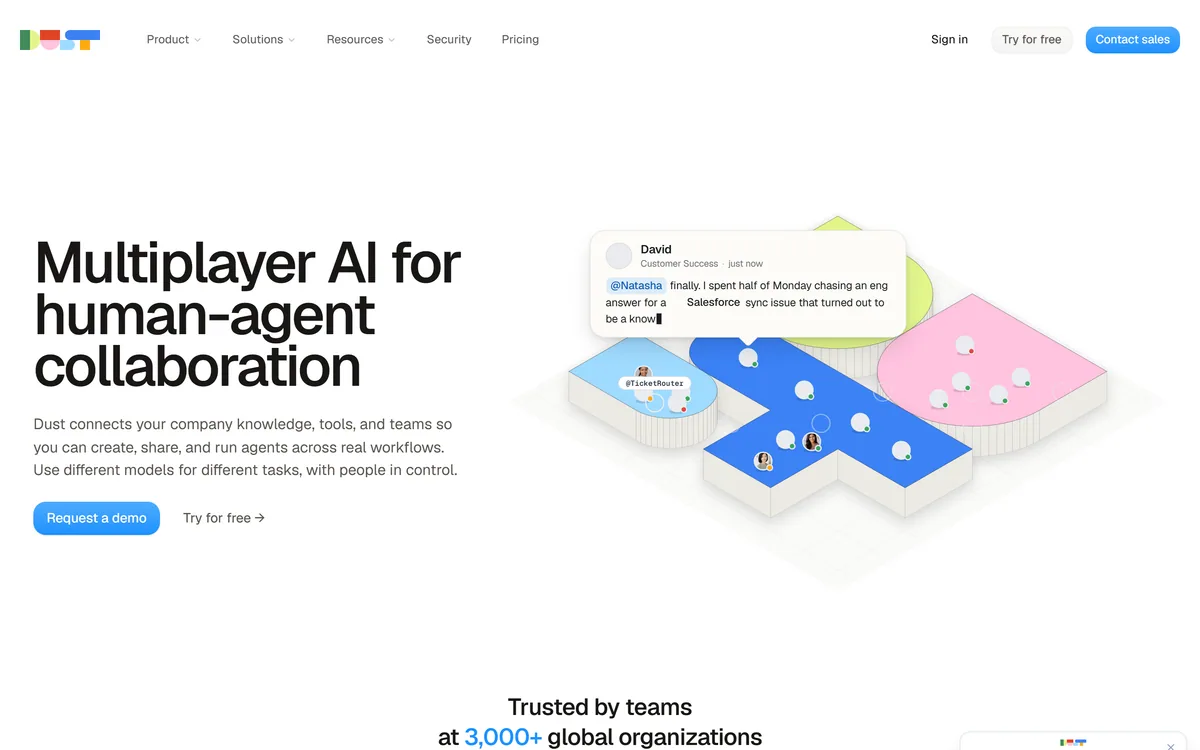
Last checked . Read from dust.tt during this check, with the screenshot above captured at the same time.
Dust runs agents across your company's systems, so it's only as safe as its permissions: the dual-layer model and audit logs must be configured and reviewed, and data residency and retention confirmed against your obligations. It states SOC 2 Type II and US/EU residency. The '3,000+ organizations' figure is a vendor claim.
An AI agent platform, an AI app builder and an open automation tool to weigh beside Dust.
AInexfinder does not list plan prices or billing details. For current pricing, plans, and trials, visit the official Dust website.
Visit official website for pricingVendor pricing, credits, and billing policies change over time. Always confirm on the official site before you buy.
Dust earns an AInexfinder Editor Score of 4.1/5 (very good). Best for: Grounded enterprise agents; Cross-system knowledge; Departmental AI rollouts.
Visit DustLog in to write a review.
No reviews yet. Be the first to share your experience with Dust.
Assigned reviewer
Daniel ReedSenior AI Tools Reviewer
Daniel leads AInexfinder's tool reviews. He researches each tool from its own pricing, documentation and policies, checks its claims against independent sources, and writes up what it does well, where it falls short and who it genuinely suits.
Daniel and the AInexfinder editorial team research Dust from its own website, pricing, documentation and policies, checked against independent sources. This review is research-based: unless its method note says otherwise, we have not bought a plan or run hands-on tests. The Editor Score is our editorial judgement, and payment never changes it.
Similar Tools
Zapier's AI layer adds agents and MCP tool access on top of its automation platform, connecting more than 9,000 apps with governed access so teams can mix AI decisions with deterministic rules under central oversight.
Lokalise is a translation management platform built for continuous localisation: strings flow from your repository, design files and CMS into an AI translation pipeline that applies your approved terminology and tone, with role-based human approval before anything ships.
CrewAI is an enterprise platform to build and run AI agents: a Discovery layer that finds automation opportunities, a no-code canvas and code-first Python API for building role-based multi-agent workflows, and a control plane that adds tracing, RBAC, audit and human-in-the-loop approvals.
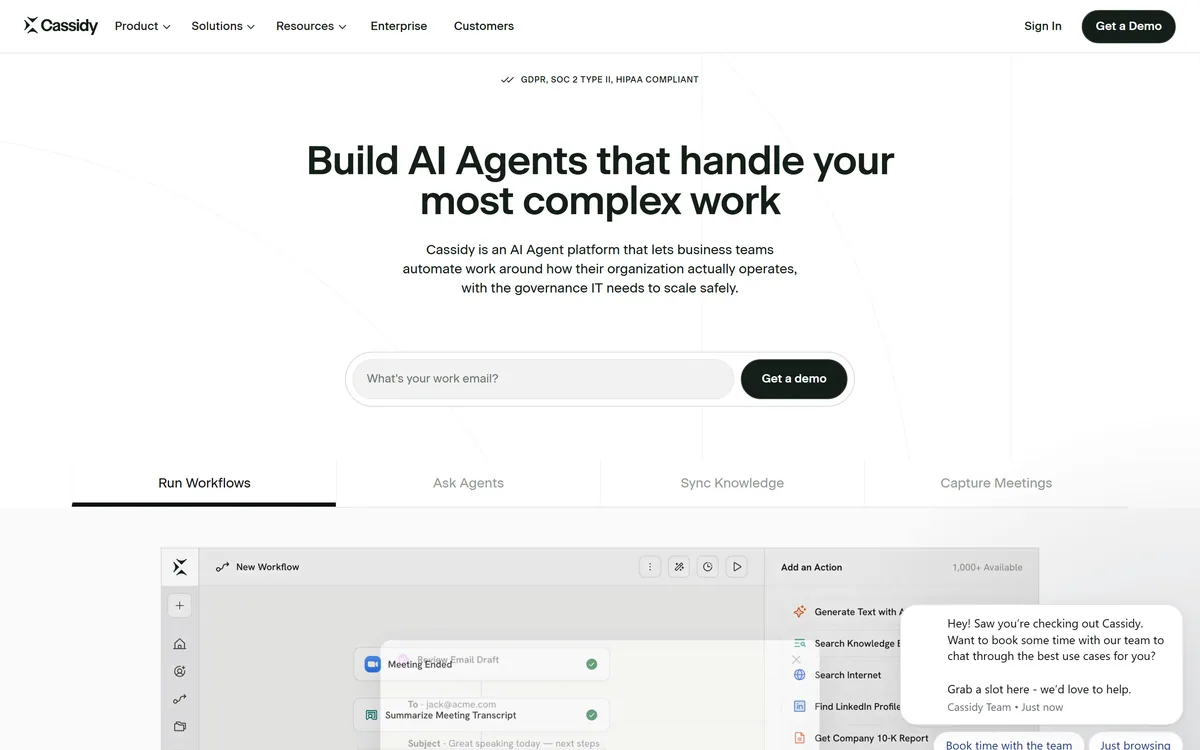
Cassidy AI is a no-code AI-agent and workflow platform that lets business teams build agents grounded in a company knowledge base, deploy them inside Teams, Slack, Chrome and Office, and keep IT in control with permissions, model-agnostic routing and SOC 2, GDPR and HIPAA compliance.
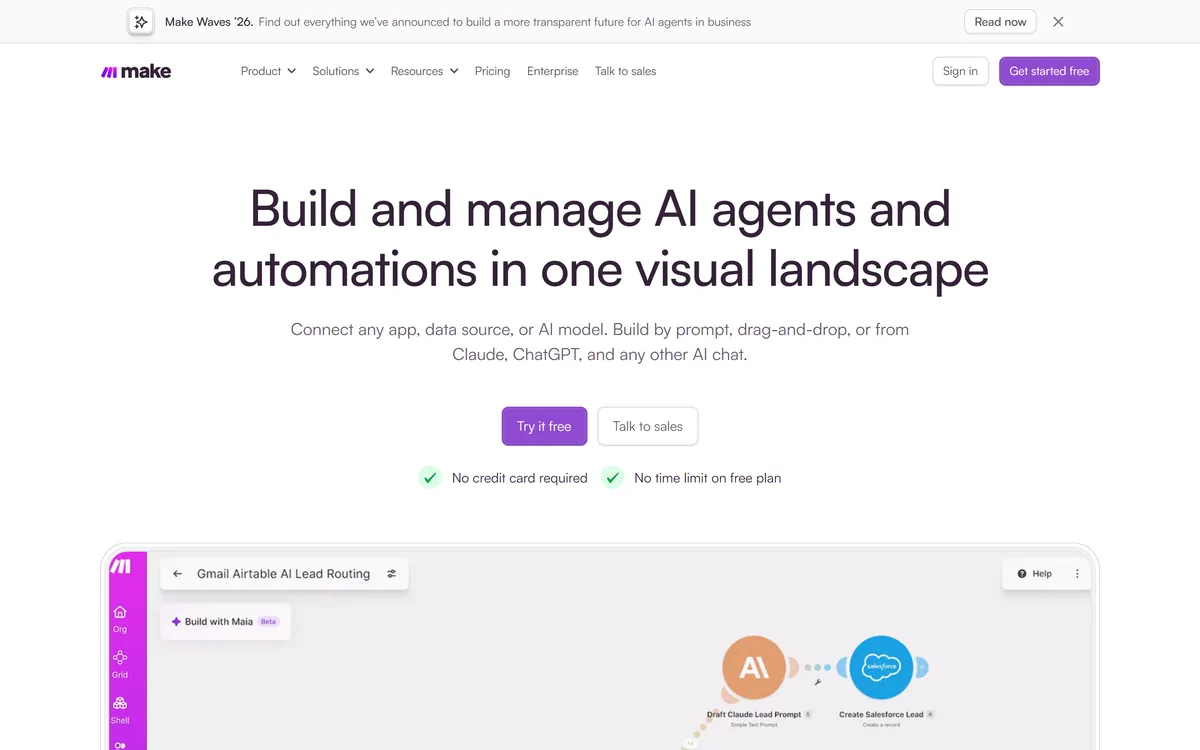
Make (formerly Integromat, now part of Celonis) is a visual workflow-automation and AI-agent platform that connects 3,500+ apps and the latest AI models via drag-and-drop, prompts or MCP, with custom code, observability and enterprise governance. It offers a free plan and scales to enterprise.
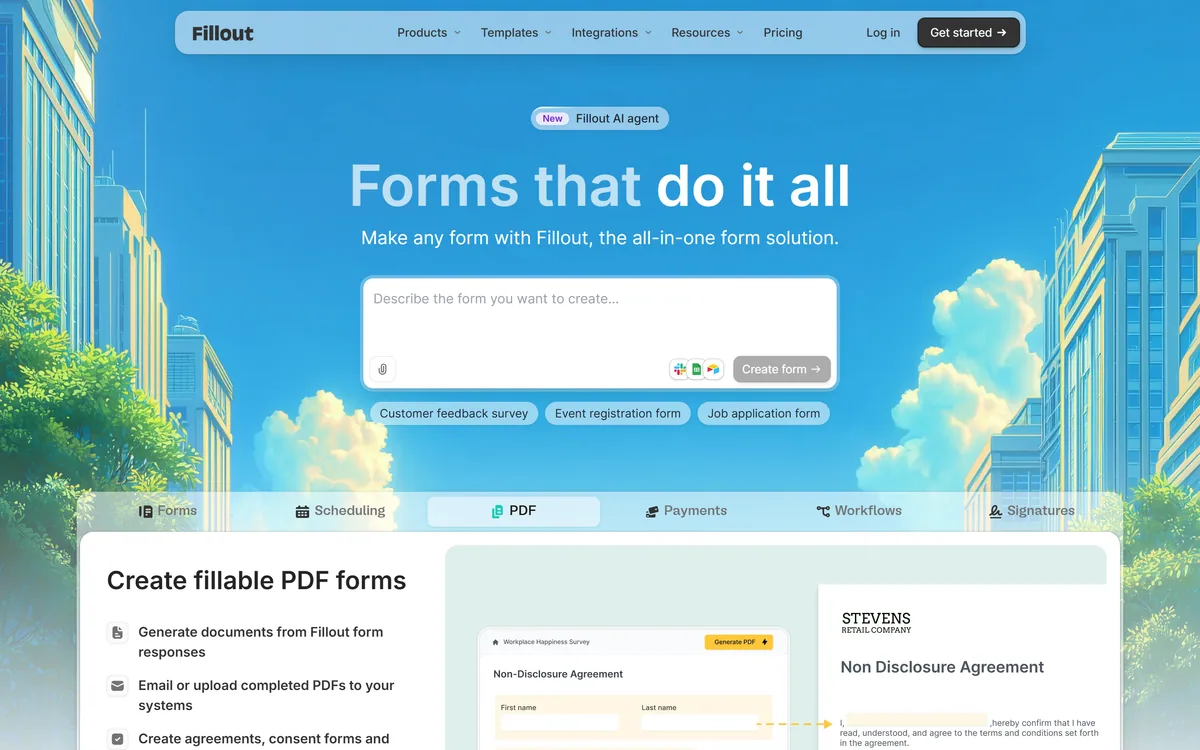
Fillout is a form builder that also handles scheduling, payment collection, PDF generation, e-signatures and workflow routing. Forms can be fully white-labelled down to the favicon, served from your own domain, embedded four ways, and made editable by respondents through login forms.
Related Pages