What Does A Generated Headshot Change?
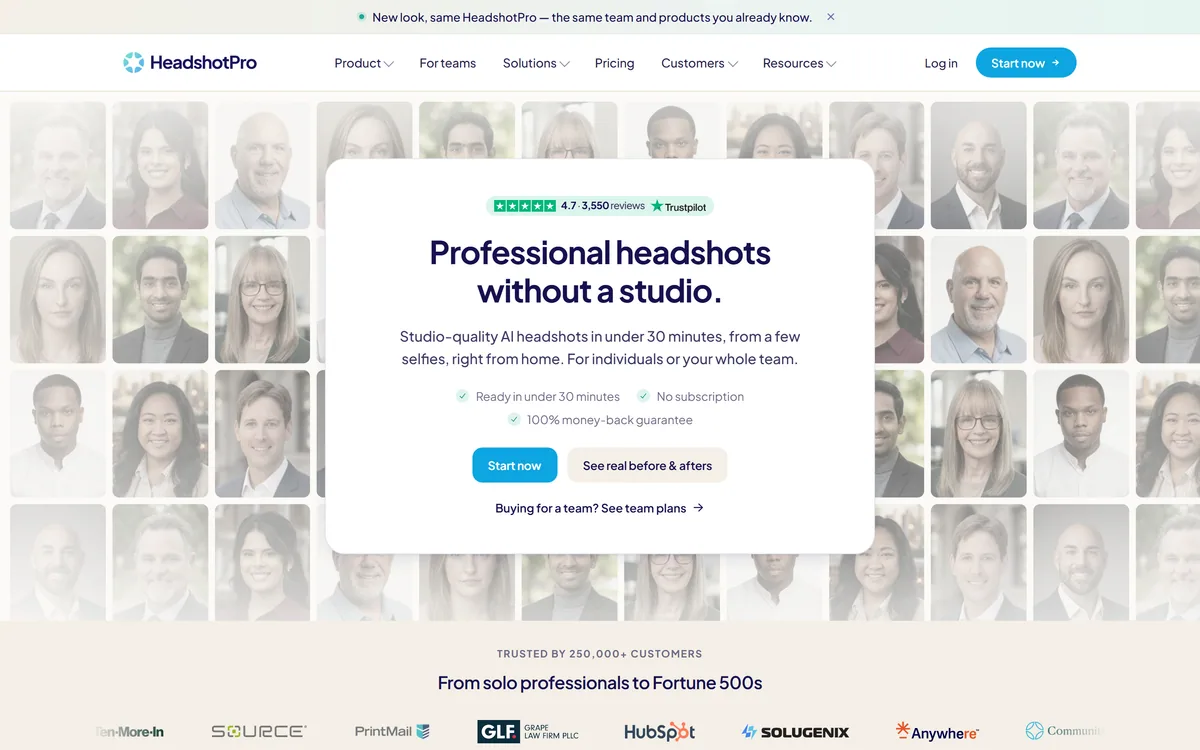
HeadshotPro's framing of the problem is sharper than its description of the solution: every recruiter, client and new hire forms a first impression from your photo, and it is probably not one you would have chosen — too old, or taken for something else entirely.
That is accurate, and the reason is economic rather than aesthetic.
A professional headshot has always required booking a photographer, travelling, and paying for a session. The result is good and then it ages, and nobody repeats the exercise for a new role, a haircut or a rebrand. So most professional photos are somewhere between two and ten years old.
Removing the session removes the reason not to update it. That is the genuine change here — not better photographs than a photographer takes, but current ones.
For teams the arithmetic is starker. Coordinating one photographer across fifty employees in three offices is a project, and the directory is out of date the day someone new starts. A link each person completes themselves is a different kind of task entirely.
The change is not better photos than a photographer takes. It is current ones, because nobody rebooks a studio for a haircut.
Where Generated Portraits Stop Being Fine
A generated headshot is an image of you that was never photographed, and it is worth being clear about where that is unremarkable and where it is not.
For a professional profile it is unremarkable. The norm on LinkedIn is already a flattering, lit, retouched photograph selected from dozens — nobody believes a headshot is candid, and the genre has always been a constructed impression rather than documentary evidence.
Where it stops being fine is anywhere the image functions as identification or as a claim about your appearance to someone deciding something personal. Identity documents obviously. Dating profiles arguably, since the implicit promise is what you look like rather than how you present professionally.
The other line is degree. A headshot that makes you look rested is the same service a photographer provides; one that changes your face is a different image of a different person, and colleagues meeting you will notice.
The tool gives you that control — edit credits cover swapping outfits and removing blemishes — so the judgement sits with you, which is where it belongs and worth exercising deliberately. Editing a photograph you actually took is the conservative alternative, and what Photoleap is for.
Photos Used Once, Then Deleted
Beside the speed claims sits the most important line on the page: we never train AI on your photos, used once, then deleted.
For this product category that is the material commitment, and it is worth understanding why.
You are uploading a set of photographs of your own face to a service you have not used before. Face data is biometric, permanent in a way a password is not, and a company that retains it holds something you cannot change if it leaks.
Training on it is a second question again. Photos absorbed into a model cannot meaningfully be withdrawn later, whatever a subsequent deletion request says.
Stating both commitments plainly, on the homepage rather than in a policy page, is the right behaviour. The footer supports it with a data processing addendum and a security and compliance page — the artefacts of a company that has been asked these questions by procurement, which is a better signal than the claim alone. Product imagery raises the same processing questions at far greater volume, which is Photoroom's domain.
- Upload the selfies they ask for, not your best ten — variety beats quality.
- Use the choose-for-me option first, then refine.
- Check the result against a mirror, not against how you would like to look.
- Use the editor to produce every platform's crop from one image.
- Keep the 4K upscale for print; it is unnecessary for a profile.
Teams, Admins And Consistent Directories
The team flow inverts the usual arrangement: admins set the styles, members upload their own selfies, and built-in rules keep everyone consistent and on brand.
That division of labour is the whole product for a company buyer, and it solves a specific coordination failure.
The reason company directories look incoherent is not indifference. It is that photos were taken at different times by different people under different instructions, and the person who cares about consistency has no way to enforce it retroactively.
Setting the backdrop and outfit rules centrally while letting each person supply their own input means consistency is a property of the system rather than of everyone remembering. New starters join the same way, so the directory stays coherent rather than degrading from day one.
The remaining question is social rather than technical. Asking employees to upload selfies of their own faces to a third-party service is a request some will decline, and a policy that makes it optional — with a real alternative — is the humane way to run it.
No Subscription, And A Refund Without An Expiry
Two commercial details sit alongside the feature list: no subscription, and a hundred percent money-back guarantee with no expiry, plus free retries on the higher packages and edit credits per person.
Both are unusual enough to be worth reading as signals.
A one-off purchase in a category that could easily be a subscription means the company is confident about repeat purchase on merit — people come back for a new role or a rebrand rather than being billed monthly for something they used once.
A refund with no expiry is the stronger signal. Most guarantees are bounded at fourteen or thirty days precisely because dissatisfaction surfaces later; removing the boundary is a commitment that is expensive if the output disappoints.
Edit credits and free retries address the actual failure mode, which is not a bad batch but one specific thing being wrong — the wrong outfit, an odd background, too little headroom. Being able to fix that without repurchasing is the difference between a usable service and a lottery. Generating clothing rather than people is an adjacent problem with its own licensing questions, as Refabric shows.
Getting A Headshot You Would Actually Use
The most common disappointment with generated headshots is not quality. It is that the person does not quite look like the user, and that is usually a function of what was uploaded.
This sequence produces a set you will actually pick from.
- Upload varied selfies — different lighting, angles and days, not one good session.
- Follow the photo guidelines rather than assuming better photos are better inputs.
- Let it choose styles first, then narrow once you see what works.
- Judge the results against a mirror rather than against an aspiration.
- Spend the edit credits on the one thing that is wrong, not on regenerating.
- Crop for each platform in the editor rather than uploading the same file everywhere.
HeadshotPro: Output And Guarantees
| Input | A few selfies, uploaded from phone or laptop, with auto-validation of bad photos |
|---|
| Output | 30 to 70 headshots, with ready times stated from as little as 15 minutes |
|---|
| Turnaround | Under 30 minutes stated as standard |
|---|
| Styles | Thousands of backdrop and outfit combinations, with per-gender outfit options |
|---|
| Automatic option | A choose-for-me setting that pairs backdrops and outfits |
|---|
| Formats | High-resolution JPEG, downloadable individually or as a ZIP, with optional 4K upscale |
|---|
| Editor | Profile picture editor with crop, shape, border, logo and text overlay |
|---|
| Editing | Edit credits per person for backdrops, outfits, blemishes and headroom |
|---|
| Privacy | States photos are used once then deleted, with no AI training on them |
|---|
| Commercial model | No subscription, with a 100 percent money-back guarantee and no expiry |
|---|
| Teams | Admins set styles; members upload their own selfies under shared rules |
|---|
| Displayed figures | 4.7 from 3,550 reviews, and 250,000-plus customers |
|---|
HeadshotPro: Selfies Into Studio Portraits
- 30 to 70 headshots in under 30 minutes from a few selfies, on phone or laptop.
- Photos used once, then deleted, with a stated policy of never training AI on them.
- Thousands of backdrop and outfit combinations, or a choose-for-me option that pairs them automatically.
- No subscription, with a full money-back guarantee that carries no expiry.
- Team deployment where admins set styles and each employee uploads their own selfies.