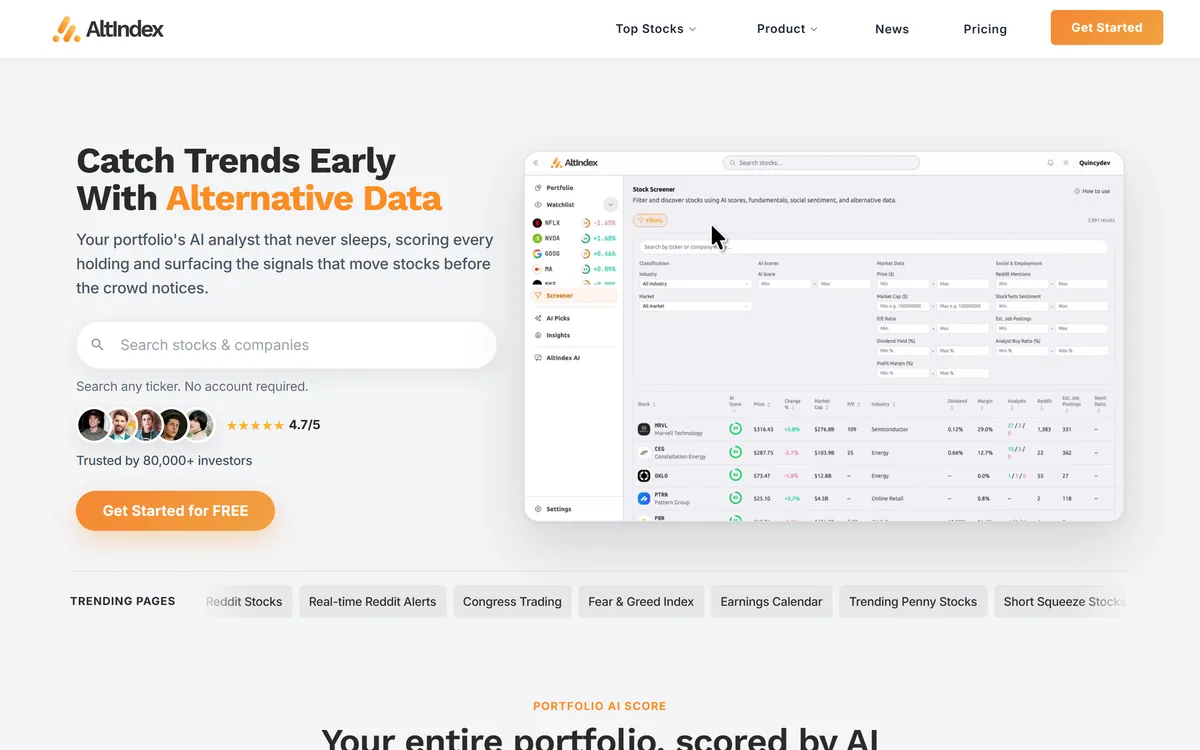
AltIndex tracks alternative data signals about public companies — social sentiment, web traffic, app downloads, job postings, employee ratings and insider trades — and turns them into an AI score per stock, with screening, alerts and portfolio analysis on top.
Not investment advice. This is a review of a software product, not a recommendation to buy, sell or hold any security. Nothing here is financial advice, and past performance figures quoted by any vendor are not a reliable indicator of future results.
The data is real and the inference from it is where all the difficulty lives.
Signals, Features And Scale
Category
Alternative data and AI-assisted investment research
Core idea
Score public companies from non-financial signals rather than from filings alone
Data sources tracked
Reddit mentions and sentiment, web traffic, app downloads, job postings, employee ratings and business outlook, insider and congressional trading, wider social sentiment
Scoring
AI score from 0 to 100 per holding, plus a portfolio-level view
Named features
Portfolio AI Score, AI Stock Picks, Stock Alerts, Stock Screener, Leaderboard, AltIndex AI conversational analyst, Autopilot rules-based copying, MCP Server
Coverage
Vendor states thousands of stocks analysed daily
Stated user base
More than 80,000 investors, per the vendor
Stated performance
61% win rate across all AI picks, per the vendor
Platforms
Web, iOS and Android
Institutional offering
Available for funds and ETF issuers
Charging model
Freemium — limited free tier, paid monthly or annual subscription, no card to start; no prices published here
What Alternative Data Is, And Why Anyone Bothers
The premise is a decade old on the institutional side and only recently affordable to individuals, which is the actual news here.
Company financials arrive quarterly, audited and late. By the time a filing tells you revenue rose, the rise happened months ago and the price moved on the announcement. Everyone gets that information simultaneously, which is precisely why it is hard to profit from.
Alternative data is everything else — the observable traces a business leaves while operating. If a retailer's web traffic climbs for eight weeks, something is happening before any filing says so. If a software company posts forty new engineering roles, that is a statement about its plans. If employee ratings fall sharply, that often precedes visible trouble.
Hedge funds have bought this for years: satellite imagery of car parks, credit card panels, app telemetry. It is expensive, and the expense was the moat.
AltIndex's proposition is packaging a retail-accessible version of that idea, in the way Danelfin packages a different feature set. The signals are shallower than an institutional dataset, but they are real signals rather than opinion, and that is a meaningful difference from the average stock-tip service.
Financial statements tell you what already happened, on everyone's screen at once. Alternative data is an attempt to watch the business rather than the report.
Reading The 61% Win Rate Properly
This figure is the centre of the marketing and it deserves neither dismissal nor acceptance. It deserves unpacking.
First, win rate is not return. A strategy can win 61% of the time and lose money, if the 39% of losses are larger than the wins. Win rate without average win and average loss is an incomplete description of any strategy — and the missing half is the half that determines whether you made money.
Second, compared with what? In a rising market a randomly chosen basket of large-cap stocks wins more often than it loses. The number that matters is performance against a relevant benchmark over the same period, not against zero.
Third, over what period, and was it live? A result derived by testing rules against history is a very different claim from one recorded in advance and audited afterwards. Backtests are famously flattering because the rules were chosen knowing the outcome.
Reading a company's actual filings — with a long-context model like Claude, say — remains the unglamorous alternative. Fourth, who is measuring? This is the vendor's own figure about its own product, unaudited by anyone else.
None of that means the number is dishonest. It means the number, as published, cannot tell you what you would need to know, and any investment tool advertising a headline performance statistic should be read this way as a matter of routine.
Where These Signals Genuinely Work — And Where They Mislead
The honest position is that alternative data is strong for a particular kind of company and close to useless for others.
It works best on consumer-facing businesses with a digital surface. App downloads genuinely track adoption for a mobile-first company. Web traffic genuinely tracks interest for an e-commerce retailer. Job postings genuinely signal expansion. For these, the data is close to the actual business.
It works poorly on B2B, industrial and regulated businesses. A company selling turbines to utilities has no app, and its website traffic tells you nothing about a sales cycle measured in years. The signal is not weak here, it is absent — and a scoring system that produces a number anyway is producing noise.
Reddit sentiment deserves particular scepticism. It measures attention, not quality, and the 2021 meme-stock episode demonstrated exactly what following retail social sentiment can do in both directions. High Reddit volume tells you a stock is being discussed — which is genuinely predictive of volatility, and not at all predictive of direction.
Insider and congressional trade tracking is the most defensible signal in the set, because it is disclosed regulatory data about what people with unusual visibility actually did with their own money. It is also public, lagged by filing deadlines, and widely watched.
The pattern to internalise: these signals are best as a prompt to investigate, and worst as a reason to trade.
Strongest on consumer apps, e-commerce and digital-first companies
Weakest on B2B, industrial, and long-sales-cycle businesses
Reddit sentiment predicts attention and volatility, not direction
Hiring data is a decent expansion signal and a slow one
Insider and congressional filings are the most solid input, and also the most public
Autopilot And The MCP Server Are Different Risks
Two features sit apart from the research tooling and each deserves its own note.
Autopilot applies rules to copy a portfolio automatically. Automation in investing is not neutral — it removes the pause between a signal and a decision, and that pause is where most people avoid their worst trades. If you use anything like this, position sizing and a hard limit on what any single rule can do matter far more than the rule itself.
The MCP Server is a more interesting inclusion and a genuinely modern one. It lets an AI assistant query AltIndex's data directly, so you can ask a general model about your portfolio and have it answer from this dataset.
That is useful and it introduces a specific failure mode worth naming: a language model given data will produce a confident narrative from it, including from signals that are noise. A cited research tool such as Perplexity at least shows you its sources. The model does not know that web traffic is meaningless for an industrial supplier. It will explain the number anyway, fluently.
Treat generated commentary as a summary of the data, never as analysis of the business.
Start on the free tier and score a portfolio you already hold and understand.
Check whether the scores agree with what you independently know about those companies.
Look specifically at how it scores a B2B or industrial holding, where the signals should be weakest.
Track the picks on paper for a full quarter before any money follows them.
Compare that paper result against a plain index over exactly the same window.
What A Subscription Actually Buys
This site does not publish plan prices. The structure is what stays true, and it is conventional here.
AltIndex is freemium with subscription tiers. There is a free level — including a screenshot-based portfolio scoring path that lets you see a score without connecting anything — and paid monthly or annual levels above it. Annual is offered, and no card is required to start.
What is metered is depth of access rather than usage: how many holdings you can score, which signals and alerts you can see, and whether features like Autopilot and the screener are available. That is the normal shape for research subscriptions and it means the free tier is a genuine preview rather than a trial clock.
There is a separate institutional offering for funds and ETF issuers, which is a different conversation and a different contract.
The one budgeting point specific to investment tools: the subscription is a certain, recurring cost set against uncertain, variable benefit. On a small portfolio an annual research subscription can be a meaningful percentage of returns, and that arithmetic is worth doing before subscribing rather than after.
Vocabulary This Category Assumes
Four terms do most of the work, and two of them are routinely misused in marketing.
Alternative data
Information about a company from outside its financial reporting — web traffic, app downloads, hiring, sentiment, imagery. Used to observe a business between filings.
Win rate
The share of picks that ended profitable. It says nothing about size, so a high win rate is fully compatible with losing money overall.
Backtest
Applying a strategy to historical data. Flattering by construction, because the rules were chosen already knowing what happened.
Insider trading data
Here it means legally disclosed transactions by executives and legislators, filed with regulators — public record, not anything improper.
Key features of AltIndex
Alternative data collection across social, web, app, hiring and insider signals
Portfolio AI Score from 0 to 100 per holding
AI Stock Picks
Real-time stock alerts across multiple signals
Stock screener and ranked leaderboard
AltIndex AI conversational portfolio analyst
Autopilot rules-based portfolio copying
MCP server for querying the data from third-party AI tools
Congressional and insider trade tracking
iOS and Android apps
Institutional offering for funds and ETF issuers
Pros & cons
Pros
6
Alternative data is genuinely different from what most retail tools offer, rather than repackaged fundamentals
Signal breadth is good — traffic, apps, hiring, ratings and disclosed trades in one place
Insider and congressional filing tracking is the most defensible signal in the set
An MCP server is a forward-looking way to let your own AI tools query the data
A genuine free tier means you can score a portfolio you already understand before paying
Alerts on companies you follow are more useful than picks you do not
Cons
6
The headline win rate is unaudited and published without the context needed to interpret it
Signals are weak to absent for B2B and industrial companies, but a score still appears
Reddit sentiment measures attention rather than direction
Automated portfolio copying removes the pause where most bad trades get avoided
AI commentary will narrate noise as confidently as signal
On a small portfolio the subscription can be a material drag on returns
Best For
Self-directed investors who already do their own research
Anyone following consumer app and e-commerce companies
Investors wanting disclosed insider and congressional trades in one feed
People who want alerts on existing holdings rather than new tips
Analysts curious about alternative data without an institutional budget
AltIndex Beside Other Research Tools
These answer different questions, and the split is between watching the business and reading the filings.
Tool
Primary input
Output
Suits
AltIndex
Alternative signals — traffic, apps, hiring, sentiment
You already do your own research and want an additional, non-financial input
You invest in consumer apps and e-commerce, where these signals are strongest
You want alerts on companies you already follow rather than new tips
You understand a score is a prompt to investigate, not a conclusion
You want disclosed insider and congressional filings collected in one place
Do Not Trade On It If
You would act on a score without independently understanding the company
Your holdings are B2B or industrial, where the underlying signals barely exist
You are looking for a system that removes judgement from investing
Your portfolio is small enough that the subscription is a material drag on returns
You would enable automated copying without hard position limits
Other Tools For Research And Analysis
Only one of these is a direct alternative; the others are for understanding rather than scoring.
Danelfin — the closest comparison — AI stock scoring from a different feature set
Perplexity — cited research when you need to understand a company, not rank it
Claude — reading filings and long documents, which scores cannot replace
Elicit — the same evidence-gathering discipline applied to academic literature
Claims Checked Against The Site
Last checked . Read from altindex.com during this check, with the screenshot above captured at the same time.
Data sources listed on site: Reddit mentions and sentiment, web traffic, app downloads, job postings, employee ratings and business outlook, insider and congressional trading
Named features confirmed: Portfolio AI Score, AI Stock Picks, Stock Alerts, Stock Screener, Leaderboard, AltIndex AI, Autopilot and an MCP Server
Scoring described as a 0 to 100 rating per holding
Coverage stated as thousands of stocks analysed daily
User base stated as more than 80,000 investors
Performance stated by the vendor as a 61% win rate across all AI picks
Mobile apps offered for iOS and Android alongside the web platform
An institutional offering for funds and ETF makers is referenced
Charging described as a free tier with paid subscription levels, monthly or annual, no card required to start; no plan prices published here, in line with this site's pricing policy
The 61% win rate is the vendor's own unaudited figure. It is published without an average win and loss, without a benchmark comparison, and without stating whether it is live or backtested — so it cannot support a conclusion about returns. This listing is a software review and not investment advice; alternative data signals are weakest exactly where a scoring system is least likely to say so.
Editor's Verdict
3.7/5
AltIndex has an AInexfinder Editor Score of 3.7/5.
AltIndex pricing
AInexfinder does not list plan prices or billing details. For current pricing, plans, and trials, visit the official AltIndex website.
Vendor pricing, credits, and billing policies change over time. Always confirm on the official site before you buy.
Frequently asked questions
What is alternative data in investing?
Information about a company from outside its financial reports — web traffic, app downloads, job postings, employee reviews, social sentiment. The idea is to observe the business between quarterly filings rather than waiting for the filing.
Is AltIndex free?
There is a free tier, including screenshot-based portfolio scoring with no card required, and paid monthly or annual subscriptions above it. What is metered is depth of access rather than usage, so the free tier works as a real preview.
Is AltIndex's 61% win rate reliable?
It is the vendor's own unaudited figure and it is published without the context you would need. Win rate says nothing about the size of wins versus losses, there is no benchmark comparison, and it is not stated whether the record is live or backtested.
Can AI predict stock prices?
No system reliably predicts prices, and any tool implying otherwise should be treated with suspicion. What alternative data can plausibly do is surface a change in a business earlier than the filings do — which is a prompt to investigate, not a signal to trade.
Does Reddit sentiment actually predict stock moves?
It predicts attention and volatility reasonably well and direction poorly. High social volume tells you a stock is being discussed heavily, which historically has preceded large moves in both directions rather than upward ones.
Which stocks does alternative data work worst for?
B2B, industrial and long-sales-cycle companies. A firm selling equipment to utilities has no app downloads and its web traffic says nothing about its pipeline. The signal is effectively absent, though a scoring system will still produce a number.
Is AltIndex investment advice?
No, and neither is this review. It is a research tool that surfaces data and scores; the decisions and the consequences remain yours. Treat any score as a reason to look closer at a company, never as a reason to buy it.
Daniel reviews AI tools the slow way — by actually using them on real projects. His reviews cover what works, what breaks, and who each tool is genuinely a good fit for.
Daniel and the AInexfinder editorial team research AltIndex using public product information, listing evidence, and (when available) hands-on checks. Scores reflect listing completeness and transparency — not paid placement.
Listings may include affiliate or sponsored placements, which are labeled when present. Editorial scores and cons are not sold. See our affiliate disclosure and review methodology.
Listomize is an Etsy SEO platform that generates titles, tags, and descriptions within Etsy's own limits, scores listings, optimises 100+ listings from a CSV, tracks competitors and trends, and auto-generates Pinterest pins.
Lahjty (لهجتي) is an Arabic-first marketing platform for MENA campaigns. From one brief it produces dialect-aware ad copy, headlines, campaign images with Arabic text rendered in, dialect-aware voice, and SEO articles grounded in your own brand sources — with a Partner API and an MCP server for teams that want it inside their own workflow.
MaxAEO is an answer engine optimisation platform from HIII PTE. LTD. It tracks how ChatGPT, Gemini, Claude, Perplexity, Copilot, Grok and Google's AI surfaces mention a brand, with sentiment, competitor benchmarking and citation tracing.
Mailjet is a Sinch-owned email platform handling both marketing campaigns and transactional sending from one account. It offers a collaborative drag-and-drop editor, an email API with SMTP relay, AI generation and segmentation, and EU-based data centres.
Outranking is an AI SEO content platform that writes briefs and first drafts and optimises them with real-time scoring, grounding content in live SERP data through its Concepts feature, with keyword clustering, internal linking and content workflows.
PitchBud is a press outreach tool that drafts a release with Claude Sonnet, publishes it to a newsroom URL with NewsArticle schema and RSS, matches relevant journalists by their recent work, and drafts personal pitches you review and send yourself.