DALL·E 3 was OpenAI's text-to-image model. OpenAI shut down the DALL·E 2 and DALL·E 3 API endpoints on 12 May 2026 and now directs users to its GPT Image models. This page explains what happened and what replaced it.
OpenAIopenai.com98,009 viewsAdded September 10, 2025500M+ visitors
DALL·E 3 is no longer available. OpenAI announced its deprecation on 14 November 2025 and shut down the DALL·E 2 and DALL·E 3 API endpoints on 12 May 2026.
This is not a rebrand or a quiet repositioning. The endpoints were switched off, and OpenAI's own deprecations page now directs developers to its GPT Image models instead.
Because DALL·E 3 is still heavily searched and widely referenced in older articles, this page sets out the timeline, what replaced it, and what to do if you built something on it.
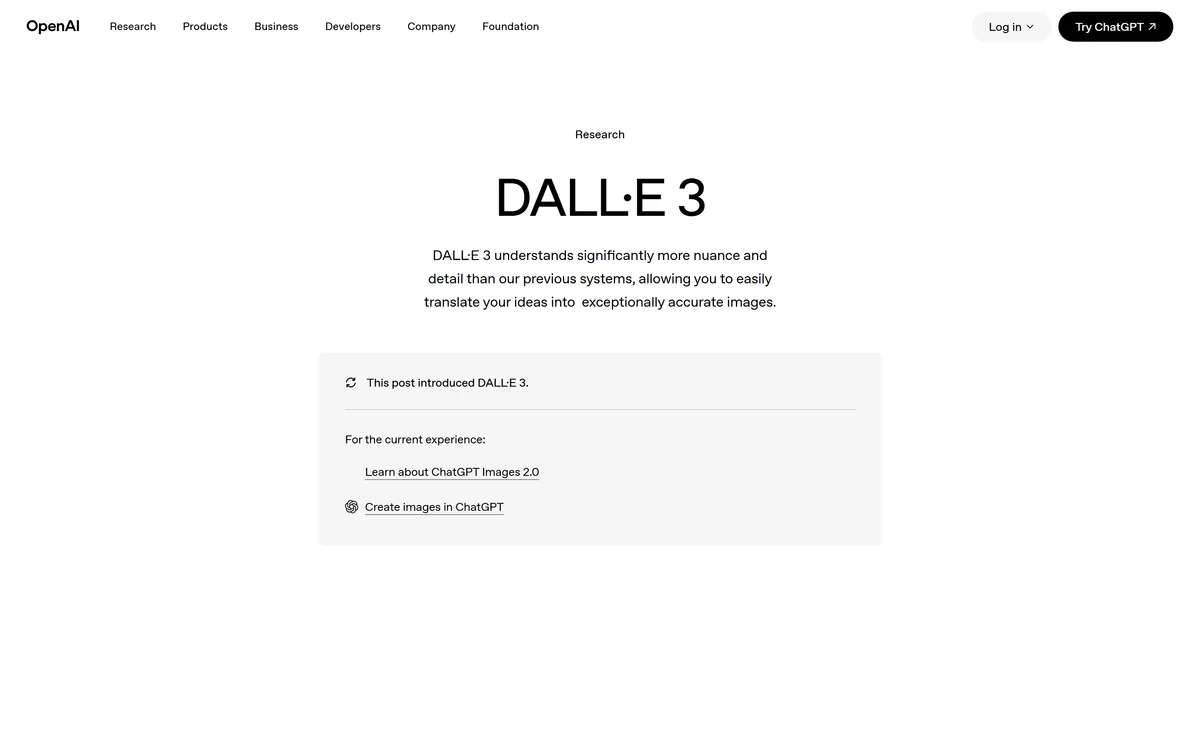
OpenAI's own DALL-E 3 page now points visitors to ChatGPT Images 2.0 as the current experience.
DALL-E 3 Status
Current status
Retired — no longer available
Shutdown date
12 May 2026, for both dall-e-2 and dall-e-3 API endpoints
Announced
14 November 2025
Replacement models
gpt-image-2, gpt-image-1, and gpt-image-1-mini
In ChatGPT
Replaced by GPT Image 1.5 in December 2025, then GPT Image 2 in April 2026
Consumer name
ChatGPT Images 2.0
Also being retired
gpt-image-1-mini, gpt-image-1.5 and chatgpt-image-latest, from 1 December 2026
Source
OpenAI's published API deprecations page
The Shutdown Timeline
The retirement ran over about eighteen months, and knowing the order of events explains why so many articles contradict each other.
November 2025: OpenAI announces the deprecation of dall-e-2 and dall-e-3
December 2025: ChatGPT quietly swaps DALL·E 3 for GPT Image 1.5 as its default image model
April 2026: GPT Image 2 launches, branded ChatGPT Images 2.0 for consumers
12 May 2026: the DALL·E 2 and DALL·E 3 API endpoints are shut down
June 2026: OpenAI announces further image model retirements, effective 1 December 2026
What DALL·E 3 Was Known For
DALL·E 3's real advance was prompt adherence. Earlier image models produced attractive pictures that ignored half the instruction; DALL·E 3 followed complex prompts closely enough that you could describe a scene and get that scene.
It also handled text inside images far better than its predecessors, which was the practical blocker for anything involving a sign, a label, or a title.
Its integration into ChatGPT mattered as much as the model. Being able to describe an image conversationally, then refine it in the same thread, brought image generation to people who would never have opened a specialist tool.
What Replaced It
OpenAI's recommended replacements are gpt-image-2, gpt-image-1, and gpt-image-1-mini. GPT Image 2 is the current flagship and the one OpenAI points new work toward.
GPT Image 2 is a different kind of model rather than a bigger DALL·E. It is described as OpenAI's first image model with native reasoning — able to search the web during generation, check its own output, and produce several coherent images from one prompt.
In ChatGPT the change happened without users needing to do anything. Anyone still typing image prompts into ChatGPT has been on GPT Image for some time, whether or not they noticed.
If You Built On The API
Calls to the DALL·E endpoints now fail rather than degrade, so any integration still pointing at them is broken, not merely outdated.
The migration path is to gpt-image-2. Note that two of the interim replacements — gpt-image-1-mini and gpt-image-1.5, along with chatgpt-image-latest — are themselves scheduled for shutdown on 1 December 2026, so migrating to those buys only a short reprieve.
The lesson worth taking from this cycle is to pin image generation behind a thin internal interface. OpenAI has retired image models three times in roughly a year, and nothing suggests that pace is finished.
What Changed Between DALL·E And GPT Image
The shift is architectural, not incremental. DALL·E 3 took a prompt and produced a picture in one pass; GPT Image 2 reasons about the request before and during generation.
In practice that means it can look something up mid-generation rather than guessing at a detail, inspect what it produced against the instruction, and return a set of images that belong together instead of variations that drift apart.
For anyone who used DALL·E 3 heavily, the biggest day-to-day difference is consistency across a batch. Producing several images that share a style and hold to one brief was the weakest part of the old workflow.
Licensing And Commercial Use
Image model retirements raise a question people rarely think about until it matters: what happens to images you already generated and shipped.
Work produced under a model that no longer exists does not become unusable, but reproducing it does. If a campaign depends on being able to regenerate assets in a consistent style, that capability leaves with the model.
Where visual consistency matters over years rather than weeks, keep the source files and the exact prompts, and treat any specific model as temporary infrastructure.
Why So Many Guides Still Describe It As Live
DALL·E 3 was the best-known image model of its generation, so an enormous volume of tutorials, comparisons, and reviews were written about it. Almost none have been updated.
Search results therefore present a model that has not existed since May 2026 as a current option, often with confident feature comparisons against tools that are still running. Some of those pages continue to rank well, which keeps the misinformation circulating long after the shutdown.
Treat any undated DALL·E 3 article as historical. OpenAI's own deprecations page is the authoritative record, and it is unambiguous about both the announcement and the shutdown date.
Choosing An Image Model Now
If you came here looking for DALL·E 3 specifically, the closest continuation is GPT Image 2 — same lineage, same ChatGPT integration, stronger prompt handling.
If you were choosing between DALL·E 3 and alternatives, that comparison needs redoing from scratch. The competitive landscape moved substantially while DALL·E 3 was being wound down, and a two-year-old comparison tells you nothing useful.
Weigh prompt adherence, text rendering, licensing terms for commercial use, and whether you need generation inside an existing workflow or as a standalone tool.
Add one criterion this episode makes obvious: how the vendor handles retirement. A provider that publishes dated deprecation notices well in advance is easier to build on than one that changes a model underneath you without saying so.
The Record On DALL·E 3
DALL·E 3 was an important model that is no longer available. It brought reliable prompt adherence and usable in-image text to a mass audience through ChatGPT, and it shaped what people expect from image generation.
Its retirement is a straightforward product decision rather than a failure — OpenAI replaced it with something more capable and consolidated onto one image line. Judged on influence rather than availability, it did more than any other model to make image generation ordinary.
For current capabilities, plans, and limits, go to OpenAI directly. Anything describing DALL·E 3 as a live option is describing the past.
Key features of DALL-E 3
Historic: strong prompt adherence for complex, multi-element descriptions
Historic: markedly better text rendering inside generated images
Historic: conversational generation and refinement inside ChatGPT
Historic: available through both ChatGPT and the OpenAI API
Current: superseded by GPT Image 2, OpenAI's recommended replacement
Pros & cons
Pros
5
Set the standard for following complex prompts accurately
Made usable in-image text practical for the first time at scale
Conversational refinement inside ChatGPT lowered the barrier enormously
Its successor, GPT Image 2, is a direct and more capable continuation
OpenAI published clear deprecation dates rather than removing it silently
Cons
5
No longer available — the API endpoints were shut down in May 2026
Existing integrations pointing at it fail outright rather than degrade
Two of its interim replacements are already scheduled for retirement
A large volume of undated articles still present it as a current option
Rapid model turnover makes any direct dependency on one endpoint risky
Best For
Readers checking whether DALL·E 3 is still available
Developers migrating a broken integration off the retired endpoints
Anyone comparing OpenAI's current image models against alternatives
Teams auditing which AI dependencies have been deprecated
Editor's Verdict
3.8/5
DALL-E 3 has an AInexfinder Editor Score of 3.8/5.
DALL-E 3 pricing
AInexfinder does not list plan prices or billing details. For current pricing, plans, and trials, visit the official DALL-E 3 website.
Vendor pricing, credits, and billing policies change over time. Always confirm on the official site before you buy.
Frequently asked questions
Is DALL-E 3 still available?
No. OpenAI shut down the DALL·E 2 and DALL·E 3 API endpoints on 12 May 2026, having announced the deprecation on 14 November 2025. The model is no longer accessible.
What replaced DALL-E 3?
OpenAI's GPT Image models. The recommended replacements are gpt-image-2, gpt-image-1, and gpt-image-1-mini, with GPT Image 2 as the current flagship — branded ChatGPT Images 2.0 for consumers.
Can I still generate images in ChatGPT?
Yes. ChatGPT switched from DALL·E 3 to GPT Image 1.5 in December 2025 and then to GPT Image 2 in April 2026. Image generation continued throughout; only the underlying model changed.
My app used the DALL-E 3 API and stopped working. What now?
The endpoints were switched off, so calls fail rather than degrade. Migrate to gpt-image-2 — and note that gpt-image-1-mini, gpt-image-1.5, and chatgpt-image-latest are themselves scheduled for shutdown on 1 December 2026.
Why do so many reviews still describe DALL-E 3 as current?
It was the most written-about image model of its generation and very little of that content has been updated. Treat any undated DALL·E 3 article as historical; OpenAI's published deprecations page is the authoritative record.
Was DALL-E 3 discontinued because it failed?
No. OpenAI consolidated onto its GPT Image line, which is more capable — GPT Image 2 adds native reasoning, mid-generation web search, and self-checking. The retirement was a product consolidation, not a withdrawal.
What did DALL-E 3 do better than earlier models?
Prompt adherence and text rendering. It followed complex, multi-part descriptions closely rather than producing an attractive image that ignored half the instruction, and it made readable text inside images practical.
Daniel reviews AI tools the slow way — by actually using them on real projects. His reviews cover what works, what breaks, and who each tool is genuinely a good fit for.
Daniel and the AInexfinder editorial team research DALL-E 3 using public product information, listing evidence, and (when available) hands-on checks. Scores reflect listing completeness and transparency — not paid placement.
Listings may include affiliate or sponsored placements, which are labeled when present. Editorial scores and cons are not sold. See our affiliate disclosure and review methodology.
krea2.org is a browser image-generation workspace that runs several third-party models side by side, including Krea 2 tiers, FLUX.2, GPT Image 2, Nano Banana and Seedream 5.0, with reference uploads, six aspect ratios and live model switching.
GenApe is an all-in-one AI platform covering writing, chat, image and video generation, image editing, product photography, translation, and research — with 145 free credits on signup and commercial rights granted to paid users.
Adobe Firefly generates images, video, and audio from models trained on licensed Adobe Stock and public domain content, with Content Credentials on every output, Firefly Boards for ideation, Custom Models for brand style, and third-party partner models alongside Adobe's own.
GPT Image 2 launched on 21 April 2026 as ChatGPT Images 2.0 and as the gpt-image-2 API model. Its distinguishing capabilities are dense, accurate text rendering, layout fidelity for infographics and packaging, up to 3840px output, prompt-guided masking, and reasoning applied to image structure before generation.
OpenArt is an all-in-one AI creation platform covering image, video, voice and audio in one place, built around a Director that lets you lay out a storyboard and shape each shot through conversation, alongside persistent characters and worlds for consistency across a project.
Stockimg AI offers separate generators for logos, stock photos, illustrations, wallpapers, product photos and social posts, then schedules the output to Instagram, TikTok, LinkedIn, YouTube and X, with an API for programmatic use.