DeepSeek is an AI model family and assistant with DeepThink reasoning, search and native multimodal understanding, usable through web chat, a desktop app and an API platform, from a lab whose models have released open weights, with a data-residency point worth noting.
deepseek.com6 viewsAdded May 27, 202611M+ visitors
DeepSeek is one of the few labs whose models reach the frontier on capability while also releasing open weights, which is why it is used both as a hosted assistant and as a model developers run themselves. That dual nature is the first thing to understand about it.
As a product it offers web chat, a desktop app and an API platform, with a DeepThink reasoning mode, search, and native multimodal visual understanding in its latest releases. For research-style questions it sits near tools like Perplexity AI, though DeepSeek is first a general model rather than a search product.
This review covers what you can do with DeepSeek, who gets the most from it, how its API is priced, and the data-residency point that makes it the wrong pick for some.
DeepSeek offers web chat, a desktop app and an API for its reasoning model family.
DeepSeek Model Facts
What it is
A frontier AI model family and assistant
Reasoning
DeepThink extended-reasoning mode
Multimodal
Native visual understanding (latest releases)
Access
Web chat, desktop app and API platform
Search
Built-in web search in chat
Lineage
Lab has released open-weight models
Operator
Consumer service under Chinese jurisdiction
Pricing
API billed per token; check current rates
DeepSeek, The Frontier Brief
DeepSeek is a frontier AI model family and assistant: reasoning, search and multimodal understanding via web, desktop and API.
Its lineage is partly open: the lab has released open-weight models, which is why it is widely self-hosted and studied.
DeepThink is the headline: an extended-reasoning mode for harder, multi-step problems, alongside normal chat and search.
There is a data-residency point: the consumer service is operated under Chinese jurisdiction, which matters for some organisations and data.
A Frontier Reasoning Model With An Open Lineage
DeepSeek matters for two reasons at once: its models have been competitive with the strongest frontier systems on reasoning and coding benchmarks, and the lab has released open weights for parts of its lineage, so the same technology can be run by anyone with the hardware. That combination is unusual and is the core of its reputation.
For a user, that means two very different ways to engage. You can use the hosted assistant like any other chatbot, or you can treat DeepSeek as a model you self-host or access through third parties, which changes the privacy and control calculation completely.
The honest framing is that DeepSeek's capability is not in question for most everyday and many advanced tasks; it is a genuinely strong model. The real decisions are about where your data goes and which access route fits your situation.
That is why this review spends as much time on jurisdiction and deployment as on features. With a frontier open-lineage model, the capability is the easy part; the governance of how you use it is where the actual choice lives.
With a frontier open-lineage model, the capability is the easy part; the governance of how you use it is where the actual choice lives.
What Can You Do With DeepSeek?
The product spans a consumer assistant and a developer platform, with a reasoning mode that is the headline feature.
Web Chat, DeepThink Reasoning And Search
Through DeepSeek Web you get a standard chat assistant with a DeepThink mode that spends more compute on extended, step-by-step reasoning for harder problems, plus web search for current information and native multimodal understanding in the latest releases. For most writing, analysis and coding help this is a capable, fast assistant.
Where you mainly want cited answers from the live web, a dedicated answer engine like Perplexity AI is built around that job, and for developers wiring semantic search into their own apps a search API like Exa is the specialist; DeepSeek gives you a general model with search attached, which is a slightly different emphasis.
Desktop App, API Platform And The Data-Residency Note
Beyond the web, DeepSeek offers a desktop app and an API platform with its own docs and pricing, so developers can build on the models directly. The lab's open-weight releases also mean the models can be run through third-party hosts or self-hosted, which is the route privacy-sensitive teams often take.
The data-residency point is factual and important: the consumer DeepSeek service is operated under Chinese jurisdiction, and its privacy policy and terms govern what happens to your inputs. For regulated data or organisations with specific residency requirements, that can rule out the hosted service even where the model itself is excellent. A research tool like Consensus answers a narrower, citation-first need where that governance question does not arise the same way.
Who Gets The Most From DeepSeek
DeepSeek suits users and developers who want frontier-level reasoning and coding help at competitive cost, and who are comfortable with where their chosen access route sends data. For individuals and non-sensitive work, the hosted assistant is capable and quick.
It especially suits developers and teams who value the open-weight lineage, because they can access the models through third-party hosts or self-host for more control over data, rather than being tied to one provider. The DeepThink mode suits anyone with genuinely hard, multi-step problems.
It fits less well organisations handling regulated or confidential data who cannot use a service under Chinese jurisdiction, and anyone who needs contractual data guarantees the consumer service does not offer. Model version names and capabilities here are read from the site at the time of checking and change quickly.
How DeepSeek Charges For Its API
The web assistant is free to use, and the API platform is billed per token with its own published rates, historically among the lower-cost frontier options. We do not reproduce prices, which change often; check the API pricing page.
The value question differs by route. For a casual user the free web assistant is simply that; for a developer the question is cost-per-token against capability for your workload, where DeepSeek has often been competitive, balanced against the data-governance route you choose.
Because the models have an open-weight lineage, the sensible approach for a privacy-sensitive team is to price the hosted API against third-party or self-hosted options, so cost and data control are decided together rather than separately.
A Grounded Way To Test DeepSeek
Because capability and governance are separate questions, test both: how good the model is, and whether the access route suits your data.
Run your hardest real reasoning or coding task in DeepThink and judge the quality.
Try normal chat with search for a current-information question and check the sourcing.
Test a multimodal input (an image plus a question) if that is part of your work.
Read the privacy policy and confirm whether the hosted service's jurisdiction suits your data.
If data-sensitive, price the API against third-party hosts or self-hosting the open weights.
Pass/fail: DeepSeek is right if the capability is there and the access route fits your governance.
Treat version names and benchmark claims as time-sensitive; re-check against current releases.
DeepSeek Model Terms
Open weights
A model whose trained parameters are published, so others can run, study or fine-tune it themselves rather than only call a hosted API.
DeepThink
DeepSeek's extended-reasoning mode, which spends more compute working through a problem step by step before answering.
Multimodal
A model that understands more than text, here including native visual understanding of images in the latest releases.
Data residency
Where your data is stored and which jurisdiction's laws govern it; for DeepSeek's consumer service that is Chinese jurisdiction.
Key features of DeepSeek
DeepThink extended reasoning
Native multimodal understanding
Web chat assistant
Built-in web search
Desktop app
API platform with docs
Open-weight model lineage
Competitive per-token API pricing
Pros & cons
Pros
5
Frontier-level reasoning and coding
Open weights enable self-hosting and third-party access
DeepThink handles hard multi-step problems
Free, capable web assistant
Historically low API cost
Cons
5
Consumer service under Chinese jurisdiction
Not suitable for regulated or confidential data as hosted
No consumer-grade contractual data guarantees
Fast-moving version names make claims time-sensitive
General model, not a dedicated answer engine
Best For
Developers valuing open weights
Low-cost frontier reasoning
Hard multi-step problems
Self-hosting and third-party hosts
Non-sensitive general use
DeepSeek Lined Up Against Other Assistants
The useful comparison is with other ways to get answers and reasoning from AI.
Users wanting frontier reasoning and coding at low cost
Developers who value an open-weight lineage
Teams who want to self-host or use third-party hosts
Anyone with hard, multi-step problems for DeepThink
Non-sensitive work where jurisdiction is not a blocker
When DeepSeek Is Not The Safe Pick
Organisations handling regulated or confidential data
Teams needing contractual data guarantees
Anyone who cannot use a service under Chinese jurisdiction
Users who only want a cited live-web answer engine
Those relying on version or benchmark claims without re-checking
How We Probed DeepSeek
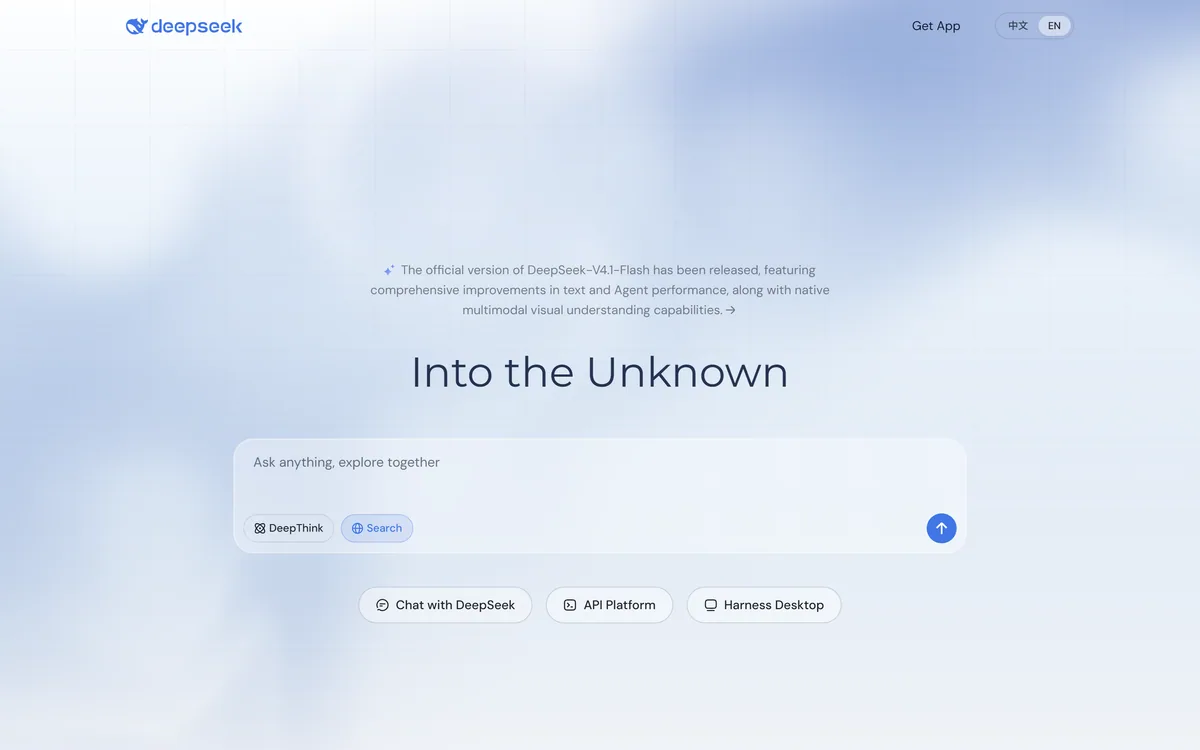
Last checked . Read from deepseek.com during this check, with the screenshot above captured at the same time.
A frontier AI model family and assistant
A DeepThink extended-reasoning mode
Native multimodal visual understanding in the latest releases
Access via web chat, a desktop app and an API platform
Built-in web search in chat
A lineage that has released open-weight models
A consumer service operated under Chinese jurisdiction
A published privacy policy and terms of use
API pricing published separately on the site
No prices reproduced here, in line with this site's pricing policy
DeepSeek's capability is strong; the real decision is data governance. The consumer service runs under Chinese jurisdiction, which can rule it out for regulated data. Model version names change quickly and are read from the site at checking time.
Other Chat And Research Tools
An answer engine, a search API and a research tool to weigh alongside DeepSeek.
DeepSeek earns 4.5 as a genuinely frontier model family: strong reasoning and coding, a DeepThink mode for hard problems, native multimodal input, and an open-weight lineage that lets developers self-host or use third-party providers rather than being locked to one. The important caveat is governance, not capability: the hosted consumer service runs under Chinese jurisdiction, which rules it out for regulated or confidential data, and its fast-moving version names make specific claims time-sensitive. For capability-per-cost with the right access route, it is excellent. AInexfinder Editor Score: 4.5/5.
DeepSeek pricing
AInexfinder does not list plan prices or billing details. For current pricing, plans, and trials, visit the official DeepSeek website.
Vendor pricing, credits, and billing policies change over time. Always confirm on the official site before you buy.
Frequently asked questions
What is DeepSeek?
DeepSeek is a frontier AI model family and assistant from a lab whose models have released open weights. It offers DeepThink reasoning, web search and native multimodal understanding, accessed through web chat, a desktop app or an API platform for developers.
Is DeepSeek open source?
Parts of its lineage are open-weight: the lab has published model weights that others can run, study and fine-tune, which is why DeepSeek is widely self-hosted and offered by third-party providers. The hosted consumer assistant and API are the lab's own commercial services.
What is DeepThink?
DeepThink is DeepSeek's extended-reasoning mode. It spends more compute working through a problem step by step before answering, which helps on harder, multi-step tasks in maths, coding and analysis compared with a quick single-pass response.
Is DeepSeek safe for sensitive data?
The hosted consumer service is operated under Chinese jurisdiction, and its privacy policy and terms govern your inputs, so it is generally not appropriate for regulated or confidential data. Privacy-sensitive teams often use the open weights through third-party hosts or self-hosting instead.
How much does DeepSeek cost?
The web assistant is free, and the API is billed per token with rates published on the site, historically among the lower-cost frontier options. We do not reproduce prices, which change; check the API pricing page, and compare against third-party or self-hosted routes.
Can DeepSeek search the web?
Yes. The chat assistant includes a search function for current information, and the latest releases add native multimodal understanding. It is first a general model with search attached, rather than a dedicated answer engine built solely around cited live-web results.
Is DeepSeek good for coding?
DeepSeek's models have been competitive with the strongest systems on coding and reasoning benchmarks, and it offers a desktop app and API for development work. As with any model, judge it on your own tasks, since benchmark standings and versions change quickly.
Who is DeepSeek best for?
Users and developers who want frontier reasoning and coding at competitive cost and are comfortable with their access route's data governance, especially those who value the open-weight lineage for self-hosting or third-party access. It is less suited to regulated-data organisations using the hosted service.
How does DeepSeek compare to Perplexity?
They do different jobs. DeepSeek is a general frontier model with search attached; Perplexity AI is an answer engine built specifically around cited answers from the live web. If you mainly want sourced current-information answers, Perplexity is more focused on that; for broad reasoning and coding, DeepSeek is the model.
Are DeepSeek's version and benchmark claims reliable?
Treat them as time-sensitive. Model names like the latest V-series release and any benchmark standings are read from the site at the time of checking and move quickly. Re-check current releases and test on your own tasks rather than relying on a specific claimed version.
Daniel reviews AI tools the slow way — by actually using them on real projects. His reviews cover what works, what breaks, and who each tool is genuinely a good fit for.
Daniel and the AInexfinder editorial team research DeepSeek using public product information, listing evidence, and (when available) hands-on checks. Scores reflect listing completeness and transparency — not paid placement.
Listings may include affiliate or sponsored placements, which are labeled when present. Editorial scores and cons are not sold. See our affiliate disclosure and review methodology.
Claude is Anthropic's AI assistant, available on web, desktop, mobile, and in Chrome, with Projects for persistent context, Artifacts for generated documents and apps, Skills, Connectors, and Claude Code for developers.
Perplexity AI is an answer engine that runs live web searches and returns cited answers, with Deep Research for long agentic reports, Spaces for persistent projects, the Comet browser, and the Sonar API for developers.
ChatGPT is OpenAI's AI assistant, covering conversation, document and image work, web browsing, Projects, Tasks, custom GPTs, agent actions, and the Codex coding agent, across web, desktop, and mobile.
JAIS Chat is a bilingual Arabic and English conversational assistant launched by Core42, part of the UAE's G42 group. It runs on the Jais family of Arabic large language models developed by Inception with MBZUAI and Cerebras, and is built to handle Arabic dialects and cultural context rather than translated English.
Kimi is Moonshot AI's assistant, running on its K3 model and positioned for agentic coding and knowledge work. Its interface opens on a set of output surfaces — slides, sheets, documents, websites, design, deep research and a multi-agent Swarm — alongside scheduled tasks, projects and a desktop app.
Reka is an AI research lab building omni models — Spark, Edge, Flash and Core — that process video, image, audio and text in a single architecture rather than bolting modalities together. It also runs Reka Cloud for training and deployment, video infrastructure available by API or MCP, and a training-data division.