Resolve.ai puts AI agents into software operations: triaging alerts, investigating incidents alongside engineers to find root cause, and running operational workflows on a schedule or trigger. It is sold to large engineering organisations, with Coinbase, DoorDash, Snowflake and Robinhood among its named customers.
env0
Verified
env0 is an infrastructure-as-code management and governance platform: self-service templates with RBAC and policy-as-code guardrails, drift detection and remediation, cloud asset management, and a newer AI-era control plane that unifies declared and discovered cloud state.
4.0Editor Score
env0.com6 viewsAdded May 14, 20268K visitors
AI now writes infrastructure code faster than humans can review it, which is exactly where things drift, misconfigure and quietly diverge from policy. env0's pitch is to put governance around that speed so teams can deploy quickly without losing control.
It is an infrastructure-as-code management platform at heart: self-service templates with guardrails, drift detection and remediation, cloud asset management and continuous policy enforcement, with a newer control plane that unifies declared and discovered cloud state. It lives in the operations world alongside reliability tools like NeuBird, though its focus is provisioning governance rather than incident response.
This review covers what env0 puts around your infrastructure, where it earns its keep, how it is priced, and who it is oversized for.
env0, The Governance Brief
- env0 is an IaC management and governance platform: it automates Terraform and other infrastructure-as-code with guardrails.
- Governance is the core: self-service templates, RBAC, scoped variables and policy-as-code keep fast deployment safe.
- It keeps code and cloud in sync: drift detection and remediation, plus cloud asset management, address state that stops matching reality.
- The AI-era control plane is newer: an autonomous control plane is being rolled out; treat early-access pieces as evolving, not finished.
env0 Control-Plane Facts
| What it is | An IaC management and governance platform |
|---|---|
| Core | Automate Terraform and other IaC with guardrails |
| Self-service | Reusable templates, RBAC, scoped variables |
| Policy | Policy-as-code and continuous enforcement |
| Drift | Drift detection and remediation |
| Assets | Cloud asset management across environments |
| Connect | GitHub, GitLab or Bitbucket, no code changes |
| Newer | An AI-era control plane (parts in early access) |
Governing Cloud Infrastructure At The Speed Of AI
env0's core problem is a real one: infrastructure is now generated and changed faster than human review can keep up, so policies fragment, drift creeps in, and what is in your code stops matching what is in your cloud. env0 exists to close that gap by making fast deployment governed by default.
The way it does this is to sit between your IaC and your cloud, enforcing guardrails as infrastructure is provisioned rather than catching problems after the fact. That shift, from review-after to guardrails-during, is the substance behind the marketing language.
It is worth separating the established product from the newer ambition. env0 has a mature track record automating and governing Terraform and other IaC; its 'autonomous cloud control plane for the AI era', including an EZ Control capability, is a newer direction with parts in early access, which should be judged as evolving rather than finished.
So the fair framing is that env0 is a solid, established IaC governance platform that is extending toward AI-era autonomy. The core automation and guardrails are the dependable part; the autonomous control plane is the forward-looking part to evaluate on its own merits.
env0's shift, from review-after to guardrails-during, is the substance behind the language about governing at the speed of AI.
What Does env0 Put Around Your Infrastructure?
The platform is a set of governance capabilities layered over your existing IaC and version control.
Self-Service Templates And Policy-As-Code Guardrails
env0 lets developers and agents deploy infrastructure from reusable templates with Git-based workflows, while built-in guardrails, RBAC, scoped variables and policy-as-code keep that self-service safe. You connect existing code from GitHub, GitLab or Bitbucket without changing it, which lowers the barrier to adopting the governance layer.
The point is to empower fast deployment without handing out unchecked access. A reliability agent like Cleric watches production behaviour after release; env0 governs the provisioning step before it, so the two address different stages of keeping systems healthy.
Drift Detection, Asset Management And Audit
env0 continuously checks for drift between your declared state and your actual cloud, flags it and supports remediation, and provides cloud asset management so teams can see and control what is actually running. Continuous policy enforcement applies rules uniformly rather than leaving each team to interpret them.
Keeping declared and discovered state in agreement is the quiet, important job here, because unnoticed drift is how risk compounds. A root-cause tool like Resolve AI helps when something has already broken; env0 is upstream of that, trying to stop infrastructure diverging from policy in the first place.
Where env0 Earns Its Keep In Cloud Ops
env0 earns its keep for platform and cloud teams managing meaningful infrastructure-as-code who need to give developers self-service without losing governance, and who are feeling the gap between fast, AI-assisted change and slow human review.
It suits organisations with multiple teams and clouds where policies tend to fragment, because central templates, RBAC and policy-as-code bring consistency, and teams who are repeatedly bitten by drift between code and cloud.
It earns it less for a small team with a handful of resources managed by hand or a simple pipeline, where a dedicated governance control plane is more than the problem requires. Its case-study names are vendor-presented references, not a guarantee your environment will see the same results.
How env0 Is Priced For Platform Teams
env0 offers a way to start for free and is sold with plans and demos aimed at platform teams and enterprises. We do not publish prices, which change; check the site.
The value question is whether the drift, misconfiguration and policy-fragmentation risk it removes outweighs its cost for your scale, which is an easy case for a large multi-team cloud estate and a weaker one for a simple setup.
Because you can connect existing code without changing it and start free, the sensible approach is to point env0 at a real repository, see how its guardrails and drift detection behave against your actual infrastructure, and judge the governance value before committing.
A Direct Way To Trial env0
Because its value is governance over real infrastructure, trial env0 against an actual repo and cloud, not a sample.
- Connect a real IaC repository from GitHub, GitLab or Bitbucket without changing the code.
- Deploy an environment from a template and confirm the Git-based workflow fits your team.
- Set RBAC, scoped variables and a policy-as-code rule, and test that the guardrails hold.
- Introduce a deliberate drift and check detection and remediation catch it.
- Review cloud asset management against what you believe is actually running.
- Pass/fail: env0 is worth it if its guardrails and drift control remove real risk at your scale.
- Evaluate any early-access autonomous features separately from the mature governance core.
env0 Infrastructure Terms
- Infrastructure as code (IaC)
- Defining cloud infrastructure in code (such as Terraform) so it can be versioned, reviewed and deployed repeatably rather than configured by hand.
- Policy as code
- Writing governance rules as code so they are enforced automatically and consistently during deployment, not applied manually afterwards.
- Drift
- When the real state of your cloud diverges from what your code declares, through manual changes or failures, creating hidden risk.
- Control plane
- The governing layer that sits between your IaC and your cloud, applying guardrails and keeping declared and discovered state in agreement.
Key features of env0
IaC automation (Terraform and more)
Self-service templates
RBAC and scoped variables
Policy-as-code guardrails
Continuous policy enforcement
Drift detection and remediation
Cloud asset management
Git-based workflows
Pros & cons
Pros
5- Governs fast deployment with guardrails
- Keeps code and cloud in sync via drift control
- Connects existing repos without code changes
- Consistent policy across teams and clouds
- Mature, established IaC governance core
Cons
5- Oversized for small, simple setups
- Autonomous control plane partly early access
- Value tied to having meaningful IaC
- Governs provisioning, not incident response
- Case studies are vendor-presented references
Best For
- Platform and cloud teams
- Governed developer self-service
- Multi-team, multi-cloud estates
- Drift-prone environments
- Policy-as-code adopters
env0 Positioned Against Other IaC Tools
The useful comparison is with other ways teams keep cloud infrastructure safe and consistent.
| Tool | Tool | Stage | Best for |
|---|---|---|---|
| env0 | Provisioning governance | IaC templates, policy, drift control | Platform teams governing IaC |
| NeuBird | Production investigation | AI-SRE root-cause analysis | On-call reliability |
| Cleric | Post-release monitoring | Verifying changes in production | Engineering on-call |
| Resolve AI | Incident response | Diagnosing what broke | Reliability teams |
Is env0 Matched To Your Cloud?
Teams env0 Fits
- Platform teams managing meaningful IaC
- Orgs giving developers governed self-service
- Multi-team, multi-cloud estates where policy fragments
- Teams repeatedly bitten by drift
- Those feeling the AI-speed-versus-review gap
When env0 Is Oversized For You
- Small teams with a handful of resources
- Simple setups managed by hand or basic pipelines
- Projects with no real governance requirement
- Anyone wanting incident response, not provisioning control
- Teams expecting early-access features to be finished
How We Examined env0
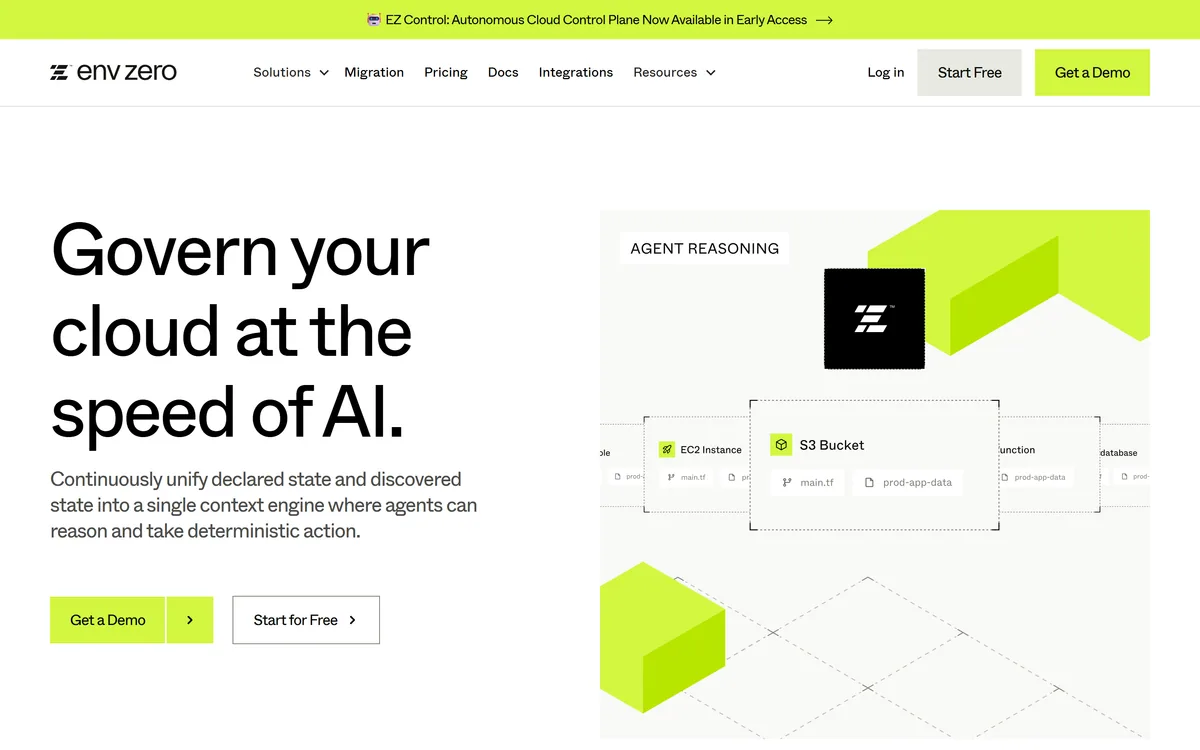
Last checked . Read from env0.com during this check, with the screenshot above captured at the same time.
- An IaC management and governance platform
- Self-service templates with RBAC and scoped variables
- Policy-as-code and continuous policy enforcement
- Cloud asset management across environments
- Connection to GitHub, GitLab or Bitbucket without code changes
- A newer AI-era control plane, with parts in early access
- Vendor-presented case studies (e.g. Western Union, Automation Anywhere)
- A free way to start, with enterprise plans and demos
- No prices reproduced here, in line with this site's pricing policy
env0's mature strength is IaC automation and governance; its 'autonomous control plane for the AI era' is a newer direction with early-access parts, which should be evaluated separately. Case-study names are vendor-presented references, not a guarantee of your results.
Other Cloud And Reliability Tools
Reliability and incident tools that sit downstream of provisioning, to weigh alongside env0.
- NeuBird — AI-SRE production investigation
- Cleric — verifying changes in production
- Resolve AI — diagnosing what broke
Editor's Verdict
4.0/5env0 earns 4.0 as a solid, established infrastructure-as-code governance platform: self-service templates with RBAC and policy-as-code, drift detection and remediation, and cloud asset management that together let teams deploy fast without losing control. Its newer 'autonomous control plane for the AI era' is a forward-looking direction with early-access parts to judge on their own merits, and it is oversized for small, simple setups. But for platform teams governing meaningful IaC across multiple teams and clouds, the core is dependable and valuable. AInexfinder Editor Score: 4.0/5.
env0 pricing
AInexfinder does not list plan prices or billing details. For current pricing, plans, and trials, visit the official env0 website.
Visit official website for pricingVendor pricing, credits, and billing policies change over time. Always confirm on the official site before you buy.
Frequently asked questions
What is env0?
env0 is an infrastructure-as-code management and governance platform. It automates Terraform and other IaC with self-service templates, RBAC and policy-as-code guardrails, detects and helps remediate drift, and provides cloud asset management, with a newer AI-era control plane direction on top.
What problem does env0 solve?
It closes the gap between infrastructure that is now generated and changed faster than humans can review, and governance that still runs at human speed. env0 enforces guardrails during provisioning so fast, even AI-assisted, change stays consistent with policy rather than drifting.
Does env0 work with my existing code?
Yes. You connect existing IaC from GitHub, GitLab or Bitbucket without changing the code, and env0 layers its governance over it through Git-based workflows. That low-friction connection is part of what makes the governance layer practical to adopt.
What is drift detection?
Drift is when your actual cloud state diverges from what your code declares, through manual changes or failures. env0 continuously checks for that divergence, flags it and supports remediation, which matters because unnoticed drift is how risk quietly compounds.
Is env0's autonomous control plane ready to use?
Treat it as evolving. env0 has a mature IaC automation and governance core, but its 'autonomous cloud control plane for the AI era', including capabilities like EZ Control, is a newer direction with parts in early access. Evaluate those separately from the established features.
How much does env0 cost?
It offers a way to start for free and is sold with plans and demos aimed at platform teams and enterprises. We do not publish prices, which change; check the site. Connect a real repo and test the guardrails against your own infrastructure before committing.
Who is env0 best for?
Platform and cloud teams managing meaningful infrastructure-as-code who want to give developers governed self-service and keep policy consistent across teams and clouds. It is oversized for a small team with a handful of resources managed by hand or a simple pipeline.
How is env0 different from a reliability tool?
env0 governs provisioning, the step before infrastructure runs, with templates, policy and drift control. Reliability tools like NeuBird or Resolve AI work downstream, investigating and fixing production behaviour after release. They address different stages of keeping systems healthy.
Are env0's case studies proof it will work for me?
Case-study names such as Western Union and Automation Anywhere are vendor-presented references, not a guarantee your environment will see the same results. Trial env0 against your own repositories and cloud, and judge the governance value at your actual scale.
Does env0 replace Terraform?
No. env0 manages and governs infrastructure-as-code like Terraform rather than replacing it; you keep writing your IaC and connect it, and env0 adds templates, policy-as-code, drift detection and audit around it. It is a governance and automation layer over your existing code, not a different language.
Reviews
Log in to write a review.
User Reviews
No reviews yet. Be the first to share your experience with env0.
Reviewed by Daniel Reed
Assigned reviewer
Daniel ReedSenior AI Tools Reviewer
Daniel reviews AI tools the slow way — by actually using them on real projects. His reviews cover what works, what breaks, and who each tool is genuinely a good fit for.
Hands-on reviewsProduct testingAI software
Daniel and the AInexfinder editorial team research env0 using public product information, listing evidence, and (when available) hands-on checks. Scores reflect listing completeness and transparency — not paid placement.
- Last verified
- Methodology
- How we review AI tools
- Sources used
- env0.com
- AInexfinder listing fields (features, pros/cons, description)
- Public vendor pages when available
- Editorial policy
- Listings may include affiliate or sponsored placements, which are labeled when present. Editorial scores and cons are not sold. See our affiliate disclosure and review methodology.
Related tools
Traversal is an AI site reliability engineering platform. It builds a dependency graph of production — what the vendor calls a Production World Model — and uses a causal search engine to triage alerts, perform evidence-backed root cause analysis across distributed systems, and drive automated remediation.
NeuBird is an agentic reliability platform (AI SRE) that connects your telemetry and LLMs once, remembers every investigation in a central governed memory, and serves engineers, leaders and your own agents the same cited truth, aiming for sub-five-minute root cause without storing your telemetry.
Parity review on AInexfinder — subscription AI tool for Coding & Development. Features, pricing notes, and alternatives.

GitHub Copilot is an AI coding assistant that spans completion, chat, agent mode, automated code review, and a cloud agent that opens pull requests, working across VS Code, Visual Studio, JetBrains, Xcode, Neovim, Eclipse, the CLI, and github.com.
FreemiumCoding & Development

Replit AI turns a written description into a working application — the Agent writes the code, and Replit supplies the database, authentication, hosting, and monitoring, so a prototype goes live without a local setup or a deployment pipeline.
FreemiumCoding & Development
Explore More
Embed this listing on your site
Featured on AInexfinder