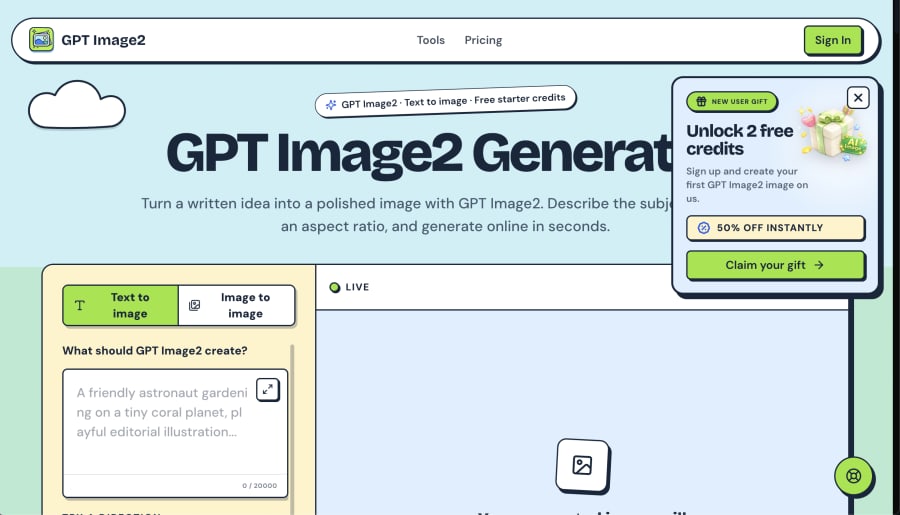
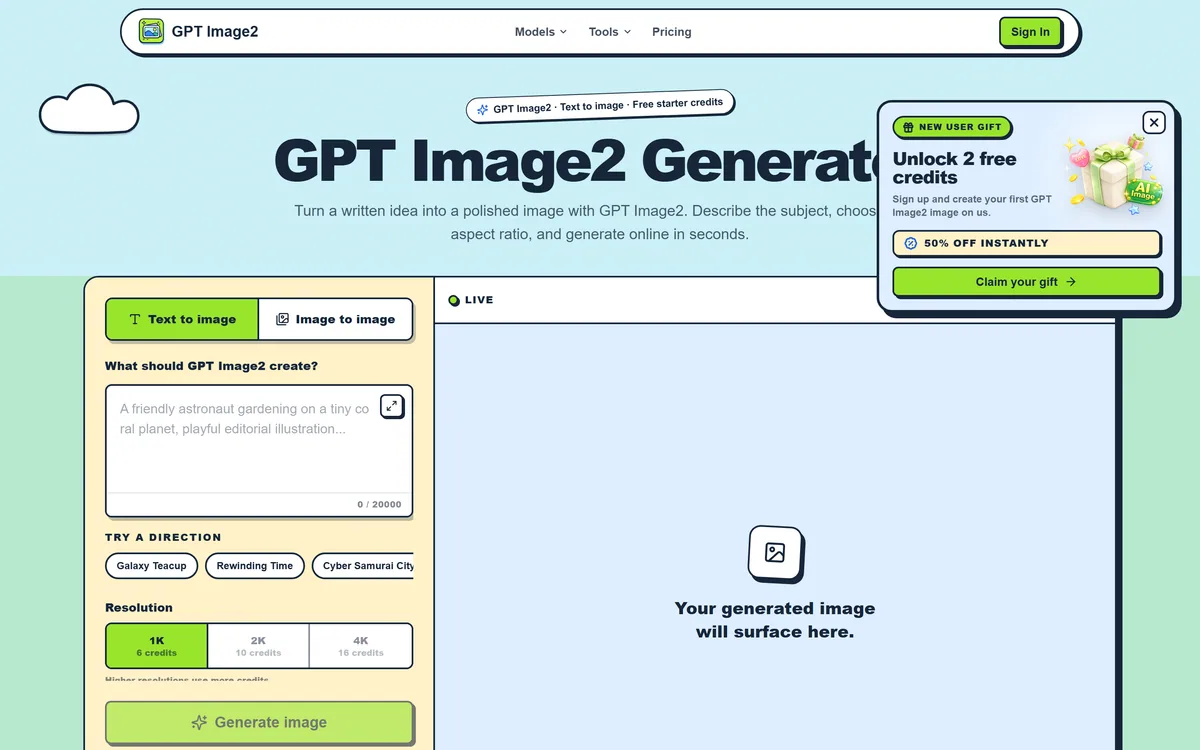
GPT Image2 is an online text-to-image and image-to-image generator that creates images from a prompt at several resolutions and aspect ratios on a credit system. Its name echoes OpenAI's image products, so treat it as an independent third-party service and verify its backend and terms.
gpt-image2.im6 viewsAdded January 17, 20269K visitors
AI image generation is a crowded field, and GPT Image2 is one of many web tools that turn a prompt into a picture on a credit system. It is straightforward to use, but the first thing worth discussing is not a feature; it is the name.
'GPT Image2' closely echoes the naming of OpenAI's image products, and a reader could reasonably assume an official link. The site does not clearly establish one, so the honest approach is to treat it as an independent third-party service until proven otherwise. For comparison, established generators like Stockimg AI make their own identity clear.
This review covers what GPT Image2 actually offers, who it suits and who should pause, how its credits work, and what to verify before relying on it.
GPT Image2 is a credit-based online text-to-image generator with multiple resolutions.
GPT Image2 Generator Facts
What it is
An online text-to-image generator
Modes
Text-to-image and image-to-image
Resolutions
1K, 2K and 4K (more credits for higher)
Ratios
Multiple aspect ratios including 1:1, 16:9, 9:16
Model
Underlying model not clearly stated; verify
Naming
Echoes OpenAI's image naming; affiliation unclear
Access
Free starter credits, then paid credits/plans
Check
Verify operator, backend and data handling
GPT Image2, The Honest Read
GPT Image2 is an online image generator: text-to-image and image-to-image, at several resolutions and aspect ratios, on credits.
The name invites a check: it echoes OpenAI's 'GPT Image' naming, but the site does not clearly establish an official affiliation.
Treat it as third-party: verify who runs it, what model actually powers it, and how it handles your prompts and images.
It is functional but unremarkable: a credit-based generator among many, judged on output and transparency rather than the brand-like name.
A Text-To-Image Generator, And A Naming Caveat
On the surface, GPT Image2 does what its interface suggests: you write a prompt, choose a resolution and aspect ratio, and it generates an image, with an image-to-image mode as well. As a basic text-to-image experience it is simple enough, and the free starter credits let you see output quickly.
The caveat that has to come first is the name. 'GPT Image2' sits very close to how OpenAI names its image products, and that similarity can lead users to assume an official pedigree the site does not clearly support. We are not alleging anything about the operator; we are flagging that the burden is on the service to make its provenance clear, and here it is not obvious.
That matters because provenance affects trust. With image tools you are sending prompts, and sometimes your own images, to a server, so who runs the service, what model it actually uses, and how it handles your data are real questions, not pedantry. A brand-like name is not evidence of a brand-like operation.
So the fair framing is cautious: GPT Image2 may be a perfectly usable generator, but it should be judged as an independent third-party tool on its output and transparency, and the name should be set aside rather than taken as reassurance.
A brand-like name is not evidence of a brand-like operation; judge GPT Image2 on its output and transparency, not its naming.
What Does GPT Image2 Actually Offer?
Setting the name aside, the offering is a standard credit-based generator with the usual controls and the usual open questions.
Text-To-Image, Resolutions And Ratios
You can generate from text or transform an existing image, choose output at 1K, 2K or 4K (higher resolutions cost more credits), and pick from a range of aspect ratios such as 1:1, 16:9 and 9:16 for different platforms. The controls are familiar and adequate for everyday creative use.
Nothing here is unusual for the category; these are table-stakes features now. An enhancer like Deep-Image.ai focuses on upscaling and quality rather than generation, so if your need is making the image bigger or cleaner rather than creating it, that is a different tool.
Credits, Plans And The Third-Party Question
GPT Image2 runs on credits: free starter credits to begin, then paid credits or plans, with higher resolutions consuming more. That model is standard, and the thing to read is not the pricing shape but the terms around it.
The open question is the backend: the site does not clearly state which underlying model powers the generator, and for a third-party service that is exactly what you want to know, along with how prompts and uploaded images are stored and used. A generator like GenApe is one of several clearer-identity alternatives worth weighing before you commit credits here.
Who GPT Image2 Suits, And Who Should Pause
GPT Image2 might suit casual users who want quick, low-stakes images from a prompt, are happy to test on the free credits, and do not need to know the underlying model, for throwaway concepts and personal use the provenance question matters less.
It suits people who have read the terms, are comfortable with the data handling, and find the output quality good enough for their purpose on the resolutions they need.
Who should pause: anyone assuming an official OpenAI link (the site does not clearly establish one), anyone sending sensitive or proprietary images without checking data handling, and anyone needing commercial-grade reliability or a known, documented model. For anything that matters, a generator with a clear identity and stated backend is the safer choice.
How GPT Image2 Sells Its Credits
GPT Image2 offers free starter credits and then sells credits or plans, with higher resolutions costing more credits and promotional discounts shown on the site. We do not reproduce prices, which change; check the site.
The value question is complicated by the transparency gaps: even if the per-image cost looks reasonable, paying into a service whose operator and backend are unclear carries a risk that a clearer competitor does not. Price is not the only cost.
Because there are free credits, the sensible approach is to test output quality first, read the terms and data-handling policy carefully, and only buy credits if both the results and the transparency satisfy you, not on the strength of the name.
A Careful Way To Try GPT Image2
Because provenance is the real issue here, trial GPT Image2 cautiously and verify before you trust it.
Use the free starter credits to judge raw output quality on your own prompts.
Look for any clear statement of who operates it and what model powers it.
Read the terms and data-handling policy, especially for image uploads.
Do not assume an official OpenAI affiliation unless it is explicitly documented.
Avoid sending sensitive or proprietary images until data handling is clear.
Pass/fail: GPT Image2 is worth credits only if output and transparency both satisfy you.
Compare against a clearer-identity generator before committing money.
Is GPT Image2 A Safe Pick?
Where GPT Image2 Can Work
Casual users wanting quick, low-stakes images
People happy to test on the free starter credits
Those who have read and accept the terms
Throwaway concepts and personal use
Users who do not need a documented model
When GPT Image2 Is Best Avoided
Anyone assuming an official OpenAI affiliation
Sending sensitive or proprietary images unchecked
Work needing commercial-grade reliability
Users who need a known, documented backend
Anyone choosing it on the name alone
Key features of GPT Image2
Text-to-image generation
Image-to-image mode
1K, 2K and 4K output
Multiple aspect ratios
Free starter credits
Credit-based plans
Prompt direction library
Web-based, no install
Pros & cons
Pros
5
Simple to use
Multiple resolutions and ratios
Free credits to test
Image-to-image as well as text-to-image
No installation needed
Cons
5
Name invites unproven OpenAI associations
Underlying model not clearly stated
Operator and provenance unclear
Data handling worth verifying before upload
Unremarkable among many generators
Best For
Casual image generation
Low-stakes personal use
Testing on free credits
Quick concept images
Non-sensitive prompts
GPT Image2 Beside Other Generators
The useful comparison is with other image tools whose identity and purpose are clearer.
Last checked . Read from gpt-image2.im during this check, with the screenshot above captured at the same time.
An online text-to-image generator
Text-to-image and image-to-image modes
Output at 1K, 2K and 4K resolutions
Multiple aspect ratios for different platforms
A credit system with free starter credits
A name that echoes OpenAI's image-product naming
No clearly stated official affiliation on the site
No clearly stated underlying model powering it
Promotional discounts shown on the site
No prices reproduced here, in line with this site's pricing policy
We make no allegation about the operator. We flag that the name invites assumptions of an OpenAI link the site does not clearly establish, and that the backend model and data handling are not obvious. Verify provenance, terms and data use before relying on it or sending sensitive images.
Editor's Verdict
3.2/5
GPT Image2 earns 3.2 as a functional but unremarkable credit-based image generator, held back less by its features than by a transparency problem. Its text-to-image and image-to-image modes, multiple resolutions and ratios are all standard, but its name closely echoes OpenAI's image-product naming without the site clearly establishing an affiliation, and it does not clearly state the underlying model or its data handling. We allege nothing about the operator; we simply advise treating it as an independent third-party tool, testing on the free credits, and verifying provenance and terms before trusting it or sending any sensitive images. AInexfinder Editor Score: 3.2/5.
GPT Image2 pricing
AInexfinder does not list plan prices or billing details. For current pricing, plans, and trials, visit the official GPT Image2 website.
Vendor pricing, credits, and billing policies change over time. Always confirm on the official site before you buy.
Frequently asked questions
What is GPT Image2?
GPT Image2 is an online text-to-image and image-to-image generator that creates images from a prompt at several resolutions and aspect ratios on a credit system, with free starter credits. It is a web tool among many in the AI image-generation space.
Is GPT Image2 made by OpenAI?
The site does not clearly establish an official affiliation, even though the name closely echoes OpenAI's image-product naming. The honest approach is to treat GPT Image2 as an independent third-party service and not to assume any OpenAI link unless it is explicitly documented.
What model does GPT Image2 use?
The site does not clearly state which underlying model powers the generator. For a third-party service that is exactly the kind of thing worth knowing, so if the backend matters to you, look for a clear statement or choose a generator that documents the model it uses.
Is GPT Image2 safe to use?
As with any image tool, you are sending prompts and sometimes your own images to a server, so read the terms and data-handling policy before uploading anything sensitive or proprietary. Because the operator and backend are not clearly stated, that verification matters more here than usual.
How does GPT Image2 charge?
It runs on credits: free starter credits to begin, then paid credits or plans, with higher resolutions costing more credits and promotional discounts shown on the site. We do not reproduce prices, which change; check the site, and test output on the free credits first.
Who should use GPT Image2?
Mainly casual users wanting quick, low-stakes images who are happy to test on the free credits and do not need a documented model. Anyone assuming an OpenAI link, sending sensitive images, or needing commercial-grade reliability should pause and consider a clearer-identity generator.
Can I use GPT Image2 images commercially?
Whether you can depends on its licensing terms, which you should read directly, and on the uncertainty around its backend. For work that matters commercially, a generator with clear licensing, a stated model and a transparent operator is a safer basis than one with open provenance questions.
Why does the review focus on the name?
Because provenance affects trust. A name that resembles a major brand's can lead users to assume a pedigree that is not established, which matters when you are sending data to the service and paying for credits. We make no allegation about the operator; we flag that the burden of clarity is on the service, and here it is not met.
What are the alternatives to GPT Image2?
Plenty of generators have a clearer identity and stated purpose, such as Stockimg AI for design assets or GenApe for general image creation, with Deep-Image.ai focused on upscaling rather than generation. Comparing output and transparency against those is wise before committing credits here.
Does GPT Image2 offer image-to-image editing?
Yes, it provides an image-to-image mode alongside text-to-image, so you can transform an existing image rather than only generate from a prompt. As with the rest of the tool, check how uploaded images are stored and used before sending anything you would not want retained.
Daniel reviews AI tools the slow way — by actually using them on real projects. His reviews cover what works, what breaks, and who each tool is genuinely a good fit for.
Daniel and the AInexfinder editorial team research GPT Image2 using public product information, listing evidence, and (when available) hands-on checks. Scores reflect listing completeness and transparency — not paid placement.
Listings may include affiliate or sponsored placements, which are labeled when present. Editorial scores and cons are not sold. See our affiliate disclosure and review methodology.
krea2.org is a browser image-generation workspace that runs several third-party models side by side, including Krea 2 tiers, FLUX.2, GPT Image 2, Nano Banana and Seedream 5.0, with reference uploads, six aspect ratios and live model switching.
GenApe is an all-in-one AI platform covering writing, chat, image and video generation, image editing, product photography, translation, and research — with 145 free credits on signup and commercial rights granted to paid users.
Adobe Firefly generates images, video, and audio from models trained on licensed Adobe Stock and public domain content, with Content Credentials on every output, Firefly Boards for ideation, Custom Models for brand style, and third-party partner models alongside Adobe's own.
GPT Image 2 launched on 21 April 2026 as ChatGPT Images 2.0 and as the gpt-image-2 API model. Its distinguishing capabilities are dense, accurate text rendering, layout fidelity for infographics and packaging, up to 3840px output, prompt-guided masking, and reasoning applied to image structure before generation.
Stockimg AI offers separate generators for logos, stock photos, illustrations, wallpapers, product photos and social posts, then schedules the output to Instagram, TikTok, LinkedIn, YouTube and X, with an API for programmatic use.
OpenArt is an all-in-one AI creation platform covering image, video, voice and audio in one place, built around a Director that lets you lay out a storyboard and shape each shot through conversation, alongside persistent characters and worlds for consistency across a project.