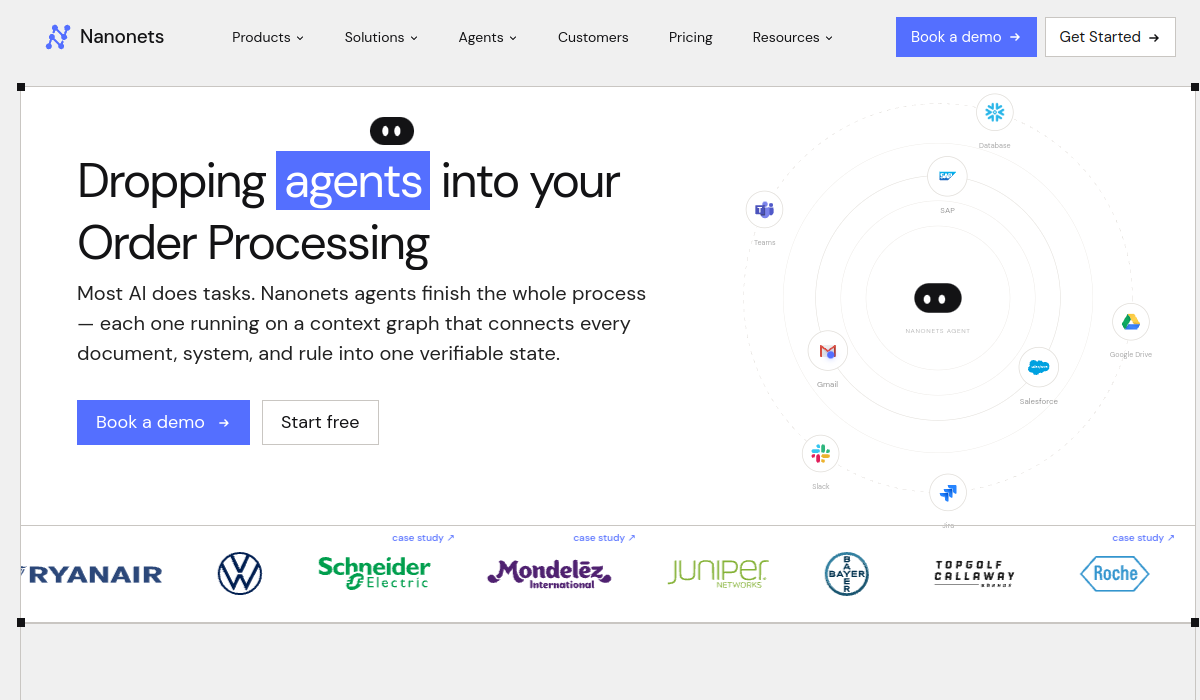
What is Nanonets?
Nanonets is an AI-powered workflow automation platform that combines intelligent document processing with autonomous agents to automate business processes end to end.
It operates through two integrated products: Nanonets Agents, which read unstructured inputs, apply business rules, and complete work within enterprise systems, and an agentic data extraction API that ranks highly on intelligent document processing benchmarks and outputs structured data suitable for agent pipelines.
The platform uses context graphs to connect documents, systems, and rules into verifiable workflows, captures and validates many document formats such as invoices, contracts, and claims, and integrates with more than twenty enterprise platforms including SAP, Salesforce, QuickBooks, and Slack.
Human-in-the-loop approval routing is available when oversight is needed, and it offers enterprise security with SSO, SAML and OIDC, audit logs, private deployment, and SOC 2 Type II, GDPR, ISO 27001, and HIPAA-eligible compliance.
It serves business teams automating accounts payable, order management, logistics, and healthcare revenue cycles, as well as developers building agentic data pipelines. Pros include highly accurate document extraction, true end-to-end automation that acts inside systems of record, and strong governance and security for regulated environments.
Cons are that homepage pricing is not transparent and requires a demo or signup, and full deployment depends on integration and rule configuration. Nanonets offers a free trial with paid plans. Pricing changes often, so check the official site for current plans.
Nanonets's core capabilities include Top-ranked agentic data extraction API, Autonomous agents that act in enterprise systems, Context graphs linking documents, systems, and rules, 20+ enterprise integrations, Human-in-the-loop approval routing and Enterprise security and compliance.
Top-ranked agentic data extraction API is built in, Autonomous agents that act in enterprise systems is built in, Context graphs linking documents, systems, and rules is built in, 20+ enterprise integrations is built in, so you get a rounded toolkit rather than a single trick.
Each feature is designed to take the manual effort out of the task and help you reach a usable result faster, which is what makes Nanonets worth a place on your shortlist.
On the plus side, users consistently highlight Highly accurate document extraction, End-to-end automation inside systems of record and Strong governance for regulated environments as the reasons they keep using Nanonets.
It isn't perfect, though — Pricing requires a demo or signup and Full deployment needs integration and rule setup are the trade-offs people most often mention, so weigh those against your own priorities before you commit.
As with any AI tool, the output still benefits from a quick human review, but Nanonets gets you most of the way there with far less effort. Nanonets runs on a paid pricing model, aimed at users who want the full feature set without free-tier limits.
AI-tool pricing changes often, so always check the current plans, seats and add-ons on the official site for the latest details before you buy. Who is Nanonets for? It's best suited for ai agents and document processing for business workflows.
Whether you're a beginner trying this kind of AI tool for the first time or a professional who'll use it every day, it's a credible option to consider.
If you're still deciding, compare Nanonets against the alternatives and the head-to-head comparisons linked below — looking at features, pricing and real user ratings side by side is the fastest way to find the right fit for your workflow and budget.
Who is Nanonets for?
Nanonets is best suited for ai agents and document processing for business workflows. Whether you are trying this kind of productivity & automation tool for the first time or use one every day, it is a credible option to shortlist — compare it with the alternatives and head-to-head comparisons linked on this page to find the best fit for your workflow and budget.