What is AI Insurance?
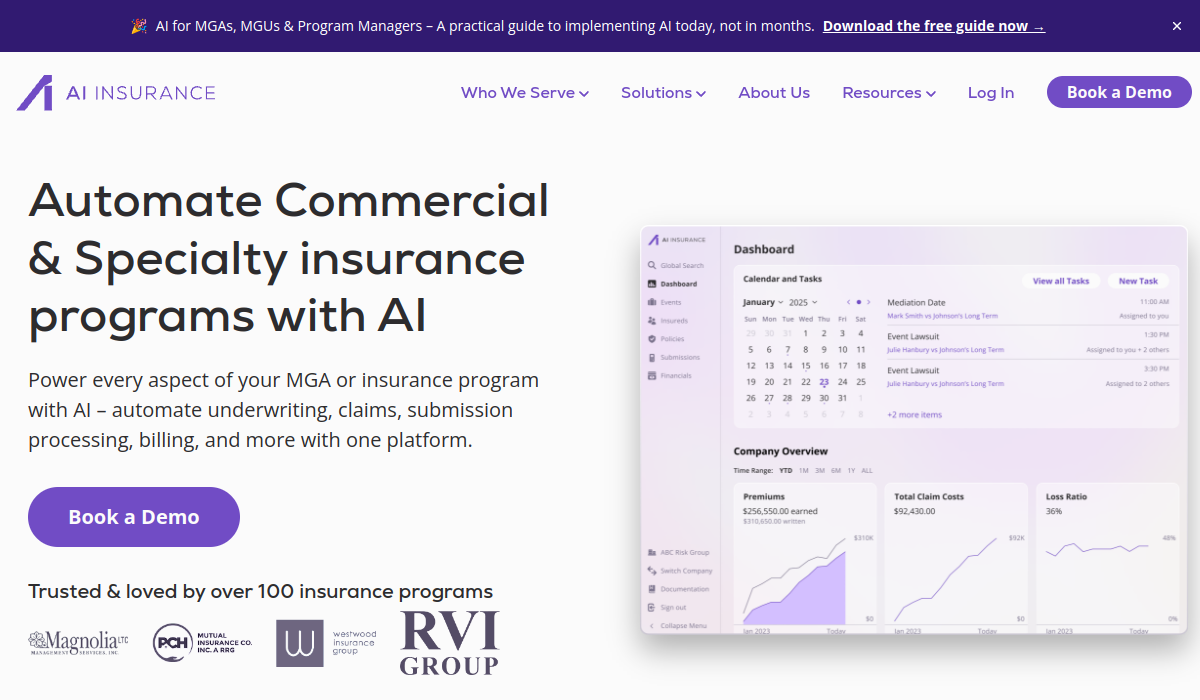
AI Insurance is a comprehensive insurance management platform that automates core operations for insurance organizations using artificial intelligence.
It is aimed at managing general agents and underwriters (MGAs and MGUs), fronting carriers, reinsurers, agencies, program managers, third-party administrators, small liability carriers, and syndicates that want to consolidate fragmented tooling into one system.
The platform parses broker submissions by automatically extracting data from emails and attachments to build quotes, processes bordereaux reports into clean validated formats, manages claims intake and processing across more than one hundred lines of business, and audits legal invoices against counsel guidelines.
An underwriting workbench calculates premiums based on custom rules, while policy issuance handles document creation and signature collection. Additional modules cover financial management for premiums and claims, a digital portal for brokers and clients, and an API for embedding the system into existing workflows.
The product is positioned for organizations that need a unified operational backbone rather than point solutions. Pros include the breadth of functionality on one platform, AI-driven submission and bordereaux automation, and an emphasis on unlimited users and storage.
Cons are that it is built for insurance businesses rather than consumers, and it requires a demo to obtain pricing, making evaluation slower. The company does not publish a public price list and sells through booked demos. Pricing changes often, so check the official site for current plans.
AI Insurance's core capabilities include Submission parsing from broker emails and attachments, Bordereaux processing and validation, Underwriting workbench with custom rules and Claims management across 100+ lines of business.
Submission parsing from broker emails and attachments is built in, Bordereaux processing and validation is built in, Underwriting workbench with custom rules is built in, Claims management across 100+ lines of business is built in, so you get a rounded toolkit rather than a single trick.
Each feature is designed to take the manual effort out of the task and help you reach a usable result faster, which is what makes AI Insurance worth a place on your shortlist.
On the plus side, users consistently highlight Broad all-in-one operational coverage, Unlimited users and data storage positioning and API for embedding into existing workflows as the reasons they keep using AI Insurance.
It isn't perfect, though — Built for insurance businesses, not individuals and Pricing only available via demo are the trade-offs people most often mention, so weigh those against your own priorities before you commit.
As with any AI tool, the output still benefits from a quick human review, but AI Insurance gets you most of the way there with far less effort. AI Insurance runs on a paid pricing model, aimed at users who want the full feature set without free-tier limits.
AI-tool pricing changes often, so always check the current plans, seats and add-ons on the official site for the latest details before you buy. Who is AI Insurance for? It's best suited for all-in-one ai platform for insurance operations.
Whether you're a beginner trying this kind of AI tool for the first time or a professional who'll use it every day, it's a credible option to consider.
If you're still deciding, compare AI Insurance against the alternatives and the head-to-head comparisons linked below — looking at features, pricing and real user ratings side by side is the fastest way to find the right fit for your workflow and budget.
Who is AI Insurance for?
AI Insurance is best suited for all-in-one ai platform for insurance operations. Whether you are trying this kind of emerging & specialized tool for the first time or use one every day, it is a credible option to shortlist — compare it with the alternatives and head-to-head comparisons linked on this page to find the best fit for your workflow and budget.