Aidoc is enterprise clinical AI for hospitals — the aiOS platform and CARE foundation model analyse imaging across radiology, cardiology, neurovascular, and vascular care to triage urgent findings, deployed in 1,600+ medical centres.
Aidoc is clinical AI for hospitals, and the problem it addresses is unglamorous but genuinely serious: a radiologist's worklist is usually ordered by when scans arrived, not by which patient is in the most danger.
Its software reads imaging as it comes in, identifies suspected urgent findings, and moves those cases forward in the queue. A suspected intracranial haemorrhage stops waiting behind a routine follow-up.
This review covers the platform, the clinical areas it covers, the outcome figures Aidoc publishes, and the questions a health system should ask before signing — because this is a procurement decision with patient-safety consequences, not a software trial.
Aidoc sells to health systems, not clinicians — this is enterprise infrastructure, not an app.
Aidoc For Busy Readers
What it is: clinical AI that analyses medical imaging and pushes urgent findings to the top of the queue, sold to hospitals and health systems.
The platform: aiOS as the enterprise layer and CARE as the underlying foundation model, rather than a collection of single-purpose algorithms.
Where it works: radiology, cardiology, neurovascular including stroke and intracranial haemorrhage, vascular disease, and incidental findings.
Scale: Aidoc states deployment across 1,600+ medical centres, and cites the largest portfolio of FDA-cleared radiology algorithms.
Not for individuals. There is no consumer or clinician-level version — this is a health system procurement.
Is Aidoc Right For Your Organisation?
Worth Evaluating If
You run imaging volume high enough that queue order affects outcomes
Stroke, PE, or haemorrhage pathways are a clinical priority
Incidental findings are being lost between departments
You want one platform rather than several separately integrated algorithms
You have clinical governance capacity to oversee an AI deployment
Not Appropriate If
You are an individual clinician looking for a personal tool
You expect it to reduce radiologist workload rather than reorder it
There is no capacity for integration and change management
Nobody will own accountability for acting on AI-generated alerts
You need a documentation or administrative tool, not imaging triage
Care coordination and patient management, including incidental findings capture
Stated scale
1,600+ medical centres worldwide
Regulatory
Aidoc cites the largest portfolio of FDA-cleared radiology algorithms
Sold to
Hospitals and health systems
Triage Is The Whole Idea
Most discussion of medical AI focuses on diagnostic accuracy — can it match a radiologist. Aidoc's proposition is different and, in practice, more achievable: change the order in which humans look at things.
The radiologist still reads the scan and still makes the call. What changes is that the scan showing a probable pulmonary embolism reaches them sooner, because the software flagged it while it was sitting in a queue.
This framing matters for how the tool should be judged. A false positive costs a radiologist a few seconds of attention. A missed urgent finding costs considerably more, which is why triage tools are tuned toward sensitivity.
The clinical value is not in the software being right. It is in the right scan being looked at first.
aiOS And CARE
Aidoc's architecture is worth understanding, because it is what distinguishes the company from vendors selling one algorithm for one condition.
The Platform Layer
aiOS is the enterprise platform that everything runs on. For a hospital, that matters more than any individual algorithm — integrating one AI tool into imaging workflow is a project, and integrating eight separately is an ordeal.
A single platform means one integration, one set of controls, and one place where clinical AI is governed.
The Foundation Model
CARE is Aidoc's foundation model, the layer beneath the individual clinical applications. The strategic bet is that a general model of medical imaging generalises better than a collection of narrow, separately trained detectors.
Whether that bet pays off is genuinely an open question in medical AI, and one worth asking the vendor about directly rather than accepting at face value.
Beyond The Read
Care coordination and patient management extend past the scan itself. Incidental findings capture is the clearest example — something noticed on a scan taken for another reason, which historically gets lost between departments.
That is a workflow failure rather than a diagnostic one, and it is a good fit for software.
The Clinical Range
Coverage is broader than most clinical AI vendors, spanning several specialties rather than concentrating on one.
Radiology — imaging analysis and worklist prioritisation across modalities
Neurovascular — stroke, brain aneurysm, spine, and intracranial haemorrhage
Vascular — venous thromboembolism, aortic disease, and IVC filters
Cardiology — coronary artery disease and echocardiography
Incidental findings — capture and follow-up of findings outside the original clinical question
The Outcome Figures, And How To Read Them
Aidoc publishes specific operational figures: 31% faster time-to-notification for pulmonary embolism patients, a 34% reduction in door-to-puncture time for stroke patients, and 99% of eligible aortic aneurysm patients scheduled for follow-up.
These are the right kind of metrics — time-to-treatment in stroke and PE is directly linked to outcomes, so speeding it up is meaningful rather than cosmetic.
They are also vendor-reported, drawn from selected deployments, and we report them as such. A hospital evaluating Aidoc should ask which sites produced these numbers, what the baseline was, and whether the comparison was contemporaneous — the standard questions for any before-and-after clinical claim.
What A Health System Should Ask First
Buying clinical AI is unlike buying other software, and the evaluation should reflect that.
Establish which specific algorithms are FDA-cleared for your intended use, rather than accepting a portfolio-level claim.
Ask what the false positive rate looks like in a population like yours, not in the validation set.
Work out where alerts land in the actual clinical workflow, and who is accountable for acting on them.
Agree what happens when the software is wrong — in both directions — before go-live, not after an incident.
Check integration with your existing PACS and reporting systems, since this is where deployments usually stall.
Plan for alert fatigue explicitly: measure how often clinicians dismiss flags after three months, not after three weeks.
Adoption As Evidence
Aidoc states deployment across more than 1,600 medical centres, naming health systems including Mount Sinai, Yale New Haven Health, Houston Methodist, Ochsner, Sutter, Mercy, and UT Southwestern.
In healthcare, adoption at that scale carries real evidential weight. Academic medical centres do not put software into diagnostic pathways without clinical governance review, so each named deployment represents a passed institutional assessment.
It is still a vendor-stated list. But it is the kind of claim that is checkable and would be conspicuous if wrong.
Honest Limitations
Alert fatigue is the most serious practical risk. Triage tools are tuned for sensitivity, which means false positives, and clinicians who learn to dismiss flags reflexively have lost the benefit while keeping the interruption.
It does not reduce radiologist workload. Aidoc changes the order of reading, not the amount, so anyone hoping for staffing relief is measuring the wrong thing.
Performance varies by population. Models trained on one demographic mix can behave differently on another, and this is under-examined across the whole field, not just at Aidoc.
And it is an enterprise commitment. Integration, clinical governance, training, and change management are the real cost, and the software licence is often the smaller half of it.
Key features of Aidoc
Worklist prioritisation that surfaces suspected urgent findings first
aiOS enterprise platform for a single integration across specialties
CARE foundation model underlying the clinical applications
Neurovascular coverage including stroke, aneurysm, and intracranial haemorrhage
Vascular coverage including venous thromboembolism and aortic disease
Cardiology coverage including coronary artery disease and echocardiography
Incidental findings capture with follow-up tracking
Care coordination and patient management beyond the initial read
Pros & cons
Pros
5
Targets time-to-treatment, which is genuinely linked to patient outcomes
One platform rather than several separately integrated point algorithms
Unusually broad clinical coverage across four specialty areas
Adoption across 1,600+ centres represents many passed governance reviews
Incidental findings capture addresses a real, well-documented workflow failure
Cons
5
Alert fatigue is a genuine risk when tools are tuned for sensitivity
Reorders radiologist work rather than reducing it — no staffing relief
Performance across different patient populations is under-examined field-wide
Outcome figures are vendor-reported from unspecified deployments
Real cost is integration, governance, and change management, not the licence
Best For
Health systems with high imaging volume where queue order matters
Hospitals prioritising stroke and pulmonary embolism pathways
Organisations losing incidental findings between departments
Radiology departments wanting one AI platform rather than several
Health systems with clinical governance capacity to oversee AI deployment
Where Aidoc Sits Among Health AI Tools
Clinical AI covers very different jobs, and these are not interchangeable.
Claude — a general assistant for literature and admin work, with no clinical clearance
Provenance Of These Facts
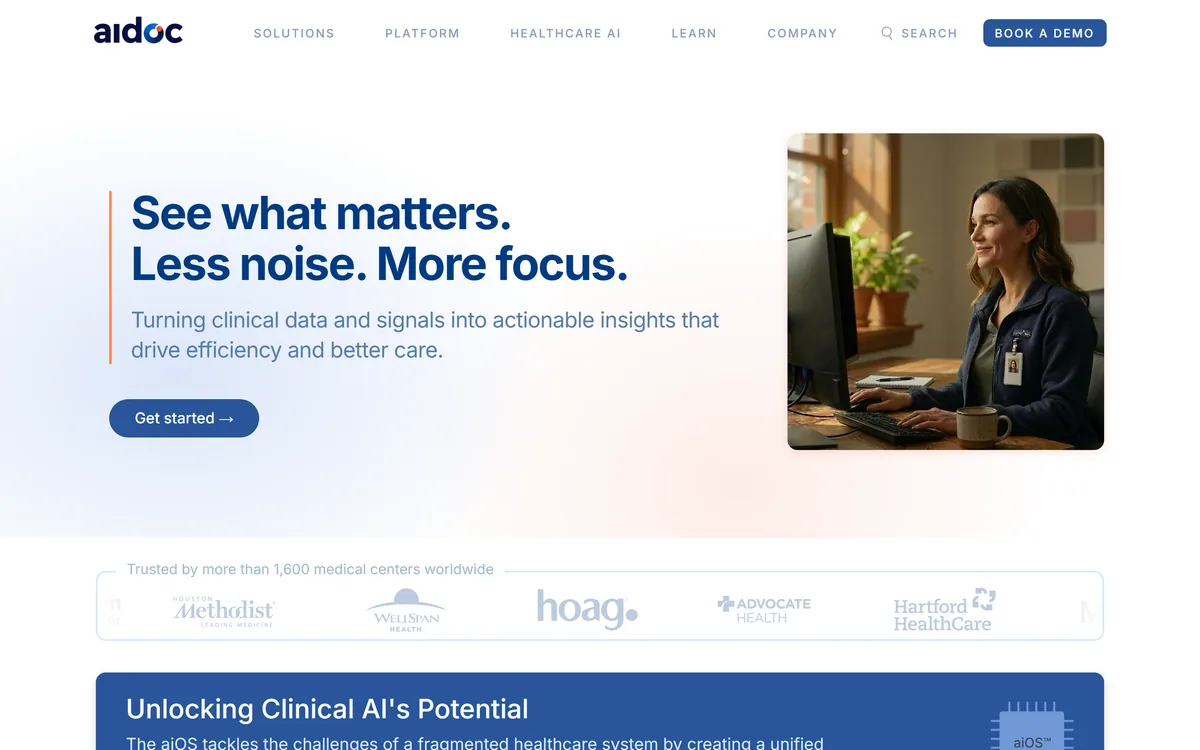
Last checked . Read from Aidoc's own site during this check, with the screenshot above captured at the same time.
Platform and model names (aiOS, CARE) and the clinical specialty coverage taken from aidoc.com
The 1,600+ medical centre figure and named health systems reported as Aidoc presents them
Outcome figures — 31% faster PE notification, 34% shorter door-to-puncture, 99% aneurysm follow-up — recorded as vendor-reported, from unspecified deployments
The FDA clearance claim is portfolio-level as Aidoc states it; specific per-algorithm clearances should be confirmed directly for any intended use
No plan prices published; this is an enterprise procurement with no list pricing
Nothing here should be read as clinical guidance. Deployment decisions belong with a health system's own clinical governance process.
Editor's Verdict
4.5/5
Aidoc has an AInexfinder Editor Score of 4.5/5.
Aidoc pricing
AInexfinder does not list plan prices or billing details. For current pricing, plans, and trials, visit the official Aidoc website.
Vendor pricing, credits, and billing policies change over time. Always confirm on the official site before you buy.
Frequently asked questions
Does Aidoc diagnose patients?
No. It triages — analysing imaging as it arrives and moving suspected urgent findings up the worklist so a radiologist sees them sooner. The clinician still reads the scan and still makes the diagnosis.
What are aiOS and CARE?
aiOS is Aidoc's enterprise platform, so a hospital integrates once rather than separately for each algorithm. CARE is the underlying foundation model on which the individual clinical applications are built.
Which clinical areas does Aidoc cover?
Radiology, neurovascular including stroke and intracranial haemorrhage, vascular including venous thromboembolism and aortic disease, cardiology including coronary artery disease and echocardiography, plus incidental findings capture.
Are Aidoc's outcome claims independently verified?
They are vendor-reported. The figures — 31% faster PE notification, 34% shorter door-to-puncture time, 99% aneurysm follow-up scheduling — come from Aidoc and unspecified deployments. Ask which sites, what baseline, and whether comparisons were contemporaneous.
Can an individual doctor buy Aidoc?
No. It is sold to hospitals and health systems as enterprise infrastructure, with integration into imaging workflow and clinical governance oversight. There is no individual or consumer version.
Will Aidoc reduce our radiologists' workload?
No, and expecting that is the most common misunderstanding. It changes the order in which scans are read, not the number. The benefit is in time-to-treatment, not staffing.
What is the biggest risk in deploying Aidoc?
Alert fatigue. Triage tools are tuned toward sensitivity, which produces false positives, and clinicians who learn to dismiss flags reflexively keep the interruption while losing the benefit. Measure dismissal rates at three months, not three weeks.
Daniel reviews AI tools the slow way — by actually using them on real projects. His reviews cover what works, what breaks, and who each tool is genuinely a good fit for.
Daniel and the AInexfinder editorial team research Aidoc using public product information, listing evidence, and (when available) hands-on checks. Scores reflect listing completeness and transparency — not paid placement.
Listings may include affiliate or sponsored placements, which are labeled when present. Editorial scores and cons are not sold. See our affiliate disclosure and review methodology.
RecipeScan is an Apple-only cooking app that builds a pantry from photos, suggests recipes against what you already have, and coordinates three dishes onto one timeline. It adds grocery lists, budget tracking, calorie estimates and a hands-free cooking mode.
RelaxFrens is a personalised meditation and sleep app that builds a plan around your goals, schedule and daily mood check-ins. Its companion, Fren, guides breathing exercises and conversations, and the app uses streaks, badges, nature sounds and adjustable voices and session lengths.
Aura is a personalised mental-wellness and sleep app bundling meditation, sleep tracks, hypnosis, CBT-style content, coaching, breathwork and more, with AI-driven recommendations and live coach and therapist sessions, offered as a freemium subscription and framed here as a wellbeing aid, not medical care.
moonbird is a tactile, screen-free handheld breathing coach that expands and contracts in your palm to pace your breath, reads your pulse and HRV, and pairs with an app whose Aura AI coach personalises the rhythm, aimed at calm and sleep as a wellbeing tool.
Youper is an AI emotional-health assistant built around conversational check-ins, mood tracking and journaling. The company has announced it is shutting down on 30 September 2026, after which accounts, chat history and personal data are permanently deleted.
Insight Timer offers a very large free audio library for meditation, sleep, yoga and breathwork, contributed by psychologists, spiritual leaders and mindfulness teachers. Live yoga and breathwork sessions run alongside courses, with a Member Plus subscription above a genuinely free core.