
MagicLight AI generates multi-scene videos up to 50 minutes from a story, script, text, image or music track. It routes across Seedance, Kling, VEO, Sora and Wan models, and adds voice cloning, lip sync and subtitles.
FreemiumVideo & Audio
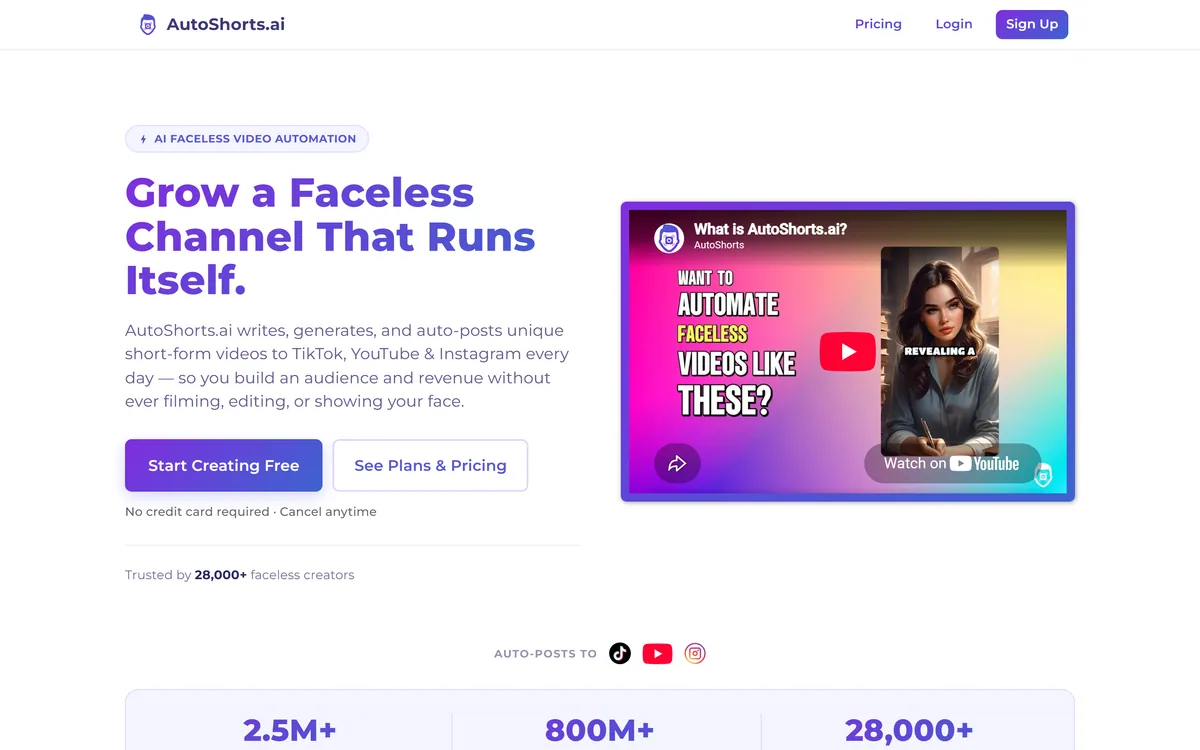
AutoShorts.ai automates faceless short-form video end to end. You choose a series topic and visual style, and it writes the script, generates the visuals, narrates it, adds music and captions, then posts to TikTok, YouTube and Instagram on a schedule without you touching it.
Faceless content is a real and slightly strange corner of the creator economy. Channels with no presenter, no camera and no identity, publishing narrated clips over stock or generated footage, some of them with audiences in the millions.
The economics are obvious once you see them: no filming, no on-camera talent, no personal brand to maintain, and the whole thing is reproducible across as many channels as you can be bothered to run.
AutoShorts.ai automates that model completely. This review covers what the series-based approach actually changes, why auto-posting is the feature that matters and the one that carries risk, what platform policy now says about this kind of content, and who realistically makes anything from it.
The design decision worth understanding is that the unit of work is a channel, not a clip.
Most AI video tools — InVideo AI among them — ask you to create something: enter a prompt, get a video, do it again tomorrow. That is still a daily task, and daily tasks are exactly what kills faceless channels — the model only works on consistency, and consistency is the thing humans are worst at.
AutoShorts asks you to configure a series once. A topic prompt, a visual style, a voice, a posting schedule. After that it generates and publishes without further input, which turns the whole thing from a habit into a setting.
That is genuinely the right architecture for this niche. The bottleneck in faceless content was never the ability to make one video; it was making the four hundredth.
The visual style library does more work than it appears to. Options spanning things like comic book, Lego, children's book and expressionist looks matter because a faceless channel's only identity is its visual signature. Consistency of look is what makes a viewer recognise the second video as belonging to the first.
Preview and editing before posting is offered, and whether you use it is the decision that separates a channel from a firehose.
Nobody fails at faceless content because they cannot make one video. They fail at the four hundredth, which is exactly the part this automates.
Connecting your TikTok, YouTube and Instagram accounts so the tool publishes directly is what completes the loop. It also hands a third-party service the keys to accounts you may care about.
The practical precaution is straightforward and worth stating: run this on accounts created for the purpose, never on an account that carries a business or an existing audience. Automated publishing goes wrong in ways that are hard to undo — a mistimed batch, a script that hit a sensitive topic badly, a run of content that tanks your engagement rate.
There is a subtler risk in the metrics themselves. Platform recommendation systems weight recent performance heavily, so a run of poorly-received automated posts can suppress reach for content you post afterwards. A dormant channel is easier to recover from than a channel the algorithm has learned to ignore.
If you already film, an editor like CapCut plus manual posting gives you far more control. The upside is that scheduling to three platforms from one place removes the most tedious part of the model — the manual upload, caption and hashtag routine, repeated three times daily.
Whether you enable full automation or keep a review step is the single decision that most determines the outcome, and it is worth making deliberately rather than by default.
This is the part most reviews of automation tools skip, and it is the part that determines whether the channel exists in a year.
All three destination platforms have moved in the same direction. YouTube's monetisation policies require content to be original and to have meaningful commentary or transformation rather than being mass-produced or repetitious; the platform has been explicit that inauthentic, templated content at volume is not what the Partner Programme is for.
TikTok and Instagram have both introduced labelling for AI-generated media and both down-rank content their systems classify as unoriginal or spammy.
None of that makes these tools against the rules. Automated production is not prohibited — mass-produced content with no added value is what gets targeted. The distinction the platforms draw is roughly between using automation to produce something worth watching, and using it to flood a feed.
The practical consequence is that the more you use the review step, the safer the channel. A series with a genuinely interesting topic, edited scripts and a distinct look sits on one side of that line. Forty near-identical videos generated from the same template sit on the other.
Anyone planning to monetise should read the current policies directly rather than relying on any tool's marketing, because these rules have tightened repeatedly and will again.
This site does not publish plan prices. The structure is more useful and it is simple here.
AutoShorts is freemium: you can start creating without a card, with paid tiers above the free level. The meter in this category is video volume — how many videos per month, and typically how many channels or connected accounts you can run.
That metering shape has a specific implication worth thinking about. You pay for videos produced, not videos that performed. An automated channel generating thirty videos a month of which two find an audience is still consuming thirty videos of allowance.
So the efficiency question is not cost per video, it is cost per video worth publishing — and that ratio is set by how good your topic prompt is, not by the tool.
Two things to confirm before upgrading: whether unused video allowance carries over, and whether the number of connected social accounts is capped separately from video count, since running multiple channels is the usual reason people scale up.
The free tier is a real test here because output quality is immediately visible. Generate five before paying for anything.
Worth being blunt, because the category markets itself on passive income.
The people who do well with faceless content typically share three traits. They pick a niche with genuine audience demand rather than the one the tool suggests, and several repurpose long-form video with OpusClip rather than generating from nothing. They treat the output as a draft and edit it. And they run the thing for months before anything happens.
The people who do not are the ones for whom the automation is the entire strategy — generate, post, wait. That approach produces a channel indistinguishable from thousands of others, which is precisely what the recommendation systems are tuned to demote.
There is also a durable structural point. When a tool makes production nearly free, production stops being the differentiator. Whatever is scarce moves elsewhere — to the topic, the writing, the specific angle. The tool cannot supply any of those.
None of this makes AutoShorts a bad product. It does the job it describes, efficiently, and the series-based design is the right one. It means the tool removes the labour and leaves the hard part untouched, which is true of most automation and rarely said out loud.
| Category | Automated faceless short-form video generation and publishing |
|---|---|
| Unit of work | A recurring series configured once, rather than individual videos |
| Pipeline | Script writing, visual generation, narration, background music, captions, publishing |
| Auto-posting destinations | TikTok, YouTube and Instagram, once accounts are connected |
| Scheduling | Recurring automatic posting, or manual review before each post |
| Visual styles | Dozens of prebuilt looks, including comic book, Lego, children's book and expressionist styles |
| Common niches | History, horror, motivational and bedtime stories among others |
| Narration | Selectable AI voices |
| Editing | Preview and edit script, title, images and background music before posting |
| Stated user base | More than 28,000 faceless creators, per the vendor |
| Charging model | Freemium — free to start with no card required, paid tiers metered on video volume; no prices published here |
Series-based configuration that produces videos on a recurring schedule
AI script writing from a topic prompt
Generated visuals in dozens of prebuilt styles
AI narration with selectable voices
Background music selection
Automatic captions
Direct auto-posting to TikTok, YouTube and Instagram
Preview and edit of script, title, images and music before publishing
Scheduling control over posting frequency
The split is between generating videos from nothing and cutting them out of footage you already have.
| Tool | Source material | Automation reach | Suits |
|---|---|---|---|
| AutoShorts.ai | Nothing — a topic prompt | Topic to auto-posted, on a schedule | Faceless channels run unattended |
| OpusClip | Your existing long-form video | Clipping and captioning | Podcasters and streamers repurposing |
| InVideo AI | A prompt, with heavy editing control | Generation, manual publishing | Marketers wanting control over each video |
| CapCut | Your own footage | Editing assistance only | Anyone actually filming |
| VEED | Your own footage or generated | Browser editing and captions | Teams producing deliberately, one at a time |
If unattended generation is not what you want, these cover the neighbouring approaches.
Last checked . Read from autoshorts.ai during this check, with the screenshot above captured at the same time and feature detail corroborated against the vendor's own published material.
User and volume figures are the vendor's own and unaudited. Platform rules matter more than tool features here: YouTube requires original content with meaningful commentary for monetisation and targets mass-produced repetitious material, while TikTok and Instagram label AI-generated media and demote content classified as unoriginal. Read the current policies directly before relying on any of this for revenue.
AutoShorts.ai has an AInexfinder Editor Score of 3.5/5.
AInexfinder does not list plan prices or billing details. For current pricing, plans, and trials, visit the official AutoShorts.ai website.
Visit official website for pricingVendor pricing, credits, and billing policies change over time. Always confirm on the official site before you buy.
Log in to write a review.
No reviews yet. Be the first to share your experience with AutoShorts.ai.
Assigned reviewer
Daniel ReedSenior AI Tools Reviewer
Daniel reviews AI tools the slow way — by actually using them on real projects. His reviews cover what works, what breaks, and who each tool is genuinely a good fit for.
Daniel and the AInexfinder editorial team research AutoShorts.ai using public product information, listing evidence, and (when available) hands-on checks. Scores reflect listing completeness and transparency — not paid placement.
MagicLight AI generates multi-scene videos up to 50 minutes from a story, script, text, image or music track. It routes across Seedance, Kling, VEO, Sora and Wan models, and adds voice cloning, lip sync and subtitles.
Fliki turns text, scripts, blog posts, presentations and single-line prompts into finished videos with voiceover, visuals, music and subtitles. It offers over 2,000 voices across 80+ languages, voice cloning, a Digital Twin avatar, screen recording with auto-editing, and one-click publishing to TikTok, Instagram and YouTube.
HeyGen creates realistic AI avatar videos featuring you, with consistent identity across clips, a text-based studio, translation and lip-sync in 175+ languages, and an unusually serious stance on verified identity and moderation.

The workspace at www-flux3.com generates 5–20 second AI videos with native audio from text or a starting image, routing across FLUX 3, MiniMax H3, Seedance, Wan 3.0 and Kling 3.0 Pro, at 720p or 1080p with video extension.

Runway is an AI video platform built around generative world models — Gen-4.5, Aleph 2.0, and Act-Two for performance capture — split across Runway Creative for filmmakers, Runway Dev for builders, and Runway Robotics.

Descript is a video and audio editor that works by editing a transcript — delete a sentence and the footage goes with it — plus Studio Sound, Eye Contact, filler-word removal, AI voices, avatars, and the Underlord assistant.