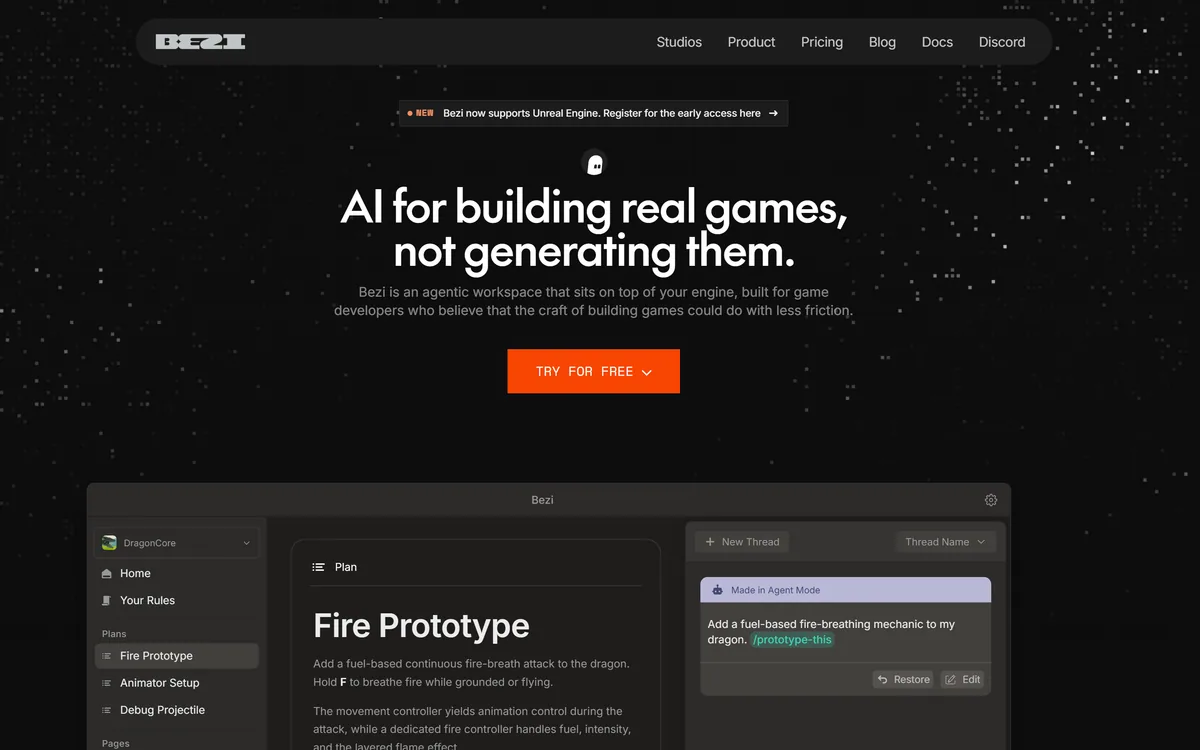
Bezi is an AI assistant and agentic workspace for game developers that works inside your Unity project, with Unreal Engine in early access, helping plan features, write and edit scripts and configure prefabs and effects, while developers stay in control of the craft.
Many AI game tools promise to generate a whole game from a prompt. Bezi takes the opposite stance: AI for building real games, not generating them, by helping developers inside the projects they already work on.
It is an agentic workspace that sits on top of your engine, Unity today with Unreal Engine in early access, helping plan mechanics, write and edit scripts, set up prefabs and effects, and track to-dos. Compared with 3D asset generators like Meshy, it works on game logic and project structure rather than assets.
This review covers how Bezi works inside a game project, which developers it suits, how its pricing works for studios, and when it is not the tool your game needs.
Bezi works inside a game project to help developers plan and build features.
Bezi, The Unity-Agent Brief
Bezi is an AI workspace for game developers: it sits on top of your engine and works inside your real project.
It helps build, not generate, games: plans, to-dos, scripts, prefabs and effects for features you design.
Unity first, Unreal coming: Unity is supported today, with Unreal Engine in early access.
Developers stay in charge: review agent changes and test in-engine before committing.
An AI Workspace For Building Real Games In Unity
Bezi's guiding idea is respect for the craft. Instead of trying to replace game developers with a prompt, it aims to remove friction from the work they already do: planning features, wiring up scripts, configuring components and debugging.
It works as an agentic workspace on top of your engine, so it understands your actual project, its scripts, prefabs, scenes and animations, rather than generating isolated code snippets that do not fit.
The site's example shows the workflow: a developer asks for a fuel-based fire-breath attack for a dragon, and Bezi explores the existing controller, animations and effects, writes a plan and to-dos, then edits the movement controller and creates a fire-breath script and prefab setup.
That plan-then-act pattern is valuable for teams, because it makes the agent's intentions visible before code changes land, and lets designers and programmers discuss a mechanic in concrete terms.
The honest framing is that Bezi can speed up feature work significantly, but game feel, balance and performance still come from developers testing in-engine. Agent edits need review like any teammate's pull request, especially in larger codebases.
Bezi aims to remove friction from game development, not replace developers; game feel and balance still come from testing in-engine.
How Does Bezi Work Inside A Game Project?
Bezi combines planning documents with an agent that changes the project.
Unity Today, Unreal In Early Access
Bezi supports Unity today and has opened early access for Unreal Engine, which matters for studios choosing tools that will follow them across engines. Early-access support is best treated as evolving rather than production-ready.
For AI-generated 3D models from images or text, Rodin is another option; combining asset tools with Bezi's project-aware assistance covers both content and code.
Which Game Developers Bezi Suits
Bezi suits Unity developers and small to mid-sized studios who want to move faster on features, prototypes and debugging without handing creative control to a generator.
It suits designers who want to expand systems and iterate on mechanics with less dependence on programmers, which studio testimonials on the site highlight.
It also suits teams onboarding new hires, since a project-aware assistant can explain unfamiliar systems and speed up the first weeks in a large codebase.
It suits less well studios on engines it does not yet support, projects with strict code-ownership or security policies that limit third-party access, and teams expecting a finished game from prompts.
Experienced engineers will still want to review architecture and performance-sensitive code, since agent-written systems can work in a prototype yet need refactoring before they scale.
Solo developers and game-jam teams may see the most immediate benefit, because the plan-then-act loop turns a rough idea into a testable mechanic quickly, leaving more time for the polish that actually makes a game fun.
How Bezi's Pricing Works For Studios
Bezi offers a free way to try it, with paid plans for individuals and studios. We do not publish prices, which change; check the site.
The value question is feature velocity: if Bezi cuts the time to prototype and implement mechanics, the subscription can pay for itself quickly for a working studio.
Studios should also consider seat counts and how many designers versus programmers will use it, since its appeal to designers can widen adoption beyond engineering.
The sensible approach is to prototype one real mechanic in your own project, review every change the agent makes, and compare the time against doing it by hand.
Indie developers working alone should weigh the subscription against evenings saved each month on prototyping and debugging, since even a few saved sessions can justify it for a serious project.
Prototyping One Mechanic With Bezi
Because Bezi works on your real project, test it on a genuine mechanic with version control in place.
Commit your project to version control before letting the agent edit anything.
Write a short spec for one real mechanic you need.
Ask Bezi to plan it and review the plan before it acts.
Let it prototype the mechanic, then test the feel in-engine.
Review every script and prefab change as you would a teammate's.
Pass/fail: Bezi is worth it if it speeds real features without messy code.
Treat Unreal support as early access until it is generally available.
Bezi Game-Dev Assistant Facts
What it is
An agentic AI workspace for game development
Engines
Unity; Unreal Engine in early access
Planning
Plans, specs, to-dos and brainstorms
Agent
Agent mode edits scripts, prefabs and effects
Context
Understands your project's code and assets
Philosophy
'Build real games, not generate them'
Proof
Studio testimonials (vendor-presented)
Access
Free to try, with paid plans
Key features of Bezi
Agentic game-dev workspace
Unity integration
Unreal early access
Plans and to-dos
Script editing
Prefab and effects setup
Project-aware context
Restore and edit agent changes
Pros & cons
Pros
5
Works inside your real project
Plan-then-act workflow is transparent
Helps designers as well as programmers
Respects developer control
Free to try
Cons
5
Unity-first; Unreal still early access
Agent edits need careful review
Third-party access to project code
Not a full game generator
Testimonials are vendor-presented
Best For
Unity feature work
Prototyping mechanics
Small studios
Designer-led iteration
Onboarding to codebases
Bezi Against Other Game-Making AI
The useful comparison is with other AI tools for games, by what they produce.
Last checked . Read from bezi.com during this check, with the screenshot above captured at the same time.
An agentic AI workspace for game development
Unity support, with Unreal Engine in early access
Plans, specs, to-dos, brainstorms and notes
An agent mode that edits scripts, prefabs and effects
A plan-then-act workflow shown in the product demo
The 'build real games, not generate them' positioning
Studio testimonials presented by the vendor
Free to try, with paid plans
No prices reproduced here, in line with this site's pricing policy
Bezi edits real projects, so use version control and review every change. Unreal support is early access. Studio productivity claims are vendor-presented.
Editor's Verdict
4.1/5
Bezi earns 4.1 as a refreshingly grounded AI tool for game developers: an agentic workspace that works inside your Unity project, with Unreal in early access, planning mechanics, editing scripts and setting up prefabs and effects while keeping developers in control. Its plan-then-act workflow makes agent changes transparent and helps designers iterate. Agent edits still need review, game feel comes from testing in-engine, and Unreal support is early, but for Unity teams it is a genuinely useful accelerator. AInexfinder Editor Score: 4.1/5.
Bezi pricing
AInexfinder does not list plan prices or billing details. For current pricing, plans, and trials, visit the official Bezi website.
Vendor pricing, credits, and billing policies change over time. Always confirm on the official site before you buy.
Frequently asked questions
What is Bezi?
Bezi is an agentic AI workspace for game developers that sits on top of your engine, supporting Unity today with Unreal Engine in early access, to help plan, script and configure features in your real project.
Does Bezi generate whole games?
No. Its stated philosophy is 'AI for building real games, not generating them'. It helps developers build features inside their own projects rather than generating a game from a prompt.
Does Bezi support Unreal Engine?
Bezi has opened early access for Unreal Engine. Unity is its established integration, so treat Unreal support as evolving.
What can Bezi's agent change?
It can explore your project and edit scripts, prefabs and effects, as shown in its example of adding a fire-breath mechanic, with a plan and to-dos you can review.
Is Bezi safe to use on my project?
Use version control before letting the agent edit anything, review its changes like a teammate's pull request, and check its data terms for code access.
Can designers use Bezi?
Yes. Studio testimonials highlight designers using it to expand systems and iterate on mechanics, which can reduce dependence on programmers for prototypes.
Is Bezi free?
Bezi offers a free way to try it, with paid plans for individuals and studios. We do not publish prices, which change; check the site.
Who is Bezi best for?
Unity developers and small to mid-sized studios who want to prototype and implement features faster while keeping creative and technical control.
How does Bezi differ from 3D generators?
3D generators create models and assets. Bezi works on game logic, scripts and project setup, so the two are complementary.
Are Bezi's productivity claims reliable?
Testimonials about faster feature development are vendor-presented. Measure the time saved on a real mechanic in your own project.
Daniel reviews AI tools the slow way — by actually using them on real projects. His reviews cover what works, what breaks, and who each tool is genuinely a good fit for.
Daniel and the AInexfinder editorial team research Bezi using public product information, listing evidence, and (when available) hands-on checks. Scores reflect listing completeness and transparency — not paid placement.
Listings may include affiliate or sponsored placements, which are labeled when present. Editorial scores and cons are not sold. See our affiliate disclosure and review methodology.
GitHub Copilot is an AI coding assistant that spans completion, chat, agent mode, automated code review, and a cloud agent that opens pull requests, working across VS Code, Visual Studio, JetBrains, Xcode, Neovim, Eclipse, the CLI, and github.com.
Replit AI turns a written description into a working application — the Agent writes the code, and Replit supplies the database, authentication, hosting, and monitoring, so a prototype goes live without a local setup or a deployment pipeline.
Tabnine is an enterprise AI coding assistant offering context-aware code completion, chat and agents with private deployment and a codebase-wide context engine. In July 2026 it was acquired by Tricentis, and tabnine.com now routes to the Tricentis agentic quality engineering platform.
Zencoder is an AI orchestration platform for engineering work: agents plan with one model, build with another and review with a third, across multi-repo indexing and full dependency mapping, inside VS Code and JetBrains. It adds scheduled automation and a work layer spanning Jira, Slack and Notion.
Pieces runs in the background on your computer forming a searchable memory of your work, capturing what you see and what you copy by default and what you hear only if you opt in. It builds a chronological timeline across Gmail, Outlook, browsers and Slack, and generates standups, briefs and recaps from real context.
Cline is an open-source AI coding agent that works in your editor as a VS Code extension, in the terminal as a CLI, as a desktop app and through an SDK, using any model including open-weight ones, with a plan-and-act workflow where you approve its actions.