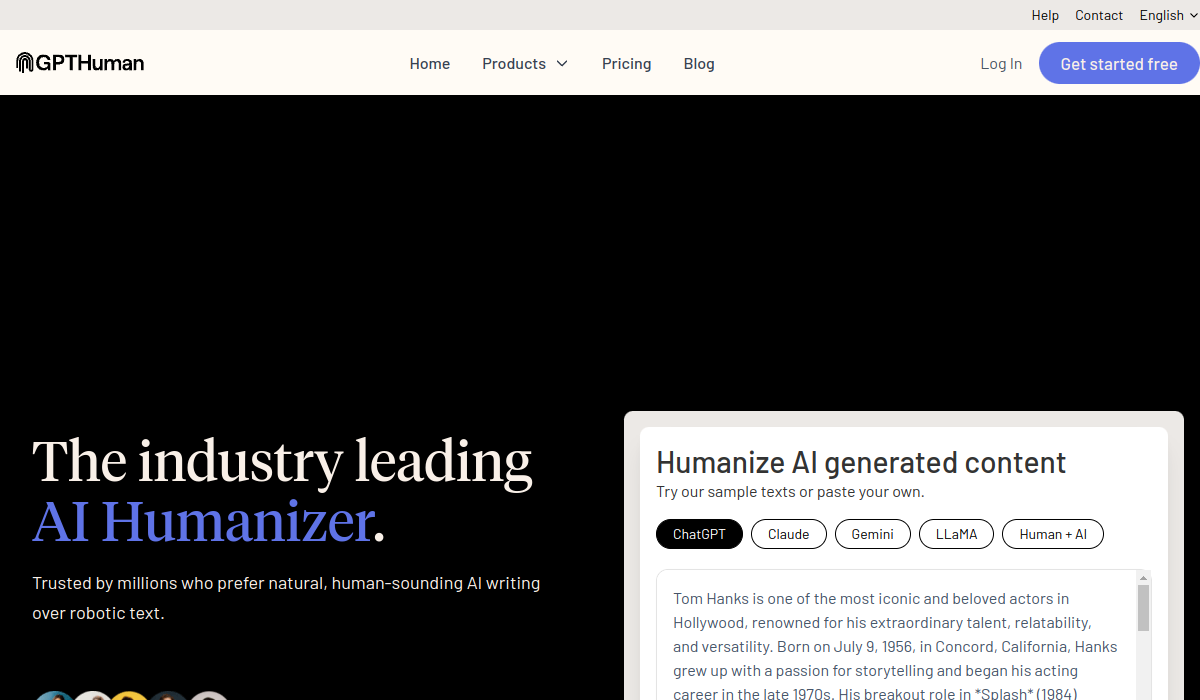
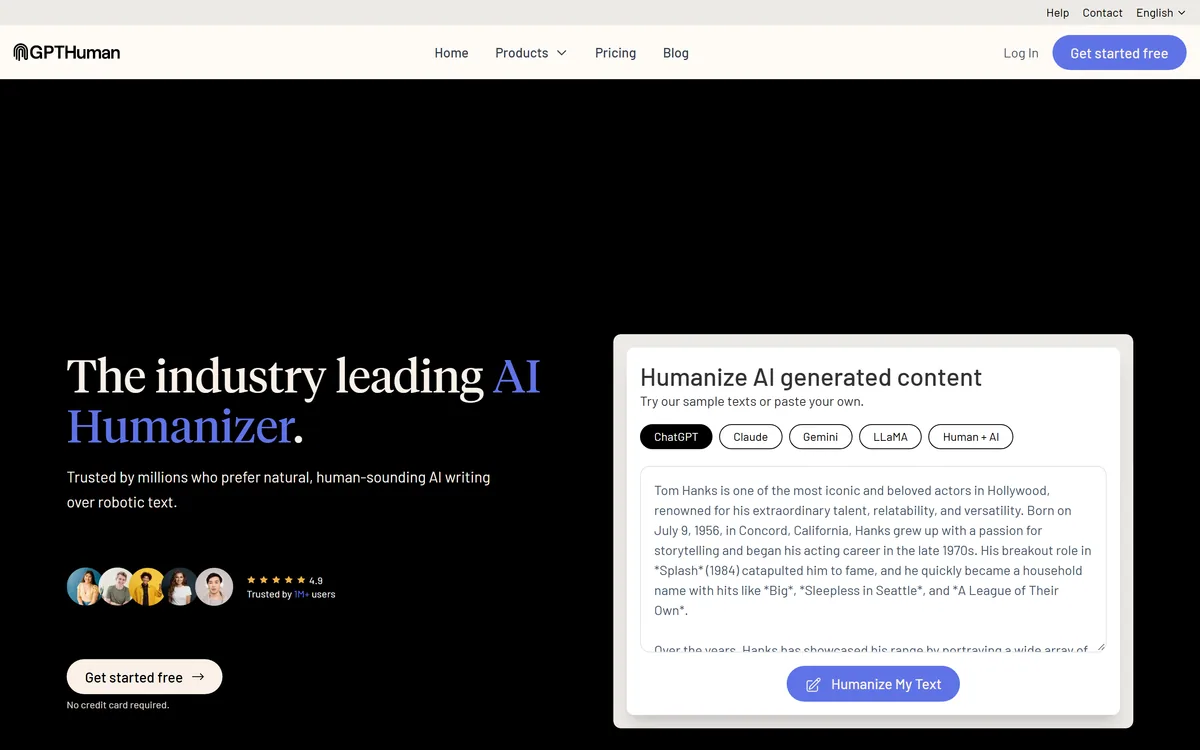
GPTHuman is an AI humanizer that rewrites text from ChatGPT, Claude, Gemini and other models to sound more human and to pass AI-detection tools. It is marketed to students, writers and SEO, but its dominant use, passing AI work off as human, breaches most institutions' rules, which this review weighs honestly.
gpthuman.ai7 viewsAdded April 26, 2025105K visitors
AI detectors are unreliable, and that creates a genuinely awkward problem: people whose own writing is wrongly flagged as AI. GPTHuman markets itself into that gap, but its broader pitch, making AI-generated text undetectable, is where an honest review has to be careful.
It rewrites output from models like ChatGPT, Claude and Gemini to read as human and to pass detection, and markets that to students, content writers and SEO. Because the integrity questions dominate, we weigh it differently from a straightforward writing aid, and point toward honest tools like Grammarly for the legitimate version of improving writing.
This review covers what GPTHuman claims to do, the lines its marketed uses cross, how it prices, and how to judge it responsibly, without any how-to for misuse.
GPTHuman rewrites AI-generated text to read as human and to pass AI detectors.
An AI Humanizer Marketed To Dodge Detection
GPTHuman's function is to take text produced by a large language model and rewrite it so it reads as more natural and, explicitly, so it passes AI-detection tools. That second goal, evading detection, is front and centre in the marketing, not an incidental side effect.
There is a kernel of a real problem here. AI detectors genuinely do misfire, flagging human-written work as machine-generated, and that false-positive risk is a legitimate worry for honest writers. If GPTHuman only addressed that narrow case, it would be a different conversation.
But the marketing goes much further, pitching 'undetectable AI content from scratch' and framing students and SEO as core audiences. The plain meaning of that is helping people present AI-written work as their own human writing, which is the part that crosses ethical and often institutional lines.
So we review it for what it is primarily sold to do, not for the one defensible edge case. A tool can function perfectly well and still have a headline purpose a responsible guide cannot endorse, and that is the situation here.
A tool can function perfectly well and still have a headline purpose a responsible guide cannot endorse, and that is the situation here.
What Does GPTHuman Claim To Do?
The claims are about rewriting and about detection, and it is the detection framing that carries the integrity problem.
Rewriting LLM Text To Read As Human
GPTHuman takes text from models like ChatGPT, Claude, Gemini or Llama and rewrites it to sound more natural, and it claims to do this without introducing the grammar errors some rewriters add. As a text transformation, that is technically unremarkable; many tools paraphrase.
The difference is purely in intent and framing. A proofreading tool like Scribbr helps you improve and correctly cite your own work; GPTHuman's distinctive selling point is not improvement but disguise, making machine text read as though a person wrote it from scratch.
The Integrity Line This Crosses In Schools
GPTHuman explicitly markets to students with language about 'authentic' academic writing. In almost every school, college and university, submitting AI-generated work as your own, whether or not it is 'humanized', is an academic-integrity violation, and using a tool specifically to evade detection compounds it. We will not provide any guidance on doing so.
The SEO pitch has its own problems: search engines and platforms increasingly judge content on genuine helpfulness, and deception-led content is a fragile strategy. For students and writers who want to improve genuinely, a study-and-writing aid like Litero used within the rules, or disclosed AI assistance, is the honest path, not a detector-evasion layer.
Who Markets GPTHuman, And The Hard Limits
GPTHuman is marketed to students, content creators and SEO practitioners, with heavy emphasis on being the humanizer that 'actually works' against detectors. Our stance is that this positioning defines its real-world use, and that use is largely one we cannot recommend.
The only narrowly legitimate case is a writer whose genuinely own work is being misflagged by an unreliable detector and who wants to adjust phrasing, or someone revising their own AI-assisted draft in a context where AI use is permitted and disclosed, and where they take full authorship responsibility.
The hard limits are everything else: students submitting work as original, anyone passing AI text off as human where disclosure is required, and deception-led SEO. In those cases GPTHuman is the wrong tool regardless of how well it performs, and the reputational, academic and policy risks fall on the user. Its '1M+ users' and '4.9' figures are vendor-stated.
How GPTHuman Charges For Rewrites
GPTHuman offers a free way to start and paid plans for more rewriting, in the usual pattern for these tools. We do not publish prices, which change; check the site.
The value question is unusual here because the main use is one we advise against. Even if the rewriting is cheap and effective, paying to evade detection buys risk, academic penalties, platform action, or simply publishing content built on deception, not a durable benefit.
If your need is the legitimate edge case, protecting genuinely human writing from false positives, weigh it against the far simpler option of keeping drafts, version history and notes that evidence your authorship, which no rewriter can replace.
How To Judge GPTHuman Responsibly
Because the integrity questions dominate, the responsible way to assess GPTHuman is to start from your actual purpose, not its features.
Be honest about why you want it: improving your own work, or disguising AI as human.
If the goal is to submit AI work as original, stop; that breaches most institutions' rules.
Check your school's, publisher's or platform's policy on AI use and disclosure first.
For genuine false-positive worries, keep drafts and version history as authorship evidence.
If you want better writing, use an honest aid and disclose AI assistance where required.
Red line: we provide no guidance on evading detection or passing AI work off as human.
Treat the user-count and rating figures as vendor-stated marketing.
GPTHuman Rewriter Facts
What it is
An AI humanizer / text rewriter
Core
Rewrites LLM output to read as human
Claim
Designed to pass AI-detection tools
Inputs
Text from ChatGPT, Claude, Gemini and others
Marketed to
Students, content writers and SEO
Integrity
Dominant marketed use breaches most schools' rules
Legitimate edge case
False positives on genuinely human text
Our stance
Scored down; honest alternatives preferred
GPTHuman, The Straight Brief
GPTHuman is an AI humanizer: it rewrites LLM output to sound human and to pass AI-detection tools.
Its marketing targets students, writers and SEO: and leans heavily on making AI content 'undetectable'.
That dominant use crosses lines: passing AI work off as your own breaches most schools' and many publishers' rules.
We score it down for that reason: it may function, but its headline purpose is one we cannot recommend, and honest alternatives exist.
Should You Use GPTHuman At All?
The Narrow Legitimate Uses
Protecting genuinely human writing from false positives
Revising your own AI-assisted draft where AI use is permitted
Contexts where you disclose AI help and take authorship
Adjusting phrasing of work you actually wrote
Anywhere you remain honest about the content's origin
Where GPTHuman Is The Wrong Tool
Students submitting AI work as their own
Passing AI text off as human where disclosure is required
Evading academic-integrity checks
Deception-led SEO content
Anywhere honesty about AI use is expected or required
Key features of GPTHuman
AI-text rewriting
Detector-evasion claim
Multiple model inputs
'From scratch' generation claim
Tone adjustment
False-positive framing
Free tier
Browser-based
Pros & cons
Pros
5
Addresses a real detector false-positive problem
Rewrites without obvious grammar damage (claimed)
Accepts output from several models
Free tier to evaluate
Simple to use
Cons
5
Dominant marketed use crosses integrity lines
Markets detection evasion to students
Deception-led SEO is fragile and risky
Risk falls entirely on the user
User-count and rating figures are vendor-stated
Best For
A narrow false-positive edge case only
Disclosed, permitted AI-assisted drafting
Writers revising their own work
Honest, authorship-owned contexts
Not for passing AI off as human
GPTHuman Against Honest Writing Aids
The useful comparison is with tools that improve writing legitimately rather than disguise its origin.
Last checked . Read from gpthuman.ai during this check, with the screenshot above captured at the same time.
An AI humanizer that rewrites LLM output
Explicitly marketed to pass AI-detection tools
Accepts text from ChatGPT, Claude, Gemini and others
Marketed to students, writers and SEO
A claim to generate 'undetectable' AI content from scratch
Framing around protecting against detector false positives
A stated 1M+ users and a 4.9 rating (vendor-stated)
A free start with paid plans
No prices reproduced here, in line with this site's pricing policy
We describe GPTHuman accurately and decline to provide any how-to for evading detection or passing AI work off as human. Submitting AI-generated work as your own breaches most institutions' rules; we score the tool down because its dominant marketed use is one we cannot recommend. The one defensible case is protecting genuinely human writing from false positives.
Other Writing And Integrity Tools
Honest writing aids that improve work rather than disguise its origin.
GPTHuman earns 3.0, and the number reflects a judgement, not a glitch. Technically it does what it says, rewriting AI text to read as human and to pass detectors, and it gestures at one real problem: unreliable detectors misflagging genuine writing. But its dominant marketed purpose, helping students and others present AI-generated work as their own human writing, crosses academic-integrity and disclosure lines we will not endorse, and we provide no how-to for it. For improving writing honestly, Grammarly, Scribbr or a study aid used within the rules are the right tools; for protecting genuine authorship, keeping drafts and version history is more credible than any humanizer. AInexfinder Editor Score: 3.0/5.
GPTHuman pricing
AInexfinder does not list plan prices or billing details. For current pricing, plans, and trials, visit the official GPTHuman website.
Vendor pricing, credits, and billing policies change over time. Always confirm on the official site before you buy.
Frequently asked questions
What is GPTHuman?
GPTHuman is an AI humanizer that rewrites text from models like ChatGPT, Claude and Gemini to read as more human and, explicitly, to pass AI-detection tools. It is marketed to students, content writers and SEO practitioners, with heavy emphasis on being 'undetectable'.
Is it cheating to use GPTHuman for schoolwork?
In almost every school, college and university, submitting AI-generated work as your own, humanized or not, is an academic-integrity violation, and using a tool specifically to evade detection compounds it. We advise against that use and provide no guidance on doing it.
Does GPTHuman have any legitimate use?
A narrow one: a writer whose genuinely own work is being misflagged by an unreliable detector, or someone revising their own AI-assisted draft in a context where AI use is permitted and disclosed and where they take full authorship responsibility. Everything beyond that crosses into deception.
Why did this review score GPTHuman down?
Because a review has to weigh purpose, not just function. GPTHuman works technically, but its dominant marketed use, passing AI work off as human, is one we cannot recommend, so the score reflects that rather than only how well it rewrites text.
Can GPTHuman reliably beat AI detectors?
Detection and evasion are an arms race, and no tool can promise to beat every detector permanently. More importantly, the goal of reliably evading detection is itself the problem in academic and disclosure contexts, so we do not assess or endorse its effectiveness at that.
What should I use instead for better writing?
Honest aids that improve your own work: Grammarly for grammar, clarity and tone, Scribbr for proofreading and citations, or a study tool like Litero used within your institution's rules. Where you use AI, disclose it if disclosure is expected, and take authorship responsibility.
I'm worried my real writing is flagged as AI. Does GPTHuman help?
That false-positive concern is real, but the stronger protection is evidence of authorship: keep your drafts, version history and notes, which demonstrate you wrote the work. Rewriting genuine text through a humanizer can even distort your own voice, and it cannot prove authorship the way a document trail can.
Are GPTHuman's user numbers reliable?
Figures like '1M+ users' and a '4.9' rating are vendor-stated marketing, not independently verified, so treat them as promotion rather than evidence of quality or legitimacy. They do not change the integrity questions around the tool's main marketed purpose.
Is using an AI humanizer against the rules?
In academic settings, submitting AI-generated work as your own, humanized or not, breaches almost every institution's integrity policy, and using a tool to evade detection compounds it. In other contexts, check whether disclosure of AI use is expected; passing AI content off as human where honesty is required is the core problem.
What is a better alternative to GPTHuman?
For improving your own writing honestly, use Grammarly for grammar, clarity and tone, or Scribbr for proofreading and citations. Where you use AI, disclose it if disclosure is expected and take authorship responsibility, rather than using a tool whose main purpose is to disguise machine text as human.
Daniel reviews AI tools the slow way — by actually using them on real projects. His reviews cover what works, what breaks, and who each tool is genuinely a good fit for.
Daniel and the AInexfinder editorial team research GPTHuman using public product information, listing evidence, and (when available) hands-on checks. Scores reflect listing completeness and transparency — not paid placement.
Listings may include affiliate or sponsored placements, which are labeled when present. Editorial scores and cons are not sold. See our affiliate disclosure and review methodology.
Undetectable AI rewrites AI-generated text so it reads as human-written and is less likely to be flagged by detectors. It also sells detection tools of its own — for text, images, voice, video and deepfakes — plus a suite of writing utilities and a Chrome extension.
RewritePal is a free online writing assistant for paraphrasing, grammar and spelling correction, tone adjustment, and making AI-generated text read more naturally, with a 40,000-character editor and no account required.
Free AI Humanizer is a tool on CopyChecker that rewrites AI-generated text to read more naturally, with controls for mode, readability level, purpose, and strength, capped at 500 words per run and usable without signup.
Decopy AI is a free suite of writing and study utilities covering text humanizing, AI detection, summarisation of documents, video and audio, speech conversion, a maths solver, flashcard and worksheet creation, and story and article generation — usable without creating an account.
Copy.ai has become an AI-native go-to-market platform: workflows and agents that run prospecting, lead processing, deal coaching, ABM, and CRM enrichment across Salesforce, HubSpot, Gong, Outreach, and 2,000+ integrations.
Writesonic has become an AI search growth platform — tracking whether your brand appears across 10 AI platforms, running optimisation and citation work through an Action Center, and reporting results against traffic and revenue.