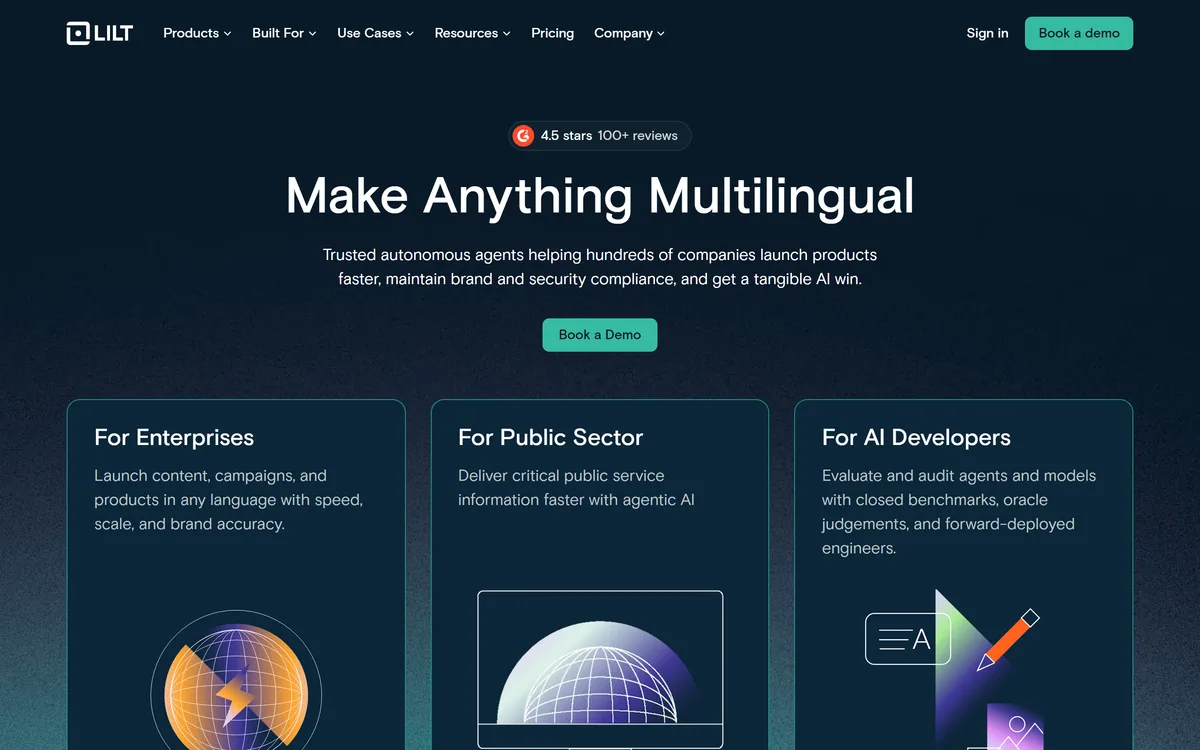
Lilt is an enterprise translation and localisation platform built on agentic AI, positioned to replace a translation management system and language service vendors with one stack. Its models learn from each human review, and it holds SOC 2 Type II, ISO 9001 and ISO 17100 certification.
Self-learning translation — each human correction improves the model, so quality compounds inside your own content.
Bring your own LLM or use Lilt's context-aware models, per pipeline.
ISO 17100 as well as SOC 2 Type II and ISO 9001 — the translation-services standard, not just a security badge.
Positioned to replace your TMS and language vendors with one platform rather than sitting beside them.
A separate offering for AI developers: closed benchmarks, oracle judgements and forward-deployed engineers.
How Does Adaptive Machine Translation Learn?
Lilt describes smarter, flexible models with self-learning that improves accuracy with every human interaction, and pairs agentic workflows with expert verification.
That loop is the product, and it is worth understanding why it beats the conventional arrangement.
The standard enterprise setup is a generic engine followed by a human post-editing pass. The engine translates, a linguist fixes it, and the corrections go into the delivered file and nowhere else. Next month the engine makes the same mistakes, because nothing told it otherwise.
An adaptive system feeds the correction back. When a reviewer changes your product name from a translated form to the trademarked one, the model learns that for every subsequent occurrence.
Compounded across a large content estate, that is the difference between paying for the same corrections forever and paying for them once. It also explains why the platform wants your whole volume rather than a project — the learning is proportional to what it sees.
A generic engine plus post-editing pays for the same corrections forever. Adaptive translation pays for them once.
Bring Your Own Model, Or Theirs
Alongside its own context-aware models, Lilt states you can use your own LLM.
That option matters more in translation than in most categories, for a reason specific to the domain.
Some organisations have already built or fine-tuned models on their own terminology, particularly in regulated fields where the vocabulary is fixed and the stakes are high — pharmaceutical labelling, legal filings, financial disclosure. Being forced onto a vendor's model discards that work.
It also hedges a commercial risk. Translation volume is large and recurring, which makes model pricing a material line item, and a platform that can route to a cheaper or better model protects you from one provider's decisions.
The trade is that self-learning presumably works best on the models Lilt controls. Worth asking directly whether the adaptive loop applies equally to a customer-supplied model, because if it does not, the two features are alternatives rather than a combination.
Why Localisation Is Not Just Translation
The use cases listed run well beyond text: website localisation, regional marketing, product launches, brand campaigns, technical documentation, helpdesk and support, professional services, clinical trials, eLearning and regulatory compliance.
That spread is the actual shape of the problem, and it is why localisation projects are consistently underestimated.
Translating a sentence is the visible part. What surrounds it is everything else: strings inside software that break layout when German makes them forty percent longer, date and currency formats, images containing text, legal disclaimers that differ by market, and a helpdesk that now needs answers in seven languages.
Clinical trials and regulatory compliance are the most demanding items on that list, because a mistranslation there is not an embarrassment but a submission failure or a safety issue.
Which is why the certifications matter more here than the feature list, and why the honest framing of this category is that content is the easy half — the same reason a dubbing tool like Dubbing AI solves a narrower problem than a localisation platform does.
Ask whether self-learning applies to a customer-supplied model.
Scope the non-text work — layout, formats, images, legal — before pricing.
Confirm which ISO 17100 scope the certification covers.
Pilot on a content type you can measure, not your hardest one.
Keep expert review in the loop where a mistranslation carries risk.
Enterprise Requirements Behind The Words
Lilt publishes three certifications: SOC 2 Type II, ISO 9001 and ISO 17100.
The third is the one worth noticing, because it is specific to this industry and most AI translation vendors do not hold it.
SOC 2 Type II covers security controls and ISO 9001 covers quality management generally — both are common and both are meaningful. ISO 17100 is the international standard for translation services, and it specifies requirements on translator competence, revision by a second person, and process documentation.
That last requirement is the interesting one in an AI context, because ISO 17100 was written around human translators and revision. A platform holding it while running agentic workflows has had to reconcile the two, which is a stronger claim than a self-declared quality process.
The question for procurement is scope. Certifications cover defined services and defined locations, and a certificate held for one workflow does not automatically cover another — so the right ask is which services the ISO 17100 registration actually names. Learning a language is an entirely separate problem, served by tools like Language Reactor and ELSA Speak rather than by a localisation platform.
Replacing A TMS And A Vendor Roster
The commercial pitch is explicit: replace fragmented tools, your translation management system and your language service vendors with one multilingual platform built on agentic AI.
That is an unusually direct thing to say, and it is worth taking at its word rather than as a figure of speech.
Displacing a TMS is a systems project. It sits between your content repositories, your developers, your reviewers and your vendors, and every one of those integrations has to be rebuilt. Displacing vendors is a commercial and relationship change on top.
The upside is real if it works, because that fragmentation is where localisation cost and delay actually live — files moving between systems, versions diverging, nobody able to say what is translated.
The realistic read is that this is a programme with a business case, not a subscription. Which is fine, and it means the evaluation should be run like a platform migration: one content type first, measured against your current cost and turnaround, before anything is decommissioned.
Localising A Product Without Breaking It
Localisation fails at the seams — the string that overflows, the date that reads as the wrong month, the disclaimer that is not legally valid in market.
This sequence puts the expensive discoveries first, while they are still cheap.
Inventory everything that needs translating, including strings and images.
Test layout with the longest target language before translating anything.
Build the glossary and do-not-translate list up front.
Pilot on one content type with a measurable baseline.
Keep expert review where a mistranslation carries legal or safety risk.
Measure whether corrections stop recurring — that is the adaptive claim.
Key features of Lilt
Adaptive translation that learns from human review
Own context-aware models or a customer-supplied LLM
Agentic workflows for review and routing
Expert human verification in the loop
Connectors into existing content systems
Evaluation tooling for models and agents
Public sector and regulated-industry deployments
SOC 2 Type II, ISO 9001 and ISO 17100 certification
Pros & cons
Pros
7
Corrections train the model, so quality compounds instead of resetting
ISO 17100 is the translation-specific standard most AI vendors lack
Bring-your-own-LLM protects existing terminology work and pricing exposure
Expert verification retained where mistranslation carries real risk
Use cases named specifically, including clinical trials and regulatory compliance
A separate, coherent offering for AI developers rather than a bolt-on
Company, status page and security documentation all published
Cons
7
Replacing a TMS and vendor roster is a programme, not a purchase
Whether self-learning applies to your own LLM is unstated
ISO 17100 scope is not published and must be asked for
The customer logo wall is unlabelled as to relationship
Oracle judgements is used without definition
Localisation cost sits largely in non-text work the platform does not remove
No pricing, so evaluation begins with a demo
Best For
Enterprises publishing continuously in many languages
Localisation teams paying for the same corrections repeatedly
Regulated industries where mistranslation is a compliance risk
Public sector organisations with statutory language obligations
AI teams needing multilingual evaluation and benchmarking
Lilt Against Other Translation Services
Language tools differ by whether they translate text, media, or a whole product.
What we could not confirm: whether the self-learning loop applies to a customer-supplied LLM as well as to Lilt's own models; the scope of the ISO 17100 registration, which covers defined services rather than a whole company; which customers the hundreds-of-companies figure refers to, as the logo wall is unlabelled; what oracle judgements means operationally for the AI developer offering; and pricing, which requires a demo. We did not translate content or run a project.
Editor's Verdict
4.2/5
Lilt's central mechanism is the right one for translation: the model improves from every correction a human reviewer makes, so quality compounds inside your own content rather than resetting with each job. That is a genuine advantage over a generic engine plus a proofreading pass. It holds ISO 17100 alongside SOC 2 and ISO 9001, which is the specific translation-services standard and rarer than a security badge. The reservation is scope — replacing your TMS and your language vendors is a large programme, not a purchase. AInexfinder Editor Score: 4.2/5.
Lilt pricing
AInexfinder does not list plan prices or billing details. For current pricing, plans, and trials, visit the official Lilt website.
Vendor pricing, credits, and billing policies change over time. Always confirm on the official site before you buy.
Frequently asked questions
What is Lilt?
An enterprise translation and localisation platform built on agentic AI, positioned to replace a translation management system and language service vendors with one stack. Its models learn from every human review, and it holds SOC 2 Type II, ISO 9001 and ISO 17100.
How does adaptive translation differ from post-editing?
In the standard setup a generic engine translates, a linguist corrects, and the correction goes into the delivered file and nowhere else — so the engine repeats the mistake next month. An adaptive system feeds the correction back into the model.
Why does that matter commercially?
Because it is the difference between paying for the same corrections forever and paying for them once. It also explains why the platform wants your whole volume rather than a project — the learning is proportional to what it sees.
Can I use my own model?
The site states you can use your own LLM alongside Lilt's context-aware models. That protects existing terminology work and gives you pricing flexibility — but ask whether the self-learning loop applies to a customer-supplied model too.
What is ISO 17100?
The international standard for translation services, specifying requirements on translator competence, revision by a second person and documented process. It is rarer than a security certification and specific to this industry.
Why is holding it notable for an AI platform?
Because ISO 17100 was written around human translators and human revision. A platform holding it while running agentic workflows has had to reconcile the two, which is a stronger signal than a self-declared quality process.
Is localisation just translation?
No, and that is why these projects overrun. Around the text sit software strings that break layout when German runs forty percent longer, date and currency formats, images containing text, market-specific legal disclaimers, and support in every language.
Should we really replace our TMS?
Treat that as a programme with a business case rather than a subscription. A TMS sits between content, developers, reviewers and vendors, and every integration has to be rebuilt — so pilot one content type against a measured baseline first.
Where should human review stay?
Anywhere a mistranslation is more than an embarrassment. Clinical trial material, regulatory submissions and legal disclaimers are the clear cases, and they are exactly the use cases the platform lists.
How do we test the adaptive claim?
Track whether specific corrections stop recurring. If a reviewer fixes your product name once and it never comes back wrong, the loop is working. If the same fix appears in month three, it is not.
Daniel reviews AI tools the slow way — by actually using them on real projects. His reviews cover what works, what breaks, and who each tool is genuinely a good fit for.
Daniel and the AInexfinder editorial team research Lilt using public product information, listing evidence, and (when available) hands-on checks. Scores reflect listing completeness and transparency — not paid placement.
Listings may include affiliate or sponsored placements, which are labeled when present. Editorial scores and cons are not sold. See our affiliate disclosure and review methodology.
Listomize is an Etsy SEO platform that generates titles, tags, and descriptions within Etsy's own limits, scores listings, optimises 100+ listings from a CSV, tracks competitors and trends, and auto-generates Pinterest pins.
Lahjty (لهجتي) is an Arabic-first marketing platform for MENA campaigns. From one brief it produces dialect-aware ad copy, headlines, campaign images with Arabic text rendered in, dialect-aware voice, and SEO articles grounded in your own brand sources — with a Partner API and an MCP server for teams that want it inside their own workflow.
MaxAEO is an answer engine optimisation platform from HIII PTE. LTD. It tracks how ChatGPT, Gemini, Claude, Perplexity, Copilot, Grok and Google's AI surfaces mention a brand, with sentiment, competitor benchmarking and citation tracing.
Mailjet is a Sinch-owned email platform handling both marketing campaigns and transactional sending from one account. It offers a collaborative drag-and-drop editor, an email API with SMTP relay, AI generation and segmentation, and EU-based data centres.
Outranking is an AI SEO content platform that writes briefs and first drafts and optimises them with real-time scoring, grounding content in live SERP data through its Concepts feature, with keyword clustering, internal linking and content workflows.
PitchBud is a press outreach tool that drafts a release with Claude Sonnet, publishes it to a newsroom URL with NewsArticle schema and RSS, matches relevant journalists by their recent work, and drafts personal pitches you review and send yourself.