LuxAlgo is a charting and trading analysis platform built around Quant, a coding agent that writes strategies, backtests them against history and optimises them on the chart. It offers 66 drawing tools, institutional-grade orderflow data across stocks, futures, crypto and forex, and a large indicator library.
luxalgo.com5 viewsAdded February 4, 202630K visitors
Charting platforms have converged. Everyone has candlesticks, indicators, drawing tools and alerts, and the differences between them are mostly ergonomic.
What is genuinely new is the layer on top: an agent that turns a description of a trading idea into code, runs it against years of history, and reports what would have happened.
That removes a real barrier — most people with an idea cannot write the script to test it. It also removes a friction that was quietly protecting them, which is the part worth thinking about carefully.
Nothing on this page is investment advice, and no tool described here changes the fact that trading involves risk of loss.
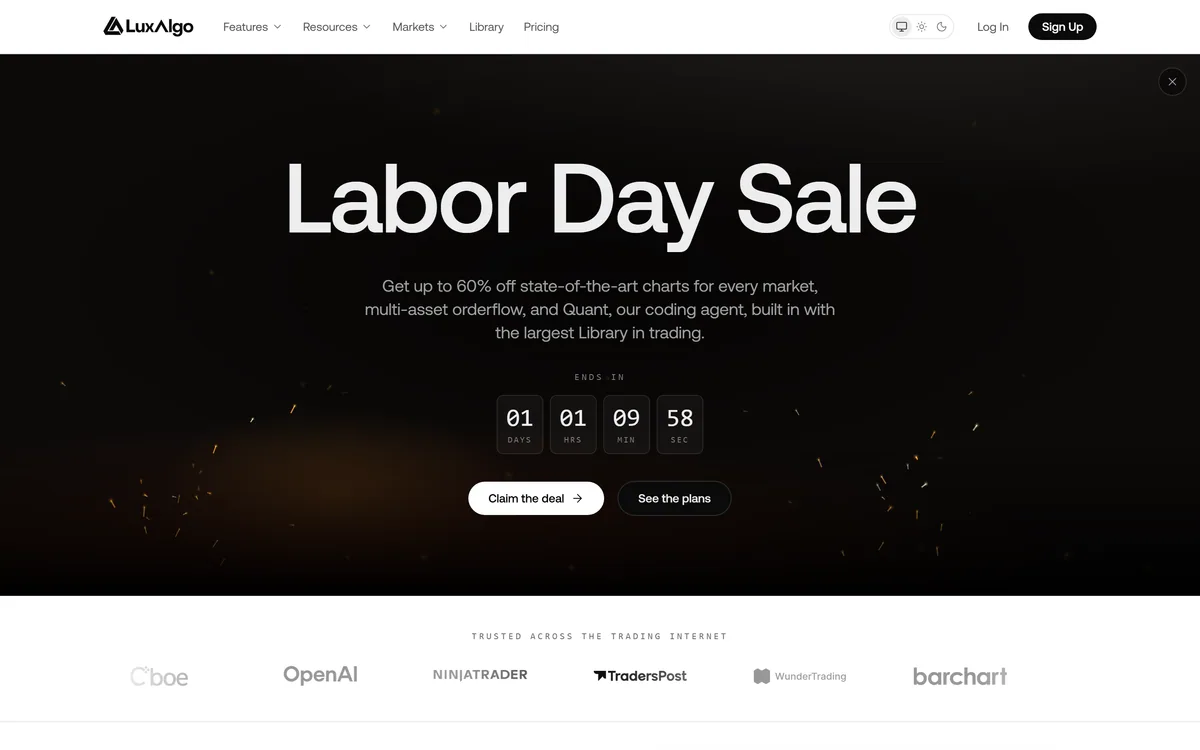
LuxAlgo's homepage, captured 9 September 2026, showing the Quant agent and charting positioning.
LuxAlgo: Charts, Orderflow And A Coding Agent
Quant writes strategies from a description, backtests them against full history, and optimises live on the chart.
Charts described as free for everyone, with 66 drawing tools, thousands of indicators and every chart type.
Orderflow data — footprints, profiles and cumulative delta from real trades across stocks, futures, crypto and forex.
Backtest output shown as equity curve, drawdown and bias-free analytics, which is the right vocabulary.
Recognised as a Pine Script Wizard in 2024, per badges displayed on the site.
What Does Quant Actually Do?
LuxAlgo describes Quant as the intelligence behind the platform, present in every pane and every market — building strategies, backtesting them against history, optimising live on the chart, and running what you approve.
The pipeline is coherent and each stage does something distinct.
Building means turning a described idea into executable code. Historically this required Pine Script or similar, which is a real skill barrier and the reason most retail ideas were never tested at all.
Backtesting runs that code against historical data. Optimising adjusts parameters to improve the historical result — and that step deserves the most scrutiny, for reasons covered below.
Running what you approve is the part where an approval gate is doing important work. An agent that writes, tests and then executes without a human step would be a fundamentally different risk proposition, and keeping the approval explicit is the correct design.
The barrier was never having ideas. It was that testing one required writing code — and that friction was quietly protecting people.
Why Backtests Flatter Every Strategy
The site shows an illustrative backtest with a net profit figure, win rate, profit factor and maximum drawdown, which is the standard vocabulary and worth understanding rather than skimming.
Backtests systematically overstate future performance, and the reasons are structural rather than a fault of any platform.
Overfitting is the main one. Optimising parameters against historical data finds the settings that best explain what already happened, and past data always contains coincidences that do not repeat. The more parameters you tune, the better the fit and the worse the prediction.
Survivorship, look-ahead bias and unmodelled costs do the rest. Historical data often excludes delisted instruments, some tests accidentally use information unavailable at the time, and spread, slippage and commission turn many profitable backtests into losing systems.
The platform's own phrase — bias-free analytics — indicates awareness of this, which is a good sign. The structural risk remains: a tool that makes generating and optimising strategies effortless makes overfitting effortless too, and the discipline has to come from the user.
Orderflow Data And What It Shows
LuxAlgo describes the largest orderflow coverage anywhere — institutional-grade footprints, profiles and cumulative delta from real trades across stocks, futures, crypto and forex.
Orderflow is a genuinely different kind of data from price, and the distinction matters when evaluating what it adds.
A candlestick summarises a period into four numbers. Orderflow shows the transactions inside it — how much traded at each price, whether buyers or sellers were more aggressive, where volume concentrated.
That granularity is why professional desks use it. Two identical candles can have completely different internals, and the internals sometimes indicate whether a move had participation behind it or was thin.
Two cautions are worth stating. Orderflow data is expensive to source and coverage varies enormously by market, so what is comprehensive in futures may be partial in equities. And more data does not mean better decisions — orderflow is difficult to read well, and the failure mode is overconfidence from detail rather than insight.
Treat backtest results as an upper bound, never as an expectation.
Tune as few parameters as possible — every one worsens the prediction.
Check whether spread, slippage and commission were modelled.
Ask which markets orderflow coverage is actually complete for.
Keep the approval step; an agent that executes unattended is a different product.
Charts, Indicators And A Large Library
The platform offers 66 drawing tools, thousands of indicators, every chart type and every market, with charts described as free for everyone with generous limits.
Indicator count is the least meaningful specification in this category, and it is worth saying why plainly.
The overwhelming majority of indicators are transformations of the same price and volume series. A dozen momentum oscillators tell you approximately the same thing, and stacking them produces the appearance of confirmation from what is effectively one measurement.
That is a genuine analytical error rather than a stylistic preference. Three correlated indicators agreeing is one signal, not three, and treating it as confluence is how people talk themselves into positions.
Where a large library does help is discovery and community — a published indicator embodies somebody's idea, and reading how it works teaches something. Free charts with generous limits is also a straightforwardly good thing, whatever the indicator count says.
The comparison worth holding in mind is with data platforms outside markets. Something like Intelligence Node guarantees matching accuracy under an SLA, because in retail pricing a wrong comparison is a contractual failure. Market data carries no such guarantee, and the burden of deciding what a number means sits entirely with you.
The other useful contrast is with accounting. A ledger, of the kind Puzzle maintains, records what happened and is auditable afterwards. A backtest records what would have happened under assumptions you chose, which is a fundamentally weaker kind of evidence dressed in the same visual language.
Using Trading Tools Without Fooling Yourself
The honest observation about trading software is that better tools have not made retail traders more profitable, and it is worth being clear about why.
The constraint was never analysis. Markets are competed over by well-resourced participants, and an edge available from publicly visible indicators on a retail chart is the kind that disappears quickly.
What tools genuinely help with is process — position sizing, consistent rules, record-keeping, and reviewing what you actually did against what you intended. Those are unglamorous and they are where measurable improvement comes from.
The specific risk of a strategy-generating agent is that it makes the appealing part effortless and leaves the disciplined part exactly as hard. Generating fifty strategies is now trivial; the judgement to discard forty-nine is not, and no software supplies it.
Treat backtest output as evidence about the past under specific assumptions, and treat any strategy as unproven until it has traded forward. That is the whole discipline, and it is the same posture that applies to any analytics platform — including observability tools like Langfuse, where the data tells you what happened rather than what to do.
Evaluating LuxAlgo Before You Rely On It
The way people get hurt here is not by bad software. It is by acting on a backtest that was never going to hold.
This sequence tests the platform's claims and your own discipline at the same time.
Use the free charts first and judge whether the platform suits how you work.
Have Quant write a strategy you already understand, and read the code it produced.
Check whether spread, slippage and commission are included in the backtest.
Deliberately overfit a strategy, then test it on data it never saw — the gap is the lesson.
Ask which markets orderflow coverage is genuinely complete for.
Paper trade anything promising forward before committing capital to it.
Trading Platform Terms
The vocabulary these platforms use, in plain terms.
undefined
undefined
undefined
undefined
undefined
undefined
Key features of LuxAlgo
Quant, an agent that writes strategy and indicator code
Backtesting against full history with equity curve and drawdown
Live parameter optimisation on the chart
Approval-gated execution of generated strategies
66 drawing tools and every chart type
Institutional-grade orderflow footprints and profiles
Cumulative delta across four asset classes
A large published indicator library
Pros & cons
Pros
7
Removes the coding barrier that stopped most retail ideas being tested at all
An explicit approval step rather than unattended execution
Orderflow shows the internals of a bar, which price alone cannot
Coverage across stocks, futures, crypto and forex in one platform
Backtest output uses the right vocabulary — drawdown and equity curve, not just profit
Free charts with stated generous limits
Publicly recognised scripting expertise behind the library
Cons
7
Making strategy generation effortless makes overfitting effortless too
Backtests systematically overstate future performance for structural reasons
Thousands of indicators are mostly transformations of the same price series
Correlated indicators agreeing reads as confluence and is one signal
Whether costs and slippage are modelled is not stated
Orderflow coverage completeness by market is unstated
Nothing about better tools has historically made retail traders profitable
Best For
Experienced traders who want to test ideas without writing Pine Script
Analysts who already work with orderflow rather than price alone
Multi-asset traders wanting one charting environment
People who understand backtesting well enough to distrust it
Anyone who will paper trade forward before risking capital
LuxAlgo Against Other Market Tools
Analytical platforms differ by what they measure and what they let you automate.
A coding agent that builds strategies, backtests against history and optimises on the chart
Execution
Runs what you approve, per the site
Charts
66 drawing tools, thousands of indicators, every chart type, free for everyone with generous limits
Orderflow
Footprints, profiles and cumulative delta from real trades
Markets
Stocks, futures, crypto and forex
Backtest output
Equity curve, drawdown and bias-free analytics
Library
Described as the largest library in trading
Recognition
Pine Script Wizard badges for 2024 displayed
Sections
Features, Resources, Markets, Library, Pricing
LuxAlgo: Read Before The Sale Banner
Last checked . Read from luxalgo.com in a browser session on the date above, with the screenshot captured alongside.
Positioned as the AI trading and charting platform
Quant described as the intelligence behind the charting platform, in every pane and every market
Quant stated as building strategies, backtesting against history, optimising live on the chart and running what you approve
Charts described as free for everyone with the most generous limits on the web
66 drawing tools, thousands of indicators and every chart type stated
Orderflow described as institutional-grade footprints, profiles and cumulative delta from real trades
Markets stated as stocks, futures, crypto and forex
Backtesting described as producing equity curve, drawdown and bias-free analytics
Pine Script Wizard 2024 recognition badges displayed
A time-limited promotional banner displayed at the top of the page
Navigation confirmed for Features, Resources, Markets, Library and Pricing
What we could not confirm: pricing, which sits behind a promotional banner we have deliberately not reproduced; whether backtests model spread, slippage and commission; which markets orderflow coverage is complete for as opposed to partial; what running what you approve means operationally and whether it connects to a broker; which models power Quant; and whether the displayed backtest figures are illustrative, which we have assumed they are. Nothing on this page is investment advice, and trading involves risk of loss.
Is LuxAlgo Right For How You Trade?
A reasonable fit when
You have trading ideas and cannot write the code to test them.
Orderflow rather than price alone is part of how you already analyse markets.
You want charting across several asset classes in one platform.
You understand backtesting well enough to distrust your own results.
You will paper trade forward before committing capital.
Step away when
You would treat a backtest result as an expectation of future returns.
You are new to markets and looking for a system that works.
More indicators feels like more confirmation to you.
You cannot afford to lose what you would be trading with.
You want a strategy to run unattended without an approval step.
Editor's Verdict
3.8/5
LuxAlgo is a serious charting platform with a genuinely current addition: an agent that writes indicator and strategy code from a description, then backtests it. For anyone who has wanted to test an idea and been blocked by not writing Pine Script, that removes a real obstacle. It is also where the caution belongs, because the constraint in trading was never the ability to produce strategies — it was that backtests flatter almost everything, and a tool that makes generating and testing them effortless multiplies the opportunity to fool yourself. Nothing here is investment advice. AInexfinder Editor Score: 3.8/5.
LuxAlgo pricing
AInexfinder does not list plan prices or billing details. For current pricing, plans, and trials, visit the official LuxAlgo website.
Vendor pricing, credits, and billing policies change over time. Always confirm on the official site before you buy.
Frequently asked questions
What is LuxAlgo?
LuxAlgo is a charting and trading analysis platform built around Quant, an agent that writes strategies from a description, backtests them against history and optimises them on the chart. It also provides orderflow data across stocks, futures, crypto and forex, and a large indicator library.
What does Quant do?
It turns a described trading idea into executable code, runs it against historical data, adjusts parameters to improve the historical result, and runs what you approve. The approval step matters — an agent that wrote, tested and executed without a human gate would be a different risk proposition entirely.
Why do backtests overstate performance?
Structurally, not because of any platform. Optimising parameters against history finds settings that explain coincidences that will not repeat, and the more you tune the better the fit and the worse the prediction. Survivorship, look-ahead bias and unmodelled costs do the rest.
How should I read a backtest result?
As an upper bound under specific assumptions, never as an expectation. Check whether spread, slippage and commission were modelled — those three regularly turn a profitable backtest into a losing system once it trades real money.
What is orderflow and why does it matter?
The transactions inside a price bar: how much traded at each price and whether buyers or sellers were more aggressive. Two identical candles can have completely different internals, and those internals sometimes show whether a move had real participation behind it.
Is more orderflow data better?
Not automatically. It is difficult to read well, and the failure mode is overconfidence from detail rather than genuine insight. Coverage also varies enormously by market — what is comprehensive in futures may be partial in equities, which is worth asking about.
Do thousands of indicators help?
Rarely. Most are transformations of the same price and volume series, so a dozen momentum oscillators tell you approximately the same thing. Three correlated indicators agreeing is one signal, not three, and treating it as confluence is how people talk themselves into positions.
Will better tools make me profitable?
Historically they have not, and it is worth being direct about that. Markets are competed over by well-resourced participants, and an edge visible from public indicators on a retail chart tends to disappear quickly. Tools help most with process — sizing, rules, record-keeping and review.
What is the specific risk of a strategy-generating agent?
It makes the appealing part effortless and leaves the disciplined part exactly as hard. Generating fifty strategies is now trivial; the judgement to discard forty-nine is not, and no software supplies it.
How should I test it honestly?
Deliberately overfit a strategy, then run it on data it never saw. The gap between the two results is the most useful lesson the platform can teach you, and it costs nothing. Then paper trade anything promising forward before committing capital.
Daniel reviews AI tools the slow way — by actually using them on real projects. His reviews cover what works, what breaks, and who each tool is genuinely a good fit for.
Daniel and the AInexfinder editorial team research LuxAlgo using public product information, listing evidence, and (when available) hands-on checks. Scores reflect listing completeness and transparency — not paid placement.
Listings may include affiliate or sponsored placements, which are labeled when present. Editorial scores and cons are not sold. See our affiliate disclosure and review methodology.
Instead is an AI agent platform for tax work spanning research across 1,500+ authoritative sources, document extraction from K-1s, W-2s and 1099s, multi-entity planning, and e-filing with the IRS, 48 states and cities across all five entity types. The platform is free, with agent work charged per credit.
Puzzle is AI accounting software that automates categorisation, reconciliation and journal entries while keeping accountant oversight. It covers AI Close, accrual automation, invoicing and revenue recognition, and connects to Stripe, Brex, Ramp, Mercury, Gusto, Deel and Rippling.
Black Ore's Tax Autopilot runs the administrative, preparation, review and audit stages of a US tax return, plugging into the tax software firms already use. It is sold to large CPA firms, backed by a notable investor group, and currently focused on individual returns with entity forms following.