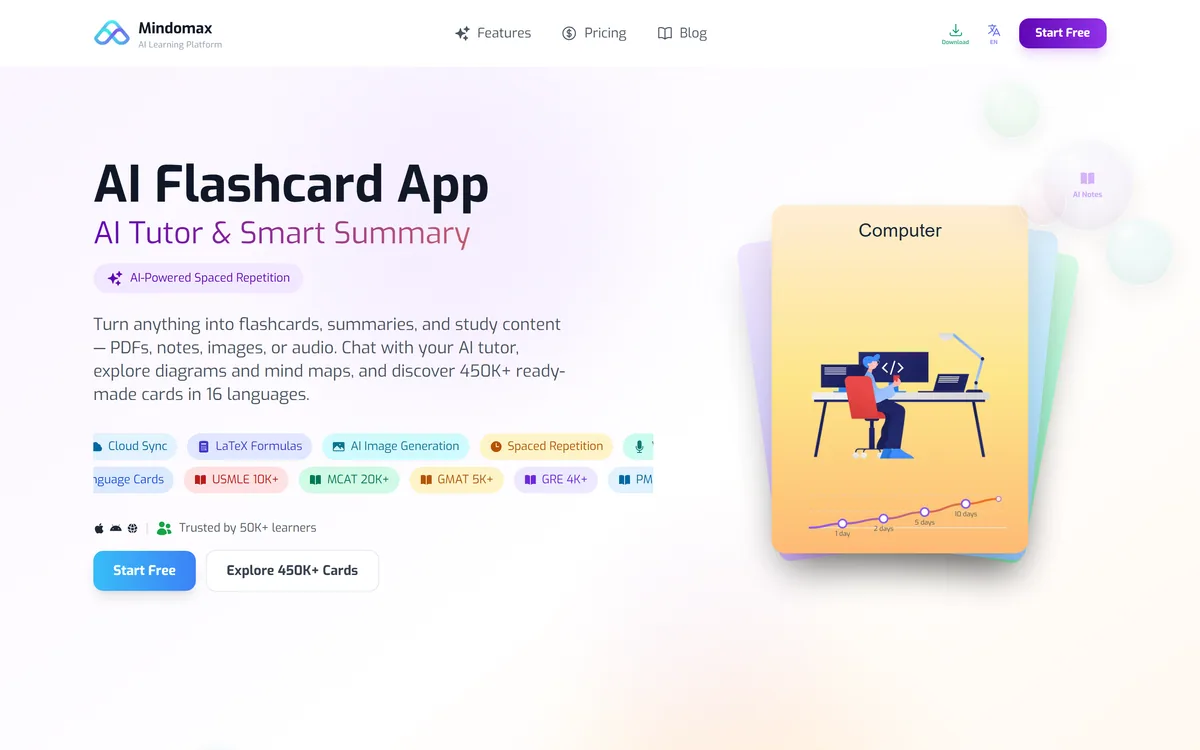
Mindomax, from Lumixis, converts PDFs, notes, images and audio into flashcards, then drills them with spaced repetition and an AI tutor. It supports LaTeX, 16 languages, four platforms, and ships a library of over 450,000 pre-made cards.
Spaced repetition works. That is not really in dispute — testing yourself at expanding intervals is among the better-evidenced findings in learning research, and medical students have organised their lives around it for years.
The reason most people never benefit is upstream of the science. Making good flashcards is slow, dull work, and a student facing four hundred pages of material and an exam in three weeks does not have an evening to spend typing questions.
Mindomax, published by Lumixis, attacks that bottleneck. Feed it a PDF, your notes, a photograph of a textbook page or a recording of a lecture, and it generates the deck. This review covers how well that works, what the AI tutor adds, why LaTeX matters more than it sounds, and where generated cards go wrong.
The pitch is removing the hours spent making cards, which is where most spaced-repetition attempts die.
Inputs, Platforms And Library Size
Publisher
Lumixis
Category
AI flashcards with spaced repetition
Accepted inputs
PDFs, typed notes, images, audio
Core method
Spaced repetition with smart review scheduling
AI features
AI Tutor, AI Card Generation, Voice to Flashcards, AI Image Generation, Talk Me
STEM support
LaTeX formula rendering
Languages
16
Card library
Over 450,000 pre-made cards, including 180,000+ for language study
Library subjects
Chemistry, biology, psychology, computer science, languages
Platforms
iOS, Android, macOS, web, with cloud sync
Named exam audiences
USMLE, MCAT, GMAT, GRE, PMP
Extras
Learning analytics and gamified progression
Four Ways Material Gets In
The input range is the product's real argument, because each one corresponds to a form of study material students genuinely have.
PDFs — lecture slides, past papers, textbook chapters. The most common and the most straightforward.
Typed notes — your own summaries, which produce the best cards because the material has already passed through your understanding once.
Images — photographed textbook pages and handwritten notes, which is how a great deal of study material actually exists.
Audio — the Voice to Flashcards path, aimed at recorded lectures and at students who think out loud better than they write.
Where Generated Cards Go Wrong
Automatic generation solves the bottleneck and introduces a different problem, and no review is honest without stating it plainly.
A good flashcard tests one atomic fact, phrased so that the answer is unambiguous and the question cannot be answered by recognising the wording. Generated cards drift towards two failure modes: cards that bundle three facts into one question, and cards where the phrasing itself gives the answer away.
The second is the more dangerous, because it feels like learning. You recall the card, not the fact, and you find out on the exam that the retrieval was cued by something that will not be present.
The practical answer is to treat generation as a first draft. Reviewing and pruning a generated deck takes a fraction of the time writing it would have, and it is the step that decides whether the deck is worth the hours you will spend drilling it.
Generation turns four hours of card-writing into forty minutes of card-editing. Skipping the forty minutes is how you end up drilling nonsense with great discipline.
The Tutor, The Analytics And The Game Layer
Around the core loop sit an AI Tutor for explanation, a Talk Me voice feature, Learning Analytics, Smart Review, Gamified Learning and Cloud Sync across iOS, Android, macOS and web.
The tutor matters most at the moment a card is failed. Getting a card wrong tells you that you do not know something; it does not tell you why, and being able to ask immediately is the difference between a failed card that teaches you something and one you simply see again in three days.
The analytics are useful in a specific way: they identify which topics you are consistently failing, which is information students are notoriously bad at judging by feel. Most people revise what they enjoy revising.
The gamification is more equivocal. Streaks and points genuinely help a student who struggles to start, and they distort behaviour for one who already has a routine — a streak protected by five easy cards at midnight is a streak, not study. Take the parts that help you and ignore the rest.
LaTeX, Languages And The Pre-Made Library
Three details determine whether Mindomax fits a particular student, and they are easy to skim past.
LaTeX support is binary for STEM. A maths, physics or engineering student whose cards cannot render an equation properly cannot use the tool for the material that matters most. Its presence is what makes the platform viable beyond memorisation-heavy subjects.
Sixteen languages plus a substantial language-learning card collection makes vocabulary a genuine second use case rather than an afterthought — and vocabulary is arguably where spaced repetition is at its most effective.
The 450,000-card library, covering chemistry, biology, psychology, computer science and language study, is the least valuable of the three despite sounding the most impressive. Cards made from your own course material track your syllabus, your lecturer's emphasis and your specific gaps. A pre-made deck tracks somebody else's. Use the library to fill holes, not as the foundation.
Running It Properly For An Exam Block
The tool rewards a particular sequence, and it is not the one most students default to.
Generate from your own notes first, not from the textbook. Material that has already been through your understanding produces sharper cards.
Review the generated deck before drilling it — delete the compound questions and rewrite anything where the phrasing leaks the answer.
Start the spaced repetition early enough for the intervals to actually expand. A week out, spaced repetition is just cramming with extra steps.
Use the AI tutor at the moment a card fails, while you still remember what confused you.
Check the analytics weekly for topics you are quietly avoiding, and add cards there rather than in the areas you already enjoy.
Pull from the pre-made library only to plug specific gaps, once you know from the analytics where those gaps are.
Keep sessions daily and short. Spaced repetition works through consistency, and a three-hour Sunday session does not substitute for six short ones.
The Short Version For A Student
It removes the card-making, which is the step where most people abandon spaced repetition entirely.
Four input types — PDFs, typed notes, photographed pages and audio — so lecture recordings and handwritten notes both get in.
Spaced repetition is the engine, and it is decades-old, well-evidenced learning science rather than an AI novelty.
LaTeX support is the detail that decides whether STEM students can use it at all.
450,000+ pre-made cards exist, but the ones you generate from your own material will nearly always beat them.
Key features of Mindomax
AI card generation from PDFs, notes, images and audio
Spaced repetition scheduling with smart review
An AI tutor for explanation at the moment a card is failed
Voice to Flashcards for lecture recordings and spoken notes
Students whose bottleneck is notes rather than recall
Is Mindomax Right For How You Study?
Say Yes If
Your exam rewards recall of a large volume of discrete facts
You have tried spaced repetition and quit during the card-making
Your material is scattered across PDFs, photographed pages and lecture recordings
You study STEM subjects and need equations to render properly
You have weeks or months before the exam, so intervals can genuinely expand
Say No If
Your assessment is essays or projects, where recall is not the constraint
Your exam is in a few days — spaced repetition needs time to work
You will drill a generated deck without reviewing it first
You need conceptual understanding more than factual recall
You already have a working Anki setup and years of tuned decks
Other Tools For Getting Through A Syllabus
Note-taking, recall and tutoring are separate problems, and most students need at least two solved.
RemNote — spaced repetition woven directly into note-taking rather than bolted on
TurboLearn AI — turns lecture recordings and slides into structured study material
StudyFetch — broader AI study assistance across a whole course
Coconote — note generation from audio, useful upstream of card-making
Khanmigo — guided tutoring when the problem is understanding rather than recall
Claims Traced To Their Source
Last checked . Read from mindomax.com during this check, with the screenshot above captured at the same time.
Conversion of PDFs, notes, images and audio into flashcards, described on the homepage
Feature names — AI Tutor, Spaced Repetition, Smart Flashcards, AI Card Generation, AI File to Flashcards, Voice to Flashcards, AI Image Generation, LaTeX Formulas, Gamified Learning, Cloud Sync, Smart Review, Learning Analytics, Talk Me, Content Library — listed on the site
Platform support for iOS, Android, macOS and web with cloud synchronisation
Sixteen languages supported, and a content library of over 450,000 cards including 180,000+ for language study
Named exam audiences USMLE, MCAT, GMAT, GRE and PMP, taken from the site
Published by Lumixis, with terms of service, privacy policy, GDPR and EULA pages present in the footer
No plan prices published here, in line with this site's pricing policy
The cautions about generated card quality and the value of self-made decks reflect established spaced-repetition practice rather than any claim by Mindomax. Learner counts advertised on the site are the vendor's own figures and are not repeated here as fact.
Editor's Verdict
4.0/5
Mindomax has an AInexfinder Editor Score of 4.0/5.
Mindomax pricing
AInexfinder does not list plan prices or billing details. For current pricing, plans, and trials, visit the official Mindomax website.
Vendor pricing, credits, and billing policies change over time. Always confirm on the official site before you buy.
Frequently asked questions
What can Mindomax turn into flashcards?
PDFs, typed notes, images including photographed textbook pages and handwriting, and audio such as lecture recordings. The breadth matters because study material rarely exists in one tidy format.
Are the generated cards actually good?
Good enough to be a first draft, not good enough to drill unreviewed. Two failure modes recur: questions that bundle several facts together, and phrasing that gives the answer away so you recall the card rather than the fact. Editing the deck takes a fraction of the time writing it would.
Should I use the pre-made library or make my own?
Your own, nearly always. Cards generated from your course material follow your syllabus, your lecturer's emphasis and your gaps. Use the 450,000-card library to plug specific holes once the analytics show you where they are.
Does it handle maths and science properly?
Yes — LaTeX rendering is supported, which is the deciding factor for STEM. Without it, a physics or engineering student cannot make cards for the material that matters most, no matter how good the rest of the tool is.
How far in advance do I need to start?
Weeks, ideally months. Spaced repetition works by expanding the interval between reviews, and there is no interval to expand a few days out. Started late, it is cramming with extra administration.
What does the AI tutor add over just seeing the card again?
Explanation at the moment of failure. Getting a card wrong tells you that you do not know something but not why, and asking immediately — while you still remember what confused you — is what converts a failed card into learning rather than a repeat.
Is it worth switching from Anki?
If your Anki setup works and your decks are tuned, probably not. The generation and the tutor are the reasons to move; years of curated cards and established habits are strong reasons to stay.
Daniel reviews AI tools the slow way — by actually using them on real projects. His reviews cover what works, what breaks, and who each tool is genuinely a good fit for.
Daniel and the AInexfinder editorial team research Mindomax using public product information, listing evidence, and (when available) hands-on checks. Scores reflect listing completeness and transparency — not paid placement.
Listings may include affiliate or sponsored placements, which are labeled when present. Editorial scores and cons are not sold. See our affiliate disclosure and review methodology.
LUCA is a K-12 reading intervention platform that analyses student reading at the phoneme level rather than the word level, identifying skill gaps in real time. It reports a 17.4 words-per-minute average fluency gain and 763,000+ grapheme-phoneme mappings, delivered through SoundScout, StoryGen and Assessment Intelligence.
Question AI is a homework-helper app that scans a question and returns step-by-step answers across school subjects, plus AI writing, search, translation and summarizing. Its study uses are legitimate; using it to hand in answers or graded work crosses academic-integrity lines, which we weigh honestly.
Gizmo is a mobile-first study app that turns your notes, PDFs, slides and YouTube videos into AI-generated quizzes and flashcards, built around active recall so revision becomes a habit rather than a chore.
RemNote combines outlining, handwriting, PDF annotation and spaced-repetition flashcards in one document, generating cards, quizzes and summaries from PDFs, slides, lecture transcripts and video, with an exam scheduler that works backwards from a date you set.
StudyFetch turns course material — PDFs, slides, lecture recordings, YouTube videos, photographed notes — into flashcards, quizzes, summaries and an AI tutor called Spark.E that answers only from your uploaded content.
ThetaWise is a STEM study tool covering maths, science and engineering with step-by-step solutions, a Tutor Mode that guides through hints, generated animated video lessons, practice quizzes, flashcards and Desmos graphing, stating 765,781 students.