
Descript is a video and audio editor that works by editing a transcript — delete a sentence and the footage goes with it — plus Studio Sound, Eye Contact, filler-word removal, AI voices, avatars, and the Underlord assistant.
FreemiumVideo & Audio
Munch has rebranded to Munch Studio and repositioned from short-form video clipping to full AI social media marketing. You give it your website, videos, photos or call recordings, and it builds a content strategy, generates posts in your brand voice, and schedules them across your channels.
This product has changed substantially. Munch was widely known as a long-form video clipping tool. The site at getmunch.com now redirects to munchstudio.com, and the product is positioned as an AI social media marketing platform. If you are looking for the clipping tool, this listing explains what replaced it and points at alternatives.

Munch built its reputation on one specific job: taking a long video and finding the short clips inside it worth posting. That was a real product with a real audience of podcasters, streamers and webinar producers, many of whom now use Descript or a dedicated clipper instead.
The product now at munchstudio.com is a different thing. It takes a business website and produces a social media presence — strategy, posts, scheduling — with video as one possible input among photos, recordings and the site itself.
This matters practically rather than as trivia. Anyone arriving from a two-year-old recommendation, a bookmark or a listicle is looking for a clipping tool and will find a social marketing agent. Those serve different buyers entirely.
It is also a rational move, and worth understanding as one. Clipping became commoditised extremely fast — OpusClip and a dozen others do it competently, and the underlying capability is now a feature inside larger editors rather than a product. Competing there means competing on price.
Moving up to owning the whole social output of a small business is a larger, stickier problem with less direct competition on capability. Whether the execution justifies it is a separate question, but the strategic logic is sound.
If clipping is what you actually need, this listing's related section points at the tools that still do it, and that is the honest recommendation.
Clipping a long video became a feature inside other people's products. Moving up the stack was the rational response, even if it strands the audience that made the name.
The onboarding — paste your domain and see what happens — is the most defensible design decision in the product.
The reason is that the hardest part of social media for a small business is not writing posts. It is knowing what to post about, consistently, without running out of ideas by week three. That is a strategy problem, and most tools skip it entirely by handing you a blank composer.
A website contains most of what a strategist would ask for in a kickoff meeting: what the business sells, how it describes itself, who it is for, what it thinks is important, and the vocabulary it uses. Deriving a content plan from that is a reasonable substitute for a brief nobody was going to write.
Conventional schedulers like eclincher assume you arrive with content already made. Accepting photos, videos and call recordings extends the same logic to material businesses already have. A recorded customer call contains genuine language about real problems, which is better raw material for a post than anything invented.
The limit is the obvious one. A website describes what a business says about itself, which is not always what its customers find interesting. A tool working from that source inherits any positioning weakness the site already has — and a business whose site is vague will get vague posts.
The vendor's framing of approve-and-schedule rather than fully automated is the right one. A review step is what stops derived strategy from drifting into generic output.
The public material is noticeably thinner than the category norm, and being straightforward about the gaps is more useful than filling them in with assumptions.
Which platforms it publishes to is not specified on the pages reviewed. That is the single most important operational fact about a social scheduling tool, and it should be the first question you ask. Coverage of LinkedIn, Instagram, TikTok, X, Facebook and YouTube differs enormously between products, and API access to each is not equally available.
Language support is not stated, which matters for anyone operating outside English.
The pricing structure is not detailed beyond a free trial being offered — no tiers, no metering, no indication of whether it is priced per brand, per channel or per post.
The named logos are shown without explanation. Asurion, Anaconda, Nas Daily, HubSpot and Perion appear on the homepage, and what each of them uses the product for, at what scale, is not described. Logos on a homepage can reflect anything from an enterprise deployment to a single trial account.
None of this means the product is weak. It means the site is currently doing less work than a buyer needs, and the sensible response is to get those five answers in writing before committing anything.
This site does not publish plan prices, and in this case the vendor publishes very little structure either.
What is stated is that a free trial is offered. Subscription tiers are referenced without detail — no metering, no plan names, and no indication of what scales the cost.
In this category the meters are predictable enough to ask about directly: number of brands or workspaces, number of connected social accounts, posts generated per month, and seats. Agencies almost always hit the brand or account limit first, while a single business usually hits post volume.
One question specific to this product's inputs: whether processing video and call recordings is metered separately from generating text posts. Media processing is materially more expensive to run than text generation, and tools that accept both frequently price them differently.
Because the structure is undocumented, the free trial is doing more work here than usual. Treat it as the point at which you extract the answers rather than as a free sample — and get the pricing terms confirmed in writing before it expires.
The same structural limit applies here as to every tool that generates social posts from derived context, and it is worth naming.
Social media rewards specificity and timeliness, and both are exactly what a system working from a static website cannot supply. The post that performs is usually about something that happened this week, or a genuine opinion, or a customer story with a real name attached.
Consistency is the thing it genuinely fixes, and that is not a small thing. Most small business social accounts fail by going quiet, not by posting mediocre content. A steady stream of adequate posts outperforms an abandoned account decisively.
So the realistic value is a floor rather than a ceiling: it keeps something present and on-message while you do the work that actually generates attention.
The failure mode to guard against is treating the generated stream as sufficient. An account posting only derived content builds no distinct voice, and audiences learn to scroll past it. Mixing in genuine, timely, human posts is what makes the automated ones worth having.
One case study figure on the site showed zero percent increases across measured categories, which appears to be a rendering problem rather than a claim. It is not treated as evidence either way here.
Content strategy derived automatically from your website
Post generation in a customised brand voice and tone
Input from business websites, videos, photos and call recordings
Review and approval before publishing
One-click posting
Non-technical editing of generated posts
Scheduling across connected channels
The first two rows are the comparison most readers actually need, because they arrived expecting a clipping tool.
| Tool | What it does | Input | Who it suits |
|---|---|---|---|
| Munch Studio | Plans, generates and schedules social posts | Your website, photos, videos, recordings | Small businesses with no social capacity |
| OpusClip | Finds and cuts short clips from long video | Your long-form video | Podcasters and streamers — the old Munch audience |
| AutoShorts.ai | Generates faceless shorts and auto-posts them | A topic prompt | Faceless channel operators |
| Sprout AI | Social management and scheduling | Your own content | Teams with a social manager |
| eclincher | Publishing, engagement and monitoring | Your own content | Agencies and multi-account teams |
| Current name | Munch Studio |
|---|---|
| Previous positioning | Long-form video to short-form clip repurposing |
| Domain change | getmunch.com redirects to munchstudio.com |
| Category | AI social media marketing and content generation |
| Onboarding | Enter a business website to generate a tailored content strategy |
| Accepted inputs | Business websites, videos, photos, and call recordings |
| Output | Social posts written to a derived content strategy and brand voice |
| Workflow | Generate, review and approve, then schedule or publish in one click |
| Editing | Posts editable without technical skill |
| Logos shown on site | Asurion, Anaconda, Nas Daily, HubSpot, Perion — shown without describing each engagement |
| Not stated on site | Which social platforms it publishes to, supported languages, and pricing tiers or metering |
| Charging model | Free trial offered; subscription tiers referenced without detail. No prices published here |
These are the honest alternatives for anyone who arrived looking for what Munch used to be.
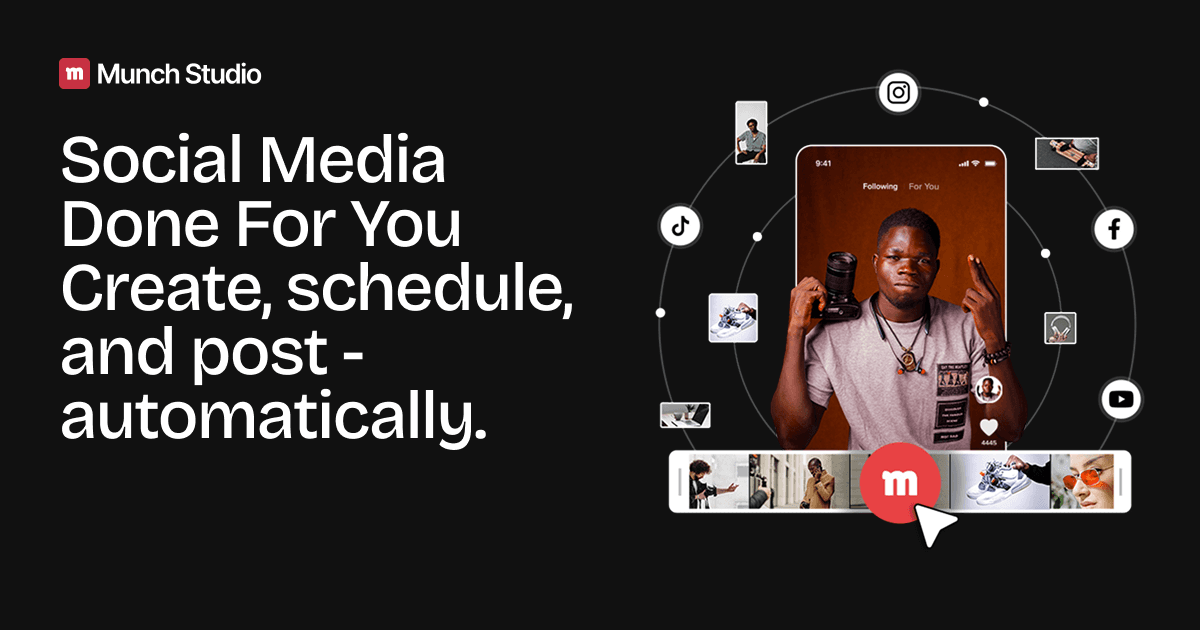
Last checked . Read from munchstudio.com during this check, reached via a redirect from getmunch.com, with the screenshot above captured at the same time.
This product has repositioned substantially from the video clipping tool it was known as, which is the most important fact for anyone arriving from an older recommendation. Publishing platforms, language support and pricing structure are not documented on the site — get those in writing before committing. Homepage logos are shown by the vendor without describing the nature or scale of each engagement, and should not be read as endorsements.
Munch has an AInexfinder Editor Score of 3.4/5.
AInexfinder does not list plan prices or billing details. For current pricing, plans, and trials, visit the official Munch website.
Visit official website for pricingVendor pricing, credits, and billing policies change over time. Always confirm on the official site before you buy.
Log in to write a review.
No reviews yet. Be the first to share your experience with Munch.
Assigned reviewer
Daniel ReedSenior AI Tools Reviewer
Daniel reviews AI tools the slow way — by actually using them on real projects. His reviews cover what works, what breaks, and who each tool is genuinely a good fit for.
Daniel and the AInexfinder editorial team research Munch using public product information, listing evidence, and (when available) hands-on checks. Scores reflect listing completeness and transparency — not paid placement.
Descript is a video and audio editor that works by editing a transcript — delete a sentence and the footage goes with it — plus Studio Sound, Eye Contact, filler-word removal, AI voices, avatars, and the Underlord assistant.
Vibrantsnap is an AI tool that turns a rough screen recording into a polished walkthrough: it rewrites your narration, reads it in a studio voice in any language, and auto-edits the video with zooms, chapters and captions.
Kapwing is a browser-based video studio combining a timeline editor, subtitler, audio editor and dubbing into 40+ languages with AI tools including Smart Cut, Trim with Transcript, B-Roll Generator, Clip Maker and Character Consistency. Made in San Francisco.
BlipCut translates and dubs video into more than 140 languages with AI lip synchronisation, so translated speech aligns with the speaker's mouth. It also clones voices in 29 languages, offers 600+ voices across 40+ languages, and generates, translates and edits subtitles from uploads or YouTube links.
VEED is an AI video-creation platform that takes an idea to a finished social video in the browser, bundling generation, AI avatars, subtitles, dubbing, clean audio and a brand kit, plus access to frontier models like Sora 2, Veo and Kling.
BIGVU is an AI personal-branding video platform with a teleprompter, AI avatars and voice cloning, auto-editing (caption, filler removal, eye-contact correction), and one-click social posting, aimed at realtors, coaches and marketers, with synthetic-media features that carry likeness and consent considerations.