OpenHands is an open-source platform for agentic software development: AI agents that work in your repositories through conversations and scheduled automations, with your choice of model, available locally, as a cloud service, through an SDK and with an enterprise control plane.
openhands.dev6 viewsAdded January 3, 20263K visitors
Coding assistants that suggest the next line are now table stakes; the frontier is agents that take a task, work through a repository and come back with a change. OpenHands is one of the best-known open-source platforms built for exactly that.
It lets agents work in your codebase through conversations and scheduled automations, with your choice of model, running locally, in the cloud, through an SDK or under an enterprise control plane. It sits alongside terminal tools like Aider, but aims to be a full platform for agentic development rather than a single assistant.
This review covers how OpenHands agents work on a codebase, where it fits an engineering organisation, how it is packaged, and the guardrails agents still need.
OpenHands runs AI coding agents on real repositories, with conversations and automations.
OpenHands, The Open-Agent Brief
OpenHands is an open-source coding-agent platform: agents that read, change and test code in real repositories.
It goes beyond chat: scheduled automations handle jobs like PR review, security passes and docs syncing.
You choose the model and where it runs: locally, in OpenHands Cloud, via an SDK, or with an enterprise control plane.
Agents still need guardrails: review their pull requests and limit their permissions like any new contributor.
Large open-source following (90K+ GitHub stars shown)
Access
Open source, with cloud and enterprise tiers
An Open-Source Platform For Software-Building Agents
OpenHands treats an AI agent less like autocomplete and more like a junior contributor. You describe what you want built, fixed or investigated, and the agent works inside a real repository: reading files, editing code, running commands and proposing a change for you to review.
Its open-source roots matter. The project has one of the largest followings among coding-agent tools, which means it is inspectable, extensible and not tied to one vendor's model, an important property for teams wary of lock-in or with strict data rules.
The platform has grown around that core: a cloud service, an SDK for embedding agents in your own tooling, an agent canvas and an enterprise control plane for governance. That breadth lets the same agent approach scale from one developer's laptop to an organisation.
The honest framing is that OpenHands is a serious, capable foundation for agentic development, but agents are not yet autonomous engineers. They need clear tasks, limited permissions and human review of what they change, and the payoff depends heavily on how well you set those up.
OpenHands treats an AI agent like a junior contributor: useful on real repositories, but its changes still deserve review.
How Do OpenHands Agents Work On A Codebase?
Day to day, OpenHands combines interactive work with automations that run on a schedule or trigger.
Conversations, Automations And Bring-Your-Own Models
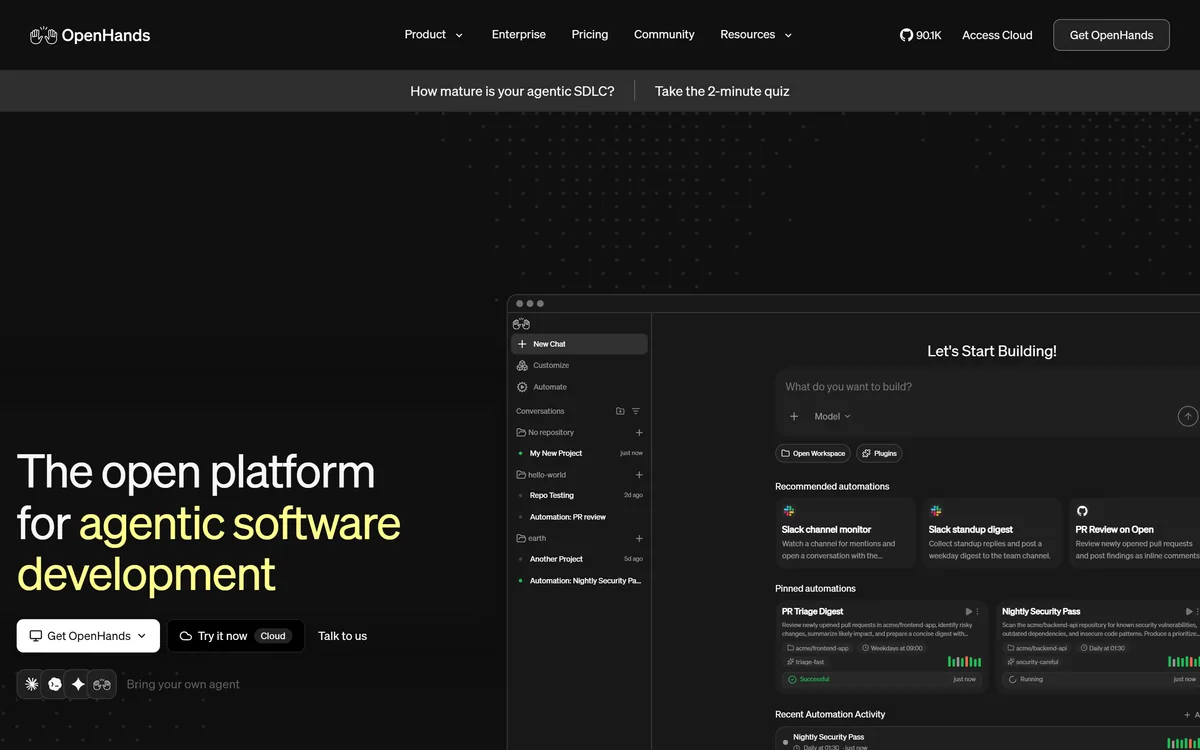
You can open a conversation in a project and ask the agent to build, fix or explain something, and you can set up automations such as reviewing newly opened pull requests, a nightly security pass over a repository, syncing docs on each push or monitoring a Slack channel and opening a conversation from a mention. You can also bring your own agent and pick the model.
That model choice is a real differentiator. Compared with a commercial assistant like Tabnine, which centres on governed, private code assistance, OpenHands is a more open, agent-first platform you can point at whichever model fits your cost and data constraints.
Cloud, Local, SDK And An Agent Control Plane
OpenHands runs locally, as OpenHands Cloud, through an SDK for building agents into your own products, and with an enterprise offering that adds an agent control plane for governance. That spread suits both individual developers experimenting and platform teams standardising agent use.
For developers who prefer a spec-first, IDE-centred workflow, a tool like Kiro structures work around specifications; OpenHands is broader infrastructure for running agents across many tasks and repositories.
Where OpenHands Fits An Engineering Org
OpenHands fits engineering teams that want to experiment with, and then operationalise, AI agents on real codebases: automating repetitive review and maintenance work, triaging pull requests, running security passes or handling well-scoped tickets.
It suits open-source-minded teams and those with data or model constraints, since it can run locally with a model of your choice, and platform teams who want an SDK and control plane rather than a closed product.
It fits less well teams expecting an agent to replace engineers on complex, ambiguous work, and organisations without the capacity to define tasks, review agent output and manage permissions. Agents can produce plausible but wrong changes, so review processes matter.
A sensible way to think about it is maturity: teams already comfortable with code review and CI will get value quickly, because agent output slots into a process that catches mistakes; teams without that discipline may find agents add risk faster than they add speed.
How OpenHands Splits Free, Cloud And Enterprise
OpenHands is open source and can be self-hosted at no licence cost, with OpenHands Cloud and enterprise tiers for hosted use, collaboration and governance. Model usage costs depend on the model you connect. We do not publish prices, which change; check the site.
The real cost question is model spend plus review time against engineering hours saved. Agents can burn through tokens on large tasks, so tracking usage per task matters as much as any subscription.
The sensible approach is to start with the open-source version or a small cloud pilot on one repository and one or two automations, measure the time saved and the review burden, and expand only once the numbers hold.
Piloting OpenHands On One Repository
Because agent value depends on task design and review, pilot OpenHands on one repository with narrow, measurable jobs.
Pick one repository and a narrow task type, such as PR review or small bug fixes.
Run OpenHands locally or in the cloud with a model your team is allowed to use.
Limit the agent's permissions and keep a human approval step on every change.
Set up one automation, such as reviewing new pull requests, and read its output critically.
Track model costs and review time per task alongside time saved.
Pass/fail: OpenHands is worth scaling if agents save more time than they cost to review.
Treat star counts and benchmarks as popularity signals, not proof of fit for your codebase.
OpenHands Agentic-Development Terms
Coding agent
An AI system that takes a task and works through a codebase, editing files and running commands, rather than only suggesting code.
Automation
A recurring or triggered agent job, such as reviewing every new pull request or running a nightly security pass.
Bring your own model
Choosing which AI model powers the agent, including local or self-hosted models, instead of a fixed vendor model.
Control plane
The governance layer that manages agents' permissions, usage and oversight across an organisation.
Key features of OpenHands
Open-source coding agents
Conversational tasks on repositories
Scheduled automations
Bring-your-own model
Local and cloud deployment
Agent SDK
Enterprise control plane
PR review automation
Pros & cons
Pros
5
Open source and inspectable
Choice of model, avoids lock-in
Automations beyond chat
Scales from laptop to enterprise
Strong community momentum
Cons
5
Agents still need careful review
Model costs can climb on big tasks
Requires task and permission discipline
Not a replacement for engineers
Setup effort for self-hosting
Best For
Agentic development pilots
PR review automation
Open-source engineering teams
Model-flexible orgs
Platform teams
OpenHands Among Other AI Coding Agents
The useful comparison is with other ways to bring AI into coding work.
No prices reproduced here, in line with this site's pricing policy
OpenHands is a capable agent platform, but agents can make plausible yet wrong changes. Keep permissions narrow and human review on every change. Popularity figures are signals, not proof of fit.
Coding Agents To Weigh Beside OpenHands
A terminal pair-programmer, a spec-driven IDE and an enterprise assistant to weigh alongside OpenHands.
OpenHands earns 4.3 as one of the strongest open-source foundations for agentic software development: agents that work in real repositories through conversations and scheduled automations, with your choice of model, running locally, in the cloud, via an SDK or under an enterprise control plane. It suits teams ready to operationalise agents with clear tasks, narrow permissions and solid review. Agents still make plausible mistakes and model costs need watching, so start with one repository and measure before scaling. AInexfinder Editor Score: 4.3/5.
OpenHands pricing
AInexfinder does not list plan prices or billing details. For current pricing, plans, and trials, visit the official OpenHands website.
Vendor pricing, credits, and billing policies change over time. Always confirm on the official site before you buy.
Frequently asked questions
What is OpenHands?
OpenHands is an open-source platform for AI coding agents. Agents work inside real repositories through conversations and scheduled automations, with your choice of model, and can run locally, in OpenHands Cloud, through an SDK or with an enterprise control plane.
Is OpenHands free?
The core project is open source and can be self-hosted without a licence fee, though you pay for whatever model you connect. OpenHands Cloud and enterprise tiers add hosted use and governance. We do not publish prices; check the site.
What can OpenHands automations do?
Examples shown include reviewing newly opened pull requests, running a nightly security pass over a repository, syncing documentation on each push and monitoring a Slack channel to open conversations from mentions.
Which AI models does OpenHands use?
You can bring your own model or agent, including hosted frontier models or locally run open models, which helps with cost control and data-residency requirements.
Can OpenHands replace software engineers?
No. It can take on well-scoped tasks and repetitive work, but agents can produce plausible yet wrong changes. Human review, clear tasks and limited permissions remain essential.
Is OpenHands safe to run on private code?
Running it locally with a model you control keeps code in your environment. In the cloud, review the provider's data terms. In all cases, restrict the agent's permissions and keep approvals on changes.
Who is OpenHands best for?
Engineering teams ready to operationalise AI agents for review, maintenance and well-scoped tickets, especially open-source-minded teams and platform teams that want an SDK and governance rather than a closed product.
How does OpenHands compare to Aider?
Aider is a focused terminal pair-programmer for individual developers. OpenHands is a broader platform for running agents across tasks and repositories, with automations, cloud and enterprise options.
What does an OpenHands pilot cost?
Mostly model usage plus your team's review time, and optionally a cloud or enterprise plan. Track cost and review effort per task so you can judge whether agents actually save time.
Are OpenHands' popularity figures meaningful?
Large GitHub followings and benchmark results show momentum and capability, but they are not proof the platform suits your codebase. Measure it on your own tasks.
Daniel reviews AI tools the slow way — by actually using them on real projects. His reviews cover what works, what breaks, and who each tool is genuinely a good fit for.
Daniel and the AInexfinder editorial team research OpenHands using public product information, listing evidence, and (when available) hands-on checks. Scores reflect listing completeness and transparency — not paid placement.
Listings may include affiliate or sponsored placements, which are labeled when present. Editorial scores and cons are not sold. See our affiliate disclosure and review methodology.
GitHub Copilot is an AI coding assistant that spans completion, chat, agent mode, automated code review, and a cloud agent that opens pull requests, working across VS Code, Visual Studio, JetBrains, Xcode, Neovim, Eclipse, the CLI, and github.com.
Replit AI turns a written description into a working application — the Agent writes the code, and Replit supplies the database, authentication, hosting, and monitoring, so a prototype goes live without a local setup or a deployment pipeline.
Tabnine is an enterprise AI coding assistant offering context-aware code completion, chat and agents with private deployment and a codebase-wide context engine. In July 2026 it was acquired by Tricentis, and tabnine.com now routes to the Tricentis agentic quality engineering platform.
Zencoder is an AI orchestration platform for engineering work: agents plan with one model, build with another and review with a third, across multi-repo indexing and full dependency mapping, inside VS Code and JetBrains. It adds scheduled automation and a work layer spanning Jira, Slack and Notion.
Cline is an open-source AI coding agent that works in your editor as a VS Code extension, in the terminal as a CLI, as a desktop app and through an SDK, using any model including open-weight ones, with a plan-and-act workflow where you approve its actions.
Pieces runs in the background on your computer forming a searchable memory of your work, capturing what you see and what you copy by default and what you hear only if you opt in. It builds a chronological timeline across Gmail, Outlook, browsers and Slack, and generates standups, briefs and recaps from real context.