Pi is a free personal AI from Inflection AI designed for warm, conversational support: thinking things through, talking about your day or rehearsing a tough conversation. It is a companion-style chatbot, not a productivity assistant, and not a substitute for professional mental-health care.
Most chatbots are built to answer questions and finish tasks. Pi was built for something different: being a patient, friendly conversation partner you can think out loud with.
It opens like a chat with a person rather than a tool, offers to help you through a tough conversation, keep your day on track or just keep you company, and is free to use. That makes it a different proposition from task-first assistants, and from privacy-first front-ends like Duck.ai that give you access to several general models.
This review covers what Pi is genuinely good at, where it stops, the company backstory that matters for its future, and who it suits.
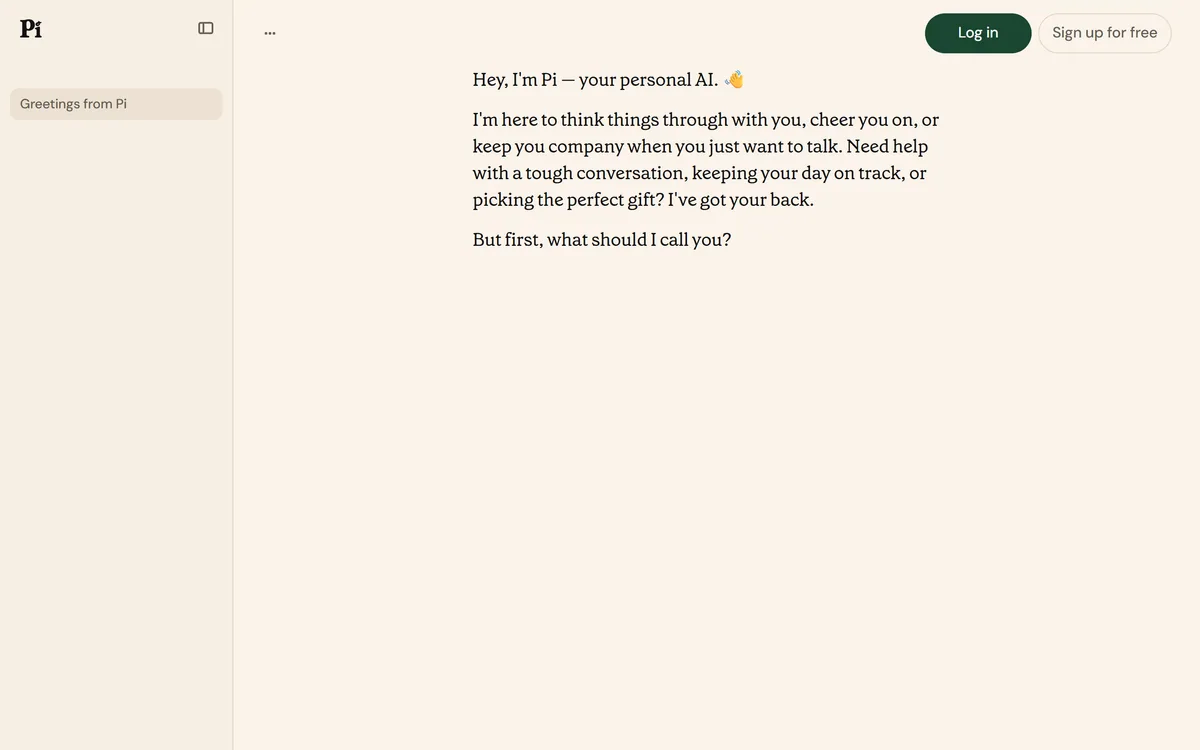
Pi opens with a conversation, introducing itself as a personal AI.
Pi Personal-AI Facts
What it is
A conversational personal AI companion
Maker
Inflection AI
Strength
Warm, supportive back-and-forth conversation
Use cases
Thinking things through, rehearsing conversations, everyday chat
History
Chats kept past 60 days only when logged in
Cost
Free to use
Caveat
Pi itself warns it may make mistakes
Not
Not therapy, medical advice or a crisis service
Pi, The Companion Brief
Pi is a conversational personal AI: it is built to talk things through, not to write code or run research.
Its tone is the product: warm, patient and back-and-forth, which suits reflection, rehearsal and everyday chat.
It is not therapy: supportive conversation is not mental-health care or a crisis service.
Its maker changed course: Inflection pivoted toward enterprise in 2024, so Pi's long-term roadmap is less certain than rivals'.
A Personal AI Built For Conversation, Not Tasks
Pi's defining choice is its personality. It is designed to be curious, encouraging and conversational, asking follow-up questions and keeping a gentle tone, rather than producing long, structured answers. The first thing it asks is what to call you.
That design is a genuine differentiator. Many people find it easier to think something through with a responsive conversational partner than with a search box, and Pi's patient style suits reflection, journaling-style chats, practising a difficult conversation or just unwinding.
The trade-off is that Pi is not built to be a power tool. It is not the assistant to reach for when you need code, deep research, document analysis or precise, sourced answers, and other assistants have moved much faster on those capabilities.
So the fair framing is that Pi does one thing distinctively well, warm conversation, and should be judged on that. Treat it as a companion for talking, not a replacement for a capable general assistant or for real professional help.
Pi does one thing distinctively well, warm conversation, and should be judged on that rather than as a general-purpose assistant.
What Is Pi Actually Good At?
Pi's strengths are conversational, and its limits are both technical and about the company behind it.
Empathetic, Back-And-Forth Conversation
Pi is good at keeping a conversation going: reflecting back what you said, asking what you meant, offering encouragement, and helping you rehearse how you might say something to someone. For people who want to process a thought rather than get an instant answer, that style can be genuinely helpful.
If you want cited, current answers instead, an answer engine like Perplexity AI is the better tool; Pi's value is the quality of the conversation, not the depth of the information.
Where Pi Stops, And The Inflection Backstory
Pi is not designed for coding, long documents or heavy research, and like any chatbot it can be wrong, a point it states itself. It is also not a mental-health service: supportive chat can feel helpful, but it is no substitute for a qualified professional, and anyone in crisis should contact local emergency services or a crisis line.
The backstory matters too. In 2024 Microsoft hired Inflection's co-founders and much of its team, and Inflection refocused on enterprise AI; Pi has continued to run, but its pace of development and long-term roadmap are less certain than those of rivals. A fast-moving frontier model like DeepSeek shows how quickly general assistants are advancing by comparison.
Who Pi's Conversational Style Suits
Pi is for people who want a friendly, patient AI to talk to: to think through a decision, practise a hard conversation, reflect on their day, or simply chat. For those uses, its tone is more important than raw capability, and it delivers on that.
It suits people who find structured, list-heavy AI answers cold or overwhelming and prefer a conversational back-and-forth, and anyone curious about companion-style AI without paying for it.
It is not for people who need a productivity or research assistant, anyone looking for professional emotional or mental-health support, or teams needing a reliable long-term platform. Because Pi can feel personal, it is also worth being mindful about what private details you share with any chatbot.
What Using Pi Costs
Pi is free to use, with a free sign-up that saves your chat history beyond 60 days. There was no paid tier presented on the page at the time of checking; check the site for current terms.
The value question is therefore less about money and more about fit and privacy: a free companion chatbot is low-risk to try, but consider what personal information you are comfortable sharing, and read the privacy policy before relying on it.
Because it costs nothing, the sensible approach is to have a few real conversations of the kind you would actually want, and judge whether Pi's style genuinely helps you think, rather than expecting it to do the work of a general assistant.
A Gentle First Chat With Pi
Because Pi is about conversation quality, judge it on a real conversation, not a quiz of facts.
Start a chat about something you are genuinely thinking through.
Notice whether its follow-up questions help you clarify your own view.
Try rehearsing a difficult conversation and see how useful the practice feels.
Ask a factual question and double-check the answer, as Pi itself advises.
Read the privacy policy before sharing anything sensitive.
Pass/fail: Pi is worth using if its conversation genuinely helps you reflect or feel heard.
If you are struggling, contact a qualified professional or a crisis line, not a chatbot.
Key features of Pi
Conversational personal AI
Warm, supportive tone
Follow-up questions and reflection
Conversation rehearsal
Free to use
Saved chat history with an account
Web access
Personalised name and chat
Pros & cons
Pros
5
Distinctively warm, patient conversation
Good for reflecting and rehearsing
Free to use
Low-friction to start
Feels less cold than task-first assistants
Cons
5
Not built for coding, research or documents
Not a mental-health or crisis service
Maker refocused on enterprise; roadmap uncertain
Can make mistakes, as it warns
Personal chats raise privacy considerations
Best For
Talking things through
Rehearsing conversations
Everyday reflection
Casual companion chat
Free conversational AI
Pi Against Other Chat Assistants
The useful comparison is with other assistants, by what each is built to do.
People who want a patient AI to talk things through
Anyone rehearsing a difficult conversation
Those who find list-heavy AI answers cold
People curious about companion AI at no cost
Everyday reflection and casual chat
When Pi's Companion Chat Is Not Enough
Anyone needing a coding or research assistant
People seeking mental-health or crisis support
Teams needing a long-term, fast-developing platform
Those wanting cited, current information
Anyone uncomfortable sharing personal details with a chatbot
How This Pi Review Was Researched
Last checked . Read from pi.ai during this check, with the screenshot above captured at the same time.
Pi introduces itself as a personal AI
It offers help thinking things through, with tough conversations or the day ahead
It opens by asking what to call you
Sign-up is free; chat history is saved beyond 60 days when logged in
Pi states that it may make mistakes
Terms and a privacy policy are linked at sign-up
No paid tier was presented on the page at the time of checking
Pi is a supportive conversation tool, not therapy, medical advice or a crisis service. Inflection, its maker, refocused on enterprise in 2024; Pi continues to run, but its roadmap is less certain. Our check is based on the public page, not extended use.
Other Chat And Companion Tools
A private chat front-end, a frontier model and an answer engine to weigh alongside Pi.
Pi earns 3.7 as a distinctive companion-style AI: warm, patient and genuinely good at back-and-forth conversation, which suits thinking things through, rehearsing a hard talk or simply chatting, and it costs nothing. It is not a productivity or research assistant, and it is not therapy or a crisis service. Its maker, Inflection, refocused on enterprise in 2024, so while Pi keeps running its long-term development is less certain than rivals'. Use it for conversation, judge it on how much it helps you reflect, and keep a capable assistant for real work. AInexfinder Editor Score: 3.7/5.
Pi pricing
AInexfinder does not list plan prices or billing details. For current pricing, plans, and trials, visit the official Pi website.
Vendor pricing, credits, and billing policies change over time. Always confirm on the official site before you buy.
Frequently asked questions
What is Pi?
Pi is a free personal AI from Inflection AI built for supportive conversation. It is designed to talk things through with you, help you rehearse a tough conversation or keep you company, rather than to write code or run research.
Is Pi free?
Yes. Pi is free to use, and a free account saves your chat history beyond 60 days. No paid tier was presented on the page at the time of checking; check the site for current terms.
Is Pi a therapist?
No. Pi can offer supportive conversation, but it is not therapy, medical advice or a crisis service. If you are struggling, contact a qualified professional, and in a crisis contact local emergency services or a crisis line.
Who makes Pi?
Pi was built by Inflection AI. In 2024 Microsoft hired Inflection's co-founders and much of its team, and Inflection refocused on enterprise AI. Pi has continued to run, but its pace of development and long-term roadmap are less certain.
What is Pi good at?
Warm, patient, back-and-forth conversation: reflecting your thoughts back, asking follow-up questions, offering encouragement and helping you practise how to say something. Its tone, more than its raw capability, is what sets it apart.
Can Pi help with coding or research?
It is not designed for that. For code, analysis or cited research, a capable general assistant or an answer engine is the better tool. Pi is best judged as a conversation partner rather than a productivity assistant.
Is Pi private?
Pi links its terms and privacy policy at sign-up. Because conversations with a companion AI can feel personal, read the policy and be mindful about what sensitive details you share with any chatbot.
Who is Pi best for?
People who want a patient AI to think out loud with, rehearse difficult conversations or chat casually, and who prefer a conversational style to list-heavy answers. It is not for anyone needing professional support or a research and productivity tool.
How does Pi compare to ChatGPT-style assistants?
General assistants focus on capability across coding, writing, research and analysis. Pi focuses on the quality of conversation. If you want answers and output, a general assistant wins; if you want to be listened to and think something through, Pi's style is the point.
Can I trust Pi's answers?
Treat them with care. Pi itself states that it may make mistakes and advises double-checking important information. Use it for conversation and reflection, and verify any factual claims elsewhere.
Daniel reviews AI tools the slow way — by actually using them on real projects. His reviews cover what works, what breaks, and who each tool is genuinely a good fit for.
Daniel and the AInexfinder editorial team research Pi using public product information, listing evidence, and (when available) hands-on checks. Scores reflect listing completeness and transparency — not paid placement.
Listings may include affiliate or sponsored placements, which are labeled when present. Editorial scores and cons are not sold. See our affiliate disclosure and review methodology.
MaxAI is a browser-extension AI assistant that puts a sidebar on every page, letting you ask about the current page, use several top AI models in one place, write, translate, generate images and reuse prompts, without tab-switching or copy-pasting.
Exa is a search API that gives AI agents real-time access to the web, built on its own large index, embedding and retrieval models, with selectable latency, search verticals, token-efficient highlights, structured enrichments and an MCP server.
Felo is a multilingual AI search and creation platform from Felo Inc. It pairs an answer engine with Felo Slides, an agent mode, an LLM playground, LiveDoc and an API, with the multilingual layer as its distinguishing feature rather than an afterthought.
R Discovery is a research reading and literature search app from Cactus Communications, covering 150M+ journal articles, 78M+ open access papers and 10M+ conference documents. It offers AI summaries with citations, chat with a PDF, generated literature reviews, audio papers and translation into 30+ languages.
Voiceflow is an enterprise conversational AI platform where CX teams design agent workflows visually, prototype them in place, and deploy one agent across web, app, WhatsApp, SMS and voice. It states 500-millisecond voice latency, 300,000 messages per minute and more than 10,000 live agents in production.