RapidNative is an AI mobile-app builder that turns a prompt, sketch, document or screenshot into a full-stack React Native app with auth, storage, realtime and a Postgres database, and helps convert, list and submit it to the App Store and Google Play.
rapidnative.com6 viewsAdded June 30, 20253K visitors
Vibe-coding tools have made web prototypes easy, but getting a real native app into the App Store and Google Play is still a slog of builds, listings and compliance. RapidNative focuses squarely on that mobile gap.
It turns a prompt, sketch, product doc or screenshot into a full-stack React Native app with auth, storage, realtime and a database, then helps you ship it to both stores. It sits next to web-first builders like Emergent, and even offers paths to bring apps from those tools onto mobile.
This review covers how RapidNative ships an app, who it is really for, how it prices, and where generated mobile apps still need human work.
RapidNative builds React Native apps from a prompt and helps publish them to the stores.
Prompt To A Real Mobile App, Ready To Publish
RapidNative's promise is specific: describe an app and get a real, full-stack mobile app ready to publish, rather than a web prototype dressed up for phones. It generates React Native, the framework many production mobile apps are built on, so the output is genuine native mobile code.
The clever part is meeting people where their idea already is. You can start from a text prompt, a hand-drawn sketch, a product requirements doc or a screenshot of an app you like, and the builder turns any of those into a working project you can keep refining.
Where it goes further than most AI builders is the last mile. RapidNative helps convert the project into a production React Native app, create store listings, handle compliance steps and submit to both the App Store and Google Play, which is exactly where non-developers usually get stuck.
The honest framing is that it compresses the path to a store-ready app dramatically, but it does not remove the realities of mobile: app review is decided by Apple and Google, and generated code still needs testing and review before real users depend on it.
RapidNative compresses the path to a store-ready app, but app review is still decided by Apple and Google, and generated code still needs testing.
How Does RapidNative Ship An App?
The workflow runs from flexible inputs through a real backend to store submission.
Prompt, Sketch Or Doc To React Native
You describe the app, sketch it, upload a PRD or paste a screenshot, and RapidNative generates a React Native app you can theme end to end, adjusting colours, typography and components to match a brand. It also offers templates and migration paths that bring apps built in other AI builders onto native mobile.
For developers who prefer a structured, spec-first coding workflow in an IDE, a tool like Kiro is a better fit; RapidNative is aimed at getting a working mobile app quickly with less hands-on coding.
A Real Backend, And App Store Submission
Every project comes with authentication, file storage and realtime updates wired up, plus a Postgres database you can query, migrate and secure, and you can point it at your own Supabase project. When you are ready, RapidNative helps convert the project into a production app, prepare store listings and submit to both stores.
Store developer accounts and fees with Apple and Google remain your responsibility, and apps can be rejected in review. If your app needs AI models behind it, a model-hosting platform like Replicate is the kind of service you would connect separately.
Who RapidNative's Mobile Builder Is For
RapidNative is really for founders, product managers, agencies and small teams who want a native mobile app, not just a web prototype, and who want help getting it through the app-store process without a dedicated mobile engineer.
It suits people who already prototyped in a web-first AI builder and now need a real mobile version, and teams testing an app idea with real users on real phones before investing in a full mobile build.
It fits less well complex apps with heavy native integrations, strict performance needs or regulated data, where experienced mobile engineers should own the code, and anyone expecting AI output to pass store review without testing. Its 'prompts shipped' figure is vendor-stated and reflects usage, not app quality.
How RapidNative Charges For Mobile Builds
RapidNative lets you start without a credit card on a block of free credits, with paid plans for more building and shipping. We do not publish prices, which change; check the site, and remember Apple and Google charge their own developer fees.
The value question is whether getting a native, store-ready app this way costs less than hiring mobile help or learning React Native, which for a validation-stage product is often true, provided you budget for testing and review.
Because there are free credits, the sensible approach is to build one real app idea, run it on your own phone, and walk through the submission preparation before paying for a plan.
A Measured First Build With RapidNative
Because mobile apps live or die on real-device behaviour, trial RapidNative on your own idea and your own phone.
Describe a real app idea, or upload a sketch or PRD you already have.
Check the generated screens, navigation and theme against what you meant.
Test auth, storage and data with real sign-ups on a real device.
Point it at your own Supabase project if you want to own the data layer.
Walk through the store-listing and submission preparation.
Pass/fail: RapidNative is worth it if it gets you to a testable, store-ready app far faster.
Budget for testing and app review; generated code still needs a human check.
RapidNative Mobile-Builder Facts
What it is
An AI builder for native mobile apps
Output
React Native apps for iOS and Android
Inputs
Prompt, sketch, PRD, image or screenshot
Backend
Auth, file storage, realtime and Postgres
Data
Can point at your own Supabase project
Shipping
Help converting, listing and submitting to both stores
Migration
Bring apps from other AI builders to React Native
Access
Free start with credits, then paid plans
RapidNative, The Mobile Brief
RapidNative builds native mobile apps from a prompt: real React Native code, not a web wrapper.
It starts from anything: a text prompt, a sketch, a PRD, a screenshot, or an app from another AI builder.
It is full-stack by default: auth, file storage, realtime and a Postgres database, which you can point at your own Supabase.
Store submission is the differentiator: it helps convert, list and submit to the App Store and Google Play, though review is still up to Apple and Google.
Key features of RapidNative
Prompt-to-app generation
Sketch, PRD and image-to-app
React Native output
Auth, storage and realtime
Postgres database
Bring-your-own Supabase
End-to-end theming
App Store and Google Play submission help
Pros & cons
Pros
5
Real native apps, not web wrappers
Full-stack backend included
Helps with the store-submission last mile
Flexible inputs from prompts to sketches
Free credits to start
Cons
5
Store approval is still up to Apple and Google
Generated code needs testing and review
Not for complex, regulated or performance-critical apps
Store developer fees are extra
Usage figures are vendor-stated
Best For
Native mobile MVPs
Founders without mobile engineers
Web-to-mobile migration
Store-ready prototypes
Real-device idea testing
RapidNative Beside Other App Builders
The useful comparison is with other ways to go from idea to a working app.
Founders who need a real native app, not a web wrapper
Teams without a dedicated mobile engineer
People moving a web prototype onto mobile
Anyone wanting help with store listing and submission
Teams testing an idea on real phones fast
When RapidNative Needs Real Mobile Engineers
Complex apps with heavy native integrations
Performance-critical or regulated apps
Anyone expecting to skip testing and app review
Teams wanting full hand-written code control
Those reading the usage figure as proof of quality
The Sources Behind Our RapidNative Review
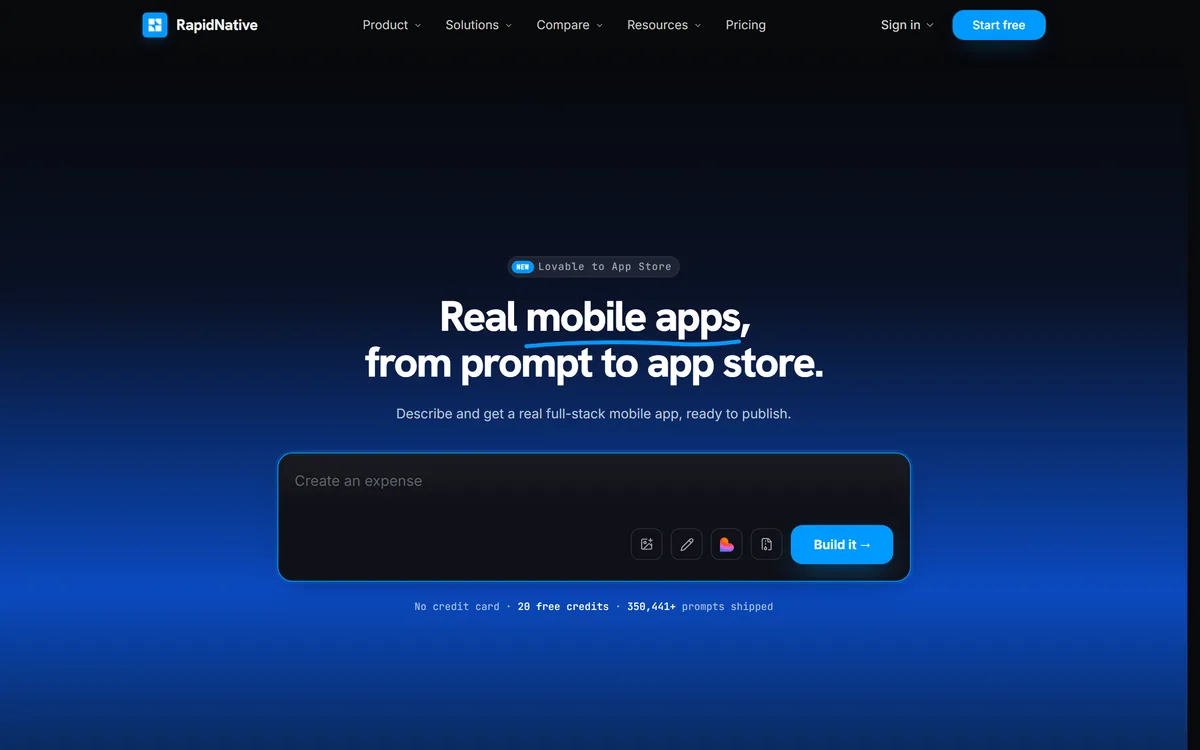
Last checked . Read from rapidnative.com during this check, with the screenshot above captured at the same time. We did not build or publish an app as part of this review.
An AI builder for native React Native apps
Inputs from a prompt, sketch, PRD, image or screenshot
Auth, file storage and realtime wired up by default
A Postgres database you can point at your own Supabase
Theming of colours, typography and components
Help converting, listing and submitting to the App Store and Google Play
Migration paths from other AI app builders
A free start with credits, no credit card
A vendor-stated count of prompts shipped
No prices reproduced here, in line with this site's pricing policy
App-store approval is decided by Apple and Google, and their developer fees are separate. Generated apps still need real-device testing and code review before real users depend on them.
More App Builders And Coding Tools
A vibe-coding builder, a spec-driven IDE and a model platform to weigh alongside RapidNative.
Emergent — describe-to-app web and mobile building
RapidNative earns 3.8 for tackling the hardest part of AI app building, getting a real native app into the stores. It turns prompts, sketches, docs or screenshots into full-stack React Native apps with auth, storage, realtime and Postgres, lets you bring your own Supabase, and helps prepare and submit to the App Store and Google Play. Approval still rests with Apple and Google, generated code still needs testing, and complex or regulated apps need real mobile engineers, but for founders and small teams who need a testable native app fast it is a strong option. AInexfinder Editor Score: 3.8/5.
RapidNative pricing
AInexfinder does not list plan prices or billing details. For current pricing, plans, and trials, visit the official RapidNative website.
Vendor pricing, credits, and billing policies change over time. Always confirm on the official site before you buy.
Frequently asked questions
What is RapidNative?
RapidNative is an AI mobile-app builder that turns a prompt, sketch, product document or screenshot into a full-stack React Native app, with auth, storage, realtime and a database, and helps you submit it to the App Store and Google Play.
Does RapidNative make real native apps?
It generates React Native, a framework used for many production iOS and Android apps, rather than a web page wrapped for phones. You still need to test on real devices and review the code before relying on it.
Can RapidNative publish my app to the App Store?
It helps convert your project into a production app, create store listings, handle compliance steps and submit to the App Store and Google Play. Approval is decided by Apple and Google, and their developer accounts and fees are your responsibility.
Does RapidNative include a backend?
Yes. Projects come with authentication, file storage, realtime updates and a Postgres database you can query, migrate and secure, and you can point the app at your own Supabase project if you want to own the data layer.
Can I move an app from another AI builder to RapidNative?
RapidNative advertises migration paths that bring apps from other AI app builders onto React Native and through to the app stores. Check how well your specific project converts before committing.
How much does RapidNative cost?
You can start without a credit card on free credits, with paid plans for more building and shipping. We do not publish prices, which change; check the site, and budget separately for Apple and Google developer fees.
Who is RapidNative best for?
Founders, product managers, agencies and small teams who want a native mobile app and help getting it through store submission without a dedicated mobile engineer. It is less suited to complex, regulated or performance-critical apps.
Do I need to know how to code?
No, you can build from prompts, sketches and documents. Some technical understanding helps you review what is generated, test properly and handle store requirements, and serious apps should still get a developer's review.
How is RapidNative different from Emergent?
Emergent is a general describe-to-app builder for web and mobile focused on fast validation. RapidNative focuses specifically on native React Native apps and the app-store last mile, including help with listings and submission.
Did this review build an app with RapidNative?
No. This review is based on RapidNative's public site at the time of checking. The trial steps above are a suggested way to evaluate it on your own app idea before paying.
Daniel reviews AI tools the slow way — by actually using them on real projects. His reviews cover what works, what breaks, and who each tool is genuinely a good fit for.
Daniel and the AInexfinder editorial team research RapidNative using public product information, listing evidence, and (when available) hands-on checks. Scores reflect listing completeness and transparency — not paid placement.
Listings may include affiliate or sponsored placements, which are labeled when present. Editorial scores and cons are not sold. See our affiliate disclosure and review methodology.
Lovable builds web applications from plain-language descriptions, handling hosting, authentication, payments, connectors, analytics and security as part of the platform. It positions itself for building and running whole products, and names Adidas, Asana, ElevenLabs, Zendesk, Workday and Nvidia among companies whose employees use it.
Base44 is a no-code AI platform, owned by Wix, that builds working apps, websites and agents from plain-language descriptions. Backend, authentication, hosting and integrations to Slack, Notion, HubSpot and Salesforce come included rather than assembled.
Emergent is an AI vibe-coding tool that turns a plain-language description into a working web or mobile app through a describe, refine and launch flow, aimed at founders and non-engineers validating an idea or MVP quickly, with the usual limits of generated code.
Replicate is a developer platform to run, fine-tune and deploy machine-learning models via API, with thousands of community and official models callable in one line, custom-model hosting through its open-source Cog tool, and pay-per-second compute that scales to zero.
GitHub Copilot is an AI coding assistant that spans completion, chat, agent mode, automated code review, and a cloud agent that opens pull requests, working across VS Code, Visual Studio, JetBrains, Xcode, Neovim, Eclipse, the CLI, and github.com.
Replit AI turns a written description into a working application — the Agent writes the code, and Replit supplies the database, authentication, hosting, and monitoring, so a prototype goes live without a local setup or a deployment pipeline.