Emergent is an AI vibe-coding tool that turns a plain-language description into a working web or mobile app through a describe, refine and launch flow, aimed at founders and non-engineers validating an idea or MVP quickly, with the usual limits of generated code.
emergent.sh7 viewsAdded April 23, 202566K visitors
Turning an idea into something clickable used to mean hiring developers or learning to code. Vibe-coding tools collapse that into a conversation, and Emergent is one of them: you describe the app you want, and it builds a working version in minutes.
Its flow is deliberately simple, describe, refine and launch, and it targets web and mobile output for people validating an idea rather than engineering a platform. It sits in the same fast-moving space as AI developer tools like Kiro, but aimed further toward non-engineers than a developer IDE is.
This review covers how Emergent builds from a prompt, who it is really for, how it prices, and where generated-app limits mean it will not be enough.
Emergent turns a plain-language description into a working app through a guided flow.
Describe An App, Watch Emergent Assemble It
Emergent's core promise is that a plain-language description becomes a working app without you writing code. You say what you want, it generates the build, and you iterate from there. For someone whose blocker is that they cannot code, that is a real unlock.
The honest value is speed to something clickable. Instead of a slide or a mockup, you get a working prototype you can actually use and show people, which is a much better basis for deciding whether an idea has legs.
It is equally honest to say that 'an app in minutes' is a starting point, not a finished product. Generated applications handle the obvious cases well and the awkward ones less well, and they need a human to review logic, security and edge cases before anything real depends on them.
So the fair way to see Emergent is as a validation and prototyping accelerator. It gets you from idea to working draft fast; turning that draft into a dependable product is still engineering work, whether you do it or someone does it for you.
Emergent gets you from idea to working draft fast; turning that draft into a dependable product is still engineering work.
How Does Emergent Build From A Prompt?
The experience is a guided build loop, with output for both web and mobile and the caveats that come with generated code.
Describe, Refine And Launch In Steps
Emergent structures the work as three steps: you describe the idea, refine it in conversation as the build takes shape, and then launch. That loop keeps a non-technical user in control of direction without needing to understand the code underneath, which is the point of a vibe-coding tool.
The refine step is where the real work happens, since first generations rarely match the intent exactly. A code-running platform like Replicate serves developers wiring models into their own apps; Emergent is aimed at the person who wants the whole app assembled for them from a description.
Web And Mobile Output, With The Usual Limits
Emergent targets both web and mobile apps, so the same describe-and-refine flow can produce more than a single-page site. The vendor cites large adoption numbers, which indicate reach rather than proof that any given build is production-ready.
The usual generated-code limits apply: you should review what it produces for correctness, security and maintainability before relying on it, and complex or regulated applications will outgrow a prompt-built foundation. For automation-heavy needs, a tool like Browser Use solves a different, narrower problem; Emergent is about standing up an app shell quickly.
Who Emergent Is Really For
Emergent is really for founders, product people and non-engineers who want to validate an idea or stand up an MVP fast, without hiring an agency or learning to code first. For that job, getting to a working, clickable prototype in minutes is genuinely valuable.
It also suits anyone running quick experiments, where the goal is to test whether an idea resonates before investing in proper engineering, and small teams who want to show stakeholders something real rather than a mockup.
It fits less well engineering teams who want fine-grained control over the codebase, and anyone building a complex, security-sensitive or regulated application where generated code is a liability rather than a shortcut. Its 10M+ creators and 15M+ apps figures are vendor-stated and reflect adoption, not build quality.
How Emergent Prices Its Builds
Emergent is free to start, with paid plans for more building, in the usual pattern for these tools. We do not publish prices, which change; check the site.
The value question is whether the time it saves getting to a working prototype outweighs its cost and the later work of hardening whatever you keep. For pure validation, even a rough build can be worth it; for anything you intend to run for real, factor in the engineering still required.
Because you can start for free, the sensible approach is to build one real idea end to end, judge how close the output is to what you meant, and only commit once you know it gets you meaningfully closer to a usable product.
A Quick Way To Put Emergent To Work
Because output quality depends on the idea and the refining, trial Emergent on a real app you actually want, not a toy.
Describe a real app idea in as much concrete detail as you can.
Use the refine step to correct where the first build misses your intent.
Launch it and actually use the result as a real user would.
Inspect the output for obvious gaps in logic, security and edge cases.
Decide whether it is a usable base or only a throwaway validation prototype.
Pass/fail: Emergent is worth it if it gets you meaningfully closer to a usable product fast.
Treat the 10M+/15M+ figures as vendor-stated; judge it on your own build.
Emergent, The Vibe-Code Brief
Emergent is an AI vibe-coding tool: describe a web or mobile app in plain language and it assembles a working build.
The flow is three steps: describe the idea, refine it in conversation, and launch, with no agency or upfront hiring.
It is aimed at validation: founders and non-engineers testing an idea or MVP fast, not shipping a hardened production system unreviewed.
Generated-code limits apply: treat the output as a fast first draft to inspect and extend, not a finished, secure codebase.
Emergent App-Builder Facts
What it is
An AI vibe-coding tool for web and mobile apps
Input
A plain-language description of the app
Flow
Describe, refine, launch
Output
A working web or mobile build
Audience
Founders and non-engineers validating ideas
Start
Free to start building
Caveat
Generated code needs review for production
Scale claim
10M+ creators, 15M+ apps (vendor)
Key features of Emergent
Describe-to-app generation
Conversational refine step
Web app output
Mobile app output
Guided three-step flow
Free to start
No-code for non-engineers
Fast prototype launch
Pros & cons
Pros
5
Fast idea-to-working-prototype path
No coding or agency needed to start
Good for validating before investing
Covers web and mobile output
Free entry point
Cons
5
Generated code needs review for production
Not for complex or regulated apps
Limited fine-grained codebase control
Refining is needed to hit intent
Adoption figures are vendor-stated
Best For
Idea validation
MVP prototyping
Non-technical founders
Quick build experiments
Stakeholder demos
Emergent Measured Against Other App Builders
The useful comparison is with other ways to go from idea to running software.
Product people testing before investing in engineering
Small teams showing stakeholders something real
Anyone running quick build experiments
When Emergent Will Not Be Enough
Engineering teams wanting full codebase control
Complex, security-sensitive or regulated apps
Anything production-critical used unreviewed
Builders who need deep custom infrastructure
Those taking adoption figures as proof of quality
How We Built With Emergent
Last checked . Read from emergent.sh during this check, with the screenshot above captured at the same time.
An AI vibe-coding tool for web and mobile apps
A plain-language description as the input
A describe, refine and launch flow
Output aimed at founders and non-engineers
A free way to start building
Generated applications that need review for production
Vendor figures of 10M+ creators and 15M+ apps
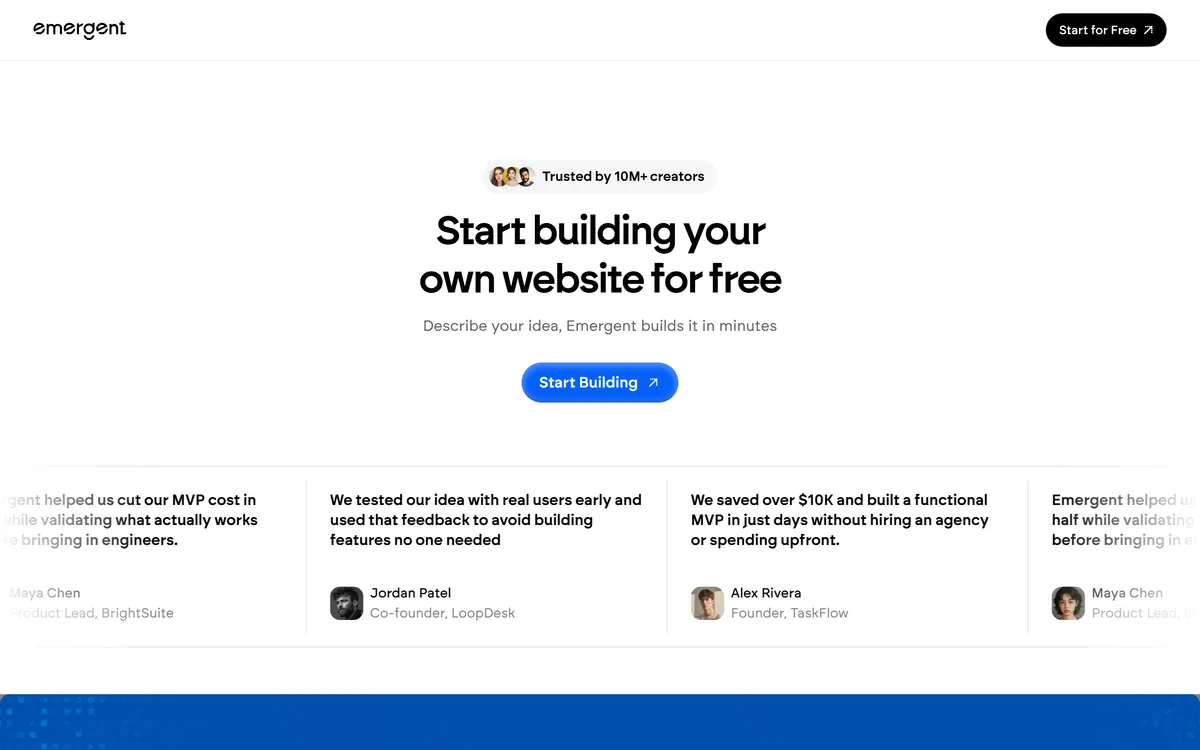
Testimonials presented on the marketing page
No plan prices reproduced here, in line with this site's pricing policy
Emergent is a validation and prototyping accelerator; generated apps need human review for logic, security and edge cases before anything real depends on them. Its adoption figures are vendor-stated and reflect reach, not build quality.
Other App-Building And Coding Tools
A developer IDE, a model platform and an automation framework to weigh alongside Emergent.
Emergent earns 3.7 as a capable vibe-coding tool for its real job: getting a non-engineer from a plain-language idea to a working, clickable web or mobile prototype in minutes, which is a genuine unlock for validation and MVPs. The describe-refine-launch flow keeps non-technical users in control, but generated applications carry the usual limits, needing human review for logic, security and edge cases, and complex or regulated builds will outgrow a prompt-built foundation. Its 10M+/15M+ figures are vendor-stated, so judge it on your own build, not the marketing. AInexfinder Editor Score: 3.7/5.
Emergent pricing
AInexfinder does not list plan prices or billing details. For current pricing, plans, and trials, visit the official Emergent website.
Vendor pricing, credits, and billing policies change over time. Always confirm on the official site before you buy.
Frequently asked questions
What is Emergent?
Emergent is an AI vibe-coding tool that turns a plain-language description into a working web or mobile app. You describe the idea, refine it in conversation, and launch, without hiring an agency or writing code yourself first.
Who is Emergent for?
Mainly founders, product people and non-engineers who want to validate an idea or stand up an MVP quickly. It is aimed further toward non-technical users than a developer IDE, prioritising speed to a working prototype over fine-grained control of the code.
Is Emergent's output production-ready?
Treat it as a fast first draft, not a finished product. Generated applications handle obvious cases well but need human review for logic, security, edge cases and maintainability before anything real depends on them. Complex or regulated apps will outgrow a prompt-built base.
Can Emergent build mobile apps?
Yes, it targets both web and mobile output, so the same describe-and-refine flow can produce more than a single web page. As with any generated build, the result is a starting point to inspect and extend rather than a guaranteed app-store-ready product.
How much does Emergent cost?
It is free to start, with paid plans for more building. We do not publish prices, which change; check the site. Build one real idea end to end on the free tier first, and only commit once you know the output gets you meaningfully closer to what you need.
How is Emergent different from a developer IDE?
A tool like Kiro is a spec-driven IDE aimed at engineers who want control over the codebase. Emergent assembles the whole app from a description for someone who does not code. They sit at different points on the control-versus-speed trade-off.
Does Emergent require coding knowledge?
No. The whole point is that you describe what you want in plain language and refine it in conversation. Some understanding of what you are building helps you refine well, but you do not need to read or write code to get a working result.
What are Emergent's main limitations?
It is a validation accelerator, not an engineering platform: generated code needs review, fine-grained control is limited, and complex, security-sensitive or regulated applications are a poor fit. Hitting your exact intent also depends on how well you use the refine step.
Are Emergent's usage numbers reliable?
Figures like 10M+ creators and 15M+ apps are vendor-stated, so treat them as reach rather than proof that builds are production-ready. The testimonials on the marketing page are also promotional. Judge Emergent on your own build and how close it gets to a usable product.
Can I edit the code Emergent generates?
Emergent is aimed at non-engineers, so the main flow is describing and refining rather than hand-editing code. For anything you intend to run for real, expect a developer to review and extend the output, since generated applications need checking for logic, security and maintainability before they are dependable.
Daniel reviews AI tools the slow way — by actually using them on real projects. His reviews cover what works, what breaks, and who each tool is genuinely a good fit for.
Daniel and the AInexfinder editorial team research Emergent using public product information, listing evidence, and (when available) hands-on checks. Scores reflect listing completeness and transparency — not paid placement.
Listings may include affiliate or sponsored placements, which are labeled when present. Editorial scores and cons are not sold. See our affiliate disclosure and review methodology.
Lovable builds web applications from plain-language descriptions, handling hosting, authentication, payments, connectors, analytics and security as part of the platform. It positions itself for building and running whole products, and names Adidas, Asana, ElevenLabs, Zendesk, Workday and Nvidia among companies whose employees use it.
Base44 is a no-code AI platform, owned by Wix, that builds working apps, websites and agents from plain-language descriptions. Backend, authentication, hosting and integrations to Slack, Notion, HubSpot and Salesforce come included rather than assembled.
Replicate is a developer platform to run, fine-tune and deploy machine-learning models via API, with thousands of community and official models callable in one line, custom-model hosting through its open-source Cog tool, and pay-per-second compute that scales to zero.
GitHub Copilot is an AI coding assistant that spans completion, chat, agent mode, automated code review, and a cloud agent that opens pull requests, working across VS Code, Visual Studio, JetBrains, Xcode, Neovim, Eclipse, the CLI, and github.com.
Replit AI turns a written description into a working application — the Agent writes the code, and Replit supplies the database, authentication, hosting, and monitoring, so a prototype goes live without a local setup or a deployment pipeline.
CodeScene measures code with CodeHealth, a validated metric predicting defects and delivery performance. It states the average enterprise codebase scores 5.15 out of 10 while AI needs 9.5 to work reliably, and offers an MCP server, automated reviews and IDE feedback. Operated by CodeScene AB.