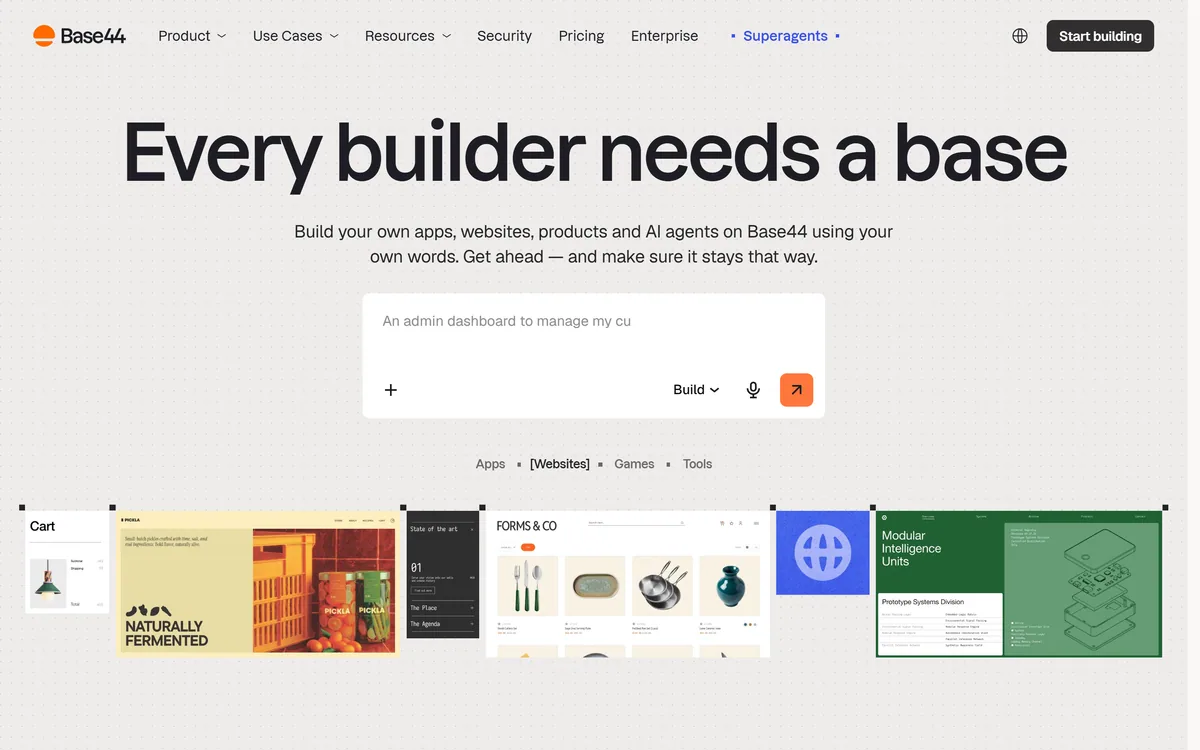
Base44 is a no-code AI platform, owned by Wix, that builds working apps, websites and agents from plain-language descriptions. Backend, authentication, hosting and integrations to Slack, Notion, HubSpot and Salesforce come included rather than assembled.
base44.com10 viewsAdded November 7, 2025332K visitors
The first wave of AI app builders had a shared problem. They generated a beautiful front end in ninety seconds and then left you standing in front of the actual work: where does the data live, how do users log in, who hosts this, and what happens when two people use it at once.
Base44's answer is to include all of that. The database, authentication, hosting and a set of one-click integrations arrive with the generated app rather than as the next six decisions.
This review covers what that changes in practice, why the Wix acquisition is relevant to a buyer, where generated apps still hit a wall, and how it compares with Lovable and Replit AI.
The differentiator is not generation — it is that the database, auth and hosting are already there.
Base44 In Five Lines
Base44 is a no-code AI platform that builds working apps, websites and agents from plain-language descriptions, with the backend and hosting included.
Owned by Wix, which matters for a no-code buyer: it means the platform has a large company behind its uptime and billing.
Backend and storage are built in — database and authentication, not just a front end you then have to wire to something.
Superagents automate workflows and connect to tools on their own, which is the part that separates this from an app builder.
One-click integrations to Google Calendar, Gmail, Slack, Notion, HubSpot and Salesforce, plus any external API.
"Backend Included" Is The Whole Argument
Generating a user interface from a description is now close to a commodity. Several tools do it well. The differences show up immediately afterwards.
An app that stores nothing is a mockup. The moment you want users to sign in, save something, and come back to it tomorrow, you need a database, an auth system, a host and the plumbing between them — and for a non-technical builder that is not a small remaining step, it is the entire project.
Base44 shipping those by default is the reason a non-developer can get from idea to something people actually use. It is unglamorous infrastructure and it is what converts a demo into a tool.
The Superagents feature extends the same logic. An agent that automates a workflow and calls other tools on its own needs somewhere to run, credentials to store and state to keep — all of which the platform already has. Building that on top of a front-end generator would be a project of its own.
Any of these tools will draw you a screen. The question is what happens when someone tries to log into it.
What The Wix Acquisition Means
Base44 is owned by Wix.com Ltd. For a no-code buyer this cuts in a specific way, and it is worth thinking about before you build something you depend on.
The reassuring side: no-code platforms are a category where vendors disappear, and when one does it takes your app with it. There is no repository to fork and no server to move. A large public parent materially reduces that risk, and it also brings enterprise billing, uptime commitments and security paperwork.
The cautious side is the standard acquisition question. Roadmaps get aligned to the parent's priorities, and a platform inside a website-builder company may drift towards the website-building use case over time.
For most users this is a net positive — the failure mode a no-code buyer should actually fear is the vendor vanishing, not the roadmap shifting. But it is worth knowing before you build a business process on it, and worth checking what export exists if you ever needed to leave.
The Feature List Is Wider Than App Building
Some of what is here is not what you would expect from an app builder, and it tells you who Base44 thinks the customer is.
The Building Half
Vibe coding from a description, one-click integrations, multi-user collaborative boards with sketching and notes, global colour and font control, and redesign recommendations with previews before you commit.
The global design controls matter more than they sound. A generated app that looks inconsistent is the usual giveaway, and being able to change type and colour once across everything is what makes the result look deliberate.
The Marketing Half
An SEO/GEO dashboard scanning for Google, ChatGPT and Gemini; AI-generated social content matched to your voice; app analytics for traffic and sales; and AI video generation for hero sections.
This is unmistakably Wix-adjacent thinking — the assumption that someone building an app also has to market it. Whether that is useful or clutter depends entirely on whether you are building an internal tool or a product with customers.
Where Generated Apps Still Stop
Being clear about the ceiling saves a wasted month, and the ceiling is real regardless of which platform you pick.
Complex business logic is the first wall. Describing a CRUD app works; describing a pricing engine with fourteen edge cases and a compliance rule does not, because the edge cases are exactly what a description omits.
Performance at scale is the second. Generated data access is written to be correct rather than efficient, and the difference is invisible at fifty records and painful at fifty thousand.
Portability is the third and the one people regret. Ask what you can export before you build, not after. A platform-hosted app with a platform-hosted database is not something you casually move.
The honest framing is that this is excellent for internal tools, prototypes, small products and anything where the alternative was a spreadsheet. If you are building the thing your company sells, you will eventually want Cursor and a real codebase — and that is not a criticism of Base44, it is what these tools are for.
Building Something You Will Not Abandon
Most no-code projects die at the same three points, all avoidable.
Write down what the app must do for one specific person before prompting anything. Generation rewards specificity and punishes vagueness.
Get one complete flow working end to end — sign in, do the thing, see the result — before adding a second feature.
Connect the integrations you actually need early, since an app that does not reach your existing tools tends not to get used.
Set the global colours and fonts once, at the start. Retrofitting consistency is far harder than starting with it.
Test with a real user who was not in the room. They will do something you never described.
Check the export and data-portability position before you make it load-bearing for anything.
Keep the scope small. The apps that survive are narrow ones that do one job people actually need.
Key features of Base44
App, website and agent generation from plain-language descriptions
Built-in database and authentication
Built-in hosting with custom domain support
Superagents that automate workflows and connect to tools independently
One-click integrations with Slack, Notion, HubSpot, Salesforce, Gmail and Google Calendar
External API connections for anything else
Global colour and font control across the whole app
AI redesign recommendations with previews before applying
Multi-user collaborative boards with notes and sketching
SEO/GEO dashboard, social content generation and app analytics
Pros & cons
Pros
5
Database, auth and hosting included is what turns a generated mockup into a usable app
Wix ownership removes the vendor-disappears risk that haunts no-code platforms
Superagents go beyond app building into workflow automation
Integrations to the tools a business already runs, on day one
Global design controls stop generated apps looking inconsistent
Cons
5
Complex business logic with many edge cases resists description-driven generation
Generated data access is written for correctness, not for volume
Portability is the standard no-code risk — check export before you depend on it
The marketing features are clutter if you are building an internal tool
An acquired platform's roadmap follows the parent's priorities
Best For
Non-technical founders who need a working product rather than a mockup
Teams replacing a spreadsheet or a manual process with a real tool
Internal tool builders who need auth and a database without a project
Prototyping ahead of a proper engineering build
Anyone who needs the app connected to Slack, Notion or a CRM immediately
Base44 Against The Other Builders
These all generate working software and differ on what comes with it.
You are not a developer and need something people can actually log into
The alternative is a spreadsheet or a manual process
You are building an internal tool where speed beats architecture
You need it connected to Slack, Notion, HubSpot or Salesforce on day one
A large parent company behind the platform reduces a risk you care about
Outgrow It When
The app is the product your company sells
Business logic has many edge cases a description cannot capture
You expect data volumes where generated queries will struggle
Portability matters and you need to own the code
You already have engineers, who will move faster in a real codebase
Other Ways To Build Without A Team
From describing an app to writing the code yourself, with several stops between.
Lovable — the closest independent alternative for generating working web apps
Replit AI — hosted apps with a real IDE underneath when you want to see the code
Cursor — where you go when the app becomes the product and needs a real codebase
Flowstep — the design stage — screens and React code before anything is built
GitHub Copilot — assistance inside an existing codebase rather than generating a new one
Sourced From base44.com
Last checked . Read from base44.com during this check, with the screenshot above captured at the same time.
Ownership by Wix.com Ltd., stated in the site's own copyright notice
Vibe coding described as generating structure, design and logic from plain-language descriptions
Backend and storage described as built in, covering database functionality and authentication
One-click integrations named as Google Calendar, Gmail, Slack, Notion, HubSpot and Salesforce, plus external APIs
Superagents described as AI agents automating workflows and connecting to tools independently
SEO/GEO dashboard covering Google, ChatGPT and Gemini; social content generation; app analytics; AI video generation
Global colour and font settings, and redesign recommendations with previews
Company, product, resources and legal sections present in the site footer, including security, misuse reporting and an accessibility statement
No plan prices published here, in line with this site's pricing policy
Observations about where generated apps hit limits — complex business logic, performance at scale and portability — describe the no-code category generally rather than measured behaviour of this platform. Export and data-portability terms were not tested; confirm them before building anything load-bearing.
Editor's Verdict
4.2/5
Base44 has an AInexfinder Editor Score of 4.2/5.
Base44 pricing
AInexfinder does not list plan prices or billing details. For current pricing, plans, and trials, visit the official Base44 website.
Vendor pricing, credits, and billing policies change over time. Always confirm on the official site before you buy.
Frequently asked questions
Who owns Base44?
Wix.com Ltd. For a no-code buyer that is mostly reassuring — the risk you should actually fear in this category is the vendor disappearing and taking your app with it, and a large public parent reduces that considerably.
Do I need to know how to code?
No. You describe what you want and the platform generates structure, design and logic. The reason it works better than a pure front-end generator is that the database, authentication and hosting come with it rather than being your next six decisions.
Base44 vs Lovable — what is the difference?
Both generate working web apps with a backend. <a href="/ai-tools/lovable">Lovable</a> is independent and focused on web apps; Base44 adds agents, a marketing layer and Wix behind it. If you want to see and own the code, <a href="/ai-tools/replit-ai">Replit AI</a> gives you a real IDE underneath.
Can it handle complex business logic?
Up to a point, and the point arrives sooner than people expect. A CRUD app describes well; a pricing engine with fourteen edge cases does not, because the edge cases are exactly what a plain-language description leaves out.
What happens if my app gets a lot of users?
Generated data access is written to be correct rather than efficient, and that difference is invisible at fifty records and painful at fifty thousand. Plan for a rebuild if you expect real scale — which is normal for this category rather than a fault of this platform.
Can I export my app if I want to leave?
Check this before you build anything load-bearing, not after. A platform-hosted app with a platform-hosted database is not something you casually move, and portability is the thing no-code users most often regret not asking about.
What are Superagents?
AI agents that automate workflows and connect to other tools on their own. They work here because the platform already has somewhere to run them, credentials to store and state to keep — building the same thing on a front-end generator would be a separate project.
Daniel reviews AI tools the slow way — by actually using them on real projects. His reviews cover what works, what breaks, and who each tool is genuinely a good fit for.
Daniel and the AInexfinder editorial team research Base44 using public product information, listing evidence, and (when available) hands-on checks. Scores reflect listing completeness and transparency — not paid placement.
Listings may include affiliate or sponsored placements, which are labeled when present. Editorial scores and cons are not sold. See our affiliate disclosure and review methodology.
Lovable builds web applications from plain-language descriptions, handling hosting, authentication, payments, connectors, analytics and security as part of the platform. It positions itself for building and running whole products, and names Adidas, Asana, ElevenLabs, Zendesk, Workday and Nvidia among companies whose employees use it.
Emergent is an AI vibe-coding tool that turns a plain-language description into a working web or mobile app through a describe, refine and launch flow, aimed at founders and non-engineers validating an idea or MVP quickly, with the usual limits of generated code.
Replicate is a developer platform to run, fine-tune and deploy machine-learning models via API, with thousands of community and official models callable in one line, custom-model hosting through its open-source Cog tool, and pay-per-second compute that scales to zero.
GitHub Copilot is an AI coding assistant that spans completion, chat, agent mode, automated code review, and a cloud agent that opens pull requests, working across VS Code, Visual Studio, JetBrains, Xcode, Neovim, Eclipse, the CLI, and github.com.
Replit AI turns a written description into a working application — the Agent writes the code, and Replit supplies the database, authentication, hosting, and monitoring, so a prototype goes live without a local setup or a deployment pipeline.
Momentic is an agentic end-to-end testing platform where AI writes tests as plain-English YAML, runs them across web, iOS and Android, and self-heals them when the UI changes, with an autonomous bug-bashing agent, an MCP server and CI integration.