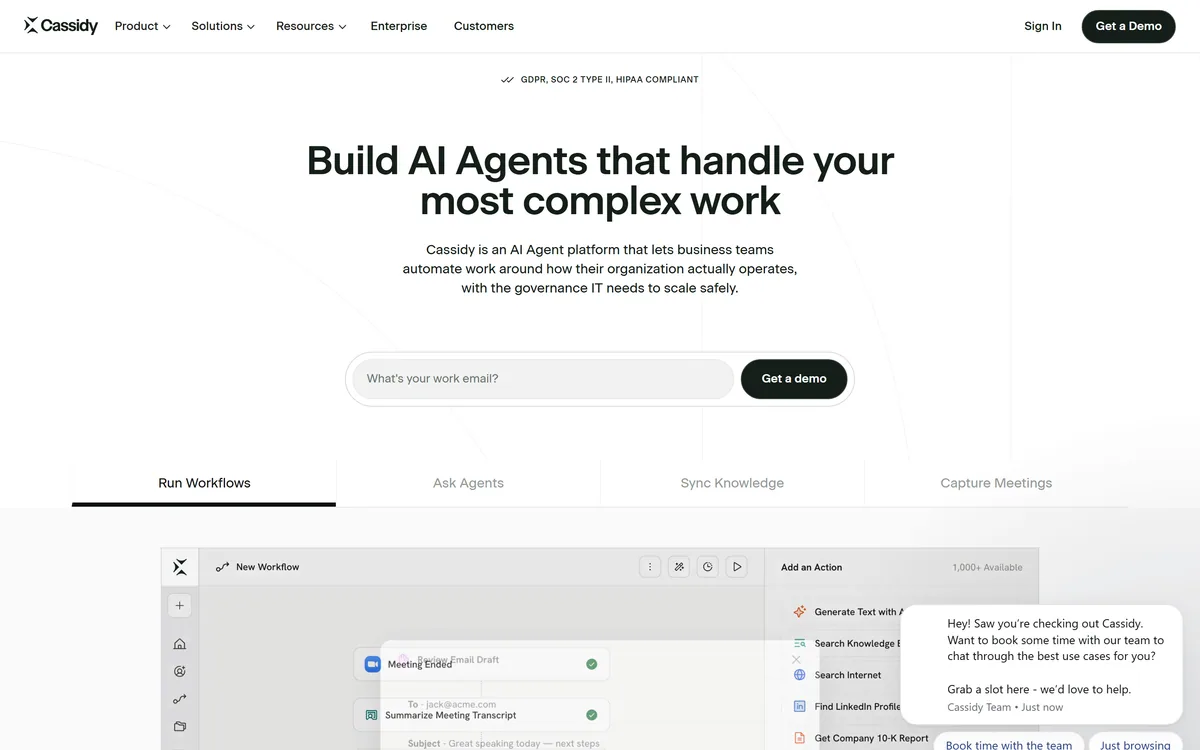
Cassidy AI is a no-code AI-agent and workflow platform that lets business teams build agents grounded in a company knowledge base, deploy them inside Teams, Slack, Chrome and Office, and keep IT in control with permissions, model-agnostic routing and SOC 2, GDPR and HIPAA compliance.
cassidyai.com7 viewsAdded November 11, 202510K visitors
Enterprise AI stalls when the people who understand the work have to wait on IT or engineering to build anything. Cassidy AI's pitch is to let those people build agents themselves, without code, inside IT's guardrails.
It is a no-code platform for building AI agents and workflows grounded in a company knowledge base, deployable inside the tools staff already use, with governance for safe scale. It sits among enterprise agent platforms like Ema, with a focus on business-team self-service rather than engineering.
This review covers how Cassidy builds a safe agent, where it fits a business team, how it is sold, and who will find it more than they need.
Cassidy AI lets the people closest to the work build agents, within IT's guardrails.
Cassidy AI Agent Facts
What it is
A no-code AI-agent and workflow platform
Grounding
A synced, cited, permission-aware knowledge base
Build
Agents and workflows in natural language
Deploy in
Teams, Slack, Chrome, Word, Excel, Outlook
Models
Model-agnostic, routing across 35+ models (vendor)
Governance
Permissions, RBAC, usage analytics
Security
SOC 2 Type II, GDPR, HIPAA, CASA (vendor)
Model
Enterprise, demo-led
No-Code AI Agents Grounded In Company Knowledge
Cassidy's premise is that the person closest to a process should be the one automating it, not a queue of engineering tickets. So it lets business users describe an agent or workflow in natural language and build it without code.
What stops that from producing confident nonsense is grounding: agents draw on a company knowledge base, synced, cited and permission-aware, so their outputs reflect how your business actually works rather than a generic model's guess. That grounding is the difference between a demo and something a team will trust.
It is aimed at operationally complex, often regulated industries, insurance, professional services, industrials, healthcare, where the work is document-heavy and accuracy matters, which is also why its governance story is front and centre.
The person closest to a process should be the one automating it, not a queue of engineering tickets. Grounding in company knowledge is what makes the result trustworthy.
How Does Cassidy Build A Safe Agent?
Two things make it enterprise-credible: the context it draws on, and the controls around it.
Knowledge Base, Meetings And Context
You connect documents, meetings, CRM and other company knowledge into a knowledge base that grounds agents, with citations so outputs are traceable, and Cassidy can join and summarise meetings so conversations become searchable context and follow-ups.
That context layer is what separates a grounded agent from a generic chatbot. For the browser-automation corner of getting work done, a tool like Axiom.ai handles a different mechanism; Cassidy's strength is reasoning over your own knowledge.
No-Code Agents With Governance
You build agents and workflows in natural language, deploy them inside Teams, Slack, Chrome and Office, and IT keeps control through permissions, row-level security, usage analytics and model-agnostic routing that picks an appropriate model per task. It states SOC 2, GDPR and HIPAA compliance and no training on your data.
That governance is the real unlock for enterprise self-service, letting non-engineers build without letting things sprawl. A general AI assistant like Cora serves the individual; Cassidy is built for the organisation, with the controls that implies.
Where Cassidy Fits A Business Team
Cassidy fits mid-size to large organisations in document-heavy, exception-heavy fields, insurance underwriting routing, professional-services proposals, industrials knowledge search, where business teams want to automate real processes and IT needs to keep it safe.
It suits functions across sales, support, operations and marketing that have clear, repeatable work to automate and the company knowledge to ground it in. The deploy-where-you-work model matters, because adoption dies when a tool is yet another tab.
It fits less well a solo user or tiny team wanting a personal assistant, where a consumer AI tool is simpler and cheaper, and anyone without organised company knowledge to ground agents in, since the grounding is what makes it worth the governance overhead.
How Cassidy Is Sold To Enterprises
Cassidy is enterprise and demo-led: engagement runs through a get-a-demo path with a solutions team and managed builds, rather than public self-serve pricing. We do not publish prices; there are none listed.
For a buyer, the value question is whether business-team self-service, within governance, genuinely reduces the engineering bottleneck and automates enough real work to justify an enterprise commitment, which a scoped pilot on real processes can answer.
Its adoption and case-study figures (workflows run, employees onboarded) are vendor-stated; treat them as claims and judge the platform on your own processes and your own knowledge base.
A Careful Way To Trial Cassidy
Because the value is grounded, governed automation, trial it on a real process with your own knowledge and IT involved.
Pick one real, repeatable process, like routing submissions or drafting a proposal section.
Connect the relevant company knowledge and confirm the agent cites it correctly.
Have a non-engineer build the agent in natural language to test the no-code claim.
Deploy it inside the tool the team actually uses (Teams, Slack or Office) and watch adoption.
Have IT verify permissions, data handling and the compliance posture meet your rules.
Pass/fail: Cassidy is worth it if business teams build useful, grounded agents without losing IT control.
Treat the workflow and onboarding stats as vendor claims, not guarantees.
Cassidy AI, The Agent Brief
Cassidy AI is a no-code AI-agent platform: business teams build agents and workflows grounded in company knowledge.
Grounding is the point: a knowledge base feeds agents real context, so outputs reflect how your business works.
It deploys where you work: inside Teams, Slack, Chrome, Word, Excel and Outlook, not a separate app.
Governance is built in: permissions, usage analytics and SOC 2, GDPR and HIPAA, for safe enterprise scale.
Cassidy AI Agent Terms
Knowledge base
The connected company documents and data that ground an agent's answers, kept synced, cited and permission-aware.
No-code agent
An AI agent built by describing it in natural language, without writing code or an engineering ticket.
Model-agnostic routing
Automatically choosing an appropriate model per task from several, so you are not locked to one and can swap without rebuilding.
Row-level security
Access control that limits which records a user or agent can see, so grounding respects permissions.
Key features of Cassidy
No-code agent and workflow builder
Knowledge base with citations and permissions
Meeting capture and summarisation
Deploy in Teams, Slack, Chrome and Office
Model-agnostic routing
Governance: permissions and analytics
CRM enrichment and ticket triage
Enterprise compliance posture
Pros & cons
Pros
5
Lets business teams build without engineering
Grounding in company knowledge keeps outputs trustworthy
Deploys inside the tools staff already use
Strong governance for safe enterprise scale
Model-agnostic, avoiding single-model lock-in
Cons
5
Overkill for solo users or tiny teams
Needs organised company knowledge to ground agents
Enterprise, demo-led, no public pricing
Adoption stats are vendor-stated
Compliance claims need verifying
Best For
Document-heavy enterprises
Regulated industries
Business-team self-service
Cross-function automation
Knowledge-grounded agents
Cassidy AI Against Other Agent Builders
The useful comparison is with other agent and automation approaches.
SOC 2 Type II, GDPR, HIPAA and CASA stated, with no training on your data
No plan prices reproduced here, in line with this site's pricing policy
Cassidy's adoption figures (workflows run, employees onboarded) and model count are vendor-stated claims; its compliance posture should be verified against current documentation for your requirements.
Other AI Agent And Automation Tools
An enterprise agent platform, a browser-automation tool and a personal assistant to weigh alongside Cassidy.
Cassidy AI earns 4.3 for a well-judged enterprise bet: no-code AI agents that business teams build themselves, grounded in a cited company knowledge base, deployed inside Teams, Slack and Office, with the governance IT needs to scale safely. Its adoption figures and compliance posture are vendor-stated and worth verifying, and it is overkill for solo users or teams without organised knowledge, but for regulated, document-heavy enterprises it fits well. AInexfinder Editor Score: 4.3/5.
Cassidy pricing
AInexfinder does not list plan prices or billing details. For current pricing, plans, and trials, visit the official Cassidy website.
Vendor pricing, credits, and billing policies change over time. Always confirm on the official site before you buy.
Frequently asked questions
What is Cassidy AI?
Cassidy AI is a no-code AI-agent and workflow platform that lets business teams build agents grounded in a company knowledge base, deploy them inside tools like Teams, Slack, Chrome and Office, and keep IT in control through permissions, model-agnostic routing and an enterprise compliance posture.
What does grounding mean in Cassidy?
Grounding means Cassidy's agents draw on a connected company knowledge base, synced, cited and permission-aware, so their answers reflect how your business actually works rather than a generic model's guess. That grounding, with citations for traceability, is what makes the output trustworthy enough to rely on.
Do you need to code to use Cassidy AI?
No. Business users describe an agent or workflow in natural language and build it without code, which is the core of Cassidy's pitch: letting the people closest to a process automate it instead of queuing for engineering. IT retains control through governance rather than by building everything.
Where do Cassidy agents run?
Inside the tools staff already use, Microsoft Teams, Slack, Chrome, Word, Excel and Outlook, rather than a separate app. That deploy-where-you-work model matters for adoption, since a tool that lives in a separate tab tends to go unused once the novelty fades.
Is Cassidy AI secure enough for regulated industries?
The vendor states SOC 2 Type II, GDPR, HIPAA and CASA compliance, no training on your data, and governance including permissions and row-level security, aimed at regulated fields. As with any such claims, verify the current posture against your own compliance requirements before rollout.
How is Cassidy AI priced?
It is enterprise and demo-led, with engagement through a get-a-demo path, a solutions team and managed builds rather than public self-serve pricing. We do not publish prices; there are none listed. Evaluate it with a scoped pilot on real processes rather than a sign-up.
What is model-agnostic routing?
It means Cassidy can choose an appropriate model per task from many, rather than locking you to one, and swap models without rebuilding your agents. That protects you from single-vendor lock-in and lets premium or efficient models be used where each makes sense.
Who is Cassidy AI for?
Mid-size to large, document-heavy and often regulated organisations, insurance, professional services, industrials, healthcare, where business teams want to automate real processes and IT needs to keep it safe. Functions across sales, support, operations and marketing all fit.
Are Cassidy's usage numbers reliable?
Figures like workflows run last quarter and employees onboarded in case studies are vendor-stated, so treat them as claims rather than independent measurements. Judge the platform on whether your own teams can build useful, grounded agents on your own processes during a pilot.
Who should not use Cassidy AI?
Solo users or tiny teams wanting a personal assistant, companies without organised knowledge to ground agents in, and anyone wanting cheap, self-serve consumer AI. Cassidy's grounding and governance are built for organisations, which is more than an individual needs.
Daniel reviews AI tools the slow way — by actually using them on real projects. His reviews cover what works, what breaks, and who each tool is genuinely a good fit for.
Daniel and the AInexfinder editorial team research Cassidy using public product information, listing evidence, and (when available) hands-on checks. Scores reflect listing completeness and transparency — not paid placement.
Listings may include affiliate or sponsored placements, which are labeled when present. Editorial scores and cons are not sold. See our affiliate disclosure and review methodology.
CrewAI is an enterprise platform to build and run AI agents: a Discovery layer that finds automation opportunities, a no-code canvas and code-first Python API for building role-based multi-agent workflows, and a control plane that adds tracing, RBAC, audit and human-in-the-loop approvals.
Axiom is a browser-automation and web-scraping platform you can build no-code in a Chrome extension, script in your IDE, or drive agentically through Claude and MCP, running on cloud browsers or your own machine for scrapers, form-fillers, monitors and scheduled workflows.
Kuse is an AI workspace from Kuse Inc. built around scheduled workflows: describe a recurring task in plain language, connect the apps it touches, and let it run. It also generates websites, documents, presentations and spreadsheets, with several model families available.
Formless by Typeform is a conversational AI form builder. Trained on your own data, it asks questions in natural language and answers the respondent's questions back, adapts its path without branching logic, and supports over 120 languages.
Zapier's AI layer adds agents and MCP tool access on top of its automation platform, connecting more than 9,000 apps with governed access so teams can mix AI decisions with deterministic rules under central oversight.
Fillout is a form builder that also handles scheduling, payment collection, PDF generation, e-signatures and workflow routing. Forms can be fully white-labelled down to the favicon, served from your own domain, embedded four ways, and made editable by respondents through login forms.