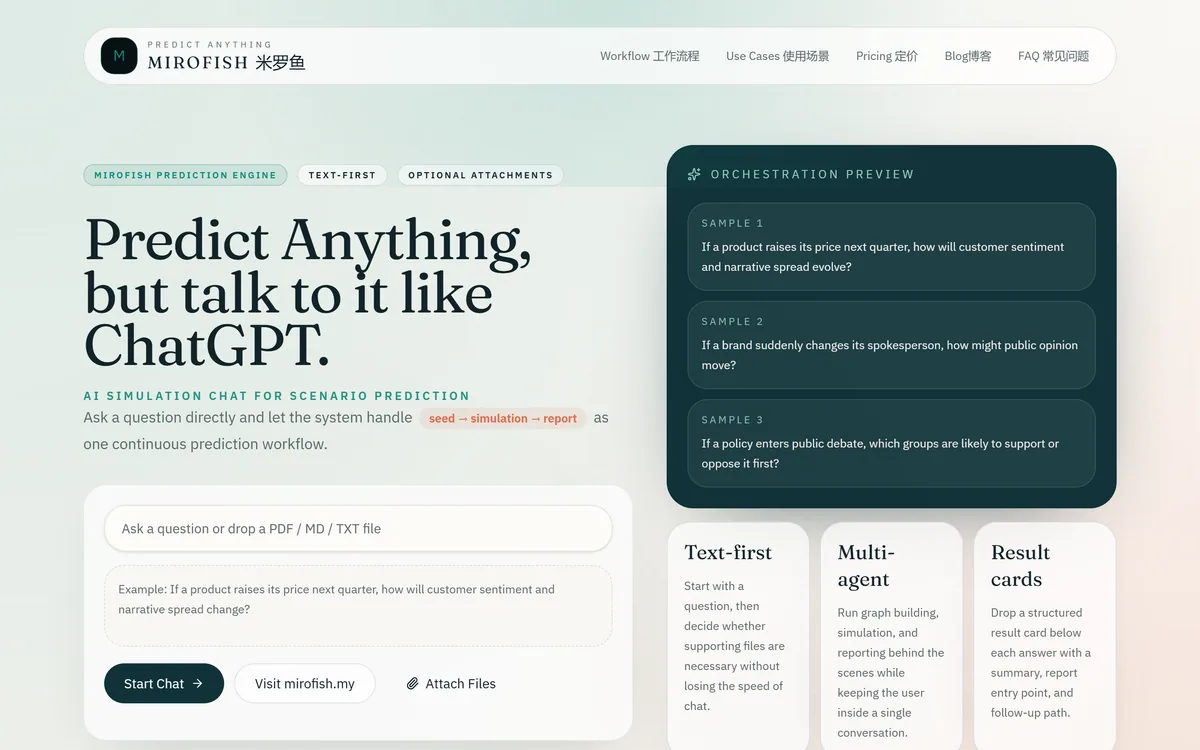
MiroFish is an AI simulation chat for scenario prediction: ask a question in plain language and it runs a seed-to-simulation-to-report workflow with multi-agent personas, so you can rehearse likely reactions to a launch, price change or policy as exploratory decision support.
Most AI tools collapse a messy human situation into one confident answer, which is exactly wrong when the thing you care about is how different groups will react to each other. MiroFish is built for that specific gap.
It is a simulation chat: you ask a plain-language question, like how customer sentiment would shift if you raised prices next quarter, and it runs a pipeline, extracting a knowledge graph, simulating personas interacting over several rounds, and condensing the result into a report you can keep questioning. The point is to rehearse a reaction, not to retrieve a fact.
This review covers how the simulation works, where it genuinely beats a single chat reply, how it is priced, and, importantly, why it should be read as exploratory support rather than a forecast.
MiroFish turns a question into a simulated world of reactions you can keep questioning.
MiroFish, The Gist
MiroFish is an AI scenario-simulation chat: ask a question and it simulates how people might react, rather than giving one flat answer.
It runs a full workflow: seed, knowledge graph, multi-agent simulation and a report, all inside one conversation.
It suits reaction-driven decisions: launches, price changes, policy debates and market narratives.
It is exploratory, not a forecast: treat the output as rehearsal and decision support, not a guaranteed prediction.
Rehearse A Reaction Instead Of Reading One Answer
MiroFish's premise is that for decisions about people, a single answer hides the thing that matters: the interaction between groups, incentives and narratives. So instead of answering, it simulates, letting modelled audiences react to a situation and to each other.
That is a genuinely different shape from a normal assistant. Ask a chatbot how a price rise will land and it gives you one confident paragraph; MiroFish is trying to show you the spread of reactions, which group pushes back first, which narrative spreads, where support splits.
The honest framing, which MiroFish itself uses, is rehearsal. It is a tabletop exercise for a decision, not an oracle, and it is most useful precisely where a spreadsheet or a single answer misses the feedback loop between people.
For decisions about people, one confident answer hides the whole point: how groups react to each other. MiroFish simulates that instead of flattening it.
How Does MiroFish Run A Scenario Simulation?
The workflow is what separates it from a chat prompt, and it runs behind a single conversation so you are not managing steps yourself.
Seed, Knowledge Graph And Agent Rounds
You start from a seed, a plain-language question, or a report, policy draft or market note, and MiroFish extracts a knowledge graph of actors, relationships and pressures, then lets persona agents interact across simulated social surfaces over multiple rounds.
That structure, grounding the simulation in extracted actors and incentives, is what makes it more than a chatbot roleplaying. A research assistant like Perplexity AI answers a question from sources; MiroFish builds a small world and watches it react.
A Report You Can Keep Questioning
The simulation condenses into a report: an executive summary, risk signals, narrative paths and follow-up questions, designed to make the next question obvious rather than to end the conversation. You can then keep interrogating the generated scenario.
That report is where the value lands for a decision, and it pairs naturally with a planning tool like Notion AI to capture and act on the findings, or an evidence tool like Consensus to check the assumptions against real research.
Where Simulation Beats A Single Chat Reply
MiroFish is honest that it is not always the right tool, which is a good sign. A single chat answer is fast and fine for brainstorming; manual research is grounded but slow; MiroFish fits the narrow case where the answer depends on many people influencing each other at once.
That means the good-fit scenarios are specific: pressure-testing a launch narrative, modelling a pricing reaction, stress-testing a policy rollout, or watching a market narrative form. In those, rehearsing plausible reactions before you commit real spend or make a public move has genuine value.
The flip side is equally clear: for a factual question, a definite answer, or anything not about human reaction, MiroFish is the wrong, slower tool. Knowing when to reach for it is most of using it well.
How MiroFish Prices Its Prediction Engine
MiroFish lets you start a chat and explore before committing, with the full simulation experience behind its paid access, and a related domain for the fuller app. It is a young product, so expect its pricing and limits to evolve.
AInexfinder does not publish plan prices, which change and are best read on the site. Because a full simulation is more expensive to run than a single answer, judge the cost against how often you face genuinely reaction-dependent decisions worth rehearsing.
For most people that will be occasional rather than daily, so weigh it as a tool you reach for at specific decision points, not an everyday assistant.
A Careful Test Of MiroFish On A Real Decision
Because its value is rehearsal and its risk is over-trusting a simulation, test it deliberately and with the right expectations.
Pick a real, reaction-dependent decision, a launch, a price change, a policy, framed as a narrow question.
Name the decision, the audience, the likely trigger and the time horizon so the simulation does not drift.
Add a real seed file, a strategy memo or brief, to ground the scenario in concrete actors.
Read the report for resistance signals and narrative paths, not for a single verdict.
Ask a follow-up, such as which group changes the result if its incentive changes.
Pass/fail: MiroFish is worth it only if the simulation surfaces a reaction or risk you had not already considered.
Treat every output as exploratory rehearsal to validate with real data and judgement, never as a guaranteed forecast.
MiroFish Simulation Terms
Seed
The starting material for a simulation: a plain-language question, or a report, policy draft or note.
Knowledge graph
The extracted actors, relationships and pressures MiroFish builds so its agents reason from structure.
Agent simulation
Persona agents interacting across simulated social surfaces over multiple rounds to produce emergent reactions.
Prediction report
The condensed output: summary, risk signals, narrative paths and follow-up questions, meant as decision support.
Marketers pressure-testing a launch or positioning before spend
Teams modelling how a price change will land across segments
Anyone stress-testing a policy or announcement for reactions
People who want to rehearse a decision, not just get an answer
Strategists who value a report they can keep questioning
When MiroFish Is The Wrong Tool
Factual or definite questions with a single correct answer
Anyone who would treat a simulation as a guaranteed forecast
Decisions that do not hinge on human reaction
Users needing fast, one-line answers for everyday tasks
Those unwilling to validate the output against real data
How We Approached The MiroFish Review
Last checked . Read from mirofish.homes during this check, with the screenshot above captured at the same time.
An AI simulation chat for scenario prediction, text-first with optional attachments
A seed, knowledge-graph, agent-simulation and report workflow
Multi-agent personas interacting over multiple rounds
Use cases across launches, pricing, policy and market narratives
A report with risk signals, narrative paths and follow-up questions
Explicit positioning as exploratory decision support, not a guaranteed forecast
A chat you can start before committing, with a fuller paid app
FAQ and workflow pages present on the site
No plan prices reproduced here, in line with this site's pricing policy
MiroFish states it is not a guaranteed forecast; its output is exploratory and should be validated with real data, analytics and judgement.
Other Decision And Research Tools
A research assistant, a planning workspace, and an evidence tool to pair with simulation.
Perplexity AI — fast, sourced answers for the factual side of a decision
Notion AI — capturing and acting on what a simulation surfaces
Consensus — checking assumptions against research evidence
Editor's Verdict
3.6/5
MiroFish earns 3.6 for a genuinely novel idea, simulating how groups react to a decision rather than flattening it into one answer, grounded in extracted actors and delivered as a questionable report, and for being honest that it is exploratory rehearsal, not a forecast; it is capped by its narrow fit, young state, and the real risk of over-trusting a simulation. AInexfinder Editor Score: 3.6/5.
MiroFish-Agent pricing
AInexfinder does not list plan prices or billing details. For current pricing, plans, and trials, visit the official MiroFish-Agent website.
Vendor pricing, credits, and billing policies change over time. Always confirm on the official site before you buy.
Frequently asked questions
What is MiroFish?
MiroFish is an AI scenario-simulation chat. You ask a plain-language question and it runs a seed-to-simulation-to-report workflow with multi-agent personas, so you can rehearse how people might react to a decision rather than reading one flat answer.
What kind of decisions is MiroFish good for?
Reaction-dependent ones: pressure-testing a launch or positioning, modelling how a price change lands across segments, stress-testing a policy rollout, or watching a market narrative form. It fits where the answer depends on many people influencing each other.
Is MiroFish a guaranteed forecast?
No, and it says so plainly. It is exploratory decision support, a way to rehearse plausible reactions before using judgement, analytics and real-world validation. Treat the report as a tabletop exercise, not a prediction you can bank on.
How does a MiroFish simulation work?
It starts from a seed, your question or a document, extracts a knowledge graph of actors, relationships and pressures, then runs persona agents interacting over several rounds, and condenses the result into a report with risks, narrative paths and follow-up questions.
How is MiroFish different from a normal chatbot?
A chatbot gives one confident answer; MiroFish builds a small world and simulates how groups react to a situation and to each other. For decisions about human reaction, that spread of responses is the point a single answer hides.
Do I need to upload files to use MiroFish?
No. You can start with text alone and add files, like a strategy memo, product FAQ or market note, when you want the simulation grounded in a specific source. Concrete seeds with real actors and constraints tend to give more useful results.
Is MiroFish free?
You can start a chat and explore before committing, with the fuller simulation experience behind paid access. It is a young product, so pricing and limits may change. We do not publish prices; check the site for current details.
When should I not use MiroFish?
For factual or definite questions, for anything not about human reaction, or when you need a fast one-line answer. In those cases a research assistant or a straight answer is quicker and more appropriate than running a full simulation.
How accurate is MiroFish?
It makes no accuracy guarantee and should not be treated as one. Its value is surfacing plausible reactions and risks you might not have considered, which you then validate with real data and judgement, rather than any claim of predictive precision.
Who is MiroFish for?
Marketers, strategists and teams facing decisions that hinge on how people will react, launches, pricing, policy, market narratives, who want to rehearse those reactions before committing. It is an occasional, decision-point tool rather than an everyday assistant.
Daniel reviews AI tools the slow way — by actually using them on real projects. His reviews cover what works, what breaks, and who each tool is genuinely a good fit for.
Daniel and the AInexfinder editorial team research MiroFish-Agent using public product information, listing evidence, and (when available) hands-on checks. Scores reflect listing completeness and transparency — not paid placement.
Listings may include affiliate or sponsored placements, which are labeled when present. Editorial scores and cons are not sold. See our affiliate disclosure and review methodology.
Exa is a search API that gives AI agents real-time access to the web, built on its own large index, embedding and retrieval models, with selectable latency, search verticals, token-efficient highlights, structured enrichments and an MCP server.
Felo is a multilingual AI search and creation platform from Felo Inc. It pairs an answer engine with Felo Slides, an agent mode, an LLM playground, LiveDoc and an API, with the multilingual layer as its distinguishing feature rather than an afterthought.
R Discovery is a research reading and literature search app from Cactus Communications, covering 150M+ journal articles, 78M+ open access papers and 10M+ conference documents. It offers AI summaries with citations, chat with a PDF, generated literature reviews, audio papers and translation into 30+ languages.
Zendy is an AI-powered research library combining open-access and premium academic literature with ZAIA, an assistant that summarises papers, highlights key phrases and gives reference-backed answers, aimed at independent researchers and institutions.
Voiceflow is an enterprise conversational AI platform where CX teams design agent workflows visually, prototype them in place, and deploy one agent across web, app, WhatsApp, SMS and voice. It states 500-millisecond voice latency, 300,000 messages per minute and more than 10,000 live agents in production.
Liner splits into three purpose-built agents: everyday search returning cited answers with one-click verification and mind maps, Liner Scholar for finding, comparing and citing papers and building literature reviews, and a writing agent that drafts, verifies and edits in the same window.