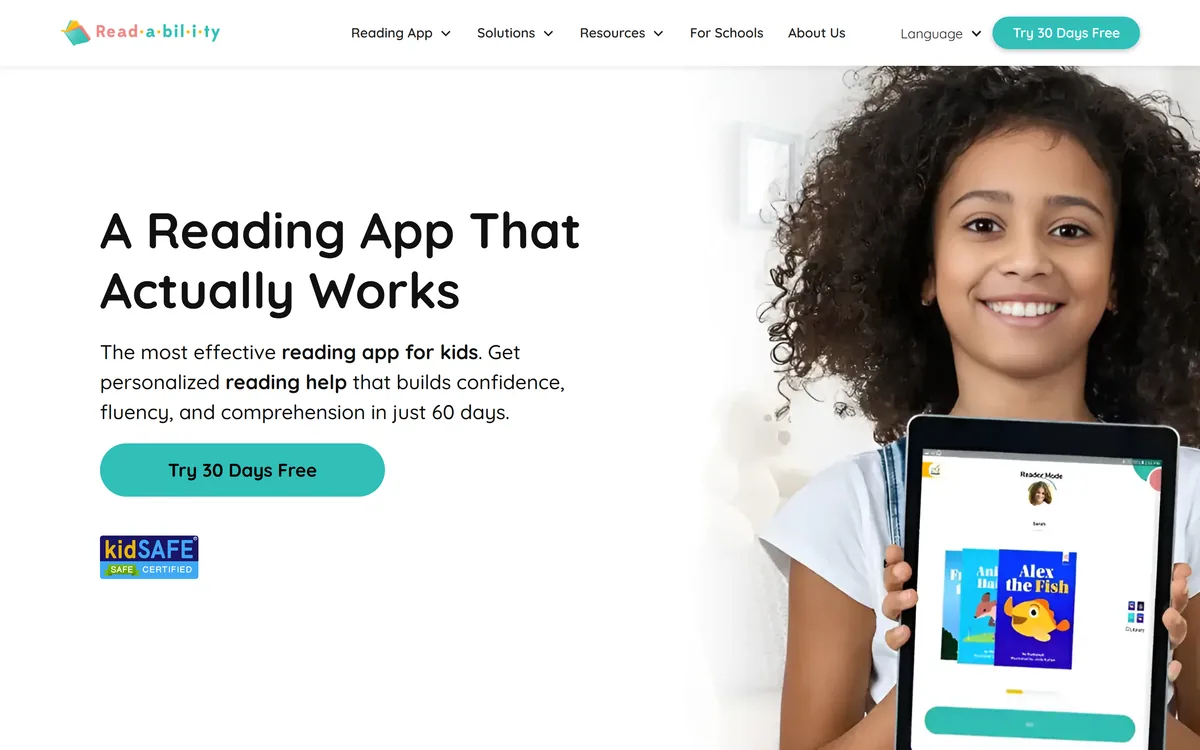
Readability is a reading app for children that listens as they read aloud, corrects errors in real time, and asks spoken comprehension questions through a system it calls IVQA. It tracks words correct per minute, accuracy and comprehension per child, and states over 350,000 students helped.
Named special education teacher, doctor of education and child psychologist
Platforms
iPhone, Android, iPad, tablets, Chromebook and MacBook
Readability: A Tutor That Listens To Reading
The description is direct: real-time reading help through an AI tutor that listens, corrects and encourages, with gains in fluency, accuracy and words correct per minute stated in under 60 days.
Listening is the entire proposition, and it addresses a genuinely hard logistical problem rather than an invented one.
Reading aloud to an attentive adult is one of the most reliably effective things a child can do, and every teacher knows it. It is also close to impossible to supply at the volume required. A class of thirty gives each child a few minutes a week, and at home the adult is usually cooking dinner.
The result is that the child who most needs to practise reading aloud — the one who is slow, hesitant and self-conscious about it — gets the least of it, because the practice is uncomfortable for everyone in the room.
An app that listens patiently, corrects without a sigh and never conveys impatience removes the social cost from the exercise. The child psychologist quoted on the site names this specifically: learning at their own pace without the pressure and expectations that produce self-doubt.
Reading aloud to an attentive adult is one of the most effective things a child can do. It is also almost impossible to supply at the volume required.
Levelled Books And Moving Up A Grade
The Smart Reading Program is described as automatically selecting the right reading material for each child, to minimise struggle and maximise improvement.
Level matching is quietly the most important feature in any reading programme, and getting it wrong ruins everything downstream.
There is a well-established range where practice works. Too easy and nothing is learned; too hard and the child spends all their attention decoding individual words with none left for meaning — and, worse, learns that reading is unpleasant. That association, once formed, is far harder to undo than any specific skill gap.
Automatic levelling that responds to performance is exactly right in principle, because a child's level moves and a parent has no reliable way to judge it.
The caveat is that a child's interests matter as much as their level. A dinosaur-obsessed seven-year-old will attempt a book two levels above them if it has dinosaurs in it, and motivation carries a reader further than difficulty matching does. A system that optimises purely on accuracy can select correctly and lose the child anyway. Broader tutoring tools such as Khanmigo address the school-subject side rather than this specific mechanic.
How Does An App Hear A Child Read?
Recognising a child reading aloud is meaningfully harder than ordinary speech recognition, and it is worth understanding why before judging any product in this category.
Children's voices sit outside the acoustic range most speech systems were built around, with higher pitch and different formant structure. Vocabularies are smaller, and pronunciation is inconsistent in ways adult speech is not.
Then there is the specific difficulty of the task. A struggling reader produces exactly the input that breaks recognition: long pauses mid-word, restarts, self-corrections, invented pronunciations of unfamiliar words, and a substituted word that fits the sentence perfectly.
That last case is the hard one. A child reading house for home has made an error worth catching. A system tuned too tightly interrupts constantly and destroys the child's confidence; tuned too loosely it misses the errors it exists to catch.
The app has one advantage no general recogniser has: it knows exactly what the text says. Constraining recognition to the expected words makes the problem tractable, and it is why reading tutors can work where open-ended child speech recognition struggles. What the site does not describe on these pages is what happens to the audio itself, which is the question we would want answered before a child uses it daily.
Check the privacy policy for how children's voice audio is handled.
Sit with your child for the first sessions to see how correction feels.
Let interest override level when the two conflict.
Treat the dashboard as a trend line, not a weekly verdict.
Keep reading together — the app replaces the listener, not the relationship.
Words Correct Per Minute And What It Measures
Words correct per minute appears throughout the site, and it is a real measure rather than a proprietary score — which is worth knowing, because it means the number is comparable to something.
It comes from curriculum-based measurement, a decades-old approach where a standard passage is timed and errors subtracted, and it is used in schools precisely because it is quick, repeatable and sensitive to change.
Its value is as a screening and progress signal. A child well below the expected range for their grade is worth looking at more closely, and a child whose rate climbs over eight weeks is improving in a way that is hard to fake.
Its limits are equally well documented. Fluency is necessary for comprehension but nowhere near sufficient — some children read a passage quickly and accurately and cannot say what happened in it, and a rate measure alone will miss that entirely.
This is exactly why the comprehension component matters as much as the fluency tracking, and why the two being in one app is the sensible design. The claim we cannot assess is the evidence framing: the site refers to using Readability in a blind study without naming it or linking a result, and a stated 60-day improvement window carries no source. Neither is unusual in consumer education, and neither should be read as a published finding. Families educating at home will need a curriculum around it, which is what LittleLit AI supplies.
Comprehension Questions Asked Aloud
IVQA — interactive voice-based questions and answers — is presented as an industry first, prompting, correcting, assessing and encouraging young readers to ensure they understand the material.
The design decision worth noticing is that the questions are spoken and answered aloud rather than tapped.
That distinction matters more than it appears. A multiple-choice comprehension question can be answered correctly by elimination, by recognising a familiar phrase, or by guessing — which is why comprehension quizzes flatter weak readers so consistently.
Asking a child to say what happened requires them to reconstruct and articulate it, which is a much better test and a much better exercise. Retelling is one of the standard classroom techniques for exactly this reason.
It also keeps the mode consistent. A child who has been reading aloud stays in speaking mode rather than switching to tapping, which keeps the session continuous. The vocabulary mechanic follows the same logic: long-press a word to hear it pronounced and see the meaning, with the word saved to a personal list. Encountering a word in context and then reviewing it is how vocabulary is actually acquired — considerably better than word lists divorced from any sentence. Adaptive practice platforms like LearnFast AI apply the same spacing principle across other subjects.
Building A Reading Habit At Home
The app can supply the listener. It cannot supply the routine, and the routine is what produces the result.
This sequence gets a habit that survives past week three.
Read the privacy policy for how your child's voice recordings are handled.
Set up each child separately so their levels and dashboards stay their own.
Sit in for the first few sessions and watch how corrections land.
Fix a short daily slot rather than a long weekly one.
Let your child pick books on interest when it conflicts with level.
Check the trend monthly, and talk to their teacher if it stays flat.
Readability: What Parents Get
A listener that never sighs — the child reads aloud and is corrected in the moment.
Spoken comprehension questions rather than multiple choice, so answers must be reconstructed.
Words correct per minute, a real school measure, tracked alongside accuracy and comprehension.
Automatic level matching plus vocabulary saved from words the child looked up.
Three readers per account, each with a separate dashboard, across phones, tablets and laptops.
Key features of Readability
Real-time listening and correction while reading aloud
Spoken comprehension questions and answers
Words correct per minute, accuracy and comprehension tracking
Automatic reading level selection
Long-press vocabulary lookup with saved word lists
Storytime read-aloud mode for early readers
Individual dashboards for up to three children
Daily and weekly reports for parents
Pros & cons
Pros
7
Supplies the attentive listener that is hardest to provide at home
Removes the social discomfort that keeps struggling readers from practising
Words correct per minute is a genuine school measure, not an invented score
Spoken comprehension answers cannot be guessed the way multiple choice can
Vocabulary learned in context and reviewed afterwards is how words actually stick
Automatic levelling responds to performance rather than a parent's estimate
Endorsements come from named, credentialed professionals rather than anonymous parents
Cons
7
A blind study is referenced without being named, linked or dated
The 60-day improvement window carries no stated source
Superlatives like most effective and industry first are asserted rather than shown
The pages we read do not describe how children's voice audio is handled
Fluency practice supports reading but does not replace phonics instruction
Level matching can conflict with a child's interests, and interest usually wins
The on-page comparison is framed against tutoring costs rather than other apps
Best For
Children who can decode but read slowly or hesitantly
Families where no adult can listen to reading daily
Parents who want measured progress rather than a general impression
Households with several children at different reading levels
Readers who have become self-conscious about reading aloud to people
Readability Beside Other Reading Apps
Children's learning tools differ by what they actually practise.
ELSA Speak — spoken feedback for language learners
Readability: Checked On The Reading Pages
Last checked . Read from readabilitytutor.com in a browser session on the date above, with the screenshot captured at the same time.
Positioned as a reading app for children, with an AI tutor that listens, corrects and encourages
Gains in fluency, accuracy and words correct per minute stated within 60 days
IVQA described as interactive voice-based questions and answers, and as an industry first
Described as built on the Science of Reading and powered by real-time AI
A Smart Reading Program described as selecting reading material at the child's level automatically
A progress dashboard covering reading history, times, accuracy, comprehension and speed
Vocabulary described as long-press for pronunciation and meaning, saved to an A-Z personal list
Storytime described as a read-to mode for early literacy and new sounds
Three readers per account, each with an individual progress dashboard
Usage stated as 350,763-plus students helped, with book and minute counts displayed
Endorsements from a named special education teacher, a doctor of education and a child psychologist
Footer showing privacy policy, terms of use, payment policy, a support phone number and email
What we could not confirm: the blind study referenced on the page, which is not named or linked; the basis for the 60-day improvement claim; how children's voice audio is stored, retained or used, which the pages we read do not describe; how the industry-first claim for IVQA was assessed; and pricing. We did not create an account or have a child use the app.
Editor's Verdict
4.0/5
Readability does the one thing that is genuinely hard to arrange at home: it gives a child an adult-equivalent listener for reading aloud, every day, without an adult having to sit there. Reading practice with immediate correction is well supported by evidence, and tracking words correct per minute is a real curriculum-based measure rather than an invented score. The endorsements are from named, credentialed professionals. What sits less comfortably is the evidence framing — a blind study is referenced without being cited, and the superlatives are stated rather than shown. AInexfinder Editor Score: 4.0/5.
Readability pricing
AInexfinder does not list plan prices or billing details. For current pricing, plans, and trials, visit the official Readability website.
Vendor pricing, credits, and billing policies change over time. Always confirm on the official site before you buy.
Frequently asked questions
What does Readability do?
A child reads aloud and the app listens, correcting errors in the moment and encouraging them. It then asks spoken comprehension questions and tracks fluency, accuracy and understanding over time.
Why does reading aloud to a listener matter?
It is one of the most reliably effective reading activities and one of the hardest to supply. A class of thirty gives each child minutes a week, and at home the adult is usually doing something else.
What is words correct per minute?
A timed fluency measure from curriculum-based measurement, used in schools for decades. Because it is a standard measure rather than a proprietary score, the number means something outside the app.
Does fluency mean my child understands what they read?
No. Fluency is necessary but not sufficient — some children read a passage quickly and accurately and cannot say what happened. That is why the spoken comprehension component matters as much as the speed tracking.
How can an app understand a child reading?
It knows what the text says, which makes the problem tractable. Children's voices are genuinely harder to recognise than adults', and a struggling reader produces pauses, restarts and substitutions that break general systems.
Why are comprehension questions spoken rather than tapped?
Because multiple choice can be passed by elimination, familiarity or a guess. Asking a child to say what happened requires them to reconstruct and articulate it, which is both a better test and a better exercise.
Is it based on the Science of Reading?
The site states so. Fluency practice, vocabulary in context and comprehension work all sit within that body of research. It is not a substitute for systematic phonics, which is where a child who cannot yet decode should start.
What about my child's voice recordings?
The pages we read do not describe how audio is stored, retained or used, so the privacy policy is the place to look before daily use. It is the question we would want answered first for any app that records a child.
Should I believe the 60-day claim?
Treat it as a marketing statement. It carries no source, and the blind study referenced elsewhere on the page is not named or linked. Your own dashboard trend over two months is better evidence for your child.
When should we see a specialist instead?
If a teacher has raised a possible specific learning difficulty, if progress stays flat after a couple of months of regular use, or if the difficulty seems to involve attention or vision rather than reading itself.
Daniel reviews AI tools the slow way — by actually using them on real projects. His reviews cover what works, what breaks, and who each tool is genuinely a good fit for.
Daniel and the AInexfinder editorial team research Readability using public product information, listing evidence, and (when available) hands-on checks. Scores reflect listing completeness and transparency — not paid placement.
Listings may include affiliate or sponsored placements, which are labeled when present. Editorial scores and cons are not sold. See our affiliate disclosure and review methodology.
LUCA is a K-12 reading intervention platform that analyses student reading at the phoneme level rather than the word level, identifying skill gaps in real time. It reports a 17.4 words-per-minute average fluency gain and 763,000+ grapheme-phoneme mappings, delivered through SoundScout, StoryGen and Assessment Intelligence.
Question AI is a homework-helper app that scans a question and returns step-by-step answers across school subjects, plus AI writing, search, translation and summarizing. Its study uses are legitimate; using it to hand in answers or graded work crosses academic-integrity lines, which we weigh honestly.
RemNote combines outlining, handwriting, PDF annotation and spaced-repetition flashcards in one document, generating cards, quizzes and summaries from PDFs, slides, lecture transcripts and video, with an exam scheduler that works backwards from a date you set.
Gizmo is a mobile-first study app that turns your notes, PDFs, slides and YouTube videos into AI-generated quizzes and flashcards, built around active recall so revision becomes a habit rather than a chore.
StudyFetch turns course material — PDFs, slides, lecture recordings, YouTube videos, photographed notes — into flashcards, quizzes, summaries and an AI tutor called Spark.E that answers only from your uploaded content.
ThetaWise is a STEM study tool covering maths, science and engineering with step-by-step solutions, a Tutor Mode that guides through hints, generated animated video lessons, practice quizzes, flashcards and Desmos graphing, stating 765,781 students.