SologoAI creates logos from a brand name, an image or a sketch, and layers a licensing model on top: traceable fonts and documented graphics, with commercial-use, trademark-use and exclusive buyout options, plus brand kits, mockups and vector export.
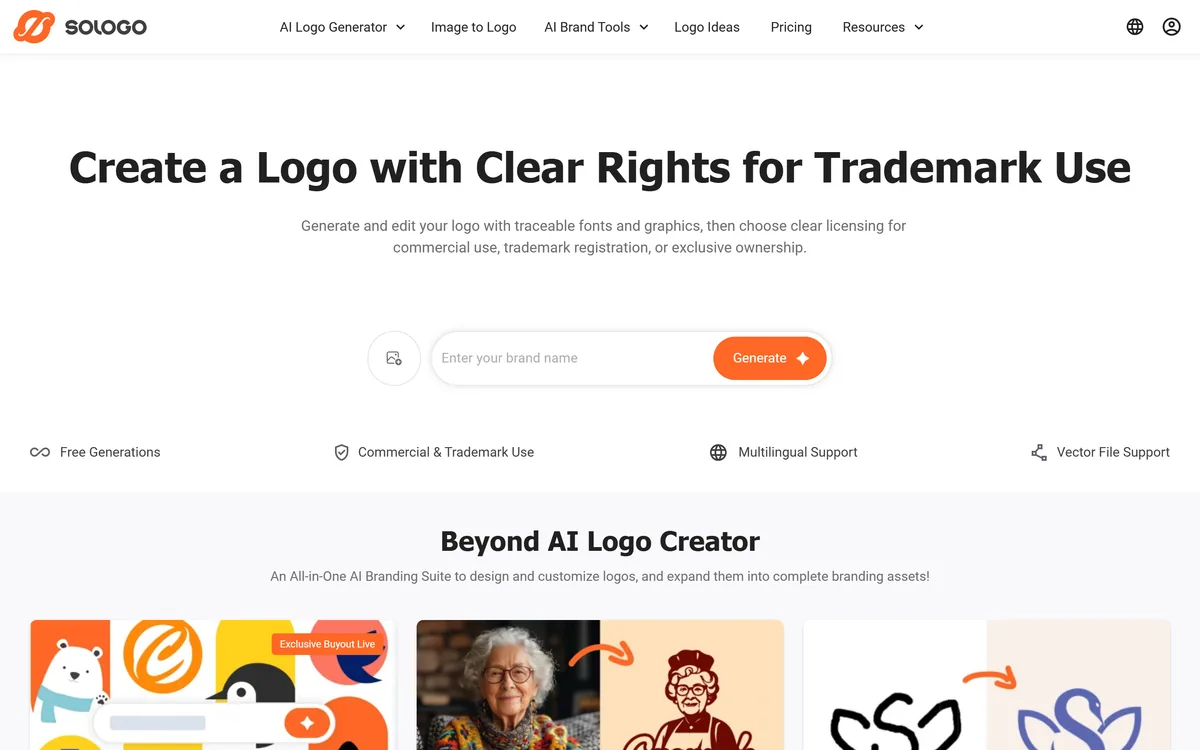
SologoAI's homepage, captured 9 September 2026, showing its trademark-use licensing positioning.
SologoAI: What The Licence Covers
Traceable fonts and graphics — design elements documented so you can see what a logo is built from.
Three licence routes: commercial use, trademark use, and exclusive buyout where available.
An explicit disclaimer that a licence does not establish legal availability to register.
Four creation modes: brand name, image, sketch or idea, with multilingual input.
Vector and animated export, plus brand kits, mockups and brand imagery.
SologoAI: A Logo You Can Actually Register
The headline states the whole differentiator: create a logo with clear rights for trademark use — generate and edit with traceable fonts and graphics, then choose licensing for commercial use, trademark registration or exclusive ownership.
Every part of that sentence addresses a failure the rest of the category ignores.
A generated logo is an image, and a brand is a legal position. The gap between them has been the unspoken problem with AI logo tools since the first one launched: you receive a picture, you build a business on it, and nobody has told you whether the typeface was licensed for commercial use, whether the mark resembles an existing one, or whether you own it firmly enough to stop someone else using it.
Most vendors handle that with a terms page and silence.
Building the product around provenance and licence tiers instead is a genuine differentiator, and it is aimed squarely at the customer who intends to still be trading in five years rather than the one who needs something for a slide.
A generated logo is an image. A brand is a legal position. Most of this category sells the first and stays quiet about the second.
Traceable Fonts And Why They Matter
The site describes reviewing available font and graphic information for an eligible logo so you can understand its design elements before choosing a licence.
Fonts are the trap almost nobody anticipates, because typefaces are software and carry software licences.
A great many freely downloadable fonts permit personal use only. Others permit commercial use but explicitly exclude logo or trademark use, on the reasonable grounds that registering a mark built from a typeface effectively claims those letterforms in that context. A business can operate for years on a wordmark it was never licensed to use commercially and discover the problem only when it tries to register.
Knowing which typeface a logo uses converts an unknown risk into a checkable fact, and that is the entire value of the word traceable.
The same logic covers graphic elements. A generated icon assembled from library assets carries whatever licences those assets came with, and a vendor able to document them is offering something a purely generative tool structurally cannot. Conventional makers such as Logomakerr.ai compete on design range rather than on provenance, which is a different product for a different buyer.
Can An AI Logo Be Trademarked?
The site's own FAQ asks this directly, which is more than most vendors risk, and the honest answer has two halves that are often confused.
Trademark and copyright are separate systems. A trademark protects a sign used to identify a trader's goods or services, and registrability turns mainly on distinctiveness and on whether a confusingly similar mark already exists. How the sign was made is largely beside the point — an office assessing a mark is asking whether it distinguishes you, not who drew it.
So a generated logo can generally be registered as a trademark, subject to the ordinary tests.
Copyright is where generation genuinely matters. Several jurisdictions require human authorship for copyright to subsist, which leaves purely machine-generated output in contested territory. That does not block trademark registration, but it may weaken your ability to act against someone copying the artwork itself outside trademark law.
The practical implications are ordinary: edit the output meaningfully, keep records of what you changed, and understand that trademark rights and copyright in the artwork are two different protections you may hold to different degrees.
Check the font licence before building a wordmark on it.
Run a clearance search in your class and territory before filing.
Edit generated output meaningfully and keep records of the changes.
Choose exclusivity if the mark must be yours alone.
Take professional advice before filing anything that matters.
Three Licence Tiers And What Each Buys
The tiers are described as commercial use, trademark use with an R-labelled logo, and an exclusive buyout where available.
That structure maps onto three genuinely different situations, and choosing wrongly is expensive in one direction only.
Commercial use covers putting a logo on a site, a product and a business card. It is what most small businesses actually need, and for a side project or an early venture it is sufficient.
Trademark use is for a mark you intend to register and defend, where the licence needs to support an application. Exclusivity is the third case and the one most people do not think about until later: without it, a generative system can produce a closely similar mark for another customer, which is precisely the outcome a trademark exists to prevent.
The most important sentence on the whole site sits in this section: a SologoAI licence does not establish legal availability — search for confusingly similar marks in your target market and consider professional advice before filing. That is accurate, it is against the vendor's short-term commercial interest, and it is the single sentence a buyer most needs to read. Template-led editors like DesignEvo give more direct control over the artwork and leave the rights question where it usually sits.
From One Logo To A Whole Brand Kit
Beyond the logo the suite covers brand kits with business cards, letterheads and presentation templates, AI mockups for products and packaging, a brand image generator for posters and social graphics, and an editable design canvas.
Export covers PNG, JPG, SVG and PDF, with logo animation offered for web and social use.
Vector export is the specification that separates a usable logo from a decorative one, and it is worth checking on any tool in this category. A raster logo fails the moment it needs to go on signage, packaging or a vehicle, and rebuilding it later costs more than starting correctly.
The brand kit expansion is the pragmatic half of the product. Consistency across touchpoints is what makes a small business look established, and the gap between having a logo and having a brand is usually a designer's invoice.
The stated 100,000-plus customers and the testimonial mix — Shopify sellers, Amazon sellers, restaurant owners, freelancers — describe the actual audience accurately. This is for people who need to look credible quickly and cannot commission an identity. Multi-purpose generators like Stockimg.ai cover the surrounding assets without the licensing apparatus.
Choosing A Mark You Can Defend
The expensive branding mistake is not a mediocre logo. It is a good logo you have to abandon in year three.
This order avoids that.
Decide first whether this mark needs to be registrable or merely usable.
Review the font and graphic information before settling on a design.
Avoid marks that describe your product — descriptive marks are refused.
Run a clearance search in your class and territory.
Take the licence tier that matches your actual intention, including exclusivity.
Export vector files and keep the source, not just a PNG.
SologoAI: Rights And Formats
Category
AI logo generation with licensing for commercial and trademark use
Creation modes
Brand name, image, sketch and idea, with multilingual input
Provenance
Traceable fonts and graphics with documented rights for eligible logos
Licence tiers
Commercial use, trademark use, and exclusive buyout where available
Published caution
States a licence does not establish legal availability to register
Export formats
PNG, JPG, SVG and PDF, plus logo animation
Brand kits
Business cards, letterheads and presentation templates
Mockups
AI-generated product, apparel and packaging mockups
Brand imagery
Posters, banners, marketing visuals and social graphics
Editing
A customisable design canvas for typography, colour and layout
Inspiration
Stated as over 5,000 logo designs across 50-plus industries
Adoption
Stated as over 100,000 customers; site copyright shown since 2023
Key features of SologoAI
Logo generation from name, image, sketch or idea
Traceable font and graphic information
Commercial, trademark and exclusive licensing options
Vector export in SVG and PDF
Animated logo output
Brand kit generation
AI product and packaging mockups
Editable design canvas
Pros & cons
Pros
7
Addresses the rights question the rest of the category avoids
Traceable fonts convert an unknown risk into a checkable fact
Publishes an explicit warning that its licence is not legal clearance
Licence tiers map onto genuinely different commercial situations
Exclusive buyout addresses the reproducibility problem in generated marks
Vector export makes output usable for signage and packaging
Brand kit expansion covers the gap between a logo and an identity
Cons
7
Design quality still competes with tools that only have to make a picture
Which logos count as eligible for rights documentation is not defined publicly
Copyright in purely generated artwork remains contested in several jurisdictions
Exclusivity enforcement against future generations is not explained
Testimonials are first-name attributions without verifiable identities
No substitute for a clearance search, which the site correctly says itself
Strategy and positioning are outside what any generator provides
Canva AI — applying an identity across every asset
SologoAI: Read From The Licensing Pages
Last checked . Read from sologo.ai in a browser session on the date above, with the screenshot captured at the same time.
Positioned as creating a logo with clear rights for trademark use
Traceable fonts and graphics described, with documented rights for eligible logos
Three licensing routes described: commercial use, trademark use and exclusive buyout
An explicit statement that a SologoAI licence does not establish legal availability
Advice to search for confusingly similar marks and consider professional advice before filing
Four creation modes offered: brand name, image, sketch and idea
Multilingual input stated, including English, Spanish and Japanese
Export offered in PNG, JPG, SVG and PDF, plus logo animation
Brand kits described covering business cards, letterheads and presentation templates
AI mockups and a brand image generator offered as separate tools
FAQ entries addressing trademark registration and the commercial-versus-trademark licence distinction
Footer showing privacy policy and terms of use, with a copyright stated since 2023
What we could not confirm: which logos qualify as eligible for traceable rights documentation; what the licence tiers cover in contractual detail; how exclusivity is enforced against future generations; how the 100,000-customer figure is counted; whether testimonials are from identifiable people; and pricing. We did not generate a logo or purchase a licence.
Editor's Verdict
4.1/5
Almost every AI logo generator sells you an image and leaves the hard part unaddressed. SologoAI has built its product around that hard part instead: fonts and graphics whose provenance is documented, licensing tiers matched to how you intend to use the mark, and an explicit warning that its licence does not establish legal availability and you should search for conflicting marks before filing. That last sentence is the most responsible thing we have read on a logo generator's homepage. The output still competes on design against tools that only have to make a picture. AInexfinder Editor Score: 4.1/5.
SologoAI pricing
AInexfinder does not list plan prices or billing details. For current pricing, plans, and trials, visit the official SologoAI website.
Vendor pricing, credits, and billing policies change over time. Always confirm on the official site before you buy.
Frequently asked questions
What makes SologoAI different from other logo generators?
It addresses rights rather than only design. Fonts and graphics are documented so you can see what a logo is built from, and licensing is tiered for commercial use, trademark use or exclusive ownership.
Can an AI-generated logo be trademarked?
Generally yes, subject to the ordinary tests. Registrability turns on distinctiveness and on whether a confusingly similar mark exists — not on how the design was made. Copyright in the artwork is a separate and more contested question.
Why do font licences matter in a logo?
Because typefaces are software with their own terms. Many free fonts permit personal use only, and some permit commercial use while explicitly excluding logo or trademark use — which a business often discovers only when filing.
Does buying a licence mean I can register the mark?
No, and the site says so directly: a licence does not establish legal availability. You still need a clearance search for confusingly similar marks in your class and territory, and professional advice is worth taking.
What is an exclusive buyout for?
Preventing the same system generating a closely similar mark for another customer. Without exclusivity that outcome is possible, and it is exactly what a trademark exists to stop.
Which licence tier do I need?
Commercial use covers a website, product and business card, which is enough for most small businesses. Trademark use is for a mark you intend to register and defend. Exclusivity is the third, separate question.
Do I get vector files?
Yes — SVG and PDF alongside PNG and JPG. Vector matters because a raster logo fails the moment it goes on signage, packaging or a vehicle, and rebuilding it later costs more than starting correctly.
Should I edit the generated logo?
It is worth doing. Several jurisdictions require human authorship for copyright to subsist, so meaningful editing with records of what changed strengthens your position on the artwork itself.
What can it not help with?
Strategy, positioning and distinctiveness in a crowded category. A generator produces artwork; deciding what the mark should say about you is the part that still needs a person.
Who is this best suited to?
Founders and small businesses that need credible branding quickly and intend to still be trading in five years — the buyer who cares whether the mark holds up, not just how it looks.
Daniel reviews AI tools the slow way — by actually using them on real projects. His reviews cover what works, what breaks, and who each tool is genuinely a good fit for.
Daniel and the AInexfinder editorial team research SologoAI using public product information, listing evidence, and (when available) hands-on checks. Scores reflect listing completeness and transparency — not paid placement.
Listings may include affiliate or sponsored placements, which are labeled when present. Editorial scores and cons are not sold. See our affiliate disclosure and review methodology.
krea2.org is a browser image-generation workspace that runs several third-party models side by side, including Krea 2 tiers, FLUX.2, GPT Image 2, Nano Banana and Seedream 5.0, with reference uploads, six aspect ratios and live model switching.
GenApe is an all-in-one AI platform covering writing, chat, image and video generation, image editing, product photography, translation, and research — with 145 free credits on signup and commercial rights granted to paid users.
Adobe Firefly generates images, video, and audio from models trained on licensed Adobe Stock and public domain content, with Content Credentials on every output, Firefly Boards for ideation, Custom Models for brand style, and third-party partner models alongside Adobe's own.
GPT Image 2 launched on 21 April 2026 as ChatGPT Images 2.0 and as the gpt-image-2 API model. Its distinguishing capabilities are dense, accurate text rendering, layout fidelity for infographics and packaging, up to 3840px output, prompt-guided masking, and reasoning applied to image structure before generation.
Stockimg AI offers separate generators for logos, stock photos, illustrations, wallpapers, product photos and social posts, then schedules the output to Instagram, TikTok, LinkedIn, YouTube and X, with an API for programmatic use.
OpenArt is an all-in-one AI creation platform covering image, video, voice and audio in one place, built around a Director that lets you lay out a storyboard and shape each shot through conversation, alongside persistent characters and worlds for consistency across a project.