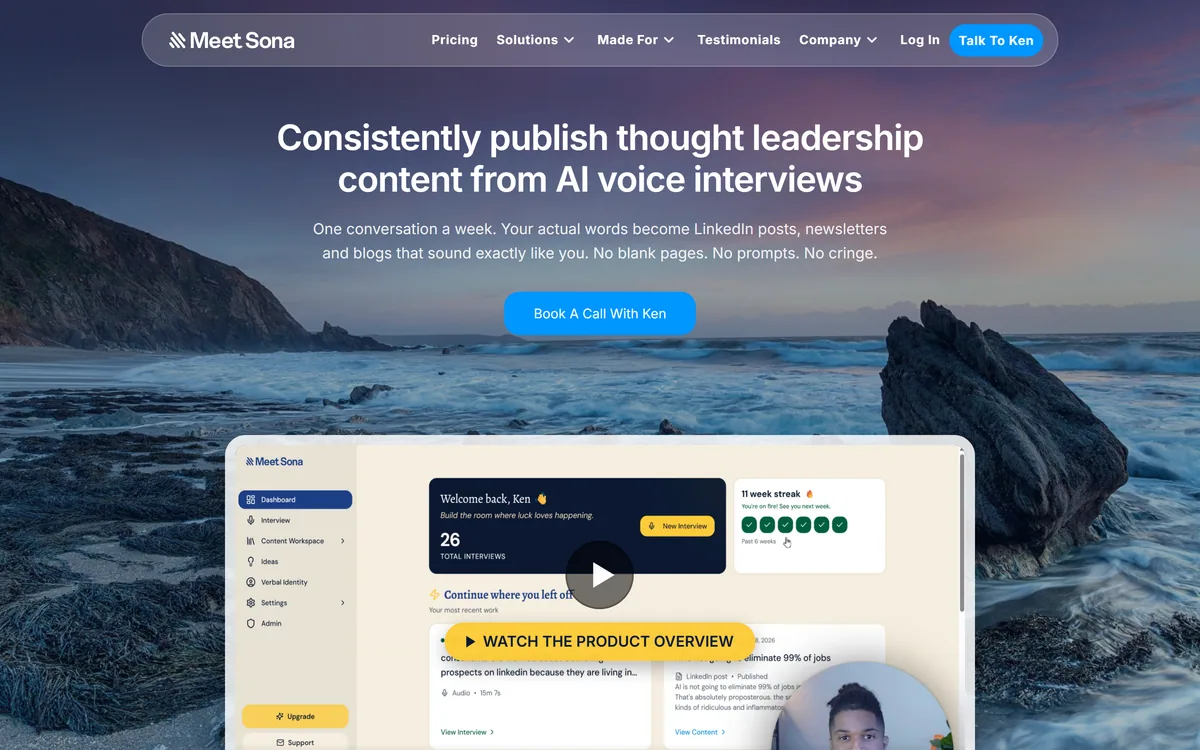
Meet Sona runs a ten-minute guided voice interview and turns it into LinkedIn posts, blog articles, newsletters, X posts and video scripts. It builds a Verbal Identity from how you speak, and publishes and schedules to LinkedIn through the official API.
Most people who cannot write can talk perfectly well. Ask a founder to explain why their pricing changed and you get five minutes of clear, specific, opinionated argument. Ask the same person to write a LinkedIn post about it and you get an empty document and a sense of dread.
Meet Sona is built on that observation. Instead of a prompt box, it runs a ten-minute guided voice interview — asking follow-up questions the way a journalist would — and turns the transcript into content across five formats.
This review covers why the interview format extracts things a prompt cannot, what Verbal Identity actually captures, how it compares with the stylometry approach Spiral takes, and the honest limits of talking your way to a publishing habit.
The input is a conversation, not a prompt — which is why the output sounds like a person.
Interview In, A Week Of Posts Out
The input is your voice, not a prompt. A ten-minute guided interview with follow-up questions, rather than a text box asking what you want to write about.
Verbal Identity captures tone, phrasing and beliefs so output across formats reads as one person.
One conversation, five formats: LinkedIn posts, blog articles, newsletters, X posts and short-form video scripts.
Publishes to LinkedIn directly through the official API, with scheduling and analytics on higher tiers.
Built by Sona Narrative Foundry LLC, with ElevenLabs credited on the voice side.
Why An Interview Beats A Prompt Box
This is a genuine insight rather than a repackaging, and it is worth understanding before judging the output.
A prompt requires you to already know what you want to say. That is the actual bottleneck — not the writing, the deciding. Most people staring at a blank post do not lack words; they lack a settled view of which of their several half-thoughts is the interesting one.
An interview solves that from the other direction. A follow-up question — 'why did that surprise you?', 'what would you tell someone about to make the same mistake?' — extracts the specific, concrete detail that makes writing worth reading. It is the same reason journalists interview people rather than emailing them a form.
The second effect is on voice. Spoken language carries rhythm, hesitation, emphasis and idiom that written-from-cold prose flattens out. Working from a transcript means the raw material already sounds like you before any style processing happens.
The trade is that you have to actually do the interview. Ten minutes of talking is a smaller commitment than an hour of writing, and it is a larger one than typing a sentence into a box — which is why this suits people who publish deliberately rather than people looking for a shortcut.
The blank page is rarely a writing problem. It is a deciding problem, and questions are better at solving it than prompts.
Verbal Identity, And How It Differs From Stylometry
Verbal Identity is described as capturing tone, style, beliefs and communication patterns so that output stays consistent across formats. That is a broader claim than it first appears, and it is worth comparing with the alternative approach in this market.
Spiral does the same job by stylometry — statistical measurement of your existing written work: sentence length, punctuation habits, vocabulary. It reproduces how you write, and it needs a body of writing to learn from.
Sona works from how you speak, and it includes beliefs and positions rather than only mechanics. That is a meaningful difference: it means the system holds something about what you think, not just how you phrase things.
Which is better depends entirely on your starting point. If you have years of published writing you are happy with, stylometry has more to work with and will match your written register more precisely. If you have little written output but plenty to say, the interview route is the only one of the two that can start at all.
There is also a subtler distinction. Spoken and written voice are not the same — most people are looser, funnier and more digressive out loud. Content built from speech tends to read warmer and less formal, which suits LinkedIn and newsletters better than it suits a technical white paper.
What One Interview Produces
The output side is where the economics work, and the Remix function is the mechanism.
LinkedIn posts — the primary format, with publishing, scheduling and analytics built around it
Blog articles — the long-form version of the same material
Email newsletters — a different register again, more direct and less performative
X posts — compressed, with the tension at the front
Short-form video scripts — spoken material returning to spoken form, which is the most natural conversion of the five
Remix — the same conversation re-angled, so one interview yields several distinct posts rather than one post in five costumes
The LinkedIn Integration Is The Practical Half
Generating content and publishing it are different problems, and most writing tools solve only the first.
Sona connects through LinkedIn's official API for posting, scheduling and performance analytics on higher tiers. The word 'official' matters — tools that automate LinkedIn through unofficial means put the account at risk, and anyone who has watched a colleague lose a profile to an automation tool takes this seriously.
Scheduling is what converts intention into a habit. The reason most people publish inconsistently is not that they run out of ideas; it is that the idea and the free moment never coincide. A week of scheduled posts from Tuesday's interview removes that coordination entirely.
Analytics closes the loop, and is the part that should change what you talk about next. If posts about hiring outperform posts about product by four to one, the next interview should go there — and without the data you are guessing.
Making The Ten Minutes Count
The tool rewards treating the interview as the work, which is precisely the opposite of how most people use content tools.
Do the interview somewhere you can speak freely and at normal volume. Half-whispering in an open-plan office produces guarded, generic answers.
Answer the follow-up questions properly rather than steering back to your prepared point — the follow-ups are where the specific detail lives.
Talk about one thing per interview. A ten-minute conversation covering four topics produces four shallow posts.
Read the first drafts for factual accuracy before voice. You said it out loud, so an error is yours, and it will be published under your name.
Use Remix to get several angles from one conversation rather than running more interviews than you need.
Schedule rather than publishing immediately, so the habit survives a busy week.
Check analytics monthly and let it choose your next interview topic instead of your mood.
Who This Will Not Suit
If you dislike hearing yourself speak or freeze when recording, the input mechanism is a barrier rather than a shortcut, and no amount of output quality compensates.
If your content is technical documentation, research writing or anything where precision beats personality, spoken-derived prose is the wrong register. Warmth is the point here, and it is a liability in a specification.
If you publish beyond LinkedIn as your main channel, note where the integration depth sits — LinkedIn gets publishing, scheduling and analytics; the other formats are drafts you take elsewhere.
And if you have nothing particular to say, this will surface that faster than a prompt-based tool would. An interview about a topic you have no view on produces ten minutes of hedging, and the drafts will show it. That is arguably a feature.
Key features of Sona
Guided ten-minute voice interviews with AI follow-up questions
Verbal Identity capturing tone, style, beliefs and communication patterns
Content drafts in five formats from a single interview
Remix, re-angling one conversation into several distinct pieces
Content idea generator with a topic pipeline
Built-in editor for refining drafts
LinkedIn publishing and scheduling through the official API
LinkedIn analytics and performance insight on higher tiers
Voice notes for capturing ideas between interviews
Interview transcripts retained alongside the drafts
Pros & cons
Pros
5
The interview format solves the deciding problem, not just the writing problem
Working from speech means the raw material already sounds like a person
Verbal Identity holds positions and beliefs, not only sentence mechanics
Official LinkedIn API rather than unofficial automation that risks the account
One conversation covering a week makes consistency realistic rather than aspirational
Cons
5
Requires you to speak comfortably on the record — a hard barrier for some
Spoken-derived prose reads warm and informal, wrong for technical writing
Integration depth is LinkedIn-first; other formats are drafts you take elsewhere
Analytics sits on higher tiers, so the feedback loop is not available at entry level
Ten minutes of talking is a real commitment compared with typing a prompt
Best For
Founders and executives who explain well out loud and publish rarely
Consultants and coaches whose expertise is verbal rather than written
Subject-matter experts with no back catalogue for a style tool to learn from
LinkedIn-led personal brands needing consistency more than volume
Anyone who has abandoned a content habit at the blank-page stage
Two Ways To Sound Like Yourself
The interesting comparison is not against generic writing tools — it is against the other approach to voice.
You explain things well out loud and freeze in front of a blank document
You have expertise and opinions but little published writing to learn from
LinkedIn is your main channel and consistency is the problem
You want one conversation to cover a week rather than daily effort
You would rather answer questions than describe a tone to a prompt box
Badly Matched When
Recording your voice makes you self-conscious or guarded
Your writing is technical or research-led, where precision beats warmth
You already have a large body of writing that a stylometry tool could learn from
Your main channels are not LinkedIn, where the integration depth sits
You want volume without having a view — the interview will expose that
Other Ways To Sound Like Yourself In Public
Voice capture, style matching and scheduling are three separable halves of the same habit.
Spiral — the stylometry alternative — learns from writing rather than speech
Supergrow — LinkedIn-specific writing if templates suit you better than interviews
FinalLayer — LinkedIn agents with research, scheduling and visual generation
Typefully — composition and scheduling when the writing is already yours
ElevenLabs — the voice technology credited on Sona's own site
Sourced From Sona's Pages
Last checked . Read from meetsona.ai during this check, with the screenshot above captured at the same time.
Ten-minute guided voice interviews as the primary input, described on the site
Named features Verbal Identity, Guided Voice Interviews, Content Drafts, Content Idea Generator, Built-In Content Editor and Remix
Output formats given as LinkedIn posts, blog articles, email newsletters, X posts and short-form video scripts
LinkedIn publishing, scheduling and analytics via LinkedIn's official API, with analytics stated as a higher-tier feature
Company identified as Sona Narrative Foundry LLC
ElevenLabs credited among partnerships in the site footer
Named audiences including founders, consultants, subject-matter experts, fractional executives and content teams
Features, about, contact, purpose, insights, product roadmap, privacy policy and AI information pages present in the footer
No plan prices published here, in line with this site's pricing policy
The comparison with stylometry describes how the two approaches differ in principle rather than a head-to-head test. Observations about spoken versus written register are general points about voice, not measurements of this product's output.
Editor's Verdict
4.1/5
Sona has an AInexfinder Editor Score of 4.1/5.
Sona pricing
AInexfinder does not list plan prices or billing details. For current pricing, plans, and trials, visit the official Sona website.
Vendor pricing, credits, and billing policies change over time. Always confirm on the official site before you buy.
Frequently asked questions
How is this different from a normal AI writing tool?
The input. A prompt box asks you to already know what you want to say, which is the actual bottleneck. An interview asks follow-up questions and extracts the specific detail that makes writing worth reading — the same reason journalists interview people rather than emailing them a form.
How does it compare with Spiral?
Different starting points. Spiral measures your existing writing statistically and reproduces how you write, so it needs a body of published work. Sona works from how you speak and captures beliefs as well as mechanics, so it can start with nothing written at all. If you have years of writing you like, Spiral has more to work with; if you do not, Sona is the only one of the two that can begin.
What do I get from one interview?
LinkedIn posts, a blog article, a newsletter, X posts and short-form video scripts — plus the Remix function, which re-angles the same conversation so you get several distinct pieces rather than one idea wearing five costumes.
Is the LinkedIn publishing safe for my account?
It uses LinkedIn's official API for posting, scheduling and analytics. That distinction matters — tools automating LinkedIn through unofficial routes put the profile at risk, and losing an account built over years is not a recoverable mistake.
What if I hate the sound of my own voice?
Then this is probably the wrong tool, honestly. The interview is the whole mechanism, and a guarded, self-conscious recording produces guarded, generic answers. A stylometry-based tool working from your writing avoids the problem entirely.
Can I use it for technical writing?
It will work, but the register is wrong. Speech-derived prose is warmer, looser and more digressive than written-from-cold text — an advantage on LinkedIn and in newsletters, a liability in documentation or research writing where precision matters more than personality.
How do I get better output?
Talk about one thing per interview, answer the follow-ups properly instead of steering back to your prepared point, and record somewhere you can speak at normal volume. Then read the drafts for factual accuracy before style — you said it out loud, so any error is yours and it publishes under your name.
Daniel reviews AI tools the slow way — by actually using them on real projects. His reviews cover what works, what breaks, and who each tool is genuinely a good fit for.
Daniel and the AInexfinder editorial team research Sona using public product information, listing evidence, and (when available) hands-on checks. Scores reflect listing completeness and transparency — not paid placement.
Listings may include affiliate or sponsored placements, which are labeled when present. Editorial scores and cons are not sold. See our affiliate disclosure and review methodology.
RepublishAI is a WordPress autoblogging platform built around specialised AI agents: one analyses search results, one writes, one generates branded images, one builds internal links and one handles SEO metadata. It publishes directly into WordPress and includes a content refresh system for older posts.
ContentBot automates content production through AI Content Workflows (Flows), bulk Imports, an AI Blog Writer, landing page generation and a humanizer, with a WordPress plugin, Chrome extension and 110+ language support via Google Translate.
BlogBuster is an AI content platform that analyses your website, suggests topics, writes long-form articles with images and internal links, and publishes them straight to WordPress, Shopify, Webflow or its own hosting. It supports more than 50 languages and includes automated backlink placement.
ContentMonk monitors how often ChatGPT, Perplexity, Claude and Google AI Overviews cite your brand, tracks classical keyword rankings alongside it, joins both to Search Console and Analytics data, and then generates and publishes articles to WordPress or Webflow. It is sold both as software and as a done-for-you service.
Copy.ai has become an AI-native go-to-market platform: workflows and agents that run prospecting, lead processing, deal coaching, ABM, and CRM enrichment across Salesforce, HubSpot, Gong, Outreach, and 2,000+ integrations.
Writesonic has become an AI search growth platform — tracking whether your brand appears across 10 AI platforms, running optimisation and citation work through an Action Center, and reporting results against traffic and revenue.