
Runway is an AI video platform built around generative world models — Gen-4.5, Aleph 2.0, and Act-Two for performance capture — split across Runway Creative for filmmakers, Runway Dev for builders, and Runway Robotics.
FreemiumVideo & Audio
Syllaby takes a content idea through script writing, video generation and scheduled publishing in four steps. It generates faceless short and long-form video, offers AI avatars with voice cloning in 29+ languages, routes across Veo, Seedance, Kling, Grok and Hailuo models, and publishes to YouTube, TikTok, Instagram Reels and Facebook.
The reason most people stop making video content is not the filming. It is that publishing consistently requires five separate skills — finding topics, writing, producing, editing and scheduling — and being bad at any one of them stops the whole chain.
Tools have historically solved one link each — Fliki the scripting, InVideo AI the generation, which leaves you assembling a pipeline out of four subscriptions and your own attention.
Syllaby's proposition is the whole chain in one product, and for the specific format it targets that is genuinely useful. It also makes a format decision on your behalf that deserves examining, because it is the part most likely to determine whether any of this works.
Four terms that describe what this tool makes and how to judge it.
Syllaby's headline is turning any idea into faceless videos, and it is worth being clear about what that format is and where it currently stands.
Faceless video means content with no on-camera presenter: stock or generated footage, text overlays, a synthetic voiceover. It became dominant because it removed the two barriers that stopped most people — being willing to appear on camera, and having anywhere decent to film.
The genuine case for it is unchanged in some categories. Explainer content, list formats, news summaries and instructional material do not need a face, and viewers do not expect one.
The honest caution is about saturation. The format's own accessibility is the problem: when anyone can produce twenty of these a week, feeds fill with them, and audiences learn to scroll past a stock clip with a synthetic voice reading a listicle. Platforms have also grown more explicit about down-ranking low-effort mass-produced content.
What still works within the format is what always worked, whether you use this or AutoShorts.ai: a genuinely useful script, a specific claim, information the viewer could not get in five seconds elsewhere. The tool makes production trivial and does nothing about that, which means the script is where your entire result is decided.
The format's accessibility is also its problem. When anyone can make twenty a week, the only thing that separates yours is the script.
Syllaby states AI voice cloning supporting 29 or more languages, alongside its avatar library. This is the capability with the most genuine upside and it is easy to overlook next to the video generation.
Most creators are confined to one language, which means most of the world is unreachable to them. Producing the same content in a dozen languages has historically meant hiring voice talent per market, at a cost that only makes sense once an audience already exists — a straightforward chicken-and-egg problem.
Cloning your own voice across languages removes it. The same content reaches markets where competition is frequently much lighter than in English.
Two cautions apply. Translation quality varies sharply by language and you cannot judge a language you do not speak, so get a native speaker to watch a full video before publishing a whole channel. And if anyone else appears in your content, cloning their voice requires their explicit permission — a voice is a person's likeness, protected independently of copyright in several jurisdictions.
Syllaby lists an unusually current model roster: Veo 3, 3.1 and their fast variants, Seedance Pro through 2.0, Kling v2.6 Pro and its editing models, Grok Imagine, and MiniMax Hailuo variants.
Keeping that list current is real work and a genuine benefit — you get whatever is best this quarter without holding accounts with five providers or learning five prompt idioms.
The corresponding position is one every aggregator shares. Syllaby does not control these models, so capability changes, price changes and availability changes pass through to you. More importantly for anyone monetising: commercial licence terms for generated footage are set by whichever model produced it, not by Syllaby.
For a creator publishing to a platform that pays, that is not academic. Establish which model produced a video before monetising it, and check that provider's terms.
The output specifications are at least published, which many competitors omit: MP4, MOV and WebM export, in 16:9, 9:16, 1:1 and 4:5 — the aspect ratios that actually matter across YouTube, TikTok and Instagram.
Syllaby includes a content calendar, a bulk scheduler, direct publishing to YouTube, TikTok, Instagram Reels and Facebook, and social analytics.
This is the least glamorous part of the product and probably the one that determines whether you keep using it. Producing a video is a burst of enthusiasm; publishing it on four platforms every week is an administrative task that quietly kills content habits.
The bulk scheduler is what makes a batch approach possible — producing a month of content in one session and letting it publish on a schedule. For anyone doing this alongside a job, that is the difference between a channel that continues and one that stops in week three.
Analytics in one place matters for a related reason: the same video performs very differently across platforms, and without a combined view nobody notices which format is actually working.
The caution is the one the whole product invites. A bulk scheduler makes it easy to queue thirty videos, and thirty mediocre videos perform worse than eight good ones — not just per video, but in total, because audiences and ranking systems both learn.
The way to judge a pipeline tool is to take one idea all the way to a published video, because the friction is always in the handoffs rather than in any single step.
The bar is step two. If the script is not something you would defend, nothing downstream can rescue it.
Access is a credit-based subscription; amounts are not disclosed on the pages we read. There is an enterprise tier and API access, plus mobile apps for iOS and Android.
Credits are the right meter for this kind of product because generation genuinely costs the vendor per run, and the practical consequence is that video generation dominates your consumption. Scripts and ideas are cheap; a minute of generated video from a premium model is not.
The lever that matters is regenerating less. Lock the script before generating, because a script change means regenerating everything downstream — and that iteration is where credit budgets disappear.
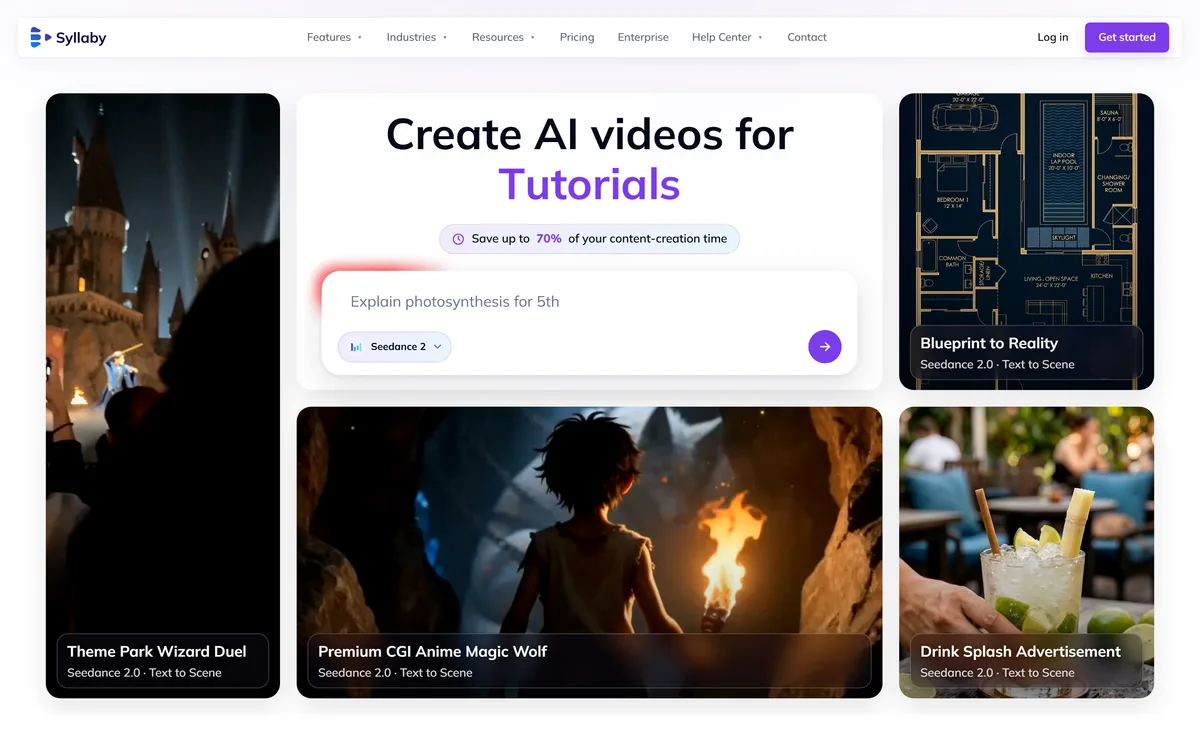
The stated time saving of up to 70 per cent of content-creation time carries no methodology or baseline, so treat it as directional. Measure your own before-and-after on one real video instead.
We do not publish amounts, since credit rates change. Check whether unused credits roll over and how avatar and voice-clone minutes are metered against video generation, because they are usually separate.
Four-step pipeline from content idea through script, video and scheduled publishing
Faceless video generation in short and long form
Text-to-scenes, audio-to-video and URL-to-video creation routes
AI avatar library plus Real Clone Lite and Studio avatar options
Voice cloning stated across 29 or more languages
Routing across Veo, Seedance, Kling, Grok Imagine and Hailuo models
Content calendar and bulk scheduler with direct publishing to four platforms
AI thumbnail generation, AI images, social analytics and an online editor
These tools cover different lengths of the chain from idea to published video. Buying one that stops short means assembling the rest yourself.
| Tool | Covers | Format | Publishing |
|---|---|---|---|
| Syllaby | Idea, script, video, schedule | Faceless video and AI avatars | Built in to YouTube, TikTok, Reels, Facebook |
| Fliki | Script to video | Narrated video from text | Export rather than direct publishing |
| InVideo AI | Generation and editing | Multi-model generative video | Export |
| AutoShorts.ai | Automated short-form production | Faceless shorts specifically | Automated posting |
| Synthesia | Script to avatar video | Corporate presenter video | Export |
| Product type | End-to-end faceless video creation and publishing |
|---|---|
| Workflow | Generate idea, write script, generate video, schedule and publish |
| Video routes | Text to scenes, audio to video, URL to video |
| Avatars | Stock avatar library plus Real Clone Lite and Real Clone Studio options |
| Voice cloning | Stated as supporting 29+ languages |
| Models routed | Google Veo 3 and 3.1 with fast variants, ByteDance Seedance Pro through 2.0, Kling v2.6 Pro and editing models, xAI Grok Imagine, MiniMax Hailuo variants |
| Export formats | MP4, MOV, WebM |
| Aspect ratios | 16:9, 9:16, 1:1, 4:5 |
| Publishing | YouTube, TikTok, Instagram Reels, Facebook |
| Extra tools | AI thumbnail generator, AI images, social analytics, online video editor, character consistency |
| Mobile | iOS and Android apps |
| Stated saving | Up to 70% of content-creation time |
| Company | Syllaby, 601A Foster Street, Durham, North Carolina |
| Pricing model | Credit-based subscription, with an enterprise tier and API access |
Last checked . Read from syllaby.io, including the footer, with the screenshot above captured in the same session.
What we could not confirm: no pricing amounts or credit rates are disclosed; the stated saving of up to 70 per cent of content-creation time carries no methodology or baseline; the platform usage counters on the site displayed as zero in what we retrieved, so no user or output figures could be read; maximum video length is not stated; commercial licence terms for generated footage are set by each underlying model rather than by Syllaby; and we did not produce a video, so nothing here reflects tested output quality.
Compare on how much of the chain each covers, since the gaps are what you end up doing yourself.
Syllaby scores fairly because it covers the whole distance most creators actually struggle with — the gap between having an idea and having a published video — rather than solving generation and leaving you to assemble everything else. Routing across Veo 3.1, Seedance, Kling and Hailuo means it inherits current model quality, and 29+ language voice cloning opens markets a single-language creator cannot reach. It loses ground because the faceless-video format it exists to produce is exactly what platforms and audiences are getting tired of, and because a pipeline this automated makes it trivially easy to publish volume that does nothing for you. AInexfinder Editor Score: 3.8/5.
AInexfinder does not list plan prices or billing details. For current pricing, plans, and trials, visit the official Syllaby website.
Visit official website for pricingVendor pricing, credits, and billing policies change over time. Always confirm on the official site before you buy.
Log in to write a review.
No reviews yet. Be the first to share your experience with Syllaby.
Assigned reviewer
Daniel ReedSenior AI Tools Reviewer
Daniel reviews AI tools the slow way — by actually using them on real projects. His reviews cover what works, what breaks, and who each tool is genuinely a good fit for.
Daniel and the AInexfinder editorial team research Syllaby using public product information, listing evidence, and (when available) hands-on checks. Scores reflect listing completeness and transparency — not paid placement.
Runway is an AI video platform built around generative world models — Gen-4.5, Aleph 2.0, and Act-Two for performance capture — split across Runway Creative for filmmakers, Runway Dev for builders, and Runway Robotics.
LipSync.video generates lip-synchronised video from a face and an audio track. It offers two model tiers, accepts uploaded video, uploaded or recorded audio, or a typed script with generated speech, and provides over 300 prebuilt avatars. Credits can be earned through daily actions as well as bought.
Viggle animates characters from a still image driven by motion from a video, built on its Joint Space-Time model — described as a physics-native world model that generates characters, motion and scenes together in shared 4D space. It offers a Meme Maker, the PINOC motion-capture tool, games and an API, and states 50 million users.
BeatViz.ai turns music into video through three tools — Chat, Workflow and Editor. Chat 2.0 is positioned as an AI music video director, and the site names the models it draws on, including Veo, Sora, Kling, Seedance, Nano Banana and GPT Image 2.
Argil is an AI video platform built around three surfaces: a Playground for generating images and video model by model, a Director that takes an idea to a finished video, and Templates that turn a repeated video format into a reusable recipe with variables.

The workspace at www-flux3.com generates 5–20 second AI videos with native audio from text or a starting image, routing across FLUX 3, MiniMax H3, Seedance, Wan 3.0 and Kling 3.0 Pro, at 720p or 1080p with video extension.