
Runway is an AI video platform built around generative world models — Gen-4.5, Aleph 2.0, and Act-Two for performance capture — split across Runway Creative for filmmakers, Runway Dev for builders, and Runway Robotics.
FreemiumVideo & Audio
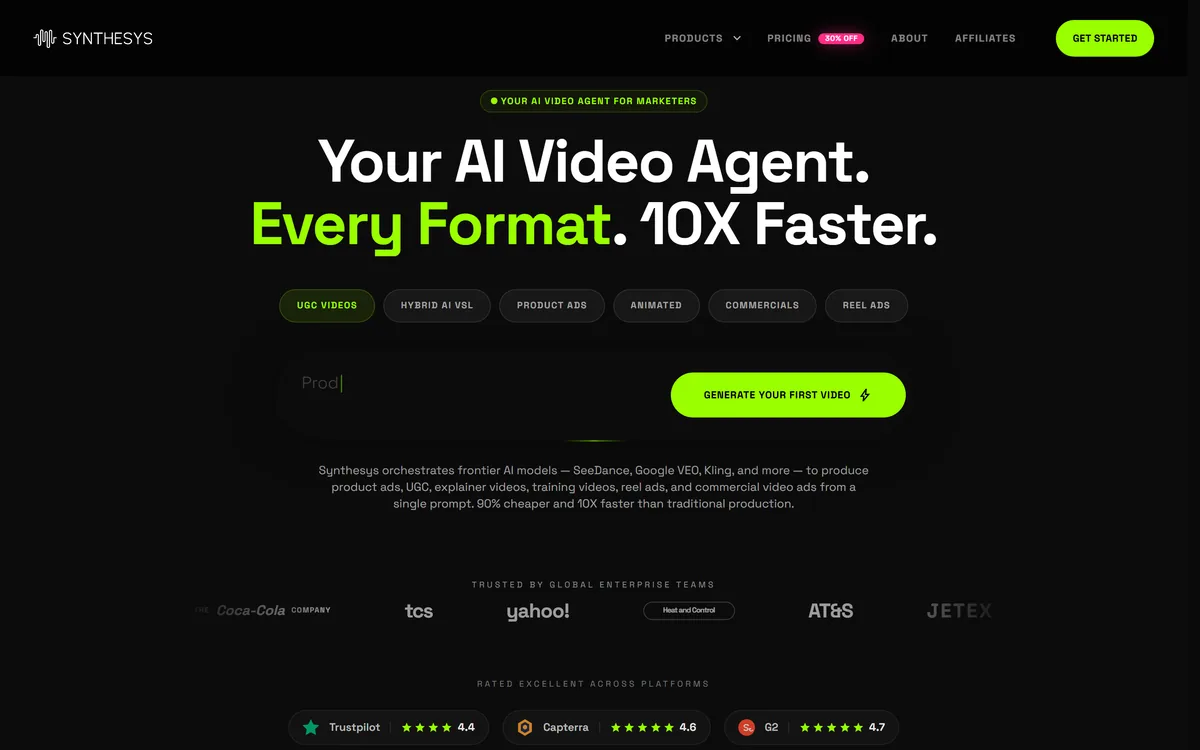
Synthesys is a London-founded AI video platform that orchestrates several frontier video models — Sora 2, Google VEO, Kling, Wan and SeeDance among them — to produce UGC ads, sales videos, product ads, animation, reels and commercials from a prompt, a URL or a product image.
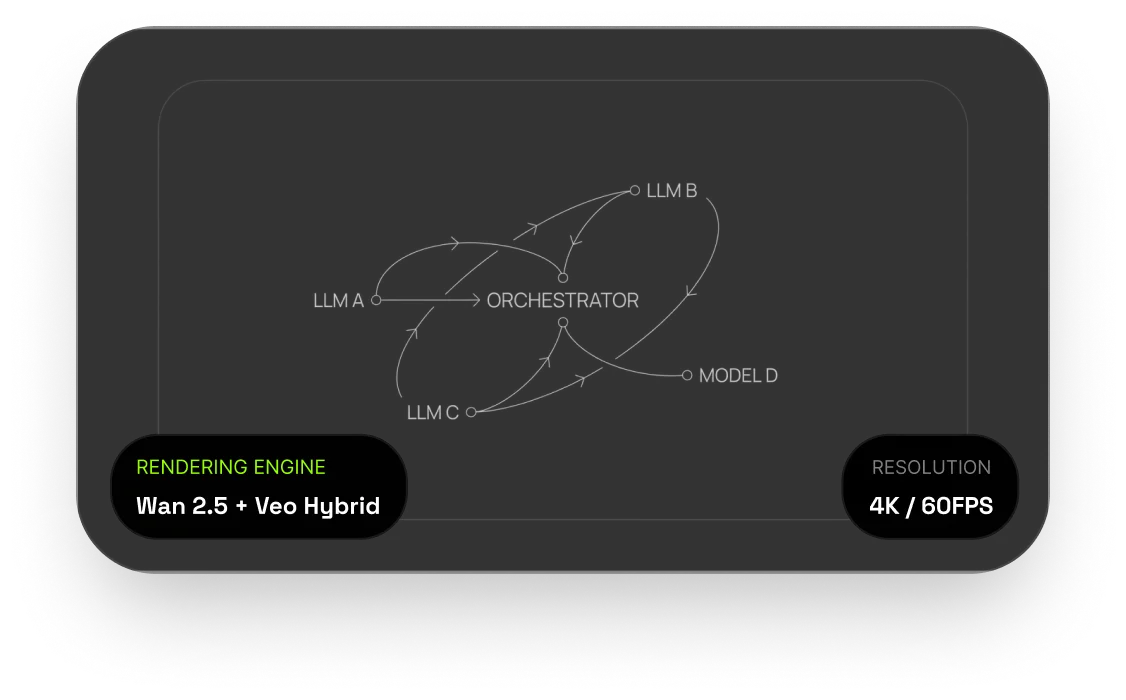
Most AI video tools wrap a single model in an interface. Synthesys does something different: it treats the models as interchangeable parts and picks one per scene.
That distinction matters because video models are not equally good at everything. One holds photorealistic faces, another handles cinematic camera motion, another renders text without turning it to soup.
The rest of the product is a set of format collections designed to constrain the prompt box, which is usually where marketing video generation goes wrong.
| Positioning | AI video agent for marketing teams |
|---|---|
| Founded | London, 2020, per the site's own description |
| Claimed scale | Over 1,000,000 videos for 50,000+ creators and businesses |
| Format collections | Social and UGC, hybrid AI VSL, product and brand, animated, reel ads, commercial ads |
| Models named | Sora 2, Google VEO 3.1, Kling 3, Wan 2.5, SeeDream and SeeDance |
| Avatars | 1,000+, with digital twin creation and clips up to 30 minutes |
| Voices | 400+ across 140+ languages with frame-accurate lip-sync |
| Inputs | Prompt, website URL, product image or an uploaded document |
| Other tools | Text to video, lipsync, AI dubbing, AI avatars |
| Rights | Full commercial rights stated on every plan |
| Displayed ratings | Trustpilot 4.4, Capterra 4.6, G2 4.7, Software Advice 4.6 |
| Claimed savings | 90–95% lower cost and 10× faster than traditional production |
The phrase sounds like marketing until you understand what it replaces. A single-model tool sends every request to the same generator, so its weaknesses become your weaknesses on every video you make.
Synthesys states that it selects the optimal model for each scene — photorealistic avatars from one, cinematic motion from another — and composites the result.
That structure has two real consequences. The first is that quality varies less predictably by task, because a weakness in one model can be routed around rather than worked around.
The second is upstream improvement. When Sora, VEO, Kling or Wan ships a better version, an orchestration layer inherits it without rebuilding anything. That is a defensible position in a field where model quality changes every few months.
The cost is reproducibility. If routing is automatic, the model that produced a result you liked may not be the one that handles the next request, and neither you nor the platform necessarily tells you which was used — the same trade every multi-model platform makes, including ImagineArt.
An orchestration layer inherits every improvement the frontier models ship. It also inherits their retirements.
The six collections are not cosmetic. Each carries assumptions that do work a prompt would otherwise have to describe.
UGC and reel ads are the strongest fit for generation, because the format's visual language tolerates imperfection. Handheld framing, uneven lighting and imperfect continuity read as authentic rather than broken.
Avatar-led formats — hybrid VSL, spokesperson, training — work well because the hard part is a talking head holding a face across a long take, which is now solved technology rather than an open research question.
Product and brand work is the honest weak spot for any generative tool. A generated object that is nearly your product is worse than useless in an ad, which is why product-first tools like Picwand exist as a separate category from general video generators.
Cinematic commercials are the highest-variance category. When they work they are remarkable; when they fail they fail in the uncanny middle, and the difference is often invisible until you watch on a large screen.
Synthesys states that it reduces video production costs by 90 to 95 percent and delivers output ten times faster, comparing against agency and freelance production it prices between one thousand and twenty thousand dollars per video.
The arithmetic is not wrong. It is the baseline that needs examining.
A 90 percent saving against an agency is only a saving if an agency was your alternative. For a marketing team that has never commissioned a shoot, the honest comparison is against not making the video at all, and the saving is zero because the spend is new.
The claim also excludes the cost that generation adds: reviewing output, discarding failures, and the time spent iterating toward something usable. Every generative tool carries that tax and none of them price it.
Where the claim is most defensible is variation. Producing fifty versions of an ad for testing is genuinely near-impossible at agency rates and genuinely cheap here, and that is a real change in what a team can do rather than a discount on what it already did.
Synthesys publishes its scores across four review platforms rather than one, which is a small honesty signal worth crediting.
Trustpilot 4.4, Capterra 4.6, G2 4.7 and Software Advice 4.6 is a consistent picture across audiences that review for different reasons, and consistency is more informative than any single high number.
The site also displays enterprise logos including Coca-Cola, TCS, Yahoo, Heat and Control, AT&S and Jetex, plus press placements. What a displayed logo means is rarely specified — a single team running a pilot and a company-wide deployment look identical on a logo wall.
The percentage outcomes attributed to customer segments are attributed to platform data from 2025 rather than to independent study, which the site states directly rather than obscuring.
None of this is a criticism. It is the difference between what a vendor page can establish and what only your own trial can, and the ratings are strong enough that the trial is worth running. Consistency across a whole body of work is a separate matter again, and closer to what Hypernatural is built for.
With 1,000-plus avatars, digital twin creation and 140-plus languages with lip-sync, the practical question stops being whether you can make the video and becomes whether you should say how you made it.
The site does not address disclosure, and no vendor page in this category does, so the decision falls entirely to you.
Three things make it worth deciding deliberately rather than by default. Advertising regulators in several markets have begun treating undisclosed synthetic presenters as a consumer information issue. Platforms increasingly require synthetic media labelling on paid placements. And audiences notice — often not consciously, but in the drop-off.
There is a second consent question specific to digital twins. A cloned presenter is a real person's face and voice, and the release you need covers not just the recording session but every future use of the likeness, including scripts written after they leave.
None of this argues against generating the video. It argues for settling two things before the first campaign: what you will disclose, and what your talent has actually agreed to.
The failure mode with a tool this broad is generating fifty things and shipping none. Six collections invite an afternoon of sampling.
This sequence starts from one real brief and tests the specific claims that decide whether the platform pays for itself.
Multi-model orchestration across several frontier video models
Six format collections with ready-made templates
1,000+ AI avatars including digital twin creation
400+ voices across 140+ languages with lip-sync
Generation from a prompt, URL, image or document
AI dubbing and lipsync as standalone tools
Avatar videos up to 30 minutes
Commercial rights stated on every plan
Marketing video tools differ by what they assume about your output.
| Tool | Approach | Models | Best for |
|---|---|---|---|
| Synthesys | Six format collections, model per scene | Sora 2, VEO, Kling, Wan, SeeDance | Marketing teams needing several formats |
| Hypernatural | Branded video with a persistent brand kit | Not named | Consistency across a series |
| Klap | Long video cut into shorts | Not named | Repurposing existing footage |
| Picwand | Product photos into video ads | Four named | Ecommerce ad creative |
| Kapwing | Browser editor with AI tools | Not named | Editing rather than generating |
Other routes to marketing video, from repurposing to product-specific generation.
Last checked . Read from synthesys.io in a browser session on the date above, with the screenshot captured at the same time.
What we could not confirm: our capture stopped inside a repeating testimonial carousel before the site footer, so we read nothing below that point and make no claim in either direction about what is published there. We also could not confirm what the displayed enterprise logos represent, how the segment outcome percentages were measured, which model handles any given request, whether routing is disclosed to the user, or the terms behind the promotional discount in the navigation. Pricing is not reproduced here. We did not generate a video.
Synthesys does something more interesting than generate video: it routes each job to whichever frontier model handles it best, then composites the result. That is a genuinely defensible position, because it inherits every improvement Sora, VEO, Kling and Wan ship without rebuilding anything. Six format collections give the prompt box the constraints it needs. The claims are where care is required — a 90 to 95 percent cost reduction is measured against agency production, which is the right comparison only if an agency was your alternative. AInexfinder Editor Score: 4.0/5.
AInexfinder does not list plan prices or billing details. For current pricing, plans, and trials, visit the official Synthesys website.
Visit official website for pricingVendor pricing, credits, and billing policies change over time. Always confirm on the official site before you buy.
Log in to write a review.
No reviews yet. Be the first to share your experience with Synthesys.
Assigned reviewer
Daniel ReedSenior AI Tools Reviewer
Daniel reviews AI tools the slow way — by actually using them on real projects. His reviews cover what works, what breaks, and who each tool is genuinely a good fit for.
Daniel and the AInexfinder editorial team research Synthesys using public product information, listing evidence, and (when available) hands-on checks. Scores reflect listing completeness and transparency — not paid placement.
Runway is an AI video platform built around generative world models — Gen-4.5, Aleph 2.0, and Act-Two for performance capture — split across Runway Creative for filmmakers, Runway Dev for builders, and Runway Robotics.
LipSync.video generates lip-synchronised video from a face and an audio track. It offers two model tiers, accepts uploaded video, uploaded or recorded audio, or a typed script with generated speech, and provides over 300 prebuilt avatars. Credits can be earned through daily actions as well as bought.
Viggle animates characters from a still image driven by motion from a video, built on its Joint Space-Time model — described as a physics-native world model that generates characters, motion and scenes together in shared 4D space. It offers a Meme Maker, the PINOC motion-capture tool, games and an API, and states 50 million users.
BeatViz.ai turns music into video through three tools — Chat, Workflow and Editor. Chat 2.0 is positioned as an AI music video director, and the site names the models it draws on, including Veo, Sora, Kling, Seedance, Nano Banana and GPT Image 2.
Argil is an AI video platform built around three surfaces: a Playground for generating images and video model by model, a Director that takes an idea to a finished video, and Templates that turn a repeated video format into a reusable recipe with variables.

The workspace at www-flux3.com generates 5–20 second AI videos with native audio from text or a starting image, routing across FLUX 3, MiniMax H3, Seedance, Wan 3.0 and Kling 3.0 Pro, at 720p or 1080p with video extension.