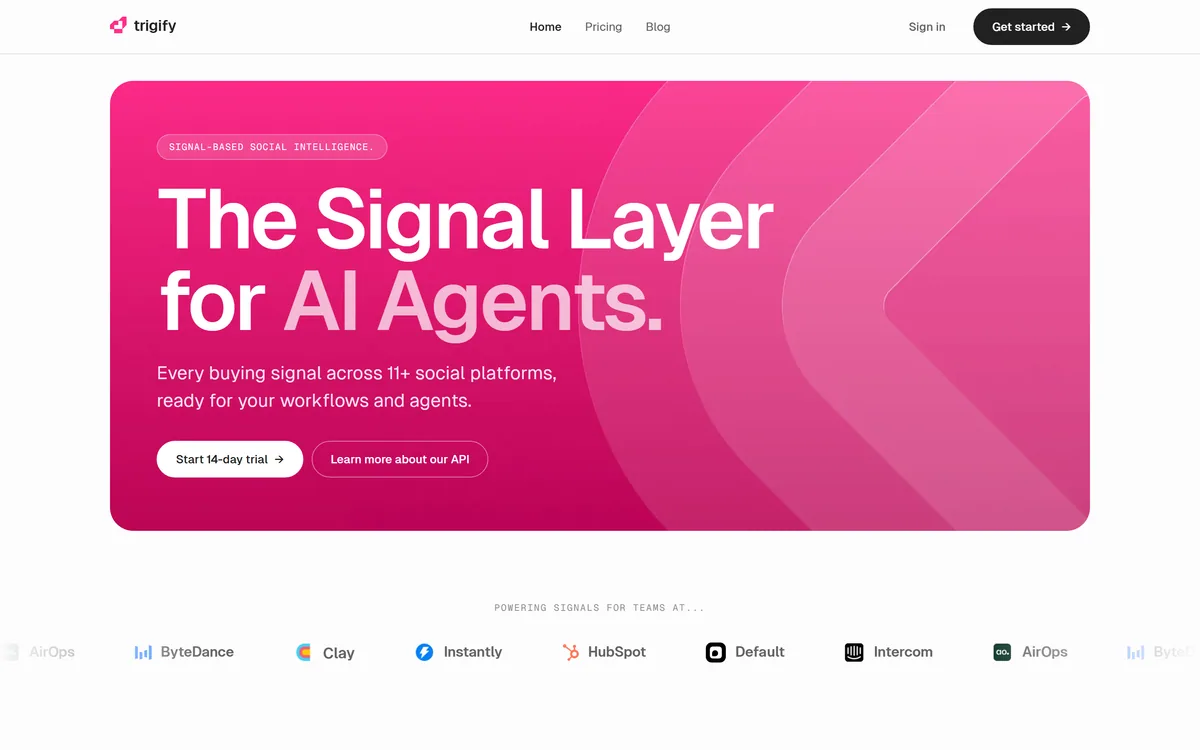
Trigify monitors buying signals across 11-plus social platforms — role changes, competitor engagement, tracked topics, hiring, expansion — enriches them with person and company data, and routes them into workflows and AI agents, with replay, backtesting and an auditable output table.
Trigify's homepage, captured 9 September 2026, showing its signal layer positioning.
Trigify: What Counts As A Signal
11-plus platforms monitored, including business networks, X, Reddit and video and developer spaces.
16-plus signal types: role changes, competitor engagement, tracked topics, hiring, expansion.
An AI co-pilot that configures monitors and workflows from a plain-English description.
Replay and backtest — run a workflow against historical signals before shipping it.
An outputs table recording every action taken, queryable and exportable.
Trigify: Signals And Surfaces
Category
Social signal intelligence for go-to-market teams and AI agents
Positioning
The signal layer for AI agents
Platforms
Stated as 11-plus and growing, across business networks, X, Reddit, video and developer spaces
Signal types
Stated as 16-plus ABM signals across person and company, growing monthly
Named signals
Changed role, changed company, competitor engagement, liked competitor content, posted about a tracked topic, started hiring, expansion, influence, buying-window
Monitor types
Profile monitor, Boolean search and engagement capture
Cadence
12-hour, 24-hour, weekly and monthly runs
Inputs
Manual entry or a CSV list of profile URLs
Configuration
An AI co-pilot that builds monitors and workflows from plain English
Enrichment
Person, company and context data attached to signals
Testing
Replay and backtest against historical signals
Auditability
An outputs table of every action taken, queryable and exportable
Trigify: Watching What Buyers Do In Public
The positioning is explicit: signal-based social intelligence, the signal layer for AI agents, with every buying signal across 11-plus social platforms ready for your workflows and agents.
The examples given describe the product precisely — someone commenting on a competitor's launch, asking for recommendations, complaining about a tool, announcing a new role, or posting about a problem you solve.
The premise is sound and the supporting statistics are the standard ones for this argument: a stated average cold-email reply rate of 0.7 percent in 2026, 73 percent of business buying journeys beginning on social, and buyers being eleven times more responsive when contacted in context. None of those carry a source we could follow, and the middle one is the kind of figure that circulates widely without attribution.
What is uncontroversially true is the direction. Untargeted cold outreach has collapsed in effectiveness, and a message referencing something a person actually said outperforms one referencing nothing.
That is the whole thesis, and it does not need a percentage to be persuasive to anyone who has run outbound recently.
Untargeted cold outreach has collapsed. A message referencing something a person actually said outperforms one referencing nothing — that is the thesis, and it needs no percentage.
Profiling People And What The Law Expects
This section is not an allegation about the company, and none is intended. It describes obligations that fall on the buyer, which the marketing page does not mention.
What the product does is monitor named individuals' public activity over time, infer intent from it, and attach that inference to a person record. Under GDPR that is profiling, and profiling is a defined activity with defined consequences: you need a lawful basis, you must be able to explain it, and the person retains rights to information, objection and erasure.
Public availability is the most common misunderstanding here. That data is publicly visible does not make it unregulated — the lawful basis most sales intelligence relies on is legitimate interest, and legitimate interest requires a balancing test weighing your commercial benefit against the individual's reasonable expectations.
A person posting on a public professional network reasonably expects to be read. Whether they reasonably expect their likes to be tracked across weeks and scored for buying intent is a genuine question, and it is yours to answer.
The practical implications are ordinary rather than alarming: know your lawful basis, be able to state it, honour objections, and do not pretend a signal-triggered message arrived by coincidence. Data enrichment platforms such as Clay sit in the same regulatory position, and the same questions apply to all of them.
Are Social Signals Better Than Cold Email?
Almost certainly yes, and it is worth being precise about the mechanism rather than accepting the framing.
A cold email fails because it is irrelevant at the moment it arrives. Nothing about the recipient's situation prompted it, so the base rate of it landing during a buying window is roughly the base rate of buying windows — which is very low. That is what a 0.7 percent reply rate describes.
A signal changes the timing rather than the message. Someone complaining that their enrichment data is stale has just told the market they are unhappy with a vendor, and a message that week meets a real problem instead of interrupting an unrelated day.
The improvement is almost entirely about when, not about how clever the copy is.
There is a failure mode worth naming, because it is common and self-defeating. A message that references someone's post in a way that reveals automated surveillance reads worse than a generic one — the person understands they were monitored, not noticed. The distinction between contextual relevance and demonstrated tracking is a copy problem, and no signal platform can solve it for you. Platforms like Artisan take the signal and run the outreach as well, which concentrates both the leverage and the risk in one place.
Establish your lawful basis for monitoring before you monitor.
Act on signals within days — most decay within a week.
Reference the problem, not the fact that you were watching.
Backtest scoring before it triggers any outreach.
Honour objections quickly and keep the record of doing so.
Sixteen Signal Types Across Eleven Platforms
The signal library is where the product is strongest, because it is specific enough to evaluate: changed role, changed company, competitor engagement, liked competitor content, posted about a tracked topic, started hiring, expansion into a new location, influence on a topic, and a buying-window signal combining topics and roles.
Those differ enormously in quality, and treating them as one category is the main way teams waste this kind of tool.
A role change is the strongest signal in business-to-business selling and always has been. A new leader has budget, a mandate and a reason to replace what their predecessor chose — and a short window in which they are actively looking.
Started hiring is nearly as good, because a company opening six roles in a function has just declared where it is investing.
Liking a competitor's post is at the other end. It might mean interest, or politeness, or a passing glance while scrolling. Signals like that are only useful in combination, which is what the buying-window signal is for — and combining weak signals is the right response to their weakness. Monitor types cover profile watching, Boolean searches and engagement capture, at cadences from twelve-hourly to monthly, which matters because signal value decays fast.
Replay, Backtest And An Auditable Trail
Two features here are rare enough to be the reason to choose this over an alternative: replay and backtest, described as running any workflow against historical signals to tune scoring before you ship, and an outputs table recording every action Trigify ever took, queryable and exportable.
Backtesting is standard practice in trading and almost unheard of in sales tooling, and its absence elsewhere is why so much signal-based outreach is configured on instinct.
Without it you write scoring rules, point them at live signals, and discover their quality by observing how prospects react — which means learning at the cost of your reputation with real people. Running the same rules against three months of history costs nothing and tells you what would have fired.
The outputs table matters for a different reason, and it connects back to the earlier section. A complete record of every action taken is exactly what you need to answer a subject access request, demonstrate a lawful basis, or investigate a complaint.
It is presented as an analytics feature and it is also a compliance asset, which is worth recognising when the record is asked for. The Jarvis co-pilot configuring monitors and workflows from plain English is the practical on-ramp, since the alternative is a workflow canvas most sales teams would not complete. Conversation analysis platforms such as Salesken work the other end of the same pipeline, once the conversation exists.
Using Signals Without Being Creepy
The line between well-timed and unsettling is narrow, and crossing it costs more than the meeting was worth.
This order stays on the right side of it.
Document your lawful basis for monitoring before configuring anything.
Start with role changes and hiring — the strongest signals available.
Backtest your scoring against historical signals before it triggers outreach.
Write messages that reference the problem, never the surveillance.
Act within days, since most signals are worthless within a week.
Keep the outputs record, and honour objections promptly when they arrive.
Key features of Trigify
Monitoring across 11-plus social platforms
Sixteen-plus person and company signal types
Profile monitors, Boolean searches and engagement capture
Configurable run cadences from twelve-hourly to monthly
An AI co-pilot for plain-English configuration
Workflows routing signals into your stack
Replay and backtesting against historical signals
An exportable table of every action taken
Pros & cons
Pros
7
The signal library is specific enough to evaluate rather than vague
Backtesting is standard in trading and almost unheard of here
The outputs table doubles as an auditable compliance record
Role change and hiring signals are genuinely the strongest available
Combining weak signals is the correct response to their weakness
Plain-English configuration removes the workflow-canvas barrier
Cadence options acknowledge that signal value decays quickly
Cons
7
The product profiles named individuals, and the page never mentions the obligations
Three headline statistics carry no source we could follow
Weak signals like a competitor like mean very little on their own
Outreach that reveals monitoring performs worse than generic outreach
Which platforms make up the eleven, and how data is collected, is unstated
Signals are worthless unless someone acts within days
Platform terms of service on data collection are outside your control
Best For
Sales teams selling to buyers who post publicly
ABM programmes with a defined target account list
Founders doing outbound who can act on a signal same-week
RevOps teams wiring signals into an existing stack
Teams building agents that need an event to react to
Trigify Against Other Intent Platforms
Go-to-market data tools differ by what they observe.
Salesken — analysing the conversations that follow
AltIndex — alternative data signals about companies
Brandwatch — listening at brand level rather than person level
Trigify: Read From The Signal Pages
Last checked . Read from trigify.io in a browser session on the date above, with the screenshot captured at the same time.
Positioned as signal-based social intelligence and the signal layer for AI agents
Coverage stated as 11-plus social platforms and growing
ABM signals stated as 16-plus across person and company, with the library growing monthly
Named signals including changed role, competitor engagement, tracked topics, hiring and expansion
Monitor types described as profile monitor, Boolean search and engagement capture
Run cadences offered at 12-hour, 24-hour, weekly and monthly intervals
Target lists accepted by manual entry or CSV of profile URLs
An AI co-pilot described as configuring signal searches, workflows and agent nodes from plain English
Signals stated to be enriched with person, company and context data
Replay and backtest described as running workflows against historical signals
An outputs table described as recording every action taken, queryable and exportable
Statistics displayed for cold-email reply rate, social buying journeys and in-context responsiveness, without cited sources; footer showing privacy and terms pages
What we could not confirm: the sources for the three displayed statistics; which specific platforms make up the 11-plus figure; how signals are collected and whether that complies with each platform's terms; what lawful basis the vendor relies on, or what it expects customers to establish; how the logo wall relationships are defined; and pricing. We did not configure a monitor or run a workflow.
Editor's Verdict
3.9/5
Trigify is technically well built and it asks something of the buyer that most tools in this category do not acknowledge. The signal library is specific rather than vague, the replay and backtest features are genuinely unusual, and the outputs table gives an auditable record of every action taken. But the product is a system for building behavioural profiles of named individuals from their public activity, and in Europe that is regulated activity with obligations attached. Nothing on the page is improper; the obligations simply belong to you, and the page does not mention them. AInexfinder Editor Score: 3.9/5.
Trigify pricing
AInexfinder does not list plan prices or billing details. For current pricing, plans, and trials, visit the official Trigify website.
Vendor pricing, credits, and billing policies change over time. Always confirm on the official site before you buy.
Frequently asked questions
What does Trigify do?
It monitors public social activity across 11-plus platforms for buying signals — role changes, competitor engagement, tracked topics, hiring, expansion — enriches them, and routes them into workflows or AI agents.
Why do social signals beat cold email?
Timing rather than cleverness. A cold email fails because nothing about the recipient's situation prompted it, so its chance of arriving during a buying window is roughly the base rate of buying windows.
Is monitoring individuals' public posts regulated?
In Europe, yes. Building behavioural profiles of named people from their activity is profiling under GDPR, which requires a lawful basis, explainability, and honouring rights to object and erase.
Does public data mean unregulated data?
No, and this is the most common misunderstanding. The usual lawful basis is legitimate interest, which requires balancing your commercial benefit against the individual's reasonable expectations — a test, not a formality.
Which signals are actually worth acting on?
Role changes are the strongest in business-to-business selling — new budget, new mandate, an active window. Hiring is close behind. A like on a competitor's post means almost nothing alone.
How quickly do signals expire?
Fast. Someone asking for recommendations is worth contacting the same day and worth nothing three weeks later, which is why the run cadence and whether anyone actions the output both matter.
What is the most common self-inflicted mistake?
Copy that reveals the surveillance. A message referencing someone's post in a way that shows they were monitored performs worse than a generic one, because they understand they were watched rather than noticed.
Why does backtesting matter?
Because without it you learn your scoring quality by watching real prospects react, at the cost of your reputation. Running the same rules against three months of history costs nothing and tells you what would have fired.
What is the outputs table for?
It records every action taken, queryable and exportable. Presented as analytics, it is also a compliance asset — exactly what you need to answer a subject access request or investigate a complaint.
When should you not use a tool like this?
When your buyers do not post publicly, when nobody will act inside the signal's window, when you cannot establish a lawful basis, or when you could simply ask your existing customers instead.
Daniel reviews AI tools the slow way — by actually using them on real projects. His reviews cover what works, what breaks, and who each tool is genuinely a good fit for.
Daniel and the AInexfinder editorial team research Trigify using public product information, listing evidence, and (when available) hands-on checks. Scores reflect listing completeness and transparency — not paid placement.
Listings may include affiliate or sponsored placements, which are labeled when present. Editorial scores and cons are not sold. See our affiliate disclosure and review methodology.
Listomize is an Etsy SEO platform that generates titles, tags, and descriptions within Etsy's own limits, scores listings, optimises 100+ listings from a CSV, tracks competitors and trends, and auto-generates Pinterest pins.
Lahjty (لهجتي) is an Arabic-first marketing platform for MENA campaigns. From one brief it produces dialect-aware ad copy, headlines, campaign images with Arabic text rendered in, dialect-aware voice, and SEO articles grounded in your own brand sources — with a Partner API and an MCP server for teams that want it inside their own workflow.
MaxAEO is an answer engine optimisation platform from HIII PTE. LTD. It tracks how ChatGPT, Gemini, Claude, Perplexity, Copilot, Grok and Google's AI surfaces mention a brand, with sentiment, competitor benchmarking and citation tracing.
Mailjet is a Sinch-owned email platform handling both marketing campaigns and transactional sending from one account. It offers a collaborative drag-and-drop editor, an email API with SMTP relay, AI generation and segmentation, and EU-based data centres.
Outranking is an AI SEO content platform that writes briefs and first drafts and optimises them with real-time scoring, grounding content in live SERP data through its Concepts feature, with keyword clustering, internal linking and content workflows.
PitchBud is a press outreach tool that drafts a release with Claude Sonnet, publishes it to a newsroom URL with NewsArticle schema and RSS, matches relevant journalists by their recent work, and drafts personal pitches you review and send yourself.