WayinVideo turns long video into short clips, generates animated multilingual captions, reframes for any aspect ratio, transcribes with speaker labels, summarises with a timestamped outline, and lets you search for a moment inside a video. It supports 100+ languages and offers an API.
wayin.ai7 viewsAdded October 10, 2025224K visitors
Every organisation with recorded video has the same silent problem: they cannot find anything in it.
Text is searchable, which is why nobody worries about losing a document. An hour of video is a black box — you know something useful was said, you have no idea when, and locating it means scrubbing a timeline until you recognise the moment.
WayinVideo does the usual things well and does one unusual thing: it lets you ask a question and jump to the answer. That is the feature worth the attention, and it is the one the marketing leads with least.
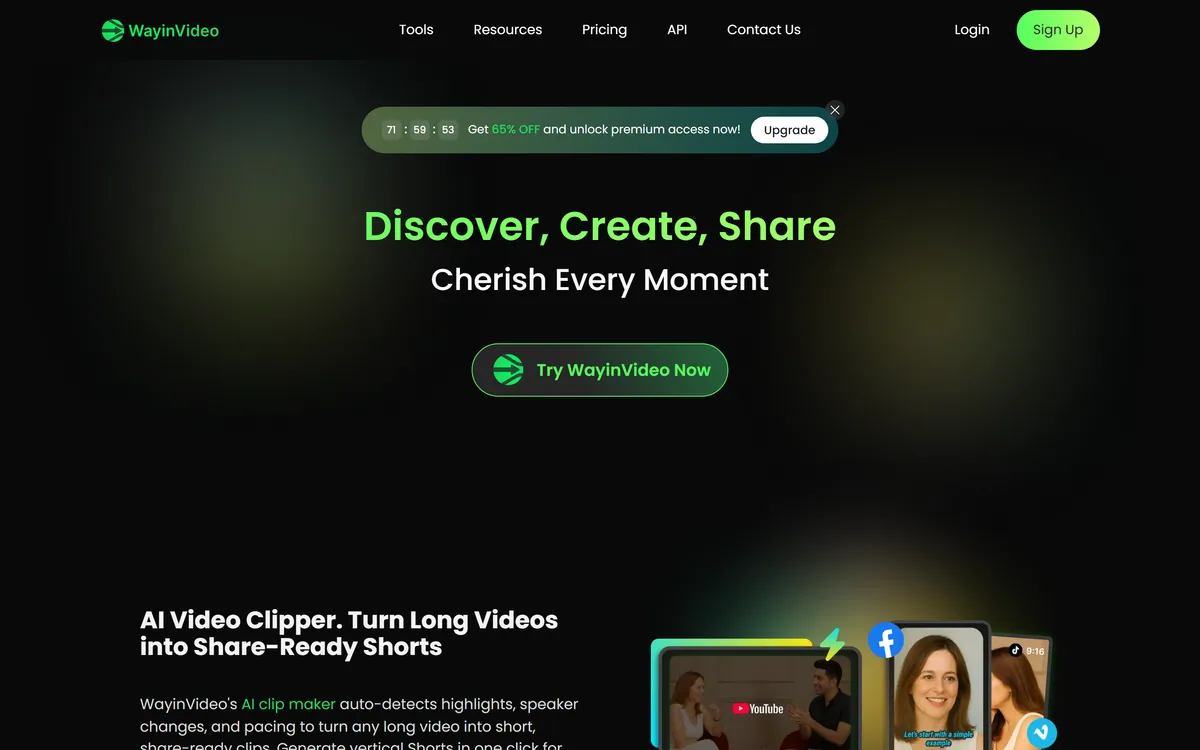
WayinVideo's homepage, captured 9 September 2026, showing the clipping, search and summarising tools.
Can You Search Inside A Video?
WayinVideo's AI video search analyses the full video and its transcript, so you can type a keyword or a question and jump to the exact moment rather than scrubbing.
The reason this matters more than clipping does is that it addresses a permanent problem rather than a publishing one. Clipping is about making new content; search is about recovering value from recordings that already exist and are currently inert.
Almost every business has that archive. Webinars, all-hands meetings, customer interviews, training sessions, conference talks — hours of material containing answers to questions people are still asking, entirely unreachable because nobody will watch an hour to find ninety seconds.
Search over a transcript is the mechanism, and understanding that sets the expectation correctly. It finds what was said, not what was shown — a question about a chart that appeared on screen without being described will not be answered by a transcript search.
The other honest limit is that a question is not always answered by the words used to ask it. Searching for a keyword works reliably; asking a question and expecting the tool to identify the passage that answers it depends on how the retrieval is built, and is worth testing on your own recordings before relying on it.
A grounded notebook like Gemini Notebook answers the same kind of question with citations, from sources you deliberately assembled. This one works on a recording you already had.
Clipping makes new content. Search recovers value from recordings that already exist and are currently inert — which is the larger problem.
Reframe And The Aspect Ratio Problem
AI Reframe tracks faces and key objects to keep the subject centred across 9:16, 1:1 and 16:9 from a single edit, and this is the feature that decides whether vertical clips are usable.
The problem is geometric. A recorded conversation or screen share is wide; a vertical clip is tall, and cropping 16:9 to 9:16 discards two-thirds of the frame — usually including whichever half of the picture mattered.
Tracking the subject instead means the crop follows what is happening. Done well the result reads as composed for vertical rather than salvaged from horizontal, and that difference is immediately visible to a viewer even if they could not name it.
The characteristic failure is worth watching for: a system tracking faces will centre on a speaker during a passage where the important thing was the slide beside them, and nothing in the pipeline notices the mistake.
One edit producing every aspect ratio is the genuine efficiency here. Publishing the same clip to YouTube, TikTok and a website normally means three exports and three crop decisions, and collapsing that into one is a real saving on every clip rather than a one-off.
An API Turns This Into Infrastructure
WayinVideo offers API access to clipping, transcription, summarisation and moment-finding, describing it as processing videos programmatically without ever opening a browser.
That distinction — a tool you visit versus a service your systems call — is the difference between using something occasionally and depending on it. A team that clips manually does it when someone remembers; a pipeline that clips on upload does it every time.
The moment-finding endpoint is the most interesting of the four to expose programmatically, because it turns a video library into something queryable by other software. A support system that could locate the point in a training video answering a customer's question is a genuinely different product from a video library.
Transcription through an API also feeds everything else. Once transcripts exist as data rather than as a feature of a video player, they can be indexed, searched, summarised and fed to any other system that reads text.
The requirement is somebody willing to build. A team without engineering capacity gets a competent web tool and leaves the part that would have changed how the organisation works entirely unused.
The same automation exists in publishing-oriented tools such as quso.ai, and the question worth asking is which end of the workflow your handoff actually sits at.
Test question-based search on your own recordings before relying on it.
Expect transcript search to find what was said, not what was shown.
Watch every reframed clip — face tracking centres on the wrong thing regularly.
Use one edit to produce all three aspect ratios rather than exporting three times.
Consider the API if you have recordings arriving continuously rather than occasionally.
Turning A Long Video Into Something Findable
The most valuable thing you can do with a recording is not clip it — it is make it searchable, which almost nobody does.
The sequence below treats publishing as the second job rather than the first.
Transcribe the recording first, with timestamps and speaker labels, and keep the transcript as a file.
Generate the summary with its timestamped outline, which gives you a map of an hour in thirty seconds.
Search for three things you know were discussed, and check whether the tool finds them accurately.
Only then generate clips, and watch each one at speed rather than trusting the selection.
Check the reframing on every kept clip, since face tracking regularly centres on the wrong subject.
Store the transcript somewhere your team searches anyway, because a transcript inside a video tool is still a black box.
Where Automated Clipping Stops
WayinVideo's clipper auto-detects highlights, speaker changes and pacing, which is a more specific description than most tools give and reveals what it is actually doing.
All three of those are detectable signals rather than judgements. A speaker change is measurable, pacing is measurable, and a highlight in this sense means a passage where something changed — volume, tone, rhythm.
That correlates loosely with interest and not at all with importance. The most valuable ninety seconds of a webinar is frequently delivered flatly, in the middle of an answer, with no signal at all — and a detector watching for change walks straight past it.
The consequence is that the tool produces a shortlist, and the shortlist is worth far more than it sounds. Reviewing twelve suggestions and keeping four takes ten minutes; finding those four by scrubbing takes an afternoon, and that ratio is the actual product.
Publishing all twelve is the failure mode. Platforms have become effective at discounting content nobody watches, and a feed of adequate clips teaches an algorithm that your account is skippable — which costs more than the clips were worth.
That failure mode is universal in this category — a specialist like OpusClip finds better moments and still cannot tell you which of them mattered.
WayinVideo: Clip, Search, Summarise
AI video search — type a keyword or question and jump to the exact moment, without scrubbing a timeline.
Clipping with highlight, speaker-change and pacing detection, producing vertical shorts in one click.
AI Reframe tracks faces and objects to keep the subject centred in 9:16, 1:1 or 16:9.
100+ languages for summaries, with animated multilingual captions and callout cards.
An API, so clipping, transcription, summarising and moment-finding can run without opening a browser.
WayinVideo: Tools And Languages
Product type
AI video clipping, search, transcription and summarising platform
AI Video Clipper
Auto-detects highlights, speaker changes and pacing; one-click vertical shorts
AI Video Search
Type a keyword or question to jump to a moment, using the full video and transcript
AI Video Summarizer
One-paragraph overview plus a timestamped outline, 100+ languages
AI Video Transcription
Punctuation, timestamps and speaker labels, with free daily credits stated
AI Caption Generator
Multilingual subtitles, animated caption styles and callout cards
AI Video Reframe
Face and object tracking across 9:16, 1:1 and 16:9
Output platforms
YouTube, TikTok, Instagram Reels, Stories and Shorts
API
Clipping, transcription, summarisation and moment-finding available programmatically
Site navigation
Tools, Resources, Pricing, API, Contact Us
Key features of WayinVideo
AI video search by keyword or question, jumping to a timestamp
Clip generation detecting highlights, speaker changes and pacing
AI Reframe tracking subjects across three aspect ratios from one edit
Transcription with punctuation, timestamps and speaker labels
Summaries with a timestamped outline, in 100+ languages
Animated multilingual captions and callout cards
API access to clipping, transcription, summarising and moment-finding
Pros & cons
Pros
7
Video search addresses a permanent problem rather than only a publishing one
A timestamped outline maps an hour of recording in thirty seconds
One edit producing three aspect ratios saves work on every clip, not once
Speaker-labelled transcripts are usable as data rather than only as captions
An API turns occasional use into an automatic pipeline
100+ language summarising extends reach well past English
The clipper's detection basis is described specifically rather than vaguely
Cons
6
Transcript search finds what was said, not what was shown on screen
Highlight detection finds change rather than importance, and misses flat but valuable passages
Face tracking regularly centres on a speaker when the slide mattered
No scheduling or publishing, so a second tool is still needed
No operating company, location or pricing is published
Countdown discount banners make the underlying value harder to judge
Best For
Organisations with archives nobody can search
Teams publishing the same clip across several aspect ratios
Multilingual channels needing summaries and captions beyond English
Anyone deciding whether an hour of recording is worth watching
Engineering teams that would process recordings through an API
How WayinVideo Compares On Search
Video tools mostly clip. The differentiator here is whether you can find something in a recording afterwards.
Gemini Notebook — for interrogating recordings with citations rather than clipping them
Wave — capturing the conversations that become these recordings
Is WayinVideo Worth The Switch?
A sound pick when
You have an archive of recordings nobody can find anything in.
You publish vertically and reframing quality decides whether clips are usable.
You need summaries or captions in languages beyond English.
Recordings arrive continuously and an API could process them automatically.
You want a timestamped outline of an hour before deciding whether to watch it.
Pick a rival when
You need scheduling and publishing, which this does not cover.
Clip selection quality is your only requirement, where a specialist may do better.
You need to record the source as well, which requires a different tool.
You would publish every suggested clip without watching them.
You need to know who operates the platform, which the site does not say.
WayinVideo: Sourcing The Claims
Last checked . Read from wayin.ai in a browser session, with the screenshot above captured alongside.
Positioned on the site as an AI video platform covering discovery, creation and sharing
AI Video Clipper confirmed, auto-detecting highlights, speaker changes and pacing, with one-click vertical shorts
AI Video Search confirmed as analysing the full video and transcript so a keyword or question jumps to a moment
AI Video Summarizer confirmed as producing a one-paragraph overview plus a timestamped outline, with 100+ languages stated
AI Video Transcription confirmed with punctuation, timestamps and speaker labels, and free daily credits stated
AI Caption Generator confirmed for multilingual subtitles, animated caption styles and callout cards
AI Video Reframe confirmed as tracking faces and key objects across 9:16, 1:1 and 16:9
Output platforms confirmed as YouTube, TikTok, Instagram Reels, Stories and Shorts
API access confirmed for clipping, transcription, summarisation and moment-finding
Site navigation confirmed for Tools, Resources, Pricing, API and Contact Us
A promotional discount banner with a countdown timer was displayed during our visit
What we could not confirm: the operating company's legal name or location, neither of which appears on the pages we read; pricing beyond a discount banner; which underlying models perform transcription, search and summarisation; how the question-based search retrieves passages; whether the 100+ language claim applies to transcription as well as summarisation; output resolution and length limits; and how uploaded video is retained. We did not process a video, so nothing here reflects tested output.
Editor's Verdict
3.8/5
The feature worth the attention here is video search — typing a question and jumping to the moment that answers it. Everything else on the list is well-executed and widely available; searching inside a recording is not, and it addresses a problem every organisation with an archive has and nobody has solved by scrubbing timelines. Reframe and animated captions cover the practical requirements of publishing vertically. It scores mid-table because clip selection remains a detection problem rather than a judgement one, and because nothing on the site identifies who operates it. AInexfinder Editor Score: 3.8/5.
WayinVideo pricing
AInexfinder does not list plan prices or billing details. For current pricing, plans, and trials, visit the official WayinVideo website.
Vendor pricing, credits, and billing policies change over time. Always confirm on the official site before you buy.
Frequently asked questions
What is WayinVideo?
WayinVideo is an AI video platform covering clipping, search, transcription, summarising, captioning and reframing. It detects highlights and speaker changes to produce vertical shorts, lets you search inside a video by keyword or question, summarises in 100+ languages, and exposes all of it through an API.
How does searching inside a video work?
It analyses the full video and its transcript, so a keyword or question jumps you to the moment rather than requiring you to scrub. That addresses a permanent problem rather than a publishing one — most organisations have hours of recordings containing answers people are still asking for, entirely unreachable.
What are the limits of video search?
It finds what was said, not what was shown. A question about a chart that appeared on screen without being described will not be answered by a transcript search. And asking a question rather than searching a keyword depends on how retrieval is built — worth testing on your own recordings before relying on it.
What does AI Reframe do?
It tracks faces and key objects so the subject stays centred when a wide recording is cropped to 9:16, 1:1 or 16:9. Cropping 16:9 to vertical discards two-thirds of the frame, usually including whatever mattered, so tracking is the difference between a composed clip and a salvaged one.
Does automated reframing get it wrong?
Regularly, and always the same way: it centres on a speaker's face during a passage where the slide beside them was the point, and nothing in the pipeline notices. Watch every reframed clip — the errors are obvious in five seconds and invisible in a status report.
How good is the automatic clip selection?
The site describes it as detecting highlights, speaker changes and pacing, which is honest — those are measurable signals rather than judgements. They correlate loosely with interest and not at all with importance, so the most valuable ninety seconds of a webinar, delivered flatly, gets walked past.
Why does the API matter?
It changes a tool you visit into a service your systems call. A team clipping manually does it when someone remembers; a pipeline clipping on upload does it every time. Exposing moment-finding programmatically is the most interesting part — it makes a video library queryable by other software.
How many clips should I publish?
Fewer than it produces. The value is the shortlist: reviewing twelve suggestions and keeping four takes ten minutes, where finding those four by scrubbing takes an afternoon. Publishing all twelve teaches an algorithm your account is skippable, which costs more than the extra clips were worth.
Does WayinVideo schedule posts?
No. It clips, searches, transcribes, summarises, captions and reframes, and stops before publishing. If your bottleneck is the handoff between having a clip and posting it, a platform that combines clipping with scheduling solves your problem and this one does not.
Who operates WayinVideo?
Not stated on the pages we read — no company name, registration or location appears, and pricing is presented mainly through a countdown discount banner. That is common in this category and it does mean a trial carries more of the evaluation weight than the marketing does.
Daniel reviews AI tools the slow way — by actually using them on real projects. His reviews cover what works, what breaks, and who each tool is genuinely a good fit for.
Daniel and the AInexfinder editorial team research WayinVideo using public product information, listing evidence, and (when available) hands-on checks. Scores reflect listing completeness and transparency — not paid placement.
Listings may include affiliate or sponsored placements, which are labeled when present. Editorial scores and cons are not sold. See our affiliate disclosure and review methodology.
RecCloud bundles speech-to-text, video translation, subtitle generation, voice synthesis, summarisation, video generation and vocal removal into a single browser-based toolkit, with screen recording and basic trimming alongside, on web, iOS and Android.
The workspace at www-flux3.com generates 5–20 second AI videos with native audio from text or a starting image, routing across FLUX 3, MiniMax H3, Seedance, Wan 3.0 and Kling 3.0 Pro, at 720p or 1080p with video extension.
Runway is an AI video platform built around generative world models — Gen-4.5, Aleph 2.0, and Act-Two for performance capture — split across Runway Creative for filmmakers, Runway Dev for builders, and Runway Robotics.
Descript is a video and audio editor that works by editing a transcript — delete a sentence and the footage goes with it — plus Studio Sound, Eye Contact, filler-word removal, AI voices, avatars, and the Underlord assistant.
Treblo generates complete songs from a text prompt in any style, with a browsable style library, an Explore feed of what others have made, iOS and Android apps, and a developer section for building on it.
kling3ai.co is an independent interface offering video generation through Kling 3.0 and Seedance models, with multi-shot storyboarding, motion control and 4K output. It is not Kuaishou's official Kling service, which runs at kling.ai.