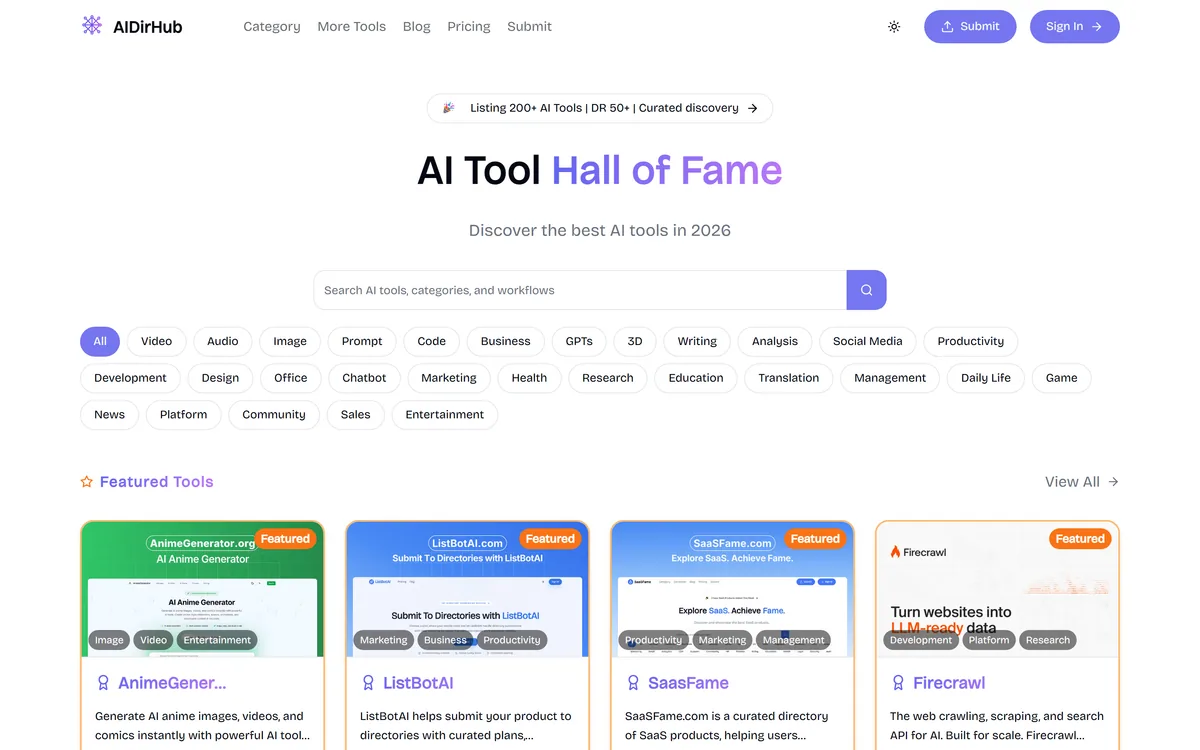
AIDirHub is a curated AI tools directory with search, tag filtering by platform, pricing model and skill level, category navigation across 30+ areas, featured and latest sections, a blog, and a submission route for vendors.
aidirhub.com12 viewsAdded July 6, 202610K visitors
Competitive disclosure: AInexfinder is itself an AI tools directory, so AIDirHub is a competitor. We are publishing this listing because our catalogue covers the category and readers deserve a straight account rather than a gap where a rival should be. Judge the assessment below on its reasoning, and apply the same tests to us.
There are a great many AI tool directories, and they are difficult to tell apart from their homepages. Each promises curation, each organises tools into categories, each offers search and filtering, and each invites vendors to submit listings.
AIDirHub is one of them: a browsable catalogue with category navigation across more than thirty areas, tag-based filtering by platform, pricing model and skill level, featured and latest sections, a blog, and a submission system for vendors seeking distribution.
Because AInexfinder is also a directory, the honest thing to write here is not a sales pitch and not a hatchet job. It is a description of what AIDirHub offers, followed by the questions worth asking of any directory — ours included.
Directories are judged on freshness and depth per entry — not on how many tools they claim to hold.
Catalogue Structure And Features
Category
AI tools directory
Operated by
The AIDirHub team, with support contact published on the site
Browsing
Category navigation across 30+ specialised areas
Search
Keyword search with filtering
Tag filters
Platform, pricing model, skill level
Homepage sections
Featured tools and latest additions
Vendor route
Submission system for listing a product
Editorial
Blog covering industry news and insights
Audiences
People looking for tools, and vendors seeking distribution
Footer
About, privacy policy, terms of service, sitemap, and partner links
What This Listing Is And Is Not
AIDirHub is a curated AI tools directory — browse, search and filter tools by category, platform, pricing model and skill level.
It runs a vendor submission route, which is how nearly every directory in this space is funded and populated.
We are a competitor, stated plainly above. Read this as a competitor's assessment and weigh it accordingly.
The useful part of this page is the set of tests for judging any directory, which apply to AIDirHub and to us equally.
Directories are judged on entry depth and freshness, not on catalogue size — and size is what every directory advertises.
Key features of AIDirHub
Category navigation across 30+ specialised areas
Keyword search with filtering
Tag-based filters for platform, pricing model and skill level
Featured tools section on the homepage
Latest additions section for recently listed products
Vendor submission system for getting a product listed
Blog covering industry news and insights
Individual product pages for each listed tool
Pros & cons
Pros
5
Skill-level filtering is a genuinely useful axis that many directories leave out
Category breadth supports discovery of tool types you did not know existed
A clear vendor submission route, which is what newly launched tools need
Standard policy pages and a support contact are published on the site
Filtering by platform and pricing model reflects real constraints rather than vague tags
Cons
5
Directory listings across this category age quickly, and freshness is the field's hardest problem
Entry depth is the key variable, and it is not something a homepage reveals
Featured placement is worth understanding before treating it as editorial recommendation
The directory badge wall signals distribution rather than any quality assessment
No directory, this one or ours, replaces evaluating a tool on the vendor's own site
Best For
People surveying an AI category they do not yet know
Buyers assembling a comparison set before evaluating properly
Vendors seeking early distribution after a launch
Anyone filtering by practical constraints like platform or experience level
Readers who want to compare how different directories cover the same tools
Directories Versus Other Ways To Find Tools
Directories are one discovery route among several, each with a different bias.
Tool
What it gives you
Main weakness
Best used for
AIDirHub
Browsable catalogue with category and tag filtering
Entry depth and freshness are the open questions
Discovering categories and assembling comparison sets
Checking whether a claimed capability has evidence
How To Judge Any AI Directory
Four questions separate a directory worth using from a page of links. They are more useful than any feature list, and you can apply them in about five minutes.
Is The Information Current?
This is the hardest problem in the category and the one most directories quietly lose. AI tools change constantly — products get acquired, rebranded, repositioned or shut down — and a listing written eighteen months ago is frequently describing something that no longer exists in that form.
Test it directly: find three tools you already know well and read what the directory says about them. Anything stale about products you can verify tells you what to assume about the thousand you cannot.
Is There Anything Behind The Entry?
A directory adds value by knowing something the vendor's own homepage does not tell you — what it is bad at, who it does not suit, how it compares.
An entry that only paraphrases marketing copy has saved you nothing, because you could have read the marketing copy. The number of entries is irrelevant if each one is a sentence and a link.
Is The Commercial Relationship Visible?
Every directory with a submission route has a commercial relationship with some of the tools it lists. That is normal, and it is how the category funds itself.
What separates a trustworthy directory from an advertising page is whether paid placement is labelled where it appears. 'Featured' sections are the specific thing to look at — ask whether featuring is editorial or purchased, and check whether the site tells you.
Does The Filtering Match Real Decisions?
AIDirHub's tags — platform, pricing model, skill level — are a reasonable set, and skill level in particular is a genuinely useful axis that many directories omit.
The test is whether you can answer a question you actually have. 'Free video tools that run on Linux and suit a beginner' is a real query; a directory whose filters cannot express it is a browsing experience rather than a research tool.
The Directory Badge Wall, Explained
AIDirHub's footer carries a large number of badges from other directories and launch platforms, and its homepage references appearing across 200+ directories. Anyone evaluating tools in this space will have noticed this pattern everywhere, and it is worth understanding rather than mistaking for endorsement.
Directory badges are a reciprocal listing and link exchange. A tool gets listed on many directories, each of which supplies a badge, and displaying them signals distribution rather than quality. No editorial judgement is involved in most of them.
This matters for a reader because a wall of badges looks like validation and is not. It tells you the operator has done distribution work — which is a real signal about their marketing, and no signal at all about whether the listings are accurate.
The same caution applies in reverse. When you see us or anyone else displaying such badges, read them the same way.
A badge wall tells you a site has been listed in many places. It tells you nothing about whether anything on it is true.
What A Directory Is Genuinely Good For
Having been sceptical, it is worth being fair about where directories earn their place — because they do.
Discovery in an unfamiliar category is the strongest case. If you do not know that a category of tool exists, no amount of searching finds it, and browsing a well-organised catalogue solves a problem search cannot.
Comparison sets are the second. Assembling five plausible alternatives yourself takes an afternoon of searching; a directory hands you the set in a minute, and you can then evaluate them properly.
Vendor distribution is the third, and it is the side of the market that funds all this. For a newly launched tool, directory listings are a legitimate and inexpensive route to being found — including by the AI assistants that increasingly read these pages when answering questions.
What a directory cannot do is make the decision. Any listing, ours included, is a starting point that should end with you on the vendor's own site, using the free tier.
Use it to discover categories you did not know existed
Use it to assemble a comparison set quickly
Use it as a vendor for early distribution after a launch
Do not use it as the final word on whether a tool suits you
Do not treat catalogue size as a quality signal, on any directory
Checking A Directory In Five Minutes
Run this on AIDirHub, run it on us, run it on the next one you land on.
Look up three tools you already know well and see whether the descriptions are current and accurate.
Read one full entry and ask whether it told you anything the vendor's homepage would not have.
Check whether featured placements are labelled, and whether the site explains how featuring is decided.
Try a filter combination that reflects a real decision and see whether the result is usable.
Look for a date on entries. A directory that never shows when something was last checked is asking for trust it has not evidenced.
Follow two outbound links and confirm they still reach live products rather than parked domains.
Then leave and go to the vendor's own site, because that is where the actual evaluation happens.
Is A Directory What You Need Right Now?
Useful Stop If
You are exploring a category you do not know well yet
You want several alternatives assembled quickly rather than searching one by one
You have just launched a tool and need early distribution
You want to filter by practical constraints like platform or skill level
You are surveying a market rather than choosing a specific product today
Go Straight To The Vendor If
You already know which tool you are evaluating
You need current pricing, which directories are least reliable about
Your decision depends on a specific integration or compliance detail
You want hands-on assessment rather than a catalogue entry
You are ready to trial something, in which case the free tier beats any description
Other Ways To Research A Tool
Directories, AI answers, competitive intelligence and evidence — different biases, different uses.
Perplexity AI — synthesised answers with citations you can follow to the source
MaxAEO — shows how AI assistants describe tools in a category, including yours
Klue — structured competitive intelligence rather than open browsing
Elicit — checking whether a claimed capability has published evidence behind it
Consensus — what research actually says, for claims that sound like science
How We Approached This Entry
Last checked . Read from aidirhub.com during this check, with the screenshot above captured at the same time. Because the site is a competitor, we have restricted ourselves to observable facts and to guidance that applies equally to us.
Directory format with category navigation across 30+ specialised areas, observed on the site
Search with filtering, and tag-based filters covering platform, pricing model and skill level
Featured tools and latest tools sections present on the homepage
A vendor submission system for listing products
The homepage references appearing across 200+ directories, and the footer carries a large number of third-party directory badges
Operated by the AIDirHub team, with a support email address published on the site
About, privacy policy, terms of service and sitemap pages confirmed present in the site footer
No plan prices published here, in line with this site's pricing policy
AInexfinder is a competing directory, disclosed at the top of this page. We have not audited AIDirHub's listing accuracy, editorial process or commercial arrangements, and make no claims about any of them — the five-minute test above is offered so readers can check for themselves, on AIDirHub and on us alike.
Editor's Verdict
3.4/5
AIDirHub has an AInexfinder Editor Score of 3.4/5.
AIDirHub pricing
AInexfinder does not list plan prices or billing details. For current pricing, plans, and trials, visit the official AIDirHub website.
Vendor pricing, credits, and billing policies change over time. Always confirm on the official site before you buy.
Frequently asked questions
Why is a directory reviewing another directory?
Because our catalogue covers this category and leaving a gap where a competitor sits would be its own kind of dishonesty. The competitive relationship is disclosed at the top of this page, and the assessment sticks to observable facts plus tests you can run yourself.
How should I judge any AI tools directory?
Four questions. Is the information current — check three tools you already know. Does an entry tell you anything the vendor's homepage would not. Is paid placement labelled where it appears. And can the filters express a decision you actually have.
What do all those directory badges in the footer mean?
They are reciprocal listings, not endorsements. A tool gets listed on many directories, each supplies a badge, and displaying them signals distribution work rather than any editorial judgement. This applies wherever you see them, including on our own pages.
Are featured listings paid?
That varies by directory and is the specific thing to check on any of them. Submission routes mean commercial relationships exist somewhere in the model, which is normal — what matters is whether placements are labelled where they appear, so you can weigh them.
Is a directory better than just asking ChatGPT?
For different things. An assistant gives you a fast shortlist and is only as good as the sources it reached. A directory is better for discovering that a whole category exists — which is a question you cannot ask if you do not know to ask it.
Should I list my tool on directories like this?
For a newly launched product, yes — it is a legitimate and inexpensive distribution route, and increasingly these pages are read by AI assistants answering buyers' questions. Just treat it as distribution rather than validation, and do not expect a listing to substitute for a real audience.
What should I do after browsing a directory?
Leave it. Any listing, ours included, is a starting point. The decision happens on the vendor's own site with the free tier, using your own data — which no catalogue entry can substitute for, however well written.
Daniel reviews AI tools the slow way — by actually using them on real projects. His reviews cover what works, what breaks, and who each tool is genuinely a good fit for.
Daniel and the AInexfinder editorial team research AIDirHub using public product information, listing evidence, and (when available) hands-on checks. Scores reflect listing completeness and transparency — not paid placement.
Listings may include affiliate or sponsored placements, which are labeled when present. Editorial scores and cons are not sold. See our affiliate disclosure and review methodology.
axess is a free AI job-search tool that scans LinkedIn, Indeed and Glassdoor daily, scores each role against your profile on both relevance and likelihood, researches the employer, and prepares a tailored CV and cover letter for the matches worth pursuing.
Otter.ai transcribes meetings live, writes summaries and action items, and organises everything into searchable Channels — with OtterPilot joining Zoom, Teams, and Google Meet, plus role-specific agents for sales, recruiting, and SDR work.
MiroFish is a multi-agent simulation platform for scenario prediction. You ask a plain-language question, attach supporting files, and it returns a structured report covering likely reactions, narrative paths, risk signals and follow-up questions.
CrewAI is an enterprise platform to build and run AI agents: a Discovery layer that finds automation opportunities, a no-code canvas and code-first Python API for building role-based multi-agent workflows, and a control plane that adds tracing, RBAC, audit and human-in-the-loop approvals.
AudioNotes is an AI note-taker that turns voice, audio, video and text into structured notes, transcripts and summaries in 99+ languages, with custom templates, chat-with-your-notes, integrations, and a clear no-AI-training privacy stance.
Goodnotes is a handwriting-first note-taking app spanning iPad, iPhone, Mac, Windows, Android and web. It converts handwriting to text, searches across typed text, handwriting and sketches, annotates PDFs, records and transcribes audio, and turns notes into mind maps and project plans.