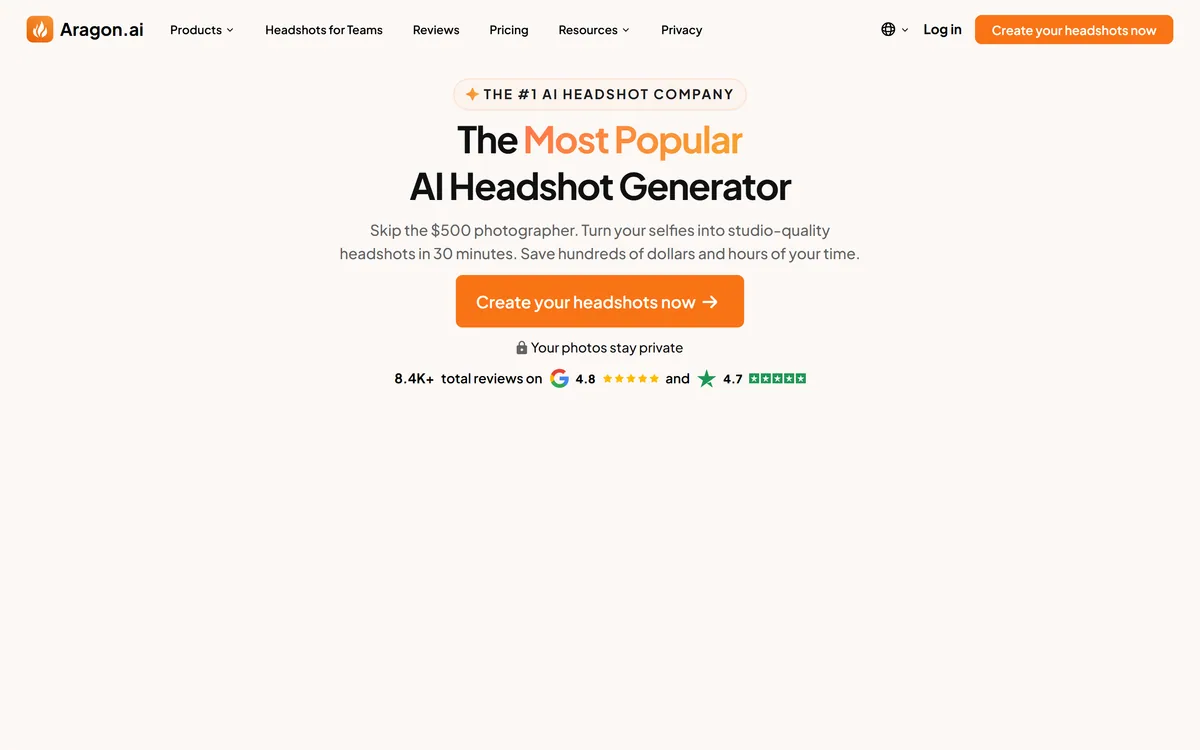
Aragon AI generates professional headshots from user-submitted selfies. You upload photos, pick outfits and backgrounds, and receive up to 100 images within about 30 minutes, at resolutions up to 1792 x 2176. It is SOC 2 Type II certified and lets users delete their data at any time.
The interesting question is not whether it works. It is who the photograph has to convince.
AI Headshots, Summarised
Aragon AI is a headshot generator that produces professional-looking portraits from selfies you upload, without a photographer, a studio or a booking.
Up to 100 headshots per generation, delivered in around 30 minutes, with outfits and backgrounds you select before it runs.
Resolution differs by tier — 896 x 1088 on the standard output and 1792 x 2176 on the executive one, which matters if the image will be printed or cropped.
The data handling is unusually well covered for this category: AES-256 encryption, SOC 2 Type II certification, account and data deletion at any time, and full ownership of the output.
Charging is a one-time purchase per generation, with a refund available if you have not downloaded, or a free regeneration instead.
Why This Category Exists At All
It is worth being clear about the problem, because it is more specific than vanity.
A professional headshot is a genuine requirement in a lot of working life. LinkedIn, a company team page, a conference speaker listing, a real estate listing, a law firm bio, a residency application. The absence of one is noticed.
Getting one traditionally means finding a photographer, booking, travelling, being photographed — which most people find uncomfortable — waiting for edits, and paying accordingly. For a single image most people update every few years, that is a lot of friction.
Broader studios like GoStudio bundle this with editing tools and video. The result is that an enormous number of professionals use a cropped photo from a wedding, a holiday, or somebody's birthday. That is the actual competition here, and it is a low bar.
Against that baseline, a generated headshot that looks like a competent studio portrait is a clear improvement, available in half an hour, from photos already on your phone.
That framing matters for judging the product. The question is not whether Aragon matches a good photographer — it does not — but whether it beats a cropped holiday photo, which it comfortably does.
The real competition is not a professional photographer. It is the cropped wedding photo that half of LinkedIn is currently using.
What The Output Is Actually Like
Being specific about quality is more useful than either enthusiasm or dismissal, and the pattern across this category is consistent.
What works well: the overall impression at thumbnail size, which is how a LinkedIn photo is mostly seen. Lighting looks deliberate, the background is clean, the framing is conventional and correct, and the clothing reads as professional.
What tends to give it away: hands if they appear, jewellery, glasses frames, complex hair, and the specific texture of skin at full resolution. The eyes are usually good now, which was not true two years ago.
Upscalers such as Aiarty will happily enlarge that idealisation too. The subtler tell is that the person looks slightly idealised — marginally more symmetrical, marginally smoother, marginally younger. Some people want exactly that; others find the result does not look like them, which defeats the purpose of a photograph whose job is recognition.
The single biggest quality variable is your input photos. Varied lighting, varied angles, varied backgrounds and recent images produce noticeably better results than fifteen selfies taken in the same room on the same day. Garbage in genuinely is garbage out here.
Generating up to 100 images is a sensible response to this. Rather than hoping one render is right, you get a spread and pick. The corollary is that most of the hundred will not be usable, and that is normal rather than a failure.
Gather input photos across different days, lighting conditions and angles rather than one session.
Include a few where you are genuinely smiling, since generated expressions inherit from the inputs.
Pick a tier by where the image will be used — thumbnail-only work does not need the executive resolution.
Review the output at full size, not in the gallery grid, checking glasses, hair edges and jewellery.
Show three candidates to someone who knows you and ask which looks most like you, not which looks best.
The Data Question Is The Serious One
You are uploading photographs of your face to a company that will train a model on them. That deserves more attention than the output quality, and Aragon has handled it better than most of the category.
The stated position covers the things that matter: AES-256 encryption, SOC 2 Type II certification, account and data deletion at any time, and you own the generated photos for any use including social, print and professional profiles.
Direct competitors like HeadshotPro should be checked on the same point. That ownership clause is not a given in this category and is worth checking wherever you go. A headshot you cannot use commercially, or that the vendor retains rights over, is not much of a headshot.
SOC 2 Type II specifically is a meaningful signal because it audits controls over a period rather than at a moment. For a consumer product built on facial images, holding it is a deliberate choice rather than a box-tick.
The residual question, which applies to every vendor here, is what happens to the trained model of your face after you delete your account. Ask specifically whether deletion removes the model as well as the source photographs — those are different artefacts, and only one of them is obviously covered by deleting a file.
Biometric data also carries specific legal treatment in several jurisdictions, with distinct consent and retention requirements. That is a reason to read the actual privacy policy rather than the summary, particularly if your employer is procuring this for a team.
Paying Once Per Shoot
This site does not publish plan prices. Aragon's structure is a good fit for the product and worth understanding.
It is a one-time purchase rather than a subscription — you buy a generation, you get your images. There is a refund available if you have not downloaded the photos, or a free regeneration as an alternative remedy.
That shape is correct for the use case. Almost nobody needs a new headshot every month, so a recurring charge would be the wrong instrument, and it is a point in Aragon's favour that they have not tried to make one work.
The refund-or-regenerate policy is also the right structure for a probabilistic product. Generation quality varies with your input photos in ways nobody can guarantee in advance, and offering a second attempt rather than only a refund reflects that the fix is usually better inputs rather than a different vendor.
Two things to establish before buying: which resolution your tier delivers, since the gap between 896 x 1088 and 1792 x 2176 is the difference between web-only and print-capable; and whether the outfit and background range you actually want sits at the tier you are considering.
The comparison worth running is against a local photographer's session rate, and against the cost of continuing to use a cropped holiday photo on a professional profile.
When You Should Still Book A Photographer
Being specific about the boundary is more useful than a general caveat.
When the audience is scrutinising the photograph. A senior executive bio, a book jacket, press material, a profile that will be seen at full size by people evaluating you. Generated images hold up at thumbnail scale and less well at full resolution.
When your face is the product. Actors, models, presenters and anyone whose casting depends on an accurate likeness need photographs that are demonstrably real, and often need them in a specific format the industry expects.
When the context is regulated or evidential. Some professional registers, visa applications and identity documents require a photograph taken under defined conditions. A generated image is not acceptable and using one may cause a real problem.
When authenticity is the brand. If your positioning is personal and unpolished, an idealised studio portrait works against you regardless of how good it is.
Everywhere else — the LinkedIn profile, the team page, the conference bio, the Slack avatar — the honest answer is that a good generated headshot is fine, and better than what most people currently have.
There is one etiquette point worth adding, because it is becoming a live question: some professional contexts now expect disclosure that a portrait is AI-generated. Norms differ by industry and are still forming, so it is worth knowing your field's.
Book a photographer: executive bios, press, book jackets, anything seen at full size
Book a photographer: acting, modelling and anywhere likeness accuracy is the job
Do not use generated: identity documents, visas, regulated professional registers
Reconsider: personal brands built on being unpolished
Generated is fine: LinkedIn, team pages, conference bios, internal directories
Output, Speed And Assurance
Category
AI headshot and portrait generation
Input
User-uploaded selfies
Output volume
Up to 100 headshots per generation
Turnaround
Around 30 minutes, delivered by email
Resolution
896 x 1088 on standard, 1792 x 2176 on the executive tier
Customisation
Curated outfits and backgrounds selected before generation
Specialised categories
Includes LinkedIn, lawyer, real estate and residency headshots, plus travel, dating and modelling photo styles
Encryption
AES-256
Certification
SOC 2 Type II
Data control
Account and data deletion available at any time
Rights
Users retain ownership of generated photos for any use, including social, print and professional profiles
Stated ratings
4.8 on Google and 4.9 on Trustpilot, per the vendor
Stated volume
More than 40 million headshots generated, per the company
Team background
Founded by AI researchers with backgrounds at MIT, Meta and Google, with venture backing
Charging model
One-time purchase per generation, with a refund if undownloaded or a free regeneration; no prices published here
Should You Generate Or Book?
Generate The Headshot If
You need a professional photo for LinkedIn, a team page or a conference bio
Your current photo is cropped from a personal occasion
You dislike being photographed enough that you keep postponing it
You need it quickly and cannot wait on a photographer's schedule
You have varied recent selfies to feed it rather than fifteen from one afternoon
Book A Photographer If
The image will be seen at full size by people evaluating you
Your likeness is the product — acting, modelling, presenting
It is for an identity document, visa or regulated professional register
Your personal brand depends on looking unpolished and real
Your industry expects disclosure and you would rather avoid the question
Key features of Aragon AI
Professional headshot generation from uploaded selfies
Up to 100 images per generation
Around 30-minute turnaround, delivered by email
Outfit and background selection before generation
Executive tier at 1792 x 2176 resolution
Role-specific styles including LinkedIn, lawyer, real estate and residency
Additional styles for travel, dating and modelling photos
AES-256 encryption with SOC 2 Type II certification
Account and data deletion on request
Full user ownership of generated images
Pros & cons
Pros
6
Beats the cropped personal photo most professionals currently use, comfortably
Turnaround of around 30 minutes removes the scheduling friction entirely
Generating up to 100 images means you pick rather than hope
SOC 2 Type II and AES-256 are serious for a consumer product built on facial images
Explicit ownership of the output is not universal in this category and matters
One-time charging matches a purchase almost nobody makes monthly
Cons
6
Output still reads as generated at full resolution to a trained eye
Results tend to look slightly idealised, which can undercut recognition
Quality depends heavily on the variety and recency of your input photos
Most of the hundred images will not be usable — that is normal, not a fault
Standard-tier resolution is web-only; print needs the executive output
It is unclear from public material whether deletion removes the trained face model
Best For
Professionals updating a LinkedIn or company profile
Remote teams needing consistent headshots without a shoot
Job seekers refreshing their application materials
Conference speakers and podcast guests needing a bio photo quickly
Anyone who avoids being photographed and keeps postponing it
Aragon Beside Other Headshot Generators
These do the same job and separate on volume, resolution and how seriously they treat the data.
Last checked . Read from aragon.ai during this check, with the screenshot above captured at the same time.
Process described as uploading photos, selecting attire and backgrounds, and receiving headshots by email
Output stated as up to 100 high-quality headshots per generation
Turnaround stated as 30 minutes
Resolutions stated as 896 x 1088 on basic and standard, and 1792 x 2176 on executive
Specialised categories listed including LinkedIn, lawyer, real estate and residency headshots, plus travel, dating and modelling photo styles
Data handling stated as AES-256 encryption with account and data deletion available at any time
SOC 2 Type II certification stated
Users stated to retain ownership of generated photos for any use
Ratings cited by the vendor as 4.8 on Google and 4.9 on Trustpilot, with more than 40 million headshots generated
Team described as founded by AI researchers from MIT, Meta and Google with venture backing
Charging described as a one-time purchase with a refund if photos are not downloaded, or free regeneration; no plan prices published here, in line with this site's pricing policy
Ratings, volume figures and certification claims are the vendor's own and were not independently audited. Uploading facial images means creating a trained model of your face — ask specifically whether account deletion removes that model as well as the source photographs, since they are separate artefacts. Biometric data carries distinct consent and retention rules in several jurisdictions, and generated portraits are not acceptable for identity documents or regulated professional registers.
Editor's Verdict
4.1/5
Aragon does the specific job well and takes the sensitive part seriously — SOC 2 Type II, AES-256, user-controlled deletion and clear ownership of the output, which matters when the input is your own face. It loses ground because generated headshots still read as generated to a trained eye, because photo quality in equals quality out, and because volume can substitute for a genuinely good single image. AInexfinder Editor Score: 4.1/5.
Aragon AI pricing
AInexfinder does not list plan prices or billing details. For current pricing, plans, and trials, visit the official Aragon AI website.
Vendor pricing, credits, and billing policies change over time. Always confirm on the official site before you buy.
Frequently asked questions
How does Aragon AI work?
You upload selfies, choose from curated outfits and backgrounds, and it returns up to 100 professional headshots by email in around 30 minutes. The model is trained on the photos you supply, which is why input variety matters so much.
Do AI headshots look fake?
At thumbnail size, which is how most profile photos are seen, they generally hold up. At full resolution the tells are glasses frames, jewellery, complex hair and skin texture. The subtler issue is that results look slightly idealised, which can make them less recognisably you.
How much does Aragon AI cost?
It is a one-time purchase per generation rather than a subscription, with a refund available if you have not downloaded the photos or a free regeneration instead. Check which resolution your tier delivers before buying.
Is it safe to upload my photos to an AI headshot service?
Aragon states AES-256 encryption, SOC 2 Type II certification and deletion of your account and data at any time, which is stronger than most of this category. Ask specifically whether deletion removes the trained model of your face as well as the source images — those are different things.
Can I use AI headshots on LinkedIn?
Yes, and it is the most common use. Aragon states you own the output for any purpose including social and professional profiles. Be aware that disclosure norms are still forming in some industries, so it is worth knowing what your field expects.
How do I get better results from an AI headshot generator?
Feed it varied input — different days, different lighting, different angles, different backgrounds, and recent photos. Fifteen selfies from one afternoon in one room produce noticeably worse output than ten taken across several months.
Can I use an AI headshot for a passport or visa?
No. Identity documents, visas and many regulated professional registers require a photograph taken under defined conditions, and a generated image is not acceptable. Using one there can cause a genuine problem rather than merely being rejected.
Daniel reviews AI tools the slow way — by actually using them on real projects. His reviews cover what works, what breaks, and who each tool is genuinely a good fit for.
Daniel and the AInexfinder editorial team research Aragon AI using public product information, listing evidence, and (when available) hands-on checks. Scores reflect listing completeness and transparency — not paid placement.
Listings may include affiliate or sponsored placements, which are labeled when present. Editorial scores and cons are not sold. See our affiliate disclosure and review methodology.
HeadshotMaster generates professional-style portraits from your photos in roughly thirty seconds, across styles grouped by profession and by regional appearance. Its clearest differentiator is a stated deletion policy: uploaded images are removed from its servers within two hours of processing.
Photo AI creates an AI model from your uploaded selfies and generates photographs of you in any pose, place or setting, with themed photo packs, multi-person support, upscaling, zoom-out and video generation. It also offers product photography with AI models and the creation of entirely synthetic personas.
krea2.org is a browser image-generation workspace that runs several third-party models side by side, including Krea 2 tiers, FLUX.2, GPT Image 2, Nano Banana and Seedream 5.0, with reference uploads, six aspect ratios and live model switching.
Pet Pic Portraits turns a pet photo into styled artwork — Royal King, Pop Art, Watercolour, Viking, Wizard and more — with an instant preview before ordering. Output is a digital download, a canvas print or framed wall art, and it includes a pet memorial option.
VividManga colourises black-and-white manga while keeping recurring characters on a fixed palette and leaving speech bubbles untouched. It takes ZIP and CBZ archives, offers twelve-plus styles, and exports pages individually or as a packaged chapter.
RetypeWords is a browser tool that replaces text that has been flattened into a PNG, JPG or WebP image. It reads the words with OCR, lets you correct what it read, then regenerates the selected area so the new wording sits in the picture rather than on top of it.