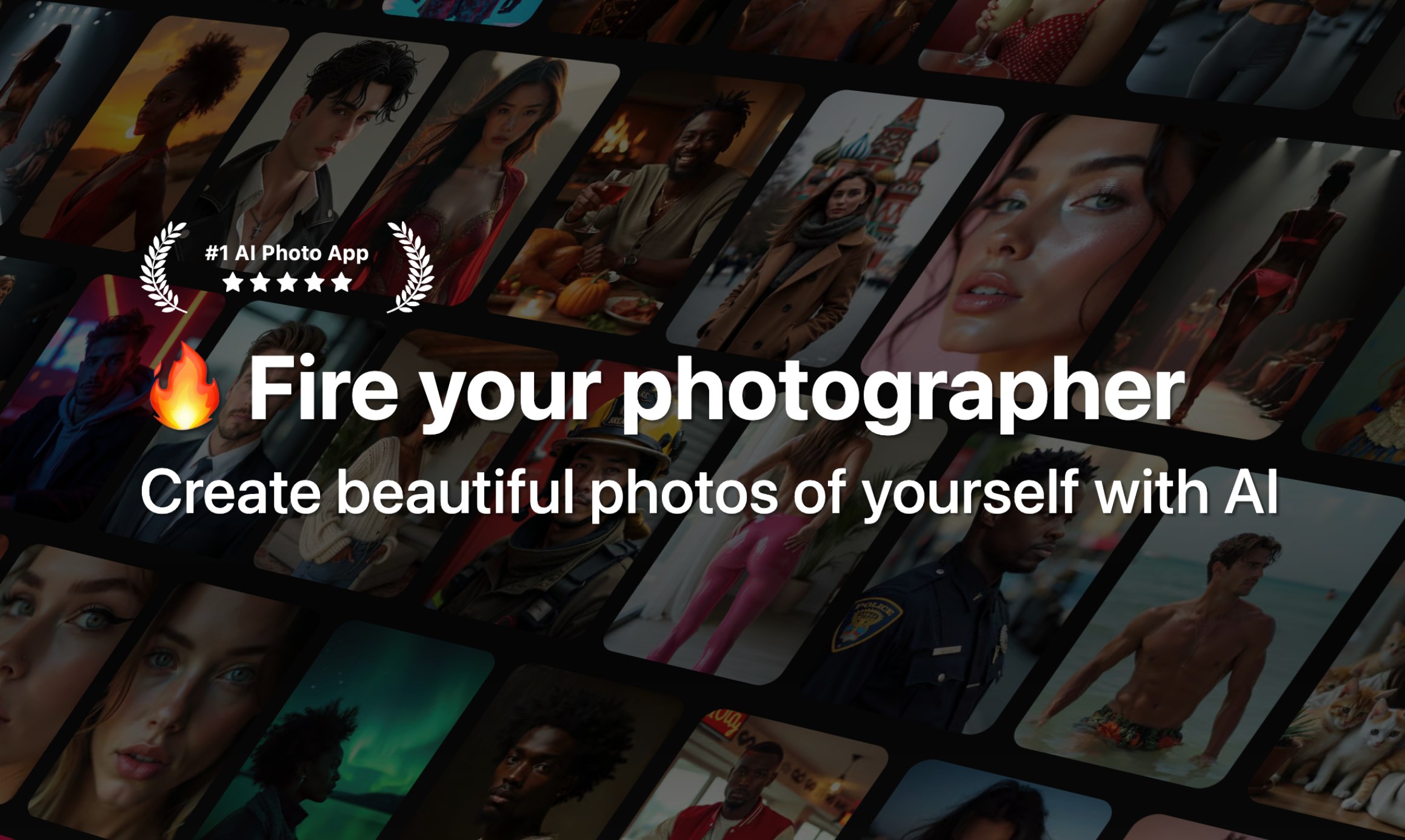
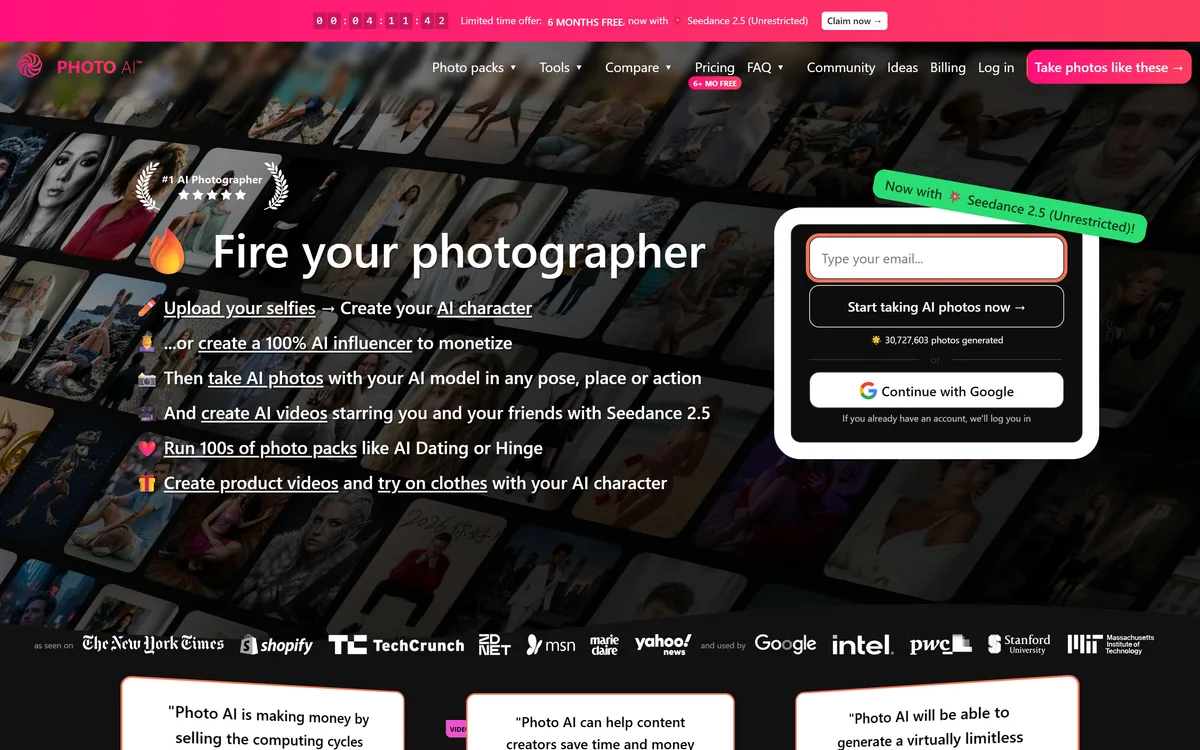
Photo AI creates an AI model from your uploaded selfies and generates photographs of you in any pose, place or setting, with themed photo packs, multi-person support, upscaling, zoom-out and video generation. It also offers product photography with AI models and the creation of entirely synthetic personas.
Photo AI's core loop is uploading selfies to create an AI character, then taking photographs of that character in any pose, place or action, with consistency across shots as the stated advantage.
Training rather than one-shot generation is a real technical difference and it explains why the output is better.
A tool working from a single photograph has to infer your face from one angle in one light. Everything it produces is an extrapolation, which is why likeness drifts and why generated portraits often look like a relative rather than you.
Training on many images gives the model your face from multiple angles, expressions and lighting conditions. It learns the structure rather than copying an appearance, which is what makes the same person recognisable across a hundred generations.
The trade is that a trained model is a durable artefact. It exists after you stop using the product, it can generate images of you indefinitely, and the questions worth asking are how long it is retained, whether it can be deleted, and who else could access it — questions that are less pressing for a service like HeadshotPro that states photos are used once and discarded.
A trained model is a durable artefact. It can generate images of you indefinitely, which makes deletion and access the questions that matter.
Packs, Poses And Studio Presets
Photo packs are described as themed collections that save you finding or writing prompts, included in membership, each offering particular aesthetics and settings.
Packs solve a real usability problem, and it is the same one every generative tool has.
Prompting well is a skill. A person who wants a professional portrait does not know that they need to specify lighting, focal length, background separation and expression, and their first attempt produces something that looks generated because none of those were said.
A pack encodes all of it. Someone who understood photography wrote the prompts once, and every user of that pack inherits the decisions without needing to know what they were.
That is the honest value here, and it is considerable. It is also why the pack list is worth reading as a statement of intent — a company's packs describe what it expects people to make, and the ones it chooses to promote are a choice rather than an inevitability.
Product Photography Without A Studio
Beyond personal photography sits a product line: upload a photograph of a product, have an AI model hold and present it, add a script, a voice and captions, and produce video for social commerce.
This is the strongest and least complicated use of the whole platform.
Product photography with a model is expensive in a way that scales badly. A studio, a photographer, a model, styling and a half-day produces images of one product, and a catalogue of two hundred items is a budget most small sellers simply do not have.
Nobody is misrepresented by a generated model holding a phone case. The product is real, the claim is about the product, and the person is understood by every viewer to be a stock presence — which has been true of catalogue models for a century.
The one caution is disclosure norms in advertising, which are tightening in several markets for synthetic presenters. It is a labelling question rather than an ethical one, and it is straightforward to comply with once you know it applies.
Ask how long a trained model is retained and whether it can be deleted.
Use it for product photography, where nobody is misrepresented.
Never generate images of another person without their agreement.
Do not use generated photographs on a dating profile.
Check advertising disclosure rules for synthetic presenters in your market.
Where Generated Photographs Cross A Line
Among the photo packs is one aimed explicitly at dating applications, promoted as producing better dating photos and more matches on named platforms.
This is the part of the product we would not use, and the reasoning is specific rather than squeamish.
A dating photograph makes one implicit claim: this is what I look like. Everything else on a profile is interpretation, and the picture is the factual element — which is why people feel misled by an out-of-date photo, let alone a generated one.
A generated image is not an unflattering angle avoided or good lighting chosen. It is a picture of a person who was never in that place, with a face the model constructed. The person who arrives at the meeting is a different proposition from the one in the photograph, and they will know that within a second.
Several dating platforms address this in their own rules, so it is a policy question as well as an ethical one. The multi-person feature raises the adjacent point: generating photographs of a partner or a friend is generating images of an identifiable person, and that requires their agreement rather than their absence.
Synthetic Personas And Disclosure
The homepage also offers creating a fully AI persona to monetise, alongside a model labelled as unrestricted in a promotional banner.
Synthetic personas are a real and growing category, and they are worth treating precisely rather than dismissing.
A clearly labelled virtual character with an audience that knows it is virtual is a legitimate creative product — animation has worked that way forever, and nobody feels deceived by a cartoon.
The difficulty is that photorealistic personas are usually not labelled, because the entire commercial proposition depends on an audience believing there is a person. Monetisation makes it sharper: a follower paying for access to someone who does not exist has been sold something other than what they thought.
Advertising regulators in several markets now require disclosure where a synthetic presenter endorses a product, and platforms are adding their own labelling rules. Anyone building a persona should assume disclosure will be required and design for it, which also happens to be the version that does not depend on a misunderstanding. For a profile picture alone a free tool like PFPMaker is sufficient, and generating garments rather than people is Refabric's domain.
Generating Photographs You Would Publish
The gap between an impressive generated image and one you would actually put your name to is mostly about likeness and about where it is used.
This sequence covers the technical work and the decision that comes before it.
Decide where the images will be used before training anything.
Upload varied selfies — different angles, lighting and days.
Start from a photo pack rather than writing prompts.
Judge likeness against a mirror, not against how you would like to look.
Use batch and upscale for product work, where volume is the point.
Confirm retention and deletion terms for your trained model.
Photo AI: A Photographer You Train On Yourself
Trains a model on your selfies, which produces markedly better likeness than generating from one photo.
Themed photo packs covering settings and styles, so you are not writing prompts from scratch.
Product photography with AI models presenting your item — a legitimate and genuinely useful application.
Batch generation, upscaling, zoom-out and video, making it a production tool rather than a novelty.
A dating photo pack and synthetic personas, which are the parts requiring a decision rather than a purchase.
Key features of Photo AI
Model training from your own selfies
Photograph generation in any pose or setting
Themed photo packs of prewritten prompts
Multi-person image generation
Product photography with AI models
Video generation from photos
Upscaling and zoom-out
Batch generation across many models
Pros & cons
Pros
7
Training on many selfies produces far better likeness than one-shot generation
Photo packs encode photographic decisions most users would not know to make
Product photography with a consistent model is a legitimate and valuable use
Batch, upscale and video make it a production tool rather than a novelty
Zoom-out and hyper-realism address real limitations in generated portraits
A named individual maker's account gives the product a visible owner
Reviews labelled as verified purchases rather than anonymous quotes
Cons
7
A dating photo pack markets generated images where likeness is the implicit claim
Retention, deletion and access for a trained model of your face are not stated
Synthetic personas for monetisation raise disclosure questions the page does not address
Multi-person generation involves an identifiable person who may not have agreed
A model labelled unrestricted is not explained
Countdown promotions sit above the product information
Our capture found no footer, so company and terms went unread
Best For
Ecommerce sellers needing product photography at catalogue scale
Photographers testing concepts before booking a real shoot
Creative projects needing many images of one character
Small brands producing social commerce video
Anyone comfortable with a trained model of their own face
Photo AI Against Other Photo Generators
Portrait tools differ by whether they train on you and what they retain.
OpenArt — consistent characters for narrative work
Photo AI: Read From The Photographer Pages
Last checked . Read from photoai.com in a browser session on the date above, with the screenshot captured at the same time.
Positioned as an AI photographer, with the instruction to upload selfies and create an AI character
Photographs stated as producible in any pose, place or action once a model is trained
Video generation described using a named third-party video model
Photo packs described as themed prompt collections included in membership
A photo pack aimed explicitly at dating applications, naming three platforms
Multi-person support described for generating two people together
Creating a fully AI persona to monetise offered as a use case on the homepage
Product photography described with AI models presenting an uploaded product, plus script, voice and captions
Upscaling, zoom-out and a hyper-realism model described as enhancement features
Batch image generation offered for producing many images across many models
A countdown banner offering months free, with a model labelled as unrestricted
Reviews displayed as verified purchases, with the site presenting an individual maker's account of building it
What we could not confirm: our capture did not reach the site footer, so we make no claim about what is published there, including the operating company or terms. We also could not confirm how long a trained model of your face is retained, whether it can be deleted, or who can access it — the questions that matter most when training rather than generating; what unrestricted describes in the promotional banner; whether any consent step applies to multi-person generation; and pricing. We did not upload photographs or train a model.
Editor's Verdict
3.3/5
Technically this is among the more capable products in its category — training on your own selfies produces far better likeness than one-shot generation, and the batch, upscale and video features make it a genuine production tool. Product photography with a consistent model is a legitimate and valuable use. What we cannot endorse is the dating pack, which markets generated photographs for profiles where the entire implicit promise is what you look like, and which several dating platforms address in their own rules. AInexfinder Editor Score: 3.3/5.
Photo AI pricing
AInexfinder does not list plan prices or billing details. For current pricing, plans, and trials, visit the official Photo AI website.
Vendor pricing, credits, and billing policies change over time. Always confirm on the official site before you buy.
Frequently asked questions
What is Photo AI?
A tool that trains a model on your uploaded selfies and then generates photographs of you in any pose or setting, with themed photo packs, multi-person support, upscaling, video generation and a product photography line.
Why does training beat generating from one photo?
Because one photograph gives a model your face from one angle in one light, so everything it produces is an extrapolation. Training on many images teaches it the structure of your face, which is what keeps you recognisable across a hundred shots.
What should I ask before training?
How long the trained model is retained, whether it can be deleted, and who can access it. A trained model is a durable artefact that can generate images of you indefinitely, which makes those questions more pressing than for one-off generation.
What is it genuinely good for?
Product photography with a consistent presenter. A studio, photographer, model and styling for a catalogue of two hundred items is a budget most sellers do not have, and nobody is misrepresented by a generated model holding a phone case.
Should I use it for dating photos?
No. A dating photograph makes one implicit claim — this is what I look like — and it is the factual element of a profile. A generated image is not a flattering angle; it is a picture of someone who was never there, and the person who arrives is a different proposition.
Do dating platforms allow it?
Several address it in their own rules, so it is a policy question as well as an ethical one. Worth reading the terms of any platform you use rather than assuming, because enforcement lands on the account rather than the tool.
What about photos of me and my partner?
Generating images of another person means generating images of an identifiable individual, which requires their agreement rather than their absence. That applies to a partner, a friend or a family member exactly as it would to a stranger.
Are AI personas legitimate?
A clearly labelled virtual character with an audience that knows is a legitimate creative product. The difficulty is that photorealistic personas usually are not labelled, and monetisation makes that sharper — a follower paying for access has been sold something other than what they thought.
Do I need to disclose synthetic presenters in ads?
Increasingly, yes. Advertising regulators in several markets require disclosure where a synthetic presenter endorses a product, and platforms are adding labelling rules. Assume it will be required and design for it.
What are photo packs for?
They encode photographic decisions — lighting, focal length, background separation, expression — that most people do not know to specify. Someone who understood photography wrote the prompts once, and every user inherits the choices.
Daniel reviews AI tools the slow way — by actually using them on real projects. His reviews cover what works, what breaks, and who each tool is genuinely a good fit for.
Daniel and the AInexfinder editorial team research Photo AI using public product information, listing evidence, and (when available) hands-on checks. Scores reflect listing completeness and transparency — not paid placement.
Listings may include affiliate or sponsored placements, which are labeled when present. Editorial scores and cons are not sold. See our affiliate disclosure and review methodology.
Aragon AI generates professional headshots from user-submitted selfies. You upload photos, pick outfits and backgrounds, and receive up to 100 images within about 30 minutes, at resolutions up to 1792 x 2176. It is SOC 2 Type II certified and lets users delete their data at any time.
HeadshotPro turns a handful of selfies into 30 to 70 professional headshots in under thirty minutes, across thousands of backdrop and outfit combinations. It offers a profile picture editor, optional 4K upscaling, edit credits for swapping backdrops and outfits, team deployment with admin-set styles, and states that photos are used once then deleted.
Pet Pic Portraits turns a pet photo into styled artwork — Royal King, Pop Art, Watercolour, Viking, Wizard and more — with an instant preview before ordering. Output is a digital download, a canvas print or framed wall art, and it includes a pet memorial option.
krea2.org is a browser image-generation workspace that runs several third-party models side by side, including Krea 2 tiers, FLUX.2, GPT Image 2, Nano Banana and Seedream 5.0, with reference uploads, six aspect ratios and live model switching.
RetypeWords is a browser tool that replaces text that has been flattened into a PNG, JPG or WebP image. It reads the words with OCR, lets you correct what it read, then regenerates the selected area so the new wording sits in the picture rather than on top of it.
Canva AI is the Magic Studio suite built into Canva — Magic Write for copy, Dream Lab for images, Magic Edit, Expand and Eraser for photos, Magic Switch for reformatting, Magic Charts for data, and Canva Code for interactive widgets.