BharatGPT is CoRover's generative AI platform covering 14+ Indian languages by voice and 120+ languages overall, delivered as video, voice and text. It is fine-tuned for Indian users and context, hosted in India for data sovereignty, and integrated with Bhashini, the national language translation mission under MeitY.
Global AI assistants such as Gemini and Claude handle Hindi reasonably and everything else in India considerably less well. Bengali, Marathi, Telugu, Tamil, Gujarati and Kannada each have more speakers than most European languages, and each is served as an afterthought by models trained predominantly on English text.
The gap is wider than a translation problem. Most of India interacts with technology by voice rather than by typing, partly because typing in Devanagari or Tamil script on a phone is slow, and partly because a meaningful share of users read less comfortably than they speak.
BharatGPT is built around those two facts rather than adapted to them, and that is the case for taking it seriously against far larger competitors.
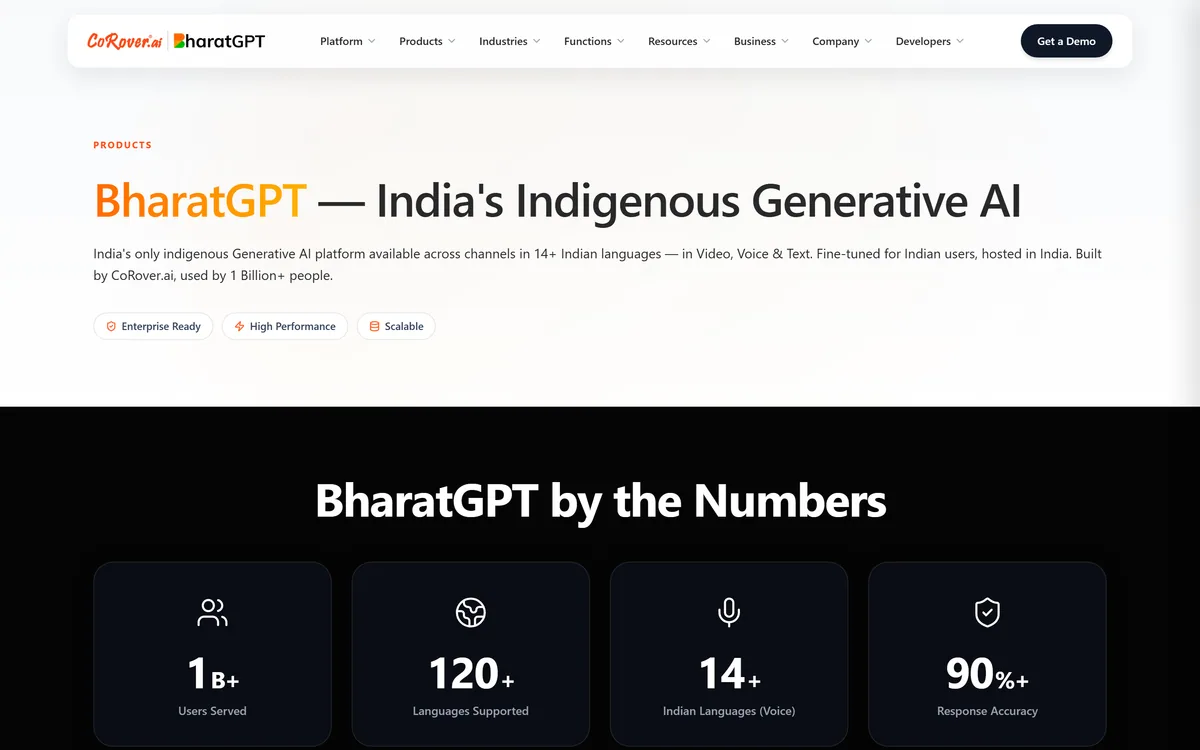
CoRover's BharatGPT page, captured 9 September 2026. The positioning is explicitly sovereign — indigenous, India-hosted, and tied to national language infrastructure.
BharatGPT, Defined
An Indian-language generative AI platform from CoRover, described as India's only indigenous generative AI platform available across channels.
14+ Indian languages by voice, with 120+ languages overall — voice coverage being the number that matters in this market.
Three modes, not one: video, voice and text, including a VideoBot with an AI avatar and lip-sync.
Hosted in India on Google Cloud Platform, stated for data sovereignty, privacy and security.
Integrated with Bhashini, the National Language Translation Mission under MeitY, which ties it to national language infrastructure.
Why Voice Coverage Is The Number That Matters
CoRover states 14 or more Indian languages by voice and 120 or more languages overall. The distinction between those two figures is the important part.
Text support in a language is comparatively easy — a model that has seen the script can generate it. Voice is much harder, because it requires speech recognition trained on real accents and speaking styles, plus speech synthesis that sounds natural rather than robotic, in each language separately.
Speech specialists such as Speechmatics face the same problem, which is why global providers publish long language lists for text and much shorter ones for good voice interaction. And in India voice is not a convenience feature; for a large share of users it is the primary interface.
Fourteen languages by voice is a serious investment. It also invites the obvious question, which the site does not answer: which fourteen. India has twenty-two scheduled languages, and whether your users' language is in the list is a yes-or-no question that determines whether the platform is usable for you at all.
That is the first thing to establish in any conversation with CoRover, along with whether coverage means recognition, synthesis or both — because a language you can speak to but that cannot speak back is a different product.
Text support in a language is easy to claim. Voice support has to be built language by language, which is why the shorter number is the honest one.
What Bhashini Integration Adds
BharatGPT is stated as integrated with Bhashini, the National Language Translation Mission under India's Ministry of Electronics and Information Technology.
This matters more than a typical partnership line. Bhashini is public language infrastructure — a national effort to build translation and speech capability across Indian languages, with datasets and models developed with public participation.
Integrating with it means the platform draws on language resources built specifically for Indian languages rather than on whatever a global model absorbed incidentally. For languages with limited digital text, that difference is substantial.
The same sovereignty argument underpins Jais Chat for Arabic. It also signals institutional alignment, which matters for the government and public-sector deployments this platform is clearly aimed at. A system connected to national language infrastructure is easier to procure in that context than a foreign alternative.
The reasonable caution is that integration is a broad word covering a wide range of technical depth. Ask what specifically is used, and for which languages.
Does Sovereign Hosting Actually Change Anything?
The platform is stated as hosted on Google Cloud Platform in India, for data sovereignty, privacy and security, and described as India's first indigenous LLM fine-tuned for Indian users, culture and context.
For a category of buyer this is decisive rather than preferable. Indian government departments, public-sector undertakings, banks and healthcare providers operate under data localisation expectations that make sending citizen data to servers abroad difficult or impossible. A platform hosted in-country removes that objection entirely.
It is worth being precise about what in-country hosting on a global cloud provider does and does not give you. It means data resides in Indian data centres, which addresses residency requirements directly. It does not by itself make the provider immune to every foreign legal process, and that nuance matters to some buyers and not others.
The cultural fine-tuning claim is harder to assess and genuinely meaningful if true. Indian users ask questions with different assumptions, reference different institutions and use English mixed with local languages in ways a globally-trained model handles poorly. A model tuned on that is measurably better at it — but no evaluation is published, so this has to be tested rather than accepted.
For a public-sector buyer the practical sequence is straightforward: confirm hosting arrangements in writing, then test in the specific languages your citizens actually use.
Confirm which specific Indian languages are supported by voice, and whether that means recognition, synthesis or both.
Get hosting and data residency arrangements documented rather than described.
Ask what Bhashini integration technically involves, and which languages it covers.
Test with your own users' speech, including regional accents and mixed-language phrasing.
Establish retention and deletion terms for citizen data before any deployment.
Video, Voice And Text Is The Right Shape For This Market
BharatGPT delivers across video, voice and text, including what CoRover calls a Generative AI VideoBot — an interactive digital twin and AI video avatar with lip-sync.
Multi-channel delivery is more consequential in India than in markets where everyone types comfortably in English. A text-only assistant excludes users who read less easily than they speak, and a voice-only one loses the reassurance that a visible presence provides in a service interaction.
The VideoBot with lip-sync is aimed at exactly that: public-facing service contexts where an avatar answering in the user's own language is more approachable than a text box. For railway enquiries, government services or banking support, that is a real usability difference rather than a novelty.
The realistic expectation is the one that applies to all avatar systems. It works well for informational exchanges — status, procedure, eligibility — and less well where the interaction is emotionally weighted or unusually complex.
For deployments at scale, the questions to press are latency in real conditions on ordinary connections, and how gracefully the system degrades to voice or text when bandwidth is poor. In much of the market that fallback is the normal case rather than the exception.
Can A Billion Users Be Right?
The site carries striking figures: used by more than a billion people, over 90 per cent response accuracy, and 99.9 per cent uptime.
The billion-user figure needs careful reading. CoRover's technology has been deployed in very high-traffic public services, and a platform embedded in a service used by a large share of India's population can accumulate an enormous cumulative reach. That is plausible as an aggregate exposure figure and it is not a count of active users of BharatGPT as a product.
The accuracy figure is unfalsifiable as stated, because accuracy depends entirely on the question set. Ninety per cent on scheduled, procedural queries in a defined domain is a very different achievement from ninety per cent on open questions in eleven languages, and both could be reported the same way.
The uptime figure is the most conventional and the easiest to hold a vendor to — ask for it as a contractual service level rather than a marketing claim.
None of this suggests the platform underperforms. It means the numbers cannot substitute for your own evaluation, and a public-sector buyer should be testing accuracy on their actual query mix in their actual languages before signing anything.
Running A Realistic Pilot
This is enterprise and government software, so evaluation happens through CoRover rather than a signup. Going in with your own tests matters more than usual, because the published claims cannot be interpreted from outside.
The bar is step three. Accuracy on your real query mix in your real languages is the only number that predicts a deployment.
Establish first which specific languages are supported by voice, and confirm your users' languages are among them.
Assemble two hundred real queries from your existing support or service logs, in the languages they actually arrived in.
Run those through the system and score the answers with native speakers, counting only errors that would affect a citizen or customer outcome.
Test mixed-language phrasing deliberately, since English mixed with a local language is how a great many Indian users actually speak.
Check VideoBot latency on a poor connection and confirm it degrades cleanly to voice or text rather than failing.
Get hosting, residency, retention and deletion terms in writing before any live citizen data is involved.
BharatGPT: What CoRover States
Product type
Generative AI platform for Indian languages across video, voice and text
Positioning
Described as India's only indigenous generative AI platform available across channels
Indian language voice support
14+ languages
Total language support
120+ languages
National integration
Bhashini, the National Language Translation Mission under MeitY
Video capability
Generative AI VideoBot — interactive digital twin and AI video avatar with lip-sync
Hosting
Google Cloud Platform, in India, stated for data sovereignty
Stated accuracy
90%+ response accuracy
Stated uptime
99.9%
Stated reach
1 billion+ users served
Company
CoRover P. Limited
Headquarters
BHIVE Premium Tech Park, HSR Campus, Hosur Road, Bengaluru 560068
Other offices
London and New Delhi
Contact
chat@CoRover.ai
Developer resources
Certifications, a HuggingFace LLM listing, and a published research paper
Who Should Consider BharatGPT
The correct fit when
You serve Indian citizens or customers who interact primarily by voice in a language other than English.
Data residency in India is a requirement rather than a preference, as it is for most public-sector deployments.
You need video, voice and text delivery, because your users are not uniformly comfortable with text.
Alignment with national language infrastructure such as Bhashini matters for your procurement.
Your use case is service delivery — enquiries, procedures, eligibility — rather than open-ended reasoning.
The wrong choice when
You need general reasoning, coding or analysis, where global frontier models are considerably stronger.
Your users' specific language is not among the supported voice languages, which is the first thing to check.
You want to evaluate by self-serve trial, since access runs through the company.
You need published benchmarks to make a decision, as the stated figures carry no methodology.
You operate outside India, where the sovereignty and Bhashini advantages do not apply.
Key features of BharatGPT
Generative AI across 14+ Indian languages by voice and 120+ languages overall
Delivery in video, voice and text rather than text alone
Generative AI VideoBot with an interactive avatar and lip-sync
Integration with Bhashini, India's national language translation mission
Hosting in India on Google Cloud Platform for data sovereignty
Fine-tuning stated for Indian users, culture and context
Multi-channel deployment across service interfaces
Published research paper and a HuggingFace listing for technical evaluation
Pros & cons
Pros
6
Voice support across 14+ Indian languages addresses how most of the market actually interacts with technology
In-country hosting removes the data residency objection that blocks most public-sector AI procurement
Bhashini integration draws on language resources built specifically for Indian languages
Video, voice and text delivery suits users who read less comfortably than they speak
A named company with a published headquarters, offices and contact address
A research paper and HuggingFace listing give technical evaluators something to read
Cons
6
The 14 supported voice languages are not enumerated, which is the specification a buyer needs first
It is not stated whether voice support means recognition, synthesis or both
The 90% accuracy figure has no published methodology or query set, making it uninterpretable
The billion-user figure appears to describe cumulative service reach rather than product usage
No named public deployments appear on the page we read
No pricing is published, and there is no self-serve access for evaluation
Best For
Indian government and public-sector service deployments
Organisations serving citizens who interact primarily by voice
Buyers for whom Indian data residency is a hard requirement
Service interactions in languages global models handle poorly
Deployments needing video, voice and text delivery together
BharatGPT Against The Global Assistants
The comparison that matters here is not general capability but language depth, delivery mode and where the data sits.
Tool
Indian language depth
Hosting
Best for
BharatGPT
14+ Indian languages by voice, Bhashini-integrated
In India, stated for data sovereignty
Indian public services, government and enterprise deployments
Speech recognition breadth rather than a full assistant
Global with deployment options
Transcription infrastructure rather than conversation
Other Assistants And Language Platforms
Compare on language depth and hosting rather than on general capability, since those decide usability here.
Gemini — the strongest global multimodal assistant, though shallower in most Indian languages
Claude — stronger for reasoning and analysis where language coverage is not the constraint
Jais Chat — the same sovereign-model argument made for Arabic
Speechmatics — speech recognition infrastructure if voice input is the specific need
Lokalise — for localising an existing product rather than deploying an assistant
Checking CoRover's Statements
Last checked . Read from the BharatGPT page on corover.ai, with the screenshot above captured in the same session.
Product described as India's only indigenous generative AI platform available across channels in 14+ Indian languages, offered in video, voice and text
Described as fine-tuned for Indian users and hosted in India
Language support stated as 14+ Indian languages by voice and 120+ languages overall
Bhashini integration stated, identified as the National Language Translation Mission under MeitY
Generative AI VideoBot described as an interactive digital twin and AI video avatar with lip-sync
Hosting stated as Google Cloud Platform for data sovereignty, privacy and security
Stated figures read from the page: 90%+ response accuracy, 99.9% uptime, and 1 billion+ users served
Company identified as CoRover P. Limited, headquartered at BHIVE Premium Tech Park, HSR Campus, Hosur Road, Bengaluru 560068, with offices in London and New Delhi
Contact address published as chat@CoRover.ai
Developer resources referenced including certifications, a HuggingFace LLM listing and a published research paper
What we could not confirm: the specific 14 Indian languages supported by voice are not enumerated, nor is it stated whether support means recognition, synthesis or both — which is the single most important specification for a buyer; the underlying model architecture and size are not described on the page we read; no benchmark or evaluation methodology accompanies the 90% accuracy figure; the billion-user figure appears to describe cumulative reach through deployed services rather than active users of this product; no named public deployments appear on the page; and no pricing is published.
Editor's Verdict
4.0/5
BharatGPT scores well because it addresses a gap the global model providers genuinely leave open: Indian language coverage by voice, at a depth that reflects how most of the country actually communicates, hosted in India so data sovereignty is not a compromise. Bhashini integration ties it to national language infrastructure rather than a private dataset, and a VideoBot with lip-sync suits a population where voice and video beat text. It loses ground because its headline figures — a billion users served, 90 per cent accuracy, 99.9 per cent uptime — carry no methodology, and because language coverage is claimed rather than enumerated where it matters most. AInexfinder Editor Score: 4.0/5.
BharatGPT pricing
AInexfinder does not list plan prices or billing details. For current pricing, plans, and trials, visit the official BharatGPT website.
Vendor pricing, credits, and billing policies change over time. Always confirm on the official site before you buy.
Frequently asked questions
What is BharatGPT?
BharatGPT is CoRover's generative AI platform for Indian languages, described as India's only indigenous generative AI platform available across channels. It covers 14 or more Indian languages by voice and 120 or more overall, delivers through video, voice and text, is hosted in India, and integrates with Bhashini, the national language translation mission under MeitY.
Which Indian languages does BharatGPT support?
The site states 14 or more Indian languages by voice and 120 or more languages overall, but does not enumerate which. That is the first question to ask, because India has twenty-two scheduled languages and whether yours is included is a yes-or-no matter. Also confirm whether support means speech recognition, speech synthesis, or both.
Why does voice support matter more than text support?
Because in India voice is the primary interface for a large share of users — typing in Devanagari or Tamil script on a phone is slow, and many users read less comfortably than they speak. Voice is also much harder to build: it needs recognition trained on real accents plus natural synthesis, in each language separately.
What is Bhashini, and why does the integration matter?
Bhashini is India's National Language Translation Mission under the Ministry of Electronics and Information Technology — public infrastructure building translation and speech capability across Indian languages. Integration means the platform draws on resources built specifically for these languages rather than what a global model absorbed incidentally, which matters most for languages with limited digital text.
Is BharatGPT hosted in India?
Yes — the site states hosting on Google Cloud Platform within India, for data sovereignty, privacy and security. For Indian government departments, public-sector undertakings, banks and healthcare providers operating under data localisation expectations, that removes an objection that blocks most foreign AI platforms outright.
Is BharatGPT better than ChatGPT or Gemini for Indian users?
For Indian-language voice interaction and for deployments requiring in-country hosting, plausibly yes — those are exactly the gaps global providers leave open. For general reasoning, coding and analysis, global frontier models are considerably stronger. The right comparison depends on whether your constraint is language and residency or raw capability.
How accurate is BharatGPT?
The site states over 90 per cent response accuracy, but publishes no methodology or query set, which makes the figure uninterpretable — 90 per cent on procedural queries in one domain is a very different result from 90 per cent on open questions across eleven languages. Test on two hundred of your own real queries scored by native speakers.
Has BharatGPT really been used by a billion people?
That figure most plausibly describes cumulative reach through very high-traffic public services where CoRover's technology has been deployed, rather than active users of BharatGPT as a product. Aggregate exposure through a national service can genuinely reach that scale — read it as reach, not as a user count.
What is the BharatGPT VideoBot?
An interactive digital twin and AI video avatar with lip-sync, delivering answers as video rather than text. In public service contexts — railway enquiries, government services, banking support — an avatar answering in the user's own language is more approachable than a text box, particularly for users who read less comfortably than they speak.
How much does BharatGPT cost?
No pricing is published and there is no self-serve access; evaluation runs through CoRover. That is normal for enterprise and government software. Budget for a proper pilot as well as a licence — testing accuracy on your real query mix, in your real languages, with native-speaker scoring, is what actually predicts a deployment.
Daniel reviews AI tools the slow way — by actually using them on real projects. His reviews cover what works, what breaks, and who each tool is genuinely a good fit for.
Daniel and the AInexfinder editorial team research BharatGPT using public product information, listing evidence, and (when available) hands-on checks. Scores reflect listing completeness and transparency — not paid placement.
Listings may include affiliate or sponsored placements, which are labeled when present. Editorial scores and cons are not sold. See our affiliate disclosure and review methodology.
Voiceflow is an enterprise conversational AI platform where CX teams design agent workflows visually, prototype them in place, and deploy one agent across web, app, WhatsApp, SMS and voice. It states 500-millisecond voice latency, 300,000 messages per minute and more than 10,000 live agents in production.
Wonderchat is a platform for building AI customer-service and sales agents from your own content and data. Agents answer with citations from approved sources, hand off to sales and capture leads in the conversation, while a QA agent flags weak answers for fixing.
Chatling deploys AI support agents across five channels — web, WhatsApp, Instagram, Telegram and Messenger — into one unified inbox. It auto-syncs your website, docs and help centre, replies in 80+ languages, and hands off to your team with full context.
Spur is a multi-channel AI agent for commerce marketing and support, unifying WhatsApp, Instagram, Facebook and website chat in one inbox, automating comment-to-DM flows and bulk campaigns, and integrating with external systems to update orders and book meetings.