MailerLite provides email campaigns, automations, signup forms, landing pages, websites, digital product sales and paid newsletter subscriptions in one platform. It states 1M+ creators and businesses, ISO 27001 certification through Bureau Veritas, GDPR compliance and 24/7 support.
mailerlite.com6 viewsAdded May 2, 2025326K visitors
Choosing an email platform by comparing feature lists is a waste of an afternoon. Every serious product now has automations, segmentation, a drag-and-drop editor, landing pages and forms, and the lists are functionally identical.
What actually differs is invisible on a comparison page: whether your email reaches inboxes, whether anyone helps when something breaks, and whether the interface makes a weekly task pleasant or grinding.
MailerLite's positioning leans on the second and third of those, and that is a more honest basis for a decision than another feature table.
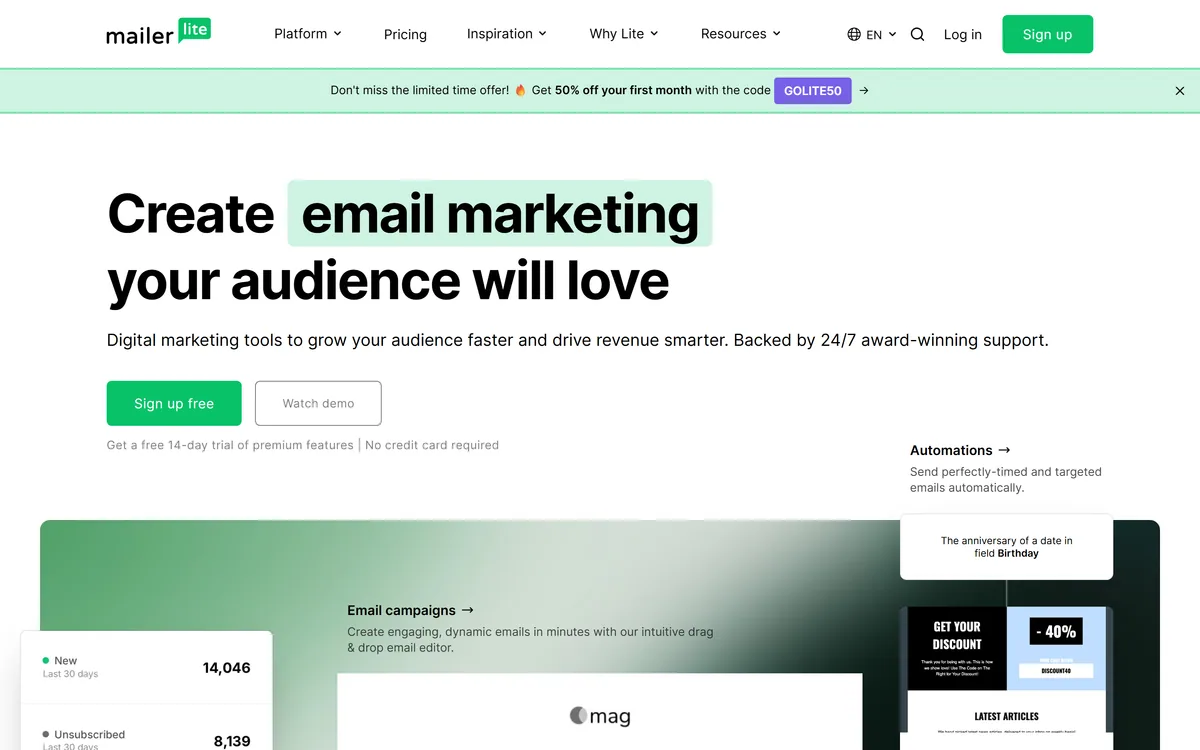
MailerLite's homepage, captured 9 September 2026, showing the campaigns, automations and websites positioning.
MailerLite: Email, Sites And Automations
More than email — campaigns, automations, forms, landing pages, websites, digital products and paid newsletters.
24/7 award-winning support, which is the differentiator that matters when a send breaks at 11pm.
ISO 27001 certified through Bureau Veritas and GDPR compliant, per the footer.
1M+ creators and businesses claimed, with a 14-day trial of premium features and no card required.
Paid newsletter subscriptions built in, which is unusual in a general email platform.
Why Do People Leave Bigger Email Platforms?
MailerLite positions itself around a simple, beautiful interface and attentive customer service, with a testimonial specifically crediting those two things for a switch.
That is a revealing pitch, because it is not competing on capability. It is competing on the experience of doing a recurring task, which is where large platforms genuinely decay.
The pattern is consistent across mature software. Products accumulate features for enterprise buyers, interfaces grow to accommodate them, and the person sending a weekly newsletter navigates an application built for someone with completely different requirements.
The cost is not obvious per session. It is a few extra minutes and a little friction each week, which compounds into a task people postpone — and postponed sending is how email lists quietly die.
Pricing structure drives the other half of switching. Email platforms typically charge by subscriber count, so a list that grows produces a bill that grows regardless of whether you send more, and that is where people start comparing alternatives.
A few extra minutes of friction each week compounds into a task people postpone. Postponed sending is how email lists quietly die.
Deliverability Is The Only Real Metric
Nothing about an email platform matters if the messages land in spam, and deliverability is the specification nobody publishes because nobody can honestly guarantee it.
It depends on shared infrastructure reputation, your own sending behaviour, list hygiene, authentication configuration and how recipients engage — and the platform controls only some of that.
What a platform genuinely provides is the sending reputation of its infrastructure and the tools to configure authentication properly. What you provide is everything else, and most deliverability problems are the sender's rather than the platform's.
The behaviours that matter are unglamorous: only emailing people who asked, removing addresses that never open, never buying a list, and sending consistently rather than in bursts after months of silence.
The practical test during a trial is to send to a small segment across several providers and check where it lands. That tells you more than any published statistic, and it is the same principle that applies to attribution or analytics claims elsewhere — measure it yourself, on your own data, as products like Cometly also depend on.
Automations, Forms And Paid Newsletters
MailerLite covers automations, signup forms, landing pages, websites, digital product sales and paid newsletter subscriptions alongside campaigns.
Automations are where email stops being a broadcast channel and starts producing revenue while nobody is watching. A welcome sequence, an abandoned interest follow-up and a birthday message account for a disproportionate share of most lists' returns.
The example shown — an anniversary trigger on a date field sending a birthday discount — is the right level of complexity. Most valuable automations are simple, and platforms that emphasise elaborate branching often sell complexity that nobody maintains.
Paid newsletter subscriptions being built in is the genuinely unusual inclusion. Most email platforms leave paid subscriptions to specialist products, and having it in a general platform means a writer can monetise without moving lists between services.
Websites and landing pages are the least differentiated part. They are convenient rather than compelling, and anyone with an existing site is better served keeping it and using the forms — which is also where purpose-built builders outclass a bundled page editor.
Digital product sales sit in a similar position to the website builder — convenient rather than competitive, and worth using only if the alternative is running another service. What genuinely benefits from being in the same platform is anything that needs the subscriber list, which is why paid newsletters belong here and a storefront arguably does not. Content produced for those campaigns is a separate problem again, closer to what Describely handles for catalogues.
Test deliverability yourself across several providers before migrating.
Build the welcome sequence first — it earns more than any campaign.
Remove non-openers regularly, since engagement drives inbox placement.
Migrate in stages and watch open rates rather than moving everything at once.
Support, Certification And What They Signal
The site states 24/7 award-winning support and the footer displays Bureau Veritas ISO 27001 certification and GDPR compliance.
Support quality is unusually consequential in email, and it is worth being specific about why. Sending is time-bound and public: a campaign going out with a broken link at 9am on launch day is not a ticket you file and revisit tomorrow.
Round-the-clock support in a category where many competitors offer business-hours email is a genuine operational difference, and it is the kind of thing people only value after the first incident.
ISO 27001 through a named certification body is stronger than the enterprise-grade security language most marketing tools use. It indicates an audited information security management system rather than an assertion.
GDPR compliance matters for a specific reason here: an email platform holds personal data on everyone who ever subscribed, including people who unsubscribed years ago. Consent records, deletion handling and where data is processed are the questions worth asking, and a certification is a starting point rather than an answer.
Moving An Email List Without Breaking It
Migrating an email list is riskier than migrating almost anything else, and the risks are not obvious until they happen.
Deliverability is the first. A list that performed well on one platform can land in spam on another, because the sending infrastructure has a different reputation and recipient providers notice the change.
Consent records are the second and the more serious. You must retain proof of when and how each subscriber opted in, and migrations are where that evidence gets lost — leaving you sending to people you can no longer demonstrate consented.
Automation logic is the third. Sequences rarely map exactly between platforms, and the failure is silent: a trigger that no longer fires produces no error, just an automation that stopped earning.
The safe approach is staged. Move a segment, send to it, compare open rates against your baseline, then move the rest — which takes a fortnight rather than an afternoon and avoids discovering a problem across your entire list at once.
Choosing An Email Platform Properly
The way people choose badly is by comparing feature tables, which are identical, and ignoring the three things that actually differ.
This sequence tests those three during a trial rather than after a migration.
Send a test campaign to addresses across several providers and see where it lands.
Contact support with a real question and time the response.
Build the automation you actually need and see how long it takes.
Check how subscriber consent records are stored and exported.
Confirm what happens to your data and lists if you leave.
Migrate a segment first and compare open rates before moving everything.
What we could not confirm: pricing and how subscriber tiers are structured, since we have deliberately not reproduced the promotional offer displayed on the page; deliverability performance, which no platform can honestly publish and which you should test yourself; where subscriber data is processed and stored; how consent records are exported if you migrate away; which integrations are available; and what the award-winning support claim refers to specifically. We did not send a campaign.
Editor's Verdict
4.2/5
Email platforms have converged on features to the point where the feature list is close to useless as a comparison. What still separates them is deliverability, support and how much friction the interface adds to a task you do weekly — and MailerLite has built its reputation on the second and third of those. Award-winning 24/7 support is a real differentiator in a category where a broken send is an emergency and most competitors offer a form. ISO 27001 certification through Bureau Veritas is a stronger claim than the generic security language most marketing tools use. AInexfinder Editor Score: 4.2/5.
MailerLite pricing
AInexfinder does not list plan prices or billing details. For current pricing, plans, and trials, visit the official MailerLite website.
Vendor pricing, credits, and billing policies change over time. Always confirm on the official site before you buy.
Frequently asked questions
What is MailerLite?
MailerLite is an email marketing platform covering campaigns, automations, signup forms, landing pages, websites, digital product sales and paid newsletter subscriptions. It states 1M+ creators and businesses, 24/7 support, ISO 27001 certification through Bureau Veritas and GDPR compliance.
How should I compare email platforms?
Not by feature list — every serious product now has automations, segmentation, an editor, pages and forms, and the lists are functionally identical. What differs is deliverability, support and how much friction a weekly task carries, none of which appears on a comparison page.
Why do people leave larger platforms?
Accumulated complexity and pricing. Products grow features for enterprise buyers and the person sending a weekly newsletter navigates an application built for someone else. That friction compounds into a postponed task, and postponed sending is how lists die.
Can any platform guarantee deliverability?
No, and nobody honestly claims to. It depends on infrastructure reputation, your sending behaviour, list hygiene, authentication and recipient engagement — and the platform controls only some of that. Most deliverability problems are the sender's rather than the platform's.
How do I test deliverability myself?
Send to a small segment across several providers during the trial and check where it lands. That tells you more than any published statistic, and it is the only measurement that reflects your list, your content and your sending pattern.
Which automations are worth building?
The simple ones. A welcome sequence, a follow-up on shown interest and a date-triggered message account for a disproportionate share of most lists' returns. Platforms emphasising elaborate branching often sell complexity nobody maintains.
Why does 24/7 support matter for email?
Because sending is time-bound and public. A campaign going out with a broken link at 9am on launch day is not a ticket you file and revisit tomorrow, and many competitors offer business-hours email support only.
What does ISO 27001 certification indicate?
An audited information security management system, verified by a named certification body rather than asserted. That is stronger than the enterprise-grade language most marketing tools use, though it is a starting point rather than an answer on data handling.
What is the biggest migration risk?
Consent records. You must retain proof of when and how each subscriber opted in, and migrations are exactly where that evidence gets lost — leaving you sending to people whose consent you can no longer demonstrate.
How should I migrate safely?
In stages. Move one segment, send to it, compare open rates against your baseline, then move the rest. That takes a fortnight rather than an afternoon and avoids discovering a deliverability problem across your entire list at once.
Daniel reviews AI tools the slow way — by actually using them on real projects. His reviews cover what works, what breaks, and who each tool is genuinely a good fit for.
Daniel and the AInexfinder editorial team research MailerLite using public product information, listing evidence, and (when available) hands-on checks. Scores reflect listing completeness and transparency — not paid placement.
Listings may include affiliate or sponsored placements, which are labeled when present. Editorial scores and cons are not sold. See our affiliate disclosure and review methodology.
Mailjet is a Sinch-owned email platform handling both marketing campaigns and transactional sending from one account. It offers a collaborative drag-and-drop editor, an email API with SMTP relay, AI generation and segmentation, and EU-based data centres.
Listomize is an Etsy SEO platform that generates titles, tags, and descriptions within Etsy's own limits, scores listings, optimises 100+ listings from a CSV, tracks competitors and trends, and auto-generates Pinterest pins.
Lahjty (لهجتي) is an Arabic-first marketing platform for MENA campaigns. From one brief it produces dialect-aware ad copy, headlines, campaign images with Arabic text rendered in, dialect-aware voice, and SEO articles grounded in your own brand sources — with a Partner API and an MCP server for teams that want it inside their own workflow.
MaxAEO is an answer engine optimisation platform from HIII PTE. LTD. It tracks how ChatGPT, Gemini, Claude, Perplexity, Copilot, Grok and Google's AI surfaces mention a brand, with sentiment, competitor benchmarking and citation tracing.
Outranking is an AI SEO content platform that writes briefs and first drafts and optimises them with real-time scoring, grounding content in live SERP data through its Concepts feature, with keyword clustering, internal linking and content workflows.