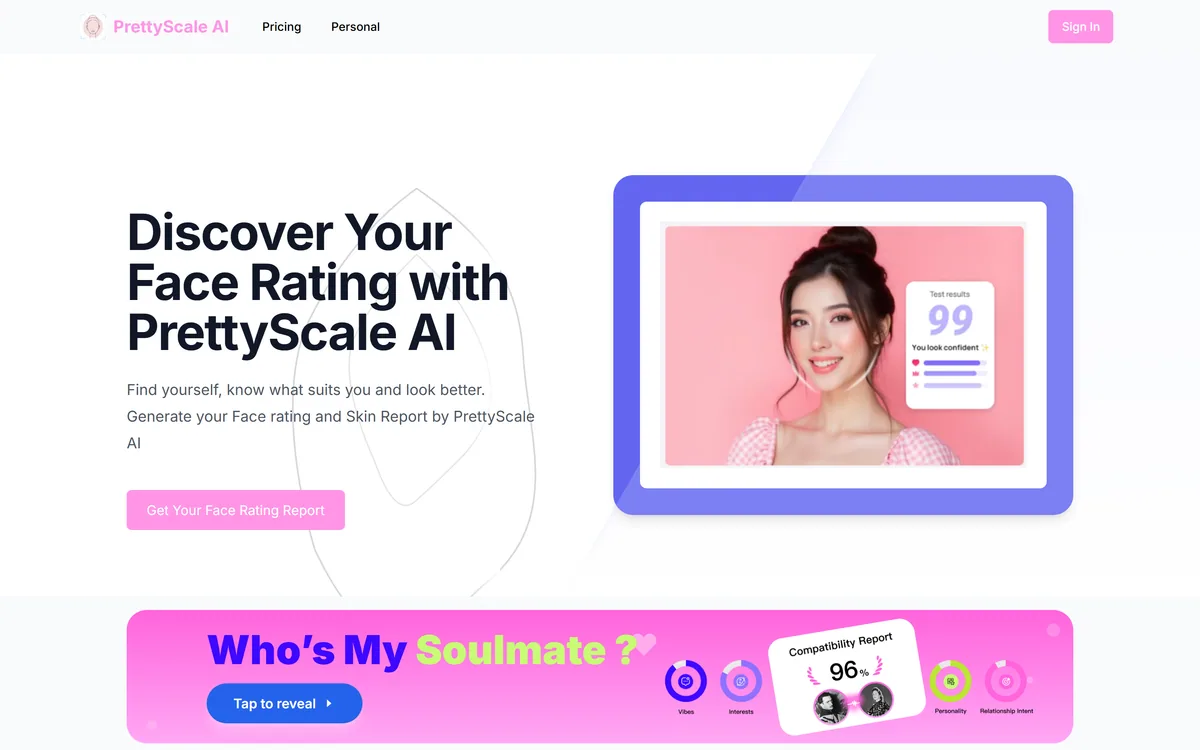
PrettyScale is a web tool that analyses an uploaded frontal photograph and returns an attractiveness score alongside symmetry measurements, facial proportions, a skin report and suggestions described as enhancing your natural features, with a history feature for tracking the score over time.
PrettyScale's homepage, captured 9 September 2026, showing its face rating positioning.
PrettyScale: What The Page Offers
An attractiveness score from one photo, described throughout the site as objective.
Measurements alongside it: symmetry, facial proportions, face shape and a skin report.
Suggestions for improvement, framed as enhancing your natural features.
A score history for tracking your rating over time.
Attractiveness is not an objective property — it is a judgement observers make, and it varies by culture and era.
PrettyScale: A Score Attached To Your Face
The proposition is stated plainly on the homepage: discover your face rating, find yourself, know what suits you and look better. You upload a well-lit frontal photograph and receive a report.
The report's contents are described consistently across the page and the FAQ.
It contains an attractiveness score, a face shape analysis covering symmetry and proportions, a skin analysis covering texture, blemishes and wrinkles, and personalised recommendations described as helping you enhance your natural features. A history feature tracks changes in the score over time.
Three of those four outputs are measurements. Symmetry can be computed from landmark points. Proportions are ratios between measured distances. Skin texture is an image-processing task with a genuine technical basis.
The fourth is not a measurement, and the difference is the whole subject of this review. An attractiveness score is a prediction of how observers would rate a face — which makes it a statement about a group of raters as much as about the person in the photograph. The skin report is the one output with a clinical analogue, and Derm AI shows what that looks like when a company treats skin as a health question.
Symmetry, proportion and skin texture are measurements. An attractiveness score is a prediction about how other people would judge you — and those are different kinds of thing.
What Happens To The Photo You Upload
The privacy answer in the FAQ is more substantial than many consumer sites manage. Photos are stated to be private by default and not visible to anyone but the user, with a stated photo security programme, security infrastructure, data responsibility practices and privacy controls.
That is a reasonable posture, and it deserves credit before the rest of this review proceeds.
It is still worth understanding what you are handing over. A frontal photograph with ears, forehead and neck visible — the exact framing the instructions request — is close to biometric-grade facial data. It is the same geometry a face recognition system uses, and unlike a password it cannot be changed if it is ever exposed.
That is not an accusation about this service. It is true of every service that asks for a clear frontal photograph, and it is the reason such uploads deserve a moment's thought rather than a reflex.
The practical questions are the ordinary ones: what the retention period is, whether images are used to improve models, and whether deletion removes the underlying data or only the visible record. The published privacy policy is where those answers should be, and reading it before uploading costs two minutes.
Can Attractiveness Be Measured Objectively?
The site's own FAQ contains the answer and the contradiction in consecutive sentences: while beauty standards vary between individuals and cultures, facial rating combines both subjective and objective elements — and PrettyScale analyses hundreds of thousands of faces to provide an objective attractiveness score.
The first clause is correct. The second does not follow from it.
Analysing a very large number of faces produces a reliable average of how those particular raters responded. Reliability is not objectivity. A tool trained on ratings gathered from one population will faithfully reproduce that population's preferences, including whatever is culturally specific or simply fashionable about them.
That is a real finding about a group of people. It is not a property of the face, and calling it objective moves it from a description of raters to a verdict on a person.
The historical record makes this concrete. Standards for body shape, skin tone, facial fullness, eyebrow shape and nose profile have all reversed within living memory, and differ sharply between regions today. A score claiming to transcend that would need to explain which population's judgement it encodes, and no such explanation appears on these pages. What the tool can honestly say is how a particular model, trained on particular ratings, scored a particular photograph.
Read the score as a model's prediction of one rater population, not a fact.
Note that lighting, angle and camera lens move facial proportions measurably.
Treat the skin report as image analysis, never as a medical opinion.
Take anything that looks like a clinical concern to a clinician.
Be wary of any feature that invites you to track the score over time.
What A Face Rating Is Actually Reporting
Set the framing aside and something more mundane is happening underneath, worth describing accurately.
The stated method is examining face structure, bone composition and skin characteristics, returning symmetry scores and facial proportions.
Landmark detection is mature technology: a model locates points around the eyes, nose, mouth and jaw, and distances between them yield ratios. Those ratios are real numbers about a real photograph, and they are also extremely sensitive to conditions the subject does not control.
Focal length changes apparent nose width. Camera height changes jaw proportion. Lighting direction changes apparent symmetry, because shadow falls unevenly on faces that are, like every face, slightly asymmetric. Two photographs of the same person taken minutes apart can produce visibly different measurements.
This matters most for the history feature. A score that moves between sessions is at least as likely to reflect the lamp you sat under as any change in you — and a chart of that variation, presented as a trend in your appearance, is the single design decision in this product we would most want reconsidered. Portrait tools like HeadshotPro use the same underlying face modelling for a purpose that does not require anyone to be scored.
Who Is Most Affected By Appearance Scores
The honest part of this review has to address who ends up typing am I pretty into a search engine, because the site's own footer uses that phrasing.
A large body of published research links repeated appearance-based social comparison with body image concerns, and finds the association strongest among adolescents and young adults.
That literature is about the general practice of measuring oneself against a standard. It is not a claim about this company, this product, or any individual's experience of it, and none is intended.
But a design that supplies a number, offers improvement suggestions and stores a history is, structurally, a comparison engine — first against an implied ideal, and then against your own earlier score. We did not find a minimum-age statement on the pages we read, and that is the detail we would most want a service in this category to publish prominently.
There are people for whom this is straightforwardly harmless entertainment, and treating every user as fragile would be its own kind of condescension. The distinction worth drawing is between curiosity and habit: opening it once is a different act from checking it weekly, and only the product's own history feature encourages the second. Sibling products named in the footer — a dating coach and a soulmate feature on the page itself — point at the same use case, which is appearance in the context of being chosen. Photo AI occupies the same territory from the other direction, generating the photograph rather than scoring it.
Deciding Whether To Upload Your Face
If you are going to use a tool like this, a few decisions made beforehand change the experience considerably.
This sequence keeps it in the category of curiosity.
Read the privacy policy for retention, model training and deletion terms.
Decide before uploading what you would do with a low number.
Use one consistent photo if you use it at all — lighting moves the result.
Read the symmetry and proportion figures; ignore the single score.
Take any skin finding that concerns you to a clinician, not a website.
Do not use the history feature, and do not share a score with anyone else.
PrettyScale: Claims And Company
Category
Face analysis and attractiveness rating
Input
A well-lit frontal photograph with ears, forehead and neck visible
Outputs
Attractiveness score, face shape analysis, symmetry test, skin report
Extras
Personalised recommendations and a face rating history
Objectivity claim
An objective attractiveness score, stated on the homepage and in the FAQ
Stated basis
Analysis of hundreds of thousands of faces
Speed
A report described as generated in minutes
Privacy
Photos stated as private by default, with a stated photo security programme
Additional feature
A soulmate feature presented on the homepage
Related products
Footer links to a dating coach product and other sibling tools
Testimonials
Six, shown as first names with social-style handles
Footer
Copyright shown as 2025, with contact, privacy policy and terms of service
Should Anyone Use A Face Rater?
Use the skin report when
You want a skin texture read as a starting point, not a diagnosis.
You are curious about your face shape for glasses or a haircut.
You understand a score describes raters, not you.
You have read the privacy policy and accept the upload.
You will look once and not return.
Close the page when
You are having a difficult time with how you look.
You would take a low number personally.
You are a teenager, or the photograph is of one.
You would start tracking the score across weeks.
You want a medical opinion about your skin.
Key features of PrettyScale
Attractiveness score from an uploaded photo
Facial symmetry measurement
Facial proportion and face shape analysis
Skin texture, blemish and wrinkle analysis
Personalised appearance suggestions
Score history across sessions
A soulmate feature on the homepage
A free tier with paid upgrades
Pros & cons
Pros
7
Symmetry and proportion measurement is genuine, well-understood geometry
Skin texture analysis has a real technical basis and a legitimate use
Face shape information is practically useful for glasses and haircuts
Photos stated as private by default, with a described security programme
The photo requirements are specific, which improves measurement consistency
A free tier means no payment is needed to see what it does
Results are returned quickly and the interface is straightforward
Cons
7
An attractiveness score cannot be objective, and the site calls it objective repeatedly
The FAQ concedes beauty standards vary, then claims objectivity in the same answer
Which population's ratings the model encodes is never identified
Scores shift with lighting, lens and camera angle rather than with the person
The history feature encourages repeated self-comparison against your own score
Improvement suggestions imply a deficit the measurement cannot establish
We did not find a minimum-age statement, in a category where one matters
Best For
People curious about their face shape for practical styling reasons
Anyone wanting a rough skin texture read before seeing a professional
Users who will treat the number as a party trick and close the tab
Readers who want to understand what these tools actually measure
PrettyScale Beside Other Face Tools
Several tools analyse faces. What they return differs completely.
Last checked . Read from prettyscale.ai in a browser session on the date above, with the screenshot captured at the same time.
Positioned as discovering your face rating and skin report, to find yourself and look better
Instructions requesting a well-lit frontal photo with head up, ears, forehead and neck visible
Analysis described as examining face structure, bone composition and skin characteristics
Reports stated to include symmetry scores, facial proportions and personalised beauty recommendations
An objective attractiveness score claimed on the homepage and repeated in the FAQ
FAQ stating beauty standards vary between individuals and cultures, in the same answer as the objectivity claim
Stated basis given as analysis of hundreds of thousands of faces
A face rating history feature offered for tracking score changes over time
A soulmate feature presented alongside the rating on the homepage
FAQ stating photos are private by default and not visible to anyone but the user
Six testimonials displayed as first names with social-style handles
Footer showing a 2025 copyright, contact, privacy policy, terms of service and links to sibling products including a dating coach
What we could not confirm: which population's ratings the scoring model was trained on; how the attractiveness score is computed or weighted against skin and symmetry inputs; retention periods, model-training use and deletion behaviour beyond the FAQ's general statements; whether the testimonials are from identifiable people; and pricing. We did not find a minimum-age statement on the pages we read. We did not upload a photograph or generate a report.
Editor's Verdict
2.0/5
The technology here is ordinary and the framing is not. Measuring facial symmetry and proportions from a photograph is a solved geometry problem, and analysing skin texture is a reasonable image-processing task. Attaching those measurements to a single attractiveness score and describing that score as objective is where the product stops being a measurement and becomes a claim it cannot support — attractiveness is a judgement made by other people, and the site's own FAQ concedes that beauty standards vary between individuals and cultures in the same paragraph that calls its output objective. A score history that tracks your face over time is the feature we would think hardest about before using. AInexfinder Editor Score: 2.0/5.
PrettyScale pricing
AInexfinder does not list plan prices or billing details. For current pricing, plans, and trials, visit the official PrettyScale website.
Vendor pricing, credits, and billing policies change over time. Always confirm on the official site before you buy.
Frequently asked questions
What does PrettyScale do?
You upload a frontal photograph and it returns an attractiveness score, a face shape and symmetry analysis, a skin report covering texture and blemishes, and suggestions described as enhancing your natural features.
Is the attractiveness score objective?
No, and it cannot be. Attractiveness is a judgement observers make, so a score reflects the preferences of whichever raters the model learned from. The site's own FAQ concedes standards vary by culture, then calls the output objective.
What is the difference between reliable and objective?
A tool can be highly reliable — returning consistent results — while measuring something that is not a property of the face. Averaging many raters produces a dependable summary of those raters, not a fact about the person.
Which parts of the report are real measurements?
Symmetry, facial proportions and skin texture. Landmark detection and ratio calculation are mature techniques, and image analysis of skin has a genuine basis. It is the single combined score that is a prediction rather than a measurement.
Why would my score change between photos?
Because focal length alters apparent nose width, camera height alters jaw proportion, and lighting direction alters apparent symmetry. Two photos taken minutes apart can measure differently without anything about you having changed.
Is the score history feature a good idea?
It is the design decision we would most want reconsidered. A chart of a number attached to your face, moving largely with lighting conditions, presents variation in photography as a trend in your appearance.
What happens to my photo?
The FAQ states photos are private by default, not visible to anyone else, and covered by a stated security programme. A clear frontal photograph is close to biometric-grade data, so retention and deletion terms are worth reading first.
Can it tell me about my skin?
It analyses texture, blemishes and wrinkles from an image, which is a reasonable starting point and not a medical assessment. Anything that looks like a clinical concern belongs with a clinician rather than a website.
Should teenagers use it?
We would advise against it. Research consistently associates repeated appearance-based comparison with body image concerns, most strongly among adolescents, and we did not find a minimum-age statement on the pages we read.
Is there a legitimate use for this?
Yes — face shape is genuinely useful for choosing glasses or a haircut, and a skin texture read has value as a prompt to see someone qualified. Read those outputs and ignore the single score.
Daniel reviews AI tools the slow way — by actually using them on real projects. His reviews cover what works, what breaks, and who each tool is genuinely a good fit for.
Daniel and the AInexfinder editorial team research PrettyScale using public product information, listing evidence, and (when available) hands-on checks. Scores reflect listing completeness and transparency — not paid placement.
Listings may include affiliate or sponsored placements, which are labeled when present. Editorial scores and cons are not sold. See our affiliate disclosure and review methodology.
krea2.org is a browser image-generation workspace that runs several third-party models side by side, including Krea 2 tiers, FLUX.2, GPT Image 2, Nano Banana and Seedream 5.0, with reference uploads, six aspect ratios and live model switching.
Pet Pic Portraits turns a pet photo into styled artwork — Royal King, Pop Art, Watercolour, Viking, Wizard and more — with an instant preview before ordering. Output is a digital download, a canvas print or framed wall art, and it includes a pet memorial option.
Canva AI is the Magic Studio suite built into Canva — Magic Write for copy, Dream Lab for images, Magic Edit, Expand and Eraser for photos, Magic Switch for reformatting, Magic Charts for data, and Canva Code for interactive widgets.
Pixlr is a browser-based photo editor from Pixlr Pte Ltd with two editors and a generative AI layer — Generative Fill, Expand and Transform, background and object removal, Super Scale upscaling, face swap, plus image, video, and audio generation.
GenApe is an all-in-one AI platform covering writing, chat, image and video generation, image editing, product photography, translation, and research — with 145 free credits on signup and commercial rights granted to paid users.
Magic Patterns is an AI design tool for product teams that turns prompts, requirements and ideas into high-fidelity UI, matching your existing design system so teams can prototype and test directions before committing engineering resources.