PromptLayer combines a prompt registry and visual CMS with dataset-backed evaluations, agent tracing and observability, letting non-engineers version and deploy prompts without a code release while every production trace stays linked to the exact version that produced it.
promptlayer.com6 viewsAdded October 18, 20259K visitors
PromptLayer's homepage, captured 9 September 2026, showing its AI engineering collaboration layer.
PromptLayer: What The Platform Holds
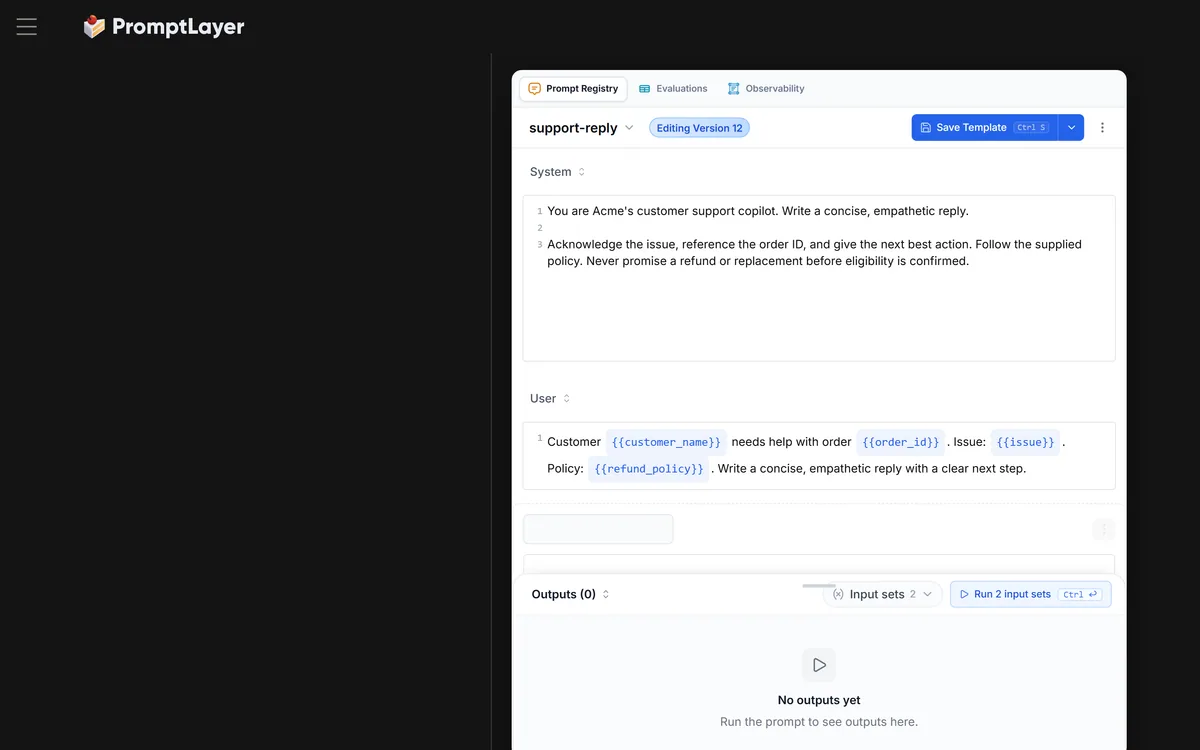
A prompt CMS with visual editing, versioning, diffs, rollback and A/B releases.
Evaluations: dataset-backed tests, human review, automated graders and historical backtests.
Observability connecting production traces to the exact prompt version that ran.
Non-engineers can ship — prompt deploys are decoupled from application releases.
SOC 2 Type 2, HIPAA and GDPR compliance stated, with a public trust centre.
PromptLayer: Prompts Out Of The Codebase
The positioning is a single sentence and an unusually accurate one: the prompt CMS, eval harness and observability stack you would build eventually, shipped today, letting domain experts collaborate without touching your codebase.
The words you would build eventually are doing the persuading, and they are correct.
Every team that ships an AI feature follows the same path. Prompts start as string literals. Someone moves them into a constants file. Someone adds an environment variable so staging can differ. Then a request arrives to change a prompt without a deploy, and a small internal admin tool appears.
Six months later that tool has versioning, an approval flow, a logs viewer and nobody who wants to maintain it. It is the classic accidental internal product.
The claim here is not that this is impossible to build. It is that you will build it, badly, while your actual product waits. The counter-argument is real too: a bespoke tool fits your workflow exactly, and it is not obvious that a hosted registry is worth the dependency until the team crosses a certain size.
One line in the feature list gives the cleanest reason to move: prompts should not be scattered through your codebase. Most teams recognise that description immediately.
Prompts start as string literals, become a constants file, then an internal admin tool with versioning and an approval flow that nobody wants to maintain.
Regression Testing A Prompt Change
The evaluation feature set is specific: historical backtests against past data, regression tests triggered whenever a prompt updates, model comparisons, and one-off bulk jobs against batches of test inputs.
Regression testing is the capability that makes fast prompt iteration safe rather than reckless, and the reason is a property of prompts that surprises people.
Prompt changes are non-local. Adding a line to fix one failing case changes behaviour on inputs that had nothing to do with it, because you have shifted the model's whole conditioning rather than patched a branch. Nothing about the edit tells you which other cases moved.
Without a dataset and automatic scoring, the only feedback is a support ticket a week later, and by then three more changes have shipped on top.
Backtesting against historical data is the sharper version of the same idea, because it answers the question that actually matters: would this version have done better on the traffic we really received? Dedicated harnesses like Promptfoo go deeper on evaluation alone; the argument here is that the eval belongs next to the registry that triggered it.
Why Should Prompts Live Outside Your Code?
The stated benefit is decoupling engineering releases from prompt deploys, with versions published interactively to production and development.
That is an operational change with a larger organisational consequence than it first appears.
When a prompt lives in the repository, changing it requires an engineer, a review, a merge and a deploy. The cost is not the typing; it is the queue. A content lead who notices the assistant is too formal files a ticket, waits, and by the time it ships has stopped noticing.
When a prompt lives in a registry, the same person edits it, tests it against a dataset and publishes it — and the iteration loop shortens from a week to minutes.
The obvious objection is that letting non-engineers change production behaviour sounds alarming. It is only alarming without the surrounding machinery. Immutable version history, diffs, comments, rollback and evals that run on every update are exactly what makes it safe, and they are the same controls engineers already expect for code.
The site's own case studies describe the outcome directly: a curriculum team compressing months of work into a week, and lawyers owning prompt iteration and catching regressions before updates reach hundreds of litigators.
Move prompts to a registry before you build the internal tool.
Require a regression eval on every prompt update, not just risky ones.
Keep release labels as the deploy mechanism, so rollback is instant.
Give domain experts the editor and the dataset together.
Link every production trace to a prompt version from day one.
Evals, Traces And What Connects Them
Observability is described as connecting production traces to prompt versions, inspecting failures, and tracking cost, latency and token usage — with a stated benefit of not jumping between separate analytics and monitoring tools.
The connection is the product, more than any individual capability.
Three things are typically owned by three different systems: the prompt lives in a repository, the logs go to a monitoring stack, and evaluations run in a notebook someone wrote. Each works. Together they cannot answer the one question that matters, which is whether the change you shipped on Tuesday made things better or worse.
Answering it requires the trace to know which prompt version produced it, and the eval score to attach to that version too.
For agents this stops being a convenience and becomes a necessity. A multi-step workflow that fails gives you a bad final answer and no indication of which step went wrong — the site's Ellipsis case study describes jumping from a workflow ID to the exact failing run in a few clicks, which is the entire debugging story for agent systems. General LLM observability tools such as Langfuse cover the tracing half well; the differentiator here is that the registry and the graders sit in the same place.
Letting Domain Experts Iterate Directly
The strongest claim on the site is a position rather than a feature: building good AI is about understanding your users, which is why subject matter experts are the best prompt engineers.
The community framing extends it — lawyers, doctors, educators and even software engineers, in that order.
The claim holds up under scrutiny. Prompting is not a technical skill in any meaningful sense. It is the ability to specify a task precisely, anticipate how it will be misread, and recognise a good answer from a plausible one. A teacher knows what a well-graded essay looks like. An engineer does not, and no amount of prompt technique substitutes.
The named case studies are consistent with that reading and are specific enough to check: support automation scaled twentyfold at an e-commerce support company, over a million grades shipped by a curriculum and engineering team building pedagogical evals, newsroom agents processing thousands of stories daily, and a launch handling 1.5 million requests through a viral spike.
The privacy posture matches the customer list — SOC 2 Type 2, HIPAA and GDPR compliance stated with a public trust centre, which is what selling into legal, healthcare and education actually requires. The integration list is long enough to matter, covering the major model providers, the common agent frameworks and OpenTelemetry. Proxy-level tools such as Helicone capture cost and usage without touching the prompt layer at all.
Shipping Prompt Changes Safely
The risk in fast prompt iteration is not a bad prompt. It is a good prompt that quietly broke something nobody was testing.
This order makes speed safe rather than merely fast.
Move prompts into the registry before writing your own admin tool.
Build a dataset from real production inputs, including the failures.
Wire regression evals to run on every prompt update automatically.
Give domain experts editing rights and the dataset at the same time.
Ship through release labels so rollback is one action.
Backtest each new version against historical traffic before promoting it.
Key features of PromptLayer
Visual prompt registry with immutable version history
Prompt deployment via release labels, without a code release
Diffs, comments, notes and one-click rollback
Gradual A/B release of prompt versions
Dataset-backed evaluations with human and automated graders
Historical backtests and update-triggered regression tests
Trace-level observability linked to prompt versions
Agent workflow versioning and tool call inspection
Pros & cons
Pros
7
Solves a problem teams reliably build badly for themselves
Registry, evals and traces in one system answer questions no single tool can
Non-engineers can ship prompt changes with real safety controls around them
Backtesting against historical traffic is the most honest form of prompt testing
Agent tracing turns an unexplainable failure into a locatable one
Compliance set matches the regulated customers in its case studies
Case studies are named and specific rather than anonymous logos
Cons
7
Adds an external dependency to a core part of your application
Case study figures carry no stated methodology
LLM-as-a-judge grading is convenient and imperfect, and needs human review
Little benefit for a small team where one engineer ships prompts daily
Whether prompts and traces can stay on your own infrastructure is not addressed
Giving non-engineers deploy rights requires organisational agreement, not just tooling
A mature internal eval pipeline already covers much of the value
Best For
Product teams where domain experts define what a good answer is
Companies shipping AI features in regulated sectors
Teams debugging multi-step agent workflows in production
Engineering leads about to build an internal prompt admin tool
Organisations that need prompt changes faster than release cycles allow
PromptLayer Beside Other AI Engineering Tools
AI engineering tools differ by which part of the loop they own.
CodeScene — measuring health in the codebase itself
PromptLayer: Read From New York
Last checked . Read from promptlayer.com in a browser session on the date above, with the screenshot captured at the same time.
Positioned as the collaboration layer for AI engineering teams: prompt CMS, eval harness and observability stack
Prompt management described as visual editing, versioning and deployment without an application redeploy
Version controls listed as comments, notes, diffs, rollback and gradual A/B release
Evaluations described as dataset-backed tests, human review and automated graders before production
Historical backtests, update-triggered regression tests and model comparison all listed
Observability described as connecting production traces to prompt versions with cost, latency and token usage
Agent features listed as workflow versioning, tool call inspection and multi-step evaluation
Stated position that subject matter experts are the best prompt engineers
Named case studies across e-commerce support, education, legal, newsroom and language learning
SOC 2 Type 2, HIPAA and GDPR compliance stated, with a trust centre link
An integration list covering major model providers, agent frameworks and OpenTelemetry
Footer stating the company is located in New York City, with a 2026 copyright and privacy, cookies and terms pages
What we could not confirm: the methodology behind the case study figures, including the twentyfold support scaling and the million-plus grades; how graders are configured and how reliable LLM-as-a-judge scoring is on these workloads; whether self-hosting is available for teams that cannot send prompts or traces off their infrastructure; and pricing. We did not create an account, register a prompt or run an evaluation.
Editor's Verdict
4.4/5
PromptLayer's core argument is one most teams reach on their own about eight months in: a prompt is content, not code, and the person best placed to write it is usually the one who understands the domain rather than the one who understands the repository. Building the registry, the eval harness and the observability layer as one connected system is what makes that argument workable, because a prompt you can change quickly without traces and regression tests is a liability rather than a feature. The case studies are named, specific and checkable, which is rare enough in this category to count for something. AInexfinder Editor Score: 4.4/5.
PromptLayer pricing
AInexfinder does not list plan prices or billing details. For current pricing, plans, and trials, visit the official PromptLayer website.
Vendor pricing, credits, and billing policies change over time. Always confirm on the official site before you buy.
Frequently asked questions
What is PromptLayer?
An AI engineering platform combining a prompt registry and visual CMS with evaluations, observability and agent tracing. Engineers version and monitor prompts while domain experts change behaviour without editing application code.
Why take prompts out of the codebase?
Because the cost of a prompt change is the queue, not the typing. A content lead who notices the assistant is too formal files a ticket and waits; with a registry the same person edits, tests and publishes in minutes.
Is it safe to let non-engineers deploy prompts?
Only with the surrounding machinery, which is the point of the platform. Immutable versions, diffs, comments, rollback and evals that run on every update are the same controls engineers expect for code.
Why do prompt changes need regression tests?
Because prompt edits are non-local. Adding a line to fix one case shifts the model's whole conditioning, changing behaviour on unrelated inputs — and nothing about the edit tells you which ones moved.
What is a backtest?
Scoring a new prompt version against historical production data. It answers the question that actually matters: would this change have performed better on the traffic you really received?
Why link traces to prompt versions?
Because otherwise you cannot tell whether Tuesday's change helped. The prompt lives in one system, logs in another and evals in a notebook — each works, and together they cannot answer that question.
Are domain experts really better at prompting?
The site argues yes, and the reasoning holds. Prompting is specifying a task precisely and recognising a good answer from a plausible one. A teacher knows what a well-graded essay looks like; an engineer generally does not.
What compliance does it hold?
SOC 2 Type 2, HIPAA and GDPR are stated, with a public trust centre. That set matches the customers in its case studies, which include legal, healthcare-adjacent and education workloads.
How does it help with agents?
Agent workflows fail with a bad final answer and no indication of which step broke. Versioned workflows, tool call inspection and traces addressable by workflow ID turn that into a locatable failure.
When is it not worth it?
When one engineer owns every prompt and ships daily, when prompts rarely change, or when policy prevents prompts and traces leaving your own infrastructure. A constants file is genuinely enough for a small application.
Daniel reviews AI tools the slow way — by actually using them on real projects. His reviews cover what works, what breaks, and who each tool is genuinely a good fit for.
Daniel and the AInexfinder editorial team research PromptLayer using public product information, listing evidence, and (when available) hands-on checks. Scores reflect listing completeness and transparency — not paid placement.
Listings may include affiliate or sponsored placements, which are labeled when present. Editorial scores and cons are not sold. See our affiliate disclosure and review methodology.
Momentic is an agentic end-to-end testing platform where AI writes tests as plain-English YAML, runs them across web, iOS and Android, and self-heals them when the UI changes, with an autonomous bug-bashing agent, an MCP server and CI integration.
Helicone is open-source LLM observability and an AI gateway. It logs and analyses requests across OpenAI, Anthropic, Gemini, Mistral, Groq, Together and OpenRouter, with sessions, user-level tracking, a query language, prompt management, datasets, a playground, rate limits and alerts.
Langfuse is an open-source LLM engineering platform covering tracing, evaluation, prompt management, experiments and human annotation. Every product feature is MIT licensed, with self-hosting via Docker Compose, Kubernetes or Terraform alongside a managed cloud in US and EU regions.
Functionize is an AI-native test automation platform for enterprise web applications. Its Studio product uses autonomous agents to create and run end-to-end UI tests, with self-healing element resolution built on custom models rather than brittle selectors, across Salesforce, ServiceNow, Workday, SAP and bespoke apps.
Bug0 is managed AI QA: a forward-deployed engineer builds end-to-end tests on Bug0's engine, covering critical flows in seven days. Tests heal themselves when the UI changes, and every failure is verified before it reaches you. It also publishes Passmark and a substantial testing blog.
GitHub Copilot is an AI coding assistant that spans completion, chat, agent mode, automated code review, and a cloud agent that opens pull requests, working across VS Code, Visual Studio, JetBrains, Xcode, Neovim, Eclipse, the CLI, and github.com.