
Runway is an AI video platform built around generative world models — Gen-4.5, Aleph 2.0, and Act-Two for performance capture — split across Runway Creative for filmmakers, Runway Dev for builders, and Runway Robotics.
FreemiumVideo & Audio
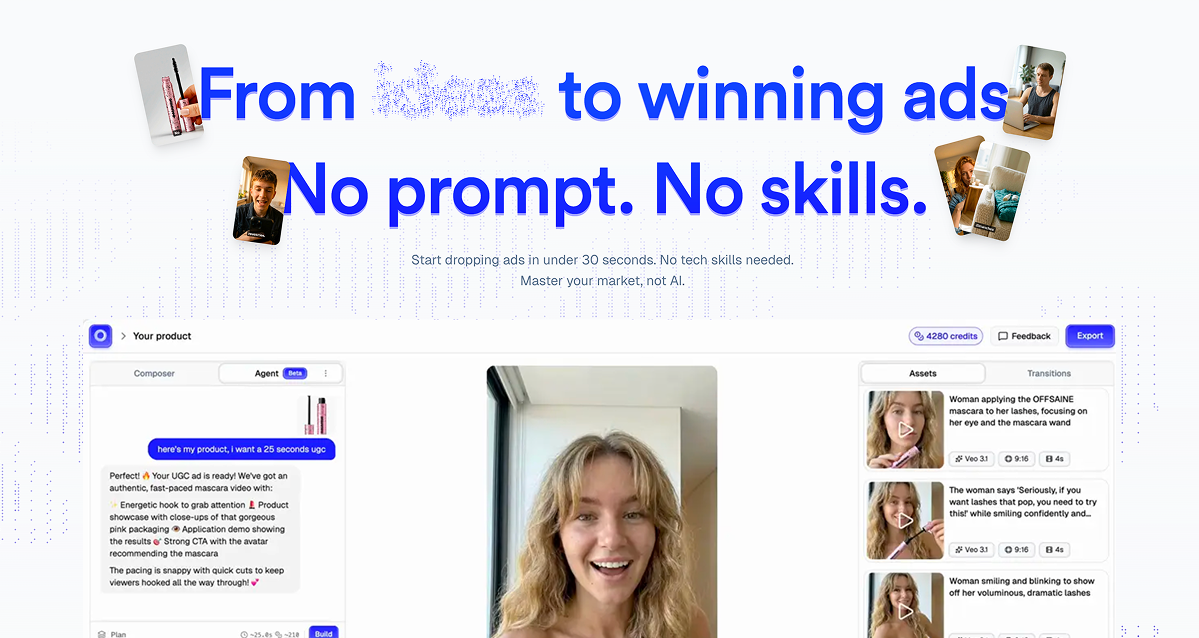
Reloop generates video advertisements without prompting: a creative agent reads your product, plans the ad and produces it with a choice of over 700 avatars and 100 voices in four visual styles, adding auto captions, music and transitions, with voice cloning and a frame-level editor.
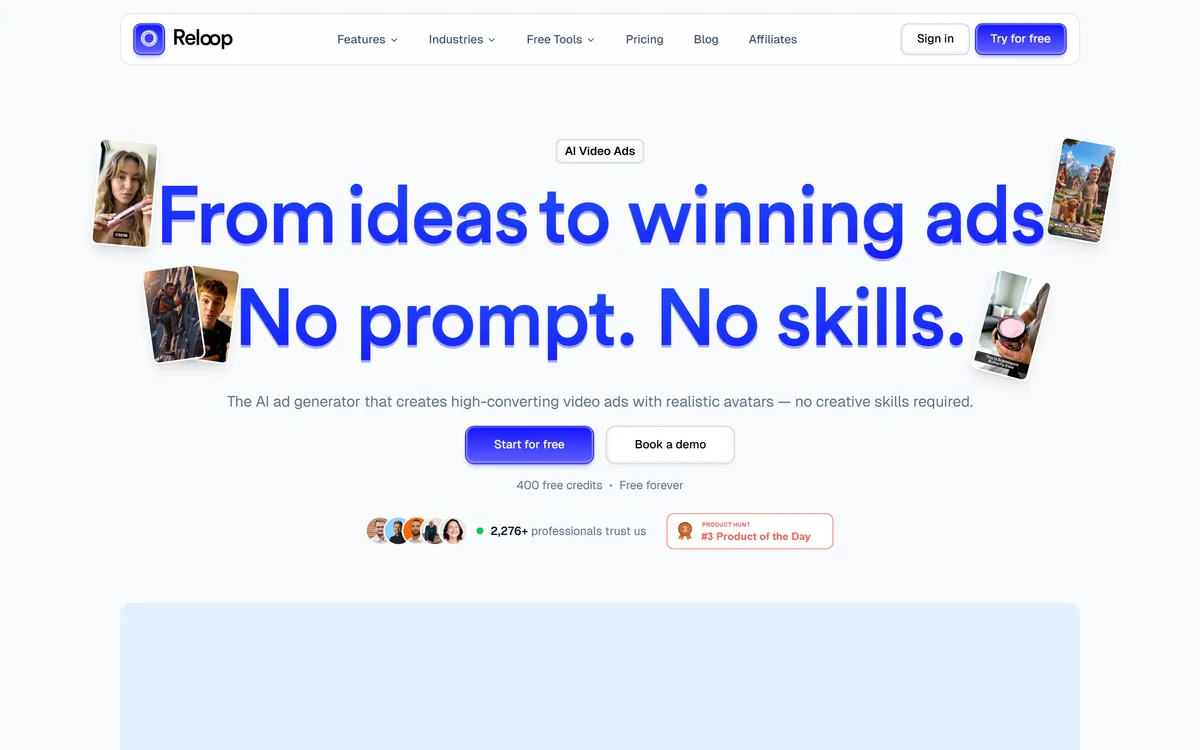
The headline is a promise about what you will not have to do: from ideas to winning ads, no prompt, no skills, with realistic avatars and no creative skills required.
The three problems it names are worth quoting because the middle one is unusually self-aware for this category.
Traditional ads are described as slow and expensive — finding creators, managing contracts, endless revisions. Finding winners is described as unpredictable, a matter of testing angles and hooks until something clicks.
And AI tools, the site says, require technical skills: prompting, iterating and troubleshooting, demanding expertise you should not need to have.
That is an accurate description of the last three years. Prompt engineering became a job title because generative tools shipped with a text box and no opinion about what you wanted, and marketers learned an interface skill that has nothing to do with marketing. Calling that a bug rather than a feature is the correct read.
Prompt engineering became a job title because generative tools shipped with a text box and no opinion. That is an interface failure, not a skill worth acquiring.
The unpredictability the site names — testing angles, hooks and concepts until something clicks — is not a solvable problem, and it is worth being precise about why volume is the only real answer.
Nobody can reliably predict which creative will perform. Experienced media buyers are better than novices at eliminating obvious failures, and considerably worse than they believe at picking winners. The distribution of ad performance is brutally uneven: most creatives do nothing and a small number carry everything.
The strategic consequence is that your hit rate matters far less than your number of attempts. A team testing forty concepts a month finds more winners than a team perfecting four, even if each of the four is better made.
That is the entire economic case for generated ad creative, and it is a strong one. It is also why the cost per attempt — credits, in this product's model — is the number that actually governs your strategy.
The limit is that volume without variation is worthless. Forty videos differing only in avatar are one test, not forty. The angle, the hook and the claim are what get tested, and those still come from someone who understands the customer. Platforms like AdCreative.ai attack the same problem from the static creative side.
The mechanism is described as a creative agent that gets your product, adapts the plan to your preferences, and produces the ad while you watch.
Inverting the interface changes who can do the work, which is a larger shift than it sounds.
With a prompt box, output quality tracks the user's skill at describing things. Two marketers with identical product knowledge get different results because one is better at writing instructions to a model, and that is an absurd basis for a creative process.
An agent that reads the product and proposes a plan moves the human's job back to where it belongs: judging a proposal rather than composing a specification. Reviewing is a skill marketers already have; prompting is one they had to acquire by accident.
The trade-off is control, and it is a real one. Prompt-free means the system decides the structure, and when its plan is wrong you have less vocabulary to correct it than a prompt would give you. The pixel-perfect editor exists as the escape hatch — fine-tune every frame, edit results down to the last detail — which is the right architecture: generate without friction, then correct precisely.
The library is large: over 700 avatars and more than 100 voices, in four stated styles — ultra-realistic, Pixar-like, manga and 3D clay — with auto captions in any language, styled and synced automatically.
Two of those deserve separate treatment, because they carry different questions.
Auto captions are the easy one, and the most valuable feature in the list for entirely practical reasons. Social video is watched with the sound off by default, so an uncaptioned ad communicates nothing to most of the people it reaches. Automatic styling and syncing removes a genuinely tedious job.
The avatars are the harder question. Seven hundred presented human faces with human names, delivering a scripted claim about a product to a stranger, raises a provenance question the pages we read do not address: whether these likenesses derive from performers who agreed to this use and are compensated for it.
We make no assertion about how this library was built. But it is a reasonable thing to ask a vendor directly before your brand stands behind a face, and the answer is worth having in writing. Voice cloning of yourself — the digital twin feature — sidesteps the question entirely, since the likeness is your own. The stylised options do too, because nobody mistakes a clay figure for a person. Tools like CreateUGC operate in the same space with the same considerations.
The agent framing extends beyond generation into the full suite: music, captions, transitions, an AI video editor, brand assets, and free tools including a script generator, an avatar library and an ad resizer.
The resizer is the least glamorous item there and the one that saves the most time in practice.
Every platform wants different dimensions, and an ad that performs in one aspect ratio needs remaking rather than cropping for another — text lands outside the frame, faces get cut, and the hook lands too late. Handling that automatically removes a job nobody has ever enjoyed.
Brand asset support is the other practical necessity, since generated ads that ignore your colours and logo are unusable regardless of quality.
One presentational note worth recording: the pricing page carries a countdown timer next to a discount. Countdown timers on subscription pricing generally reset, and a buyer should evaluate the price as it stands rather than as an expiring offer. The customer count on the page is stated as a specific figure, and the testimonials are attributed to named people with company roles, which is more than many competitors offer. Platforms like Pencil attach a predicted performance score before you spend anything running the creative.
The mistake with generated ad creative is producing forty videos that constitute one test.
This sequence produces variation that actually tells you something.
| Category | AI video advertisement generation |
|---|---|
| Interface | Prompt-free — a creative agent plans the ad from your product |
| Avatars | Stated as over 700 |
| Voices | Stated as over 100 |
| Styles | Ultra-realistic, Pixar-like, manga and 3D clay |
| Captions | Automatic subtitles in any language, styled and synced |
| Personalisation | Digital twin avatar and voice cloning of yourself |
| Editing | A frame-level editor described as pixel-perfect |
| Extras | Music, transitions, brand asset upload |
| Free tools | Script generator, avatar library and ad resizer |
| Onboarding | 400 free credits, described as free forever |
| Adoption | Stated as 2,276-plus professionals |
Prompt-free ad generation from your product
A creative agent that plans the ad
Over 700 avatars in four visual styles
Over 100 voices
Voice cloning and digital twin avatars
Automatic captions in any language
Frame-level video editor
Free script generator, avatar library and ad resizer
Ad creative tools differ by format and by how much you have to specify.
| Tool | Produces | Input needed | Best for |
|---|---|---|---|
| Reloop | Video ads with avatars | Your product, no prompt | Volume testing without a studio |
| AdCreative.ai | Static and display creative | Brand and assets | Performance display advertising |
| CreateUGC | UGC-style video | Script or brief | Ads that read as organic |
| Pencil | Ads with predicted performance | Brand and past results | Teams wanting a forecast first |
| A creator or studio | Filmed footage | A brief and a budget | Brand work where a real person matters |
Other ways to produce advertising creative at volume.
Last checked . Read from reloop.so in a browser session on the date above, with the screenshot captured at the same time.
What we could not confirm: where the 700 avatar likenesses originate, or on what basis they are licensed, which the pages we read do not address; how the creative agent constructs an ad plan; how the 2,276 figure is counted; whether the discount countdown on the pricing page resets; and pricing. We did not generate an ad or create a digital twin.
Reloop's insight is that prompting was always an accidental interface, not a feature — a performance marketer needs twenty ad variants by Thursday, not a skill in describing what they want to a model. Removing that step is genuinely useful, and the volume argument behind it is sound: creative testing is a numbers game and the cost per attempt is what determines how many angles you can try. What the site does not address is where 700 avatar likenesses come from, which is the question anyone putting a synthetic face in front of customers should ask before they do. AInexfinder Editor Score: 3.7/5.
AInexfinder does not list plan prices or billing details. For current pricing, plans, and trials, visit the official Reloop website.
Visit official website for pricingVendor pricing, credits, and billing policies change over time. Always confirm on the official site before you buy.
Log in to write a review.
No reviews yet. Be the first to share your experience with Reloop.
Assigned reviewer
Daniel ReedSenior AI Tools Reviewer
Daniel reviews AI tools the slow way — by actually using them on real projects. His reviews cover what works, what breaks, and who each tool is genuinely a good fit for.
Daniel and the AInexfinder editorial team research Reloop using public product information, listing evidence, and (when available) hands-on checks. Scores reflect listing completeness and transparency — not paid placement.
Runway is an AI video platform built around generative world models — Gen-4.5, Aleph 2.0, and Act-Two for performance capture — split across Runway Creative for filmmakers, Runway Dev for builders, and Runway Robotics.
LipSync.video generates lip-synchronised video from a face and an audio track. It offers two model tiers, accepts uploaded video, uploaded or recorded audio, or a typed script with generated speech, and provides over 300 prebuilt avatars. Credits can be earned through daily actions as well as bought.
Viggle animates characters from a still image driven by motion from a video, built on its Joint Space-Time model — described as a physics-native world model that generates characters, motion and scenes together in shared 4D space. It offers a Meme Maker, the PINOC motion-capture tool, games and an API, and states 50 million users.
BeatViz.ai turns music into video through three tools — Chat, Workflow and Editor. Chat 2.0 is positioned as an AI music video director, and the site names the models it draws on, including Veo, Sora, Kling, Seedance, Nano Banana and GPT Image 2.
Argil is an AI video platform built around three surfaces: a Playground for generating images and video model by model, a Director that takes an idea to a finished video, and Templates that turn a repeated video format into a reusable recipe with variables.

The workspace at www-flux3.com generates 5–20 second AI videos with native audio from text or a starting image, routing across FLUX 3, MiniMax H3, Seedance, Wan 3.0 and Kling 3.0 Pro, at 720p or 1080p with video extension.