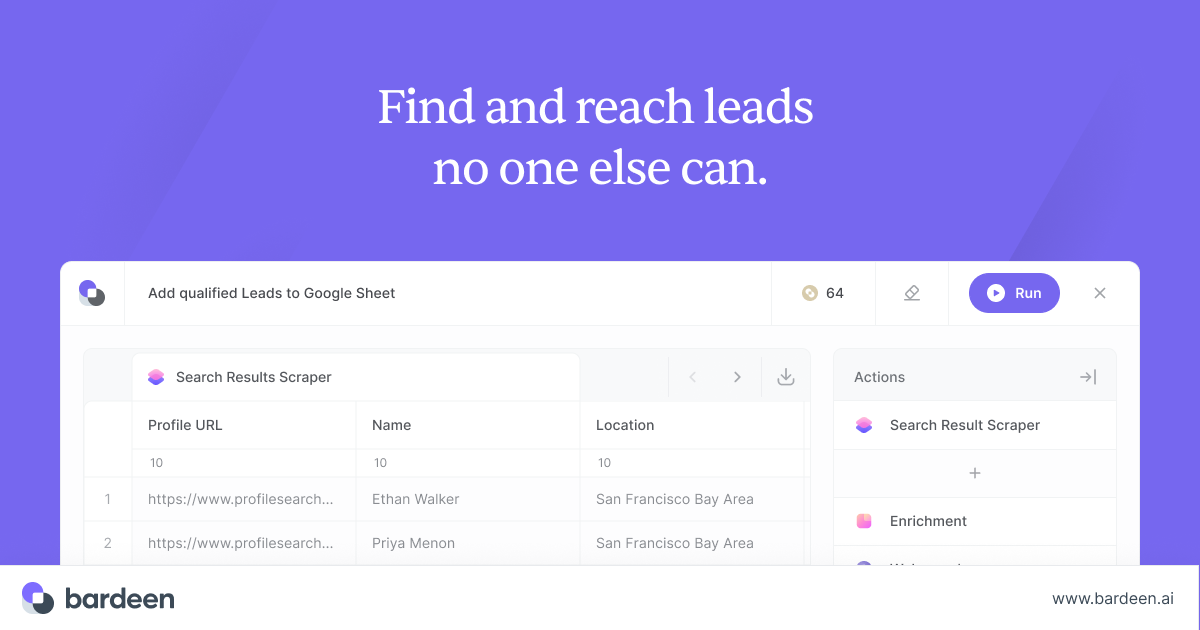
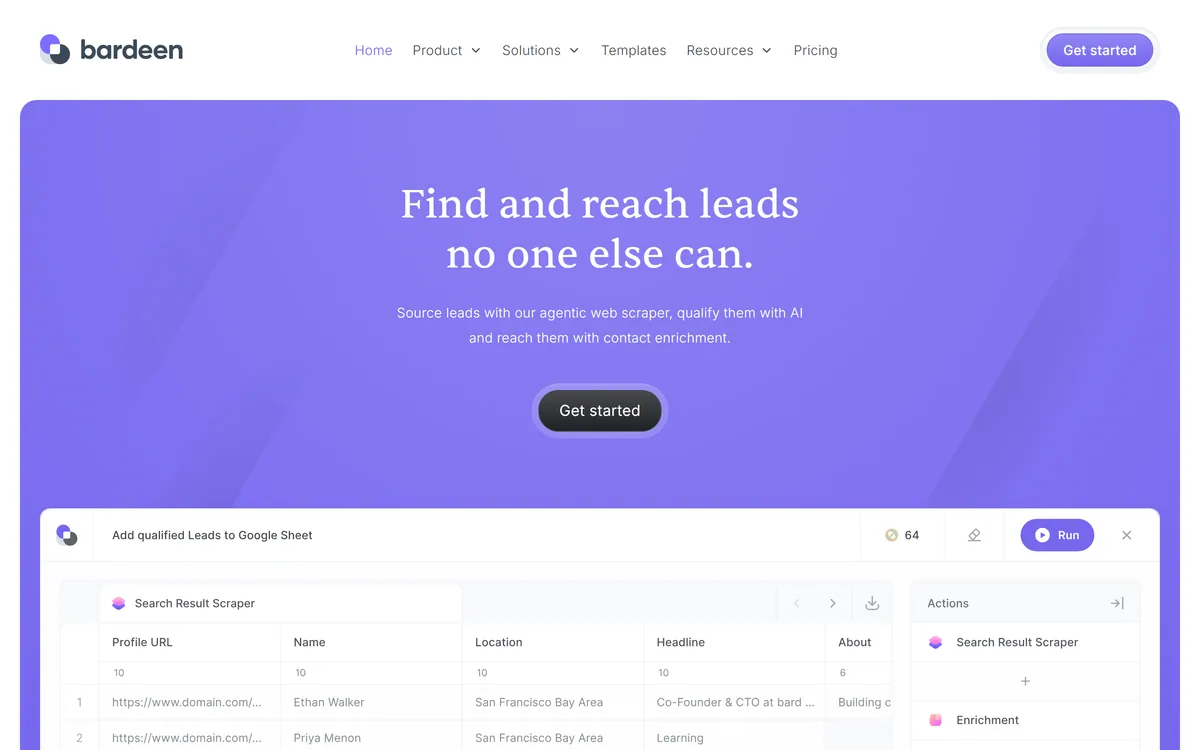
Bardeen is a browser-based web automation platform aimed at sales teams: it extracts data from any website, researches leads with AI search, finds validated contact details, qualifies them against a described ideal profile, and pushes the result to Sheets, Airtable, Notion or a CRM.
Prospecting has always been four jobs pretending to be one. Find the companies. Find the people at them. Find a way to contact those people. Work out which of them are worth contacting at all.
Most teams solve these with four subscriptions — a scraper, an enricher such as Clay, a sender, a CRM — and a spreadsheet holding them together, and the spreadsheet is where the process actually breaks — stale, half-enriched, and owned by whoever built it.
Bardeen's proposition is to run all four in one place, starting from the browser you already have open. That is genuinely useful, and it carries an obligation the marketing does not linger on: automating web scraping and contact enrichment at scale makes you responsible for both. This review covers what it does, what it costs, and where that responsibility bites.
What Does Bardeen Automate?
It scrapes any website — you build a scraper or use a prebuilt template, and it extracts structured data from pages as you browse.
AI research and enrichment run on top: it researches leads with AI search and finds validated phone numbers and email addresses.
Qualification is the differentiator — you describe your ideal lead profile in plain language and it scores what it found against that.
Bardeen Studio is a no-code builder, so a salesperson can chain scraping, enrichment and export without engineering help.
Compliance is unusually strong for this category: SOC 2 Type II, GDPR, and CASA Tier 2 and 3 certified.
Bardeen's homepage, captured 9 September 2026. The positioning has narrowed to sales prospecting from what was once general browser automation.
Scraping The Web Is The Engine
Everything Bardeen does starts with extraction. It runs as a browser extension, so it can read pages you can read — including pages behind a login you are entitled to use, which is what separates it from a server-side scraper hitting a site anonymously.
You either build a custom scraper against a page's structure or use one of the premium templates for common sources. The extension approach is the reason a non-technical user can build one: you are pointing at things on a page you are already looking at, rather than writing selectors against HTML you have never seen.
Extracted data lands in CSV, Google Sheets, Airtable or Notion, or onward into HubSpot AI, with broader integrations into CRMs, communication platforms and project tools.
The practical limitation of browser-based scraping is throughput and fragility. It runs at the speed of a browser rather than a server farm, and a site redesign breaks a scraper built against the old layout. Both are acceptable trades for the accessibility you get, but they mean this is a tool for hundreds or thousands of records rather than millions, and one that needs occasional maintenance.
A scraper you can build by pointing at a page is a different product from one you write selectors for. The accessibility is the whole proposition.
Qualification Is Where The AI Earns Its Place
Bardeen lets you describe an ideal lead profile and then qualifies scraped leads against it. This is the step where a language model is genuinely the right tool rather than a fashionable one.
Unlike an outbound platform such as Artisan, filtering on structured fields — company size, industry code, location — has been possible forever and does not need AI. What was never possible was filtering on judgement: whether a company's own description of itself suggests they have the problem you solve, whether a job title implies the authority to buy, whether a recent announcement makes now the right moment.
Those are readable from text and not from a database field, which is exactly what a language model is good at.
The caution is that qualification is a judgement, and a confident wrong judgement wastes the most expensive resource in the process — a salesperson's attention. Sample the output before trusting it: take fifty qualified leads, review them by hand, and count how many you would actually have picked. That hit rate tells you how much to trust the score, and it is the only number that matters.
Is Automated Lead Research Legal?
This deserves a direct answer rather than a disclaimer, because a tool that makes scraping and enrichment effortless does not make them consequence-free, and the responsibility sits with the operator rather than the vendor.
Three separate questions are involved and they have different answers. Whether you may scrape a site is governed by its terms of service and, in some jurisdictions, by computer access law. Whether you may hold someone's business contact details is data protection law. Whether you may email or call them is marketing law, which differs sharply by country.
Under GDPR, business contact data is personal data. Legitimate interest can be a valid basis for B2B outreach, but it requires a documented assessment, a genuine relevance to the recipient's role, and an easy way to opt out — and it does not survive indiscriminate volume. In several jurisdictions unsolicited commercial email to individuals requires prior consent regardless of how the address was obtained.
Bardeen's own compliance posture is genuinely good: SOC 2 Type II, GDPR and CASA Tier 2 and 3 certification says the platform handles data properly. That is a statement about the tool, not about your campaign.
The practical guidance is short. Check the terms of any site you scrape at volume. Keep a record of where each contact came from, because a data subject can ask. Honour opt-outs immediately and permanently. And take advice before running high-volume outreach into the EU or the UK, where the rules are strictest and enforcement is real.
Read the terms of service of any site you scrape systematically, not just occasionally.
Record the source of every contact record — provenance is the first thing a regulator or a recipient asks about.
Treat business contact details as personal data under GDPR, because they are.
Make opting out trivial, and process it permanently across every list you hold.
Get advice before high-volume outreach into the EU or UK; consent rules there are stricter than most US-built playbooks assume.
Where Credits Actually Go
Bardeen runs on credits, and the practical difficulty is that different actions consume very different amounts, which makes a monthly figure hard to predict before you have used it.
The rough hierarchy is worth internalising. Scraping a page is cheap. Running an AI research step against a lead is more expensive, because it involves a model call and often a web search. Contact enrichment — finding and validating a phone number or email — is usually the most expensive step, because the vendor is buying or verifying that data from somewhere.
So a workflow that scrapes a thousand companies costs far less than one that scrapes a thousand companies, researches each one and finds two contacts at each. The number of records is not what drives the bill; the number of enrichment steps per record is.
The way to control this is to filter before enriching rather than after. Scrape broadly, qualify on the cheap text you already have, and only spend enrichment credits on the leads that survived. Teams that enrich first and qualify second routinely spend several times more for the same outcome.
We do not publish amounts, since credit rates change. Run one realistic workflow end to end, note the credits consumed, and multiply by your actual monthly prospecting volume — that figure, not the tier label, is what this costs you.
A Test That Tells You Whether It Fits
Automation tools demo beautifully on a clean target site and struggle on the messy one you actually need. Test on yours.
The bar is step four. A qualification hit rate you would not accept from a junior researcher is not one you should feed to a sales team.
Pick the site you genuinely prospect from, not the one in the demo. Template coverage is only useful if it covers your source.
Build one scraper against fifty real records and check the extracted fields by hand. Field-level errors compound through every later step.
Write your ideal customer profile as you would explain it to a new hire, then run qualification against those fifty.
Review all fifty yourself and count how many you would actually have chosen. That hit rate is the whole product; below about seven in ten it is costing you attention rather than saving it.
Now enrich only the qualified subset, and note the credits that consumed versus enriching all fifty. The difference is your monthly saving from filtering first.
Export to the destination you really use and confirm the fields map cleanly, since a broken CRM import undoes the entire workflow.
Buying Bardeen: The Credit Question
Access is a credit-based subscription with tiers, and the credits are the meter that matters rather than seats or automation count.
That structure suits uneven usage, which prospecting genuinely is — a heavy month building a new list and a light one working it. It penalises teams who cannot predict their volume, because the tier has to be chosen before the pattern is known.
The named customer list is a reasonable signal here: Deel, Kearney, JotForm and others are recognisable companies, and vendors do not usually name customers who would object to being named.
Two things to establish before committing. Whether unused credits roll over, since prospecting is bursty and a use-it-or-lose-it month is real waste. And whether enrichment credits are drawn from the same pool as automation credits, because if they are, a single enrichment-heavy campaign can consume a month's allowance.
We do not publish amounts. Model your cost on one real workflow rather than on the tier description.
Key features of Bardeen
Custom web scrapers built against any site, plus premium templates for common sources
AI research across leading AI and web search providers
Contact enrichment returning validated phone numbers and email addresses
AI qualification scoring leads against a plain-language ideal customer profile
Bardeen Studio no-code workflow builder for chaining steps
Export to CSV, Google Sheets, Airtable and Notion
Integrations across CRMs, communication platforms and project management tools
Runs as a browser extension, so it can read pages you are entitled to view
Pros & cons
Pros
6
Joins four normally separate steps — scrape, research, enrich, qualify — in one place
Browser extension means a non-technical salesperson can build a scraper by pointing at a page
Plain-language qualification filters on judgement, which structured database filters cannot do
Compliance posture is genuinely strong for the category: SOC 2 Type II, GDPR and CASA Tier 2 and 3
Exports to the destinations data actually needs to reach, rather than trapping it
Named, recognisable customers rather than unattributed logos
Cons
6
Credit pricing makes monthly cost hard to predict, since actions consume very different amounts
Browser-based extraction limits throughput and breaks when a source site is redesigned
No credit-per-action table is published, so you cannot model spend before using it
The sources behind contact enrichment are not named, which matters for data provenance
Effortless scraping and enrichment put real legal responsibility on the operator, which the marketing does not dwell on
A confident but wrong qualification wastes a salesperson's attention, the most expensive input in the process
Best For
Sales teams prospecting from websites rather than purchased databases
Non-technical operators who need scrapers without engineering help
Qualification criteria that depend on reading text rather than filtering fields
Teams that need data landing in Sheets, Airtable, Notion or a CRM
Automation tools differ on where they run and what they are for. A browser extension, a workflow engine and an outbound platform solve genuinely different problems.
Your prospecting sources are websites rather than a database you can query or buy.
The people doing the prospecting are not engineers and will not write scrapers by hand.
Your qualification criteria are judgements about text — what a company says about itself — rather than structured filters.
You need data landing in Sheets, Airtable, Notion or a CRM rather than sitting in another tool.
Your procurement asks for compliance certification, which this platform actually carries.
It does not fit when
You need millions of records; browser-based extraction is not built for that throughput.
Your data already exists in a purchasable database, where a data provider is cheaper and cleaner.
You cannot predict your monthly volume, which makes credit-based tiers uncomfortable.
Your outreach targets EU or UK individuals at volume without a documented lawful basis and an opt-out process.
You want the sending and sequencing too — that is an outbound platform, not an extraction tool.
What We Confirmed On Bardeen
Last checked . Read from bardeen.ai, including the footer, with the screenshot above captured in the same session.
Product described as web automation for finding and reaching leads, built around scraping, research, enrichment and qualification
Web scraping confirmed as extracting data from any website, with custom scrapers and premium templates
AI research described as researching leads using leading AI and web search providers
Contact enrichment described as finding validated phone numbers and email addresses
AI qualification described as scoring leads against an ideal lead profile you describe
Bardeen Studio confirmed as a no-code workflow builder
Export destinations confirmed as CSV, Google Sheets, Airtable and Notion, with wider CRM, communication, project and customer success integrations
Compliance stated on the site as SOC 2 Type II, GDPR and CASA Tier 2 and Tier 3 certified
Named customers listed on the site including Deel, Kearney, Casafari, JotForm, EasyDMARC and Humane
Pricing confirmed as credit-based, with amounts not disclosed on the page we read
Footer read directly and confirmed to carry Product, Solutions, About, Resources, Support and Scraper Templates sections
What we could not confirm: no credit-per-action table is published, so cost cannot be estimated before use, and whether enrichment and automation draw from the same credit pool is not stated; no stated user numbers or accuracy figures for enrichment data appear on the page we read; the sources behind contact enrichment are not named, which matters for data provenance under GDPR; and we did not run the product, so nothing here reflects measured qualification accuracy.
Other Prospecting And Automation Tools
Compare on where the tool runs and which step of the funnel it owns.
Clay — the closest comparison on enrichment depth, with a spreadsheet-style interface
Artisan — runs the full outbound motion including sending, which Bardeen does not
Zapier AI — better for connecting applications that already expose APIs
HubSpot AI — where the leads land and the pipeline is actually worked
Aviso — forecasting on top of the pipeline these leads eventually fill
Editor's Verdict
4.0/5
Bardeen scores well because it joins four steps that are normally four separate tools — scrape, research, enrich, qualify — inside a browser extension a salesperson can actually operate, and it exports to the places that data needs to land. SOC 2 Type II, GDPR and CASA Tier 2 and 3 certification is a stronger compliance posture than most automation tools in this space carry. It loses ground because credit-based pricing makes real monthly cost genuinely hard to predict before use, and because a tool that makes large-scale scraping and contact enrichment effortless puts the legal responsibility for both squarely on the user, which the marketing does not dwell on. AInexfinder Editor Score: 4.0/5.
Bardeen pricing
AInexfinder does not list plan prices or billing details. For current pricing, plans, and trials, visit the official Bardeen website.
Vendor pricing, credits, and billing policies change over time. Always confirm on the official site before you buy.
Frequently asked questions
What does Bardeen do?
Bardeen is a browser-based automation platform for sales prospecting. It scrapes data from any website, researches leads using AI search, finds validated phone numbers and email addresses, qualifies those leads against an ideal customer profile you describe in plain language, and exports the result to Google Sheets, Airtable, Notion, CSV or a CRM.
Do I need to code to use Bardeen?
No. Bardeen Studio is a no-code builder, and because the tool runs as a browser extension you build a scraper by pointing at elements on a page you are already looking at rather than writing selectors against HTML. That accessibility is the core of the product — it is why a salesperson can operate it without engineering help.
Is Bardeen free?
It is a credit-based subscription and amounts are not published on the page we read. The complication is that actions consume very different amounts: scraping a page is cheap, AI research costs more, and contact enrichment is usually the most expensive step. Run one realistic workflow, note the credits used, and multiply by your real monthly volume.
Is it legal to scrape websites with Bardeen?
It depends on three separate things: the terms of service of the site you are scraping, data protection law covering the contact details you hold, and marketing law covering whether you may then contact those people. Bardeen's own compliance posture is strong, but that describes the platform, not your campaign. Check site terms, record where each contact came from, and take advice before high-volume outreach into the EU or UK.
How accurate is Bardeen's lead qualification?
No accuracy figure is published, and the honest test is your own. Take fifty qualified leads, review them by hand, and count how many you would actually have chosen. Below roughly seven in ten, the tool is costing your team attention rather than saving it — and a salesperson's attention is the most expensive input in the whole process.
How do I stop Bardeen burning through credits?
Filter before you enrich, not after. Scrape broadly, run qualification on the cheap text you already have, and spend enrichment credits only on the leads that survived. Teams that enrich everything first and qualify second routinely spend several times more for the same result, because enrichment is the most expensive step per record.
Is Bardeen GDPR compliant?
The site states SOC 2 Type II, GDPR and CASA Tier 2 and Tier 3 certification, which is a strong posture for this category. Note carefully what that covers: it says the platform handles data properly, not that your outreach is lawful. Business contact details are personal data under GDPR, so you still need a documented lawful basis, source records, and a working opt-out.
What is the difference between Bardeen and Zapier?
Zapier connects applications that already expose APIs; Bardeen reads web pages that do not. If your data lives in SaaS tools with integrations, Zapier is the better fit. If it lives on websites — directories, company pages, listings — Bardeen's browser extension can extract it where an API-based tool simply cannot reach.
Can Bardeen handle large-scale scraping?
Not at the scale a server-side scraper can. It runs in your browser, which means it works at browser speed and is well suited to hundreds or thousands of records rather than millions. It also means a scraper built against a site's layout will break when that site is redesigned, so expect occasional maintenance.
Where does Bardeen's contact data come from?
The sources behind its contact enrichment are not named on the page we read. That matters more than it might appear: under GDPR a person can ask where you obtained their details, and you need an answer. Ask the vendor directly for enrichment data provenance before running enrichment at volume in a regulated market.
Daniel reviews AI tools the slow way — by actually using them on real projects. His reviews cover what works, what breaks, and who each tool is genuinely a good fit for.
Daniel and the AInexfinder editorial team research Bardeen using public product information, listing evidence, and (when available) hands-on checks. Scores reflect listing completeness and transparency — not paid placement.
Listings may include affiliate or sponsored placements, which are labeled when present. Editorial scores and cons are not sold. See our affiliate disclosure and review methodology.
CrewAI is an enterprise platform to build and run AI agents: a Discovery layer that finds automation opportunities, a no-code canvas and code-first Python API for building role-based multi-agent workflows, and a control plane that adds tracing, RBAC, audit and human-in-the-loop approvals.
Kuse is an AI workspace from Kuse Inc. built around scheduled workflows: describe a recurring task in plain language, connect the apps it touches, and let it run. It also generates websites, documents, presentations and spreadsheets, with several model families available.
Axiom is a browser-automation and web-scraping platform you can build no-code in a Chrome extension, script in your IDE, or drive agentically through Claude and MCP, running on cloud browsers or your own machine for scrapers, form-fillers, monitors and scheduled workflows.
Formless by Typeform is a conversational AI form builder. Trained on your own data, it asks questions in natural language and answers the respondent's questions back, adapts its path without branching logic, and supports over 120 languages.
Browser Use is an open-source project (117k GitHub stars, MIT) offering AI agents that complete web tasks and a simple remote browser infrastructure for your own agents, benchmark-led, pay-as-you-go, with MCP, form-filling and login automation, usable in the cloud or self-hosted.
Zapier's AI layer adds agents and MCP tool access on top of its automation platform, connecting more than 9,000 apps with governed access so teams can mix AI decisions with deterministic rules under central oversight.