Phrasly is a suite of eight writing tools built around an AI humanizer and detector, with a document editor, content and thesis generators, a translator and a citations generator. Its page title describes it as an AI detection remover and stealth writer, and it also publishes an ethics page.
phrasly.ai7 viewsAdded September 6, 202571K visitors
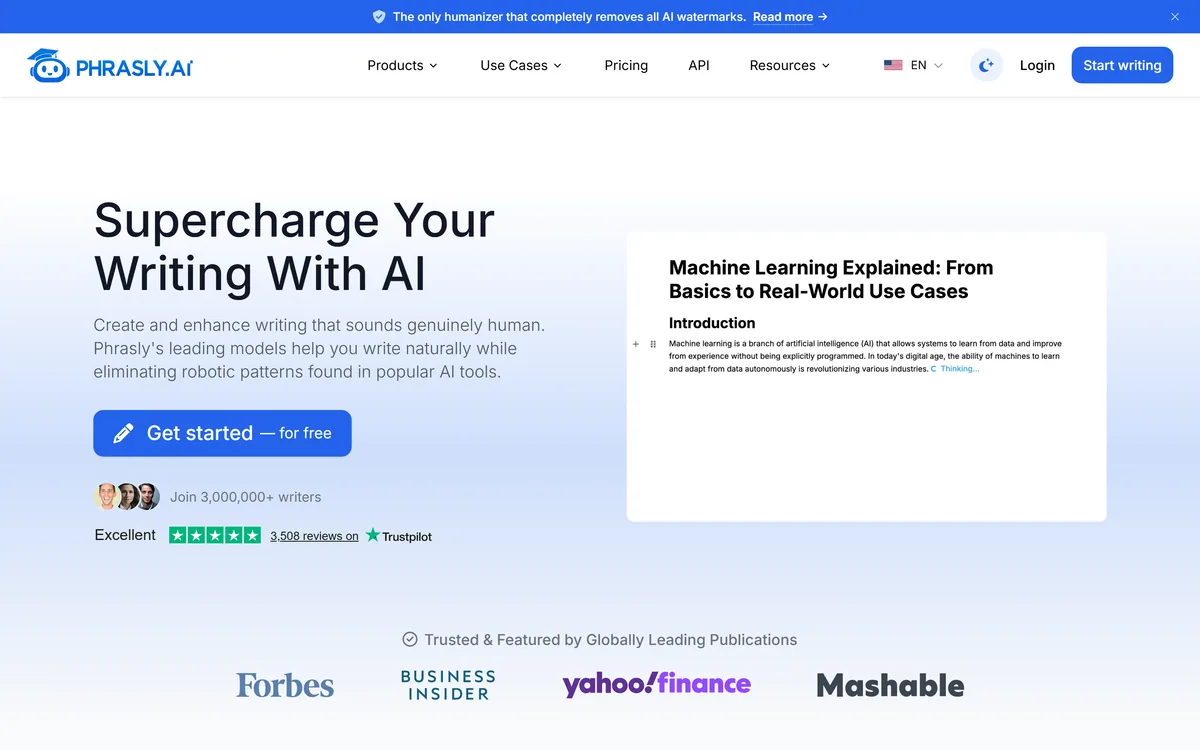
Phrasly's homepage, captured 9 September 2026.
Phrasly: Another Detector And Humanizer
Eight tools around a humanizer and detector, plus a document editor, thesis generator, translator and citation generator.
Its own page title describes it as an AI detection remover and stealth writer.
A banner claims complete removal of all AI watermarks — an absolute no tool can deliver.
Two detection platforms named directly in the FAQ as things content will score well on.
A Human Auto Typer listed in the footer, alongside a published ethics page.
Why Is Detector Evasion Impossible To Promise?
A banner across the top of the site states that this is the only humanizer that completely removes all AI watermarks, and the page title describes the product as an AI detection remover and stealth writer.
That is stated more absolutely than anything in this category can support, and the reason is structural rather than a limitation of any particular product.
Detection is performed by systems the vendor does not control, running models nobody can inspect, updated on schedules nobody publishes. Text that scores as human today can score differently next month because the detector changed rather than the text.
Watermarking is a separate and more specific claim. Some model providers embed statistical signals in output; most do not; the schemes differ; and none publishes its method in enough detail for a third party to verify removal. Completely removing all of them is not a testable statement.
This applies equally to every product in the category, including Humalingo and Rephrasy. What distinguishes this listing is not the mechanism but the absoluteness of the marketing around it.
Detection runs on systems the vendor does not control, updated on a schedule nobody publishes. There is no fixed target to remove yourself from.
A Tool That Types For You
Among the products listed in the footer, alongside the humanizer and the flashcard maker, sits a Human Auto Typer.
It is worth explaining what such a tool does, because its purpose is narrower than the name suggests.
Document platforms retain version history. A file that appears complete in one revision, with no drafting, no rewriting and no pauses, looks different from one written over hours — and educators increasingly use exactly that history to check authorship when a submission is queried.
A tool that types text out gradually produces a version history resembling composition. Its function is to make text that was pasted appear to have been written.
There is no legitimate second use for that. Every other tool in this suite has an honest application for someone editing their own work; this one exists solely to defeat a check on who wrote something, and its presence in the product list is the single most informative thing on the page.
The Academic Line, Stated Plainly
The FAQ states that refined content scores well on two named detection platforms, adding that this is not because it is designed to trick them but because quality writing naturally resembles human writing. A separate ethics section states that the tool should never be used for unethical practices and that users should follow their institution's policies.
Both statements are on the same page as a title advertising detection removal, and readers deserve a plain account of where the line actually falls.
Submitting work generated by a model as your own — rewritten or not — misrepresents authorship. That breaches academic integrity policy at essentially every institution, and rewriting is what those policies exist to address rather than a route through them.
The consequences are also asymmetric. A student carries the academic penalty; no vendor is party to that hearing, and a subscription receipt is not a defence.
None of this is a claim about the company, which sells text tools. It is a statement about what the described use involves, and anyone reading the page title as a promise should understand what they would be agreeing to.
Never submit generated writing as your own, rewritten or otherwise.
Keep draft history — that is what evidences authorship.
Read any complete-removal claim as unverifiable.
Check your institution's stated policy directly.
Use the citation and translation tools, which raise none of this.
Legitimate Editing Versus Misrepresented Work
It would be inaccurate to present this suite as having no valid use, because most of the eight tools do.
A translator is a translator. A citations generator formats references, which is clerical work nobody should be doing by hand. A word counter counts words. None of those touches authorship at all.
Editing your own writing is the substantive legitimate case. A second-language writer with the expertise and the ideas but stiff English prose is not misrepresenting anything by improving the sentences, and one of the displayed testimonials — a marketing team smoothing blog posts — describes ordinary editorial work.
The tell is what started the process. If the argument, the structure and the claims are yours and the tool adjusted the phrasing, that is editing. If a model produced the thinking and the tool adjusted how it reads, it is not, and no feature setting changes which one you did.
One displayed testimonial describes generating example papers to base your own writing on, which sits on the line. Reading a model's version to see how a paper is structured is study; keeping its sentences is not.
Reading The Scale And Training Claims
The site states more than three million writers, 180-plus countries, 300-plus institutions using Phrasly, a 4.7 out of 5 rating and models trained on 500,000-plus real human articles.
Two of those need care.
Institutions using Phrasly is ambiguous in a way that matters here. It could describe institutional licences, or it could describe students at those institutions having accounts — and those are opposite facts. A university that has licensed a rewriting tool and a university whose students use one are very different situations.
The training claim — proprietary models trained exclusively on authentic human data rather than synthetic content — is presented as a quality differentiator and raises its own question, since 500,000 human articles were written by people who did not obviously consent to this use. The site does not say where they came from.
The 4.7 rating names no platform and no review count, which makes it uncheckable. The three million figure counts accounts rather than users, as such figures always do. A tool that marks problems without rewriting them, like Hemingway Editor, sits at the opposite end of this category.
Making Generated Text Genuinely Your Own
If you use a model to draft and want the result to be honestly yours, the work is substantive rather than cosmetic.
This sequence is about authorship rather than about scores.
Write the argument in your own words first, however roughly.
Use a model for structure or phrasing, never for the claims.
Replace every generality with something specific you actually know.
Read it aloud and cut any sentence you could not defend.
Keep the draft history — it is the only real evidence of authorship.
For anything graded or supervised, follow the stated policy exactly.
Phrasly: Tools And Positioning
Company
Phrasly, LLC, per the footer
Page title
Describes the product as an AI detection remover and stealth writer
Banner claim
States it is the only humanizer that completely removes all AI watermarks
Eight named tools
Humanizer, detector, content generator, thesis generator, translator, document editor, citations generator and a plagiarism checker listed as coming soon
Document editor
Phrasly Pages, combining generation and editing
Other listed tools
A flashcard maker, a Human Auto Typer, chat with PDF and an MCP server
Training claim
Proprietary models stated as trained on 500,000-plus real human articles
Detection platforms named
Two are named in the FAQ as platforms content scores well on
Claimed scale
Three million-plus writers, 180-plus countries and 300-plus institutions
Displayed rating
4.7 out of 5, with no platform or review count given
Ethics
A published ethics page and an on-page integrity statement
Privacy claim
States content is not stored or shared and each session is private
Key features of Phrasly
AI humanizer and paraphraser
AI detector with area-level feedback
Content generator with citation support
Thesis statement generator
Translator
Document editor combining the tools
Citations generator
An MCP server and a business API
Pros & cons
Pros
7
Several tools — translator, citations, word counter — raise no authorship question at all
A published ethics page and an on-page integrity statement exist
The detector gives area-level feedback rather than a bare percentage
Citation generation is clerical work worth automating
Genuine value for second-language writers editing their own prose
States that content is not stored or shared
An MCP server makes the tools reachable from other clients
Cons
7
The page title itself markets detection removal and stealth writing
Claims to completely remove all AI watermarks, which is not verifiable
Names two detection platforms directly as things content scores well on
Ships a Human Auto Typer, whose only function is to make pasted text look typed
The ethics statement sits alongside all of the above
Institutions using Phrasly is ambiguous between licences and student accounts
The source of 500,000 human training articles is not disclosed
Best For
Second-language writers polishing prose they wrote
Marketing teams smoothing commercial copy nobody grades
Anyone needing a translator or citation formatter
Writers curious why their drafts read as formulaic
Users who will keep authorship on their own side of the line
Phrasly Against Other Rewriting Tools
Writing tools differ most in what they assume about whose words these are.
Linguix — correction and consistency without the framing
MathGPT — a study tool that warns you to check its work
Should You Rely On A Humanizer?
Edit your own words when
The argument and the claims started as yours.
You write in a second language and the prose reads stiffly.
You need the translator or the citation generator, which raise none of this.
You are smoothing commercial copy nobody grades.
You want to understand why your writing reads as formulaic.
Write it properly when
The work is graded, supervised or submitted under your name.
You did not write the argument being rewritten.
Your institution has a stated policy on AI assistance.
You would use a typing simulator to disguise how text was produced.
A score matters to you more than whether the writing is honest.
Phrasly: Read On The Landing Page
Last checked . Read from phrasly.ai in a browser session on the date above, including the full footer and FAQ. The screenshot was captured at the same time.
Page title describes the product as an AI detection remover and stealth writer
A banner states it is the only humanizer that completely removes all AI watermarks
Eight tools displayed, including a humanizer, detector, thesis generator and citations generator
A plagiarism checker listed as coming soon
Phrasly Pages described as combining content generation and document editing
Models stated as proprietary and trained on 500,000-plus real human articles
The FAQ names two detection platforms as ones refined content scores well on
The FAQ states this is not because the tool is designed to trick them
An ethics statement on the page says the tool should never be used for unethical practices
Claimed scale of three million-plus writers, 180-plus countries and 300-plus institutions
The footer lists additional tools including a flashcard maker, a Human Auto Typer, chat with PDF and an MCP server
Footer confirms Phrasly, LLC, with terms of service, privacy policy, cookie policy and a separate ethics page
What we could not confirm: the basis for the claim that all AI watermarks are completely removed, which is not a testable statement given that watermarking schemes are undisclosed and not universally used; whether 300-plus institutions means institutional licences or students holding accounts, which are opposite facts; where the 500,000 human articles used for training came from; which platform the 4.7 rating is from and over how many reviews; and pricing, which we did not reproduce. We did not submit text to the tool.
Editor's Verdict
2.2/5
The writing tools here are competent and the platform is broad — eight of them, plus a document editor and a citations generator. We score it lowest in the programme for what it sells itself as. Its own page title describes it as an AI detection remover and a stealth writer, a banner claims to completely remove all AI watermarks, the FAQ names two detection platforms directly, and the footer lists a Human Auto Typer. An ethics page sits alongside all of that. Submitting generated work as your own misrepresents authorship whatever a tool is called. AInexfinder Editor Score: 2.2/5.
Phrasly pricing
AInexfinder does not list plan prices or billing details. For current pricing, plans, and trials, visit the official Phrasly website.
Vendor pricing, credits, and billing policies change over time. Always confirm on the official site before you buy.
Frequently asked questions
What is Phrasly?
A suite of eight writing tools built around an AI humanizer and detector, with a document editor, content and thesis generators, a translator and a citations generator. Its page title describes it as an AI detection remover and stealth writer.
Can it really remove all AI watermarks?
That is not a testable claim. Watermarking schemes are undisclosed, most model providers do not use one, and none publishes enough detail for a third party to verify removal. Completely removing all of them cannot be demonstrated.
Can any tool guarantee passing detection?
No. Detection runs on systems the vendor does not control, updated on schedules nobody publishes. Text scoring as human today can score differently next month because the detector changed rather than the text.
What is a Human Auto Typer?
A tool that types text out gradually so a document's version history resembles composition rather than a single paste. Its function is to make text that was pasted appear to have been written, and there is no second use for it.
Is it acceptable to use for coursework?
Submitting generated writing as your own — rewritten or not — misrepresents authorship and breaches academic integrity policy at essentially every institution. Rewriting is what those policies exist to address, not a route through them.
The site has an ethics page. What should I make of that?
It states the tool should never be used for unethical practices and that users should follow institutional policies. It sits on the same site as a title advertising detection removal and a banner about watermarks, and readers can weigh those together.
Which of its tools are unproblematic?
The translator, the citations generator and the word counter touch authorship not at all. Editing prose you wrote yourself is ordinary editorial work. The line is whether the thinking was yours before the tool got involved.
What if my own writing gets flagged?
It happens, disproportionately to second-language writers whose formal register came from textbooks. The defensible response is documentation — drafts, notes, version history — because a draft history evidences authorship and a rewriting log does not.
What does 300-plus institutions mean?
The site does not say, and the two readings are opposite. Institutional licences and students at those institutions holding accounts describe very different situations, and only one of them is an endorsement.
What should I use instead for graded work?
Your own words with a draft history. Write the argument roughly first, use a model for structure rather than claims, replace generalities with specifics you know, and follow whatever policy your institution has published.
Daniel reviews AI tools the slow way — by actually using them on real projects. His reviews cover what works, what breaks, and who each tool is genuinely a good fit for.
Daniel and the AInexfinder editorial team research Phrasly using public product information, listing evidence, and (when available) hands-on checks. Scores reflect listing completeness and transparency — not paid placement.
Listings may include affiliate or sponsored placements, which are labeled when present. Editorial scores and cons are not sold. See our affiliate disclosure and review methodology.
Undetectable AI rewrites AI-generated text so it reads as human-written and is less likely to be flagged by detectors. It also sells detection tools of its own — for text, images, voice, video and deepfakes — plus a suite of writing utilities and a Chrome extension.
RewritePal is a free online writing assistant for paraphrasing, grammar and spelling correction, tone adjustment, and making AI-generated text read more naturally, with a 40,000-character editor and no account required.
Free AI Humanizer is a tool on CopyChecker that rewrites AI-generated text to read more naturally, with controls for mode, readability level, purpose, and strength, capped at 500 words per run and usable without signup.
Decopy AI is a free suite of writing and study utilities covering text humanizing, AI detection, summarisation of documents, video and audio, speech conversion, a maths solver, flashcard and worksheet creation, and story and article generation — usable without creating an account.
Copy.ai has become an AI-native go-to-market platform: workflows and agents that run prospecting, lead processing, deal coaching, ABM, and CRM enrichment across Salesforce, HubSpot, Gong, Outreach, and 2,000+ integrations.
Writesonic has become an AI search growth platform — tracking whether your brand appears across 10 AI platforms, running optimisation and citation work through an Action Center, and reporting results against traffic and revenue.