Pingo AI teaches languages by conversation rather than drills, carrying your level, errors, vocabulary and goals from one session to the next. It covers 25-plus target languages, teaches in 15-plus native languages, and displays a 4.8 rating alongside a stated 6 million learners.
pingo.ai8 viewsAdded September 24, 20252K visitors
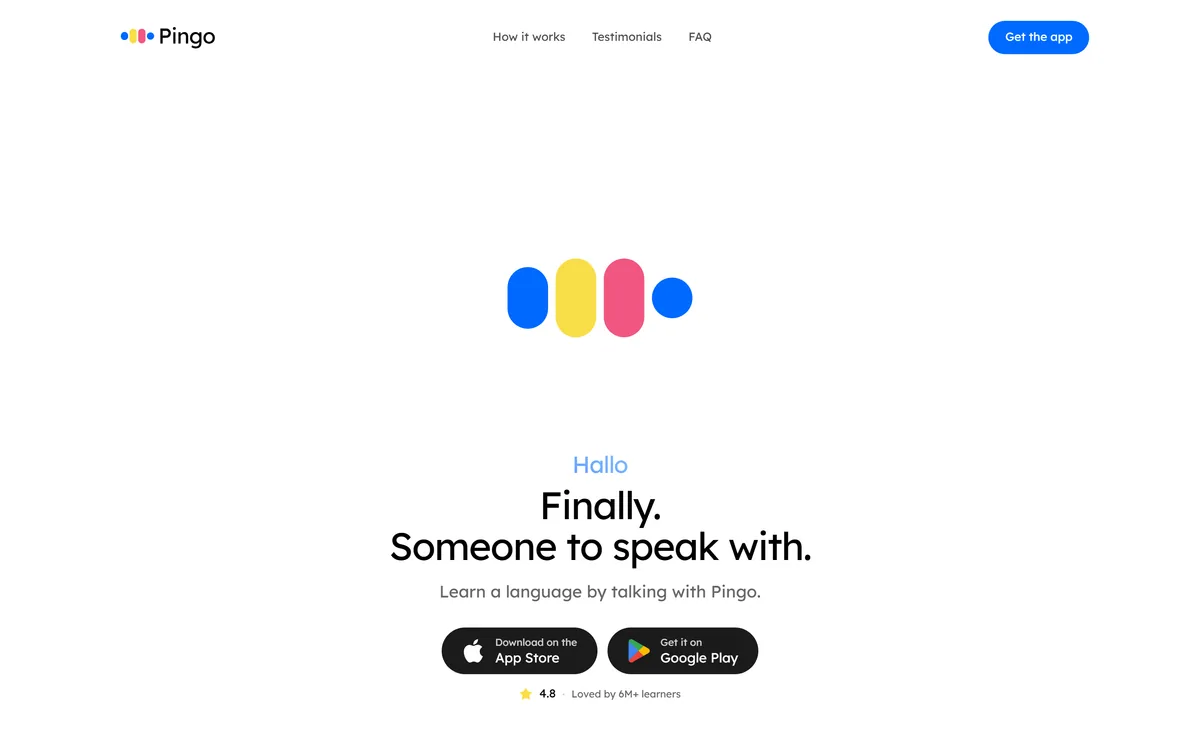
Pingo AI's homepage, captured 9 September 2026, showing its speak-from-day-one positioning.
Pingo AI: What You Get When You Speak
Conversation from session one — the product is talking, not tapping through drills.
Memory between sessions: your level, mistakes, vocabulary and goals carry forward.
25-plus target languages, taught in 15-plus native languages.
Scenario roleplay covering trips, interviews, hobbies and everyday moments.
Mobile-first, on both major app stores, displaying a 4.8 rating and 6 million-plus learners.
Pingo AI: Languages And Reach
Method
Conversation-led practice with in-the-moment correction
Target languages
Stated as 25-plus, with 15 listed on the homepage
Interface languages
Stated as 15-plus native languages supported for teaching
Continuity
Level, mistakes, vocabulary and goals remembered between sessions
Onboarding
Described as three minutes to your first conversation
Scenarios
Trips, interviews, hobbies, daily life and free-form topics
Levels
Positioned for beginners through advanced, including debates and professional roleplay
Session output
Transcript and vocabulary list produced for each conversation
Voice data
Short voice samples recorded to generate feedback, per the published FAQ
Platforms
iOS and Android; no web app advertised
Rating displayed
4.8, alongside a stated 6 million-plus learners
Company
Pingo AI, Inc., per the 2026 footer copyright
Pingo AI: Learning A Language By Talking
The homepage headline is a complaint before it is a pitch: Finally. Someone to speak with. Underneath it sits the whole product — learn a language by talking with Pingo.
That framing is more precise than it looks, and it names a real gap rather than inventing one.
Anyone who has worked through a streak-based app for a year knows the specific failure it produces. You can read a menu, follow a subtitled scene, and recognise a thousand words on sight. Then someone asks you a question at normal speed and nothing comes out.
The reason is not laziness or insufficient vocabulary. Recognition and production are genuinely different skills, and tapping the right tile out of four trains only the first one.
Production requires retrieving a word under time pressure, assembling a sentence while the other person waits, and recovering when it comes out wrong. None of that is comfortable, which is precisely why apps built for daily engagement rarely make you do it.
Recognition and production are different skills. Tapping the right tile out of four trains only one of them, and it is not the one you need in front of a person.
Roleplay Scenarios And Why They Stick
The examples on the page are unusually concrete: a first day in Korean, saying what you like in Spanish, picking Italian back up where the subjunctive caught you out, asking for directions before a trip to Rio, and a job interview conducted in Japanese.
Scenario practice works for a reason that has nothing to do with novelty.
Language is stored contextually rather than as a flat list. Vocabulary learned inside a situation — ordering, apologising, negotiating a delivery date — comes back when that situation recurs, because the situation itself is part of the retrieval cue. Words learned from a list have no such handle.
The interview example is the most useful of them, because it is the case where rehearsal has obvious value and a human partner is hardest to find. You cannot ask a friend to conduct a formal interview in Japanese ten times until you stop freezing.
That is the honest version of what an AI partner offers: not better than a good human tutor, but available at 6am, infinitely repeatable, and completely indifferent to how many times you get it wrong. Praktika builds the same idea around avatar tutors with visible faces.
Why Is Conversation The Missing Half?
The FAQ answers this directly: you improve faster because you are speaking from the start, getting corrected in the moment, and returning to practise what tripped you up last time.
Each of those three elements is doing separate work, and it is worth pulling them apart.
Speaking from the start matters because the anxiety of production is itself a skill barrier. Learners who delay speaking until they feel ready mostly never feel ready, and the delay compounds — every month of silent study raises the stakes of the first real conversation.
Correction in the moment matters because of how errors set. A mistake repeated uncorrected for six months becomes automatic, and unlearning an automatic error costs far more than learning the correct form would have.
Returning to what tripped you up is the part most apps cannot do at all, because they have no model of your specific errors. A drill app knows which lessons you completed. A conversation partner that remembers knows that you keep using the wrong past tense — and those are different kinds of knowledge entirely. Pronunciation is the one sub-skill this design does not isolate, which is exactly where ELSA Speak concentrates.
Speak in the first session, badly, on purpose.
Say the corrected sentence out loud rather than reading it.
Pick scenarios you will actually face within a month.
Use the transcript afterwards; that is where the learning consolidates.
Let it correct you rather than switching to your own language when stuck.
Memory Across Sessions And Why It Helps
Step three of the onboarding is the feature that separates this from a chatbot with a language prompt: Pingo remembers your level, mistakes, words and goals, so every session builds on the last.
Continuity is the difference between a tutor and a conversation.
A good human tutor's value is largely accumulated context. They remember that you always drop the article, that you are learning for a specific move rather than for pleasure, and that the subjunctive defeated you in March. Every lesson starts from that, which is why the tenth lesson is worth more than the first.
A stateless AI conversation partner starts from zero every time. It will be patient and fluent and completely unaware that you have made the same error forty times, which makes it a pleasant experience and a slow teacher.
One of the site's own testimonials describes exactly this loop in practice — a conversation resuming where the subjunctive had caused trouble the day before. Whether the memory is that granular in daily use is worth testing during the trial, because it is the single feature that determines whether month three is better than month one. Langua makes the same continuity bet from the browser rather than the phone.
Twenty-Five Languages And Fifteen Interfaces
Two numbers in the FAQ do different jobs. Pingo teaches 25-plus target languages, and it supports teaching in 15-plus native languages — with 15 target languages listed by name on the homepage and in the footer.
The second number is the one most learners never think to check, and it matters more than it sounds.
Almost every language app assumes you speak English. If you are a Vietnamese speaker learning Japanese, or a Turkish speaker learning German, an English-only interface means learning through a third language you may hold less firmly than the one you are studying. That is a real handicap and a common one.
Fifteen teaching languages is a genuine investment, because explanations, corrections and grammar notes all have to work in each of them rather than merely being translated strings.
The gap between 25-plus taught and 15 listed by name is worth reading as depth rather than inconsistency: the listed set is likely the mature one. The FAQ invites requests for unlisted languages and states that new ones are prioritised by demand, which is a fair answer as long as you check yours before committing.
Getting To Your First Conversation
The promise is three minutes to your first conversation, and the barrier is not setup — it is willingness to sound bad out loud.
This order gets past that faster than waiting until you feel ready.
Confirm your target and native language are both supported before subscribing.
Tell it your real goal — a trip, a move, a job — rather than a level.
Speak in the first session even if every sentence is broken.
Read the transcript afterwards and say the corrections aloud.
Pick one recurring scenario and repeat it until it stops being frightening.
Check in month two whether it still remembers your earlier mistakes.
Key features of Pingo AI
Conversation-led practice with spoken input
In-the-moment correction during a session
Persistent memory of level, errors, vocabulary and goals
Scenario roleplay for travel, work and daily life
Transcripts and vocabulary lists per conversation
Debates and professional roleplay for advanced learners
Teaching in 15-plus interface languages
iOS and Android apps
Pros & cons
Pros
7
Targets production, the half of language learning most apps skip
Session memory turns a chatbot into something closer to a tutor
Scenario framing matches how language is actually retrieved
Teaching in 15-plus native languages rather than assuming English
Transcripts give you something to review after the conversation ends
Unlimited repetition of situations no human partner would sit through
The published FAQ addresses voice data directly rather than ignoring it
Cons
7
Not a substitute for systematic grammar instruction from zero
Only 15 of the stated 25-plus target languages are named publicly
How granular the memory really is cannot be judged from outside
No web version advertised, so practice is phone-only
Voice recording is inherent to the product and worth reading the policy for
Testimonials are vendor-selected and include competitor comparisons
Speaking-first is uncomfortable, and the app cannot supply accountability
Best For
Intermediate learners stuck at the point of speaking
Anyone with a trip, move or interview on a fixed date
Learners whose native language is not English
People who cannot commit to scheduled lesson times
Advanced speakers wanting professional and debate practice
Pingo AI Beside Other Language Apps
Language tools differ by which half of the skill they train.
Langua — browser-based conversation with grammar help
Language Reactor — learning from subtitled video you already watch
Humalingo — another entrant in the language tooling space
Pingo AI: Confirmed On The App Pages
Last checked . Read from pingo.ai in a browser session on the date above, with the screenshot captured at the same time.
Positioned as learn a language by talking, under the headline Finally. Someone to speak with
A three-step flow: state your goals, learn through real conversations, pick up where you left off
Memory described as retaining your level, mistakes, words and goals between sessions
Onboarding stated as three minutes to your first conversation
Fifteen languages listed by name on the homepage and repeated in the footer
FAQ stating 25-plus target languages and 15-plus native languages supported for teaching
Scenario examples shown for a first Korean session, a Rio trip and a Japanese job interview
Advanced use described as fast-paced roleplays, debates and professional scenarios
FAQ stating short voice samples are recorded to generate personalised feedback
A displayed rating of 4.8 alongside a stated 6 million-plus learners
Testimonials attributed to named App Store and Google Play reviewers, several citing transcripts and vocabulary lists
Footer showing Pingo AI, Inc. with a 2026 copyright, plus careers, privacy, terms and help links
What we could not confirm: the full list of 25-plus target languages, since only 15 are named; how granular the session-to-session memory is in extended use; how long voice samples are retained beyond the FAQ's general statement; whether any independent assessment supports the learning-speed claims; and pricing. Testimonials on the site are vendor-selected. We did not install the app or complete a conversation.
Editor's Verdict
4.2/5
Pingo AI has picked the correct problem. Most language apps make you excellent at recognising a language and leave you mute in front of an actual person, because recognition and production are different skills and only one of them is easy to gamify. Building the whole product around talking, with session-to-session memory so yesterday's mistake becomes today's starting point, addresses the gap directly. It is not a substitute for structured grammar instruction, and the site does not pretend otherwise. AInexfinder Editor Score: 4.2/5.
Pingo AI pricing
AInexfinder does not list plan prices or billing details. For current pricing, plans, and trials, visit the official Pingo AI website.
Vendor pricing, credits, and billing policies change over time. Always confirm on the official site before you buy.
Frequently asked questions
What makes Pingo AI different from a streak-based language app?
You speak rather than tap. Drill apps train recognition — picking the right option out of four — while Pingo trains production, which is retrieving a word under time pressure and assembling a sentence while someone waits.
Can a complete beginner use it?
The FAQ says yes: you state your level and goals, and early sessions cover core phrases, numbers and introductions in short interactive conversations. If you want systematic grammar foundations first, a structured course still does that better.
How many languages does it teach?
It states 25-plus target languages and 15-plus native languages for the teaching interface, with 15 target languages named on the homepage. Check that both your languages are supported before committing.
Does it remember me between sessions?
That is the stated design — level, mistakes, words and goals carry forward so each session builds on the last. It is also the feature worth testing during a trial, because it determines whether month three is better than month one.
Why does correcting mistakes immediately matter?
Because errors fossilise. A mistake repeated uncorrected for six months becomes automatic, and unlearning an automatic error costs considerably more effort than learning the correct form would have in the first place.
What happens to my voice recordings?
The FAQ states short voice samples are recorded to generate personalised feedback, processed securely, and retained only as necessary, referring to the privacy policy. Since speaking is the entire product, that policy is worth reading properly.
Is it useful for advanced learners?
The site positions advanced use as fast-paced roleplays, debates and professional scenarios with feedback on pronunciation, tone and delivery. Interview rehearsal is the clearest case, because repetition is easy to get and a human partner is not.
Can it replace a human tutor?
Not for structure or accountability. What it replaces is the unavailable practice partner — the one who would need to sit through the same conversation ten times at six in the morning without visible impatience.
Why does the interface language matter so much?
Because learning Japanese through English when your first language is Vietnamese means routing everything through a third language you may hold less firmly. Fifteen teaching languages is a real investment, not a translation exercise.
How should I actually use it?
Speak in the first session even if it is broken, read the transcript afterwards and say the corrections out loud, and repeat one scenario you will genuinely face until it stops being frightening.
Daniel reviews AI tools the slow way — by actually using them on real projects. His reviews cover what works, what breaks, and who each tool is genuinely a good fit for.
Daniel and the AInexfinder editorial team research Pingo AI using public product information, listing evidence, and (when available) hands-on checks. Scores reflect listing completeness and transparency — not paid placement.
Listings may include affiliate or sponsored placements, which are labeled when present. Editorial scores and cons are not sold. See our affiliate disclosure and review methodology.
LUCA is a K-12 reading intervention platform that analyses student reading at the phoneme level rather than the word level, identifying skill gaps in real time. It reports a 17.4 words-per-minute average fluency gain and 763,000+ grapheme-phoneme mappings, delivered through SoundScout, StoryGen and Assessment Intelligence.
Question AI is a homework-helper app that scans a question and returns step-by-step answers across school subjects, plus AI writing, search, translation and summarizing. Its study uses are legitimate; using it to hand in answers or graded work crosses academic-integrity lines, which we weigh honestly.
RemNote combines outlining, handwriting, PDF annotation and spaced-repetition flashcards in one document, generating cards, quizzes and summaries from PDFs, slides, lecture transcripts and video, with an exam scheduler that works backwards from a date you set.
Gizmo is a mobile-first study app that turns your notes, PDFs, slides and YouTube videos into AI-generated quizzes and flashcards, built around active recall so revision becomes a habit rather than a chore.
StudyFetch turns course material — PDFs, slides, lecture recordings, YouTube videos, photographed notes — into flashcards, quizzes, summaries and an AI tutor called Spark.E that answers only from your uploaded content.
ThetaWise is a STEM study tool covering maths, science and engineering with step-by-step solutions, a Tutor Mode that guides through hints, generated animated video lessons, practice quizzes, flashcards and Desmos graphing, stating 765,781 students.