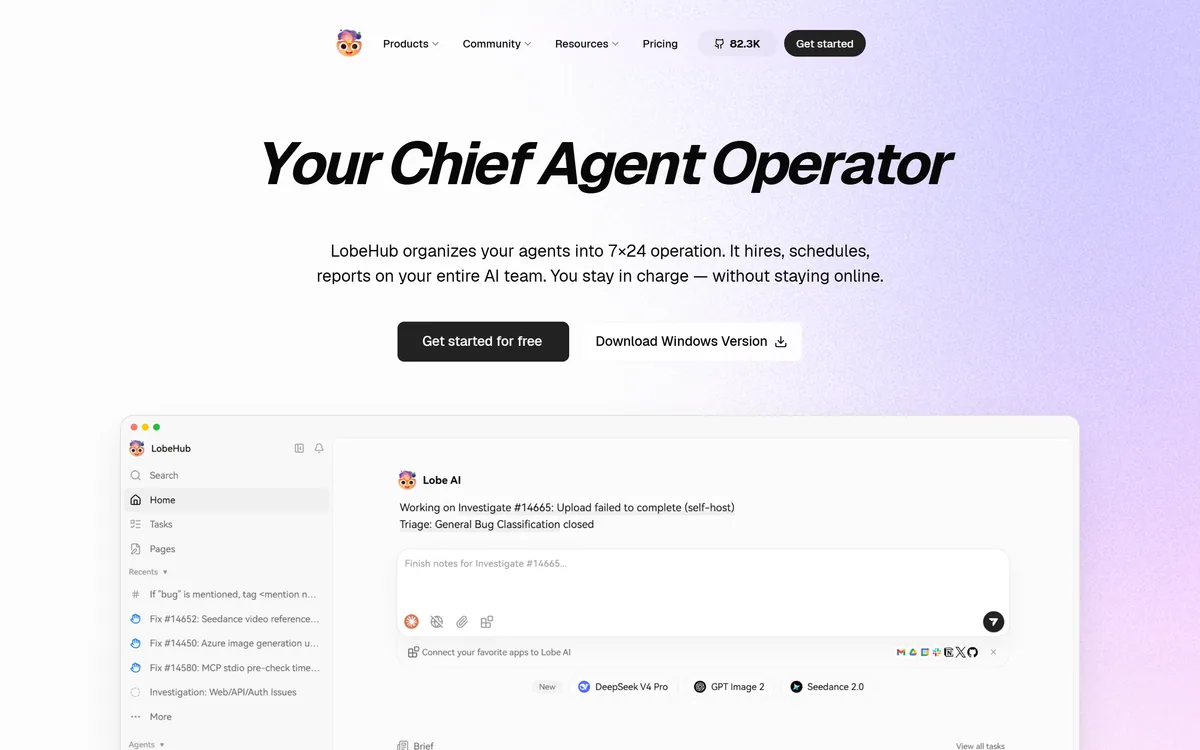
LobeHub has grown from an open-source universal chat interface into what it calls a Chief Agent Operator: a system that assembles agents from a skills marketplace, runs them continuously, groups them into teams for parallel work, and reports back through the chat tools you already use.
lobehub.com7 viewsAdded January 12, 202692K visitors
LobeHub's homepage, captured 9 September 2026, showing its Chief Agent Operator positioning.
LobeHub: A Chief Agent Operator
Agents that run continuously — hired, scheduled and reported on, described as staying in charge without staying online.
Two marketplaces: agents, and a skills marketplace counted in the hundreds of thousands alongside MCP servers.
Agent groups assembled automatically for a task, working in parallel with iterative improvement.
White-box memory — structured and editable rather than an opaque store.
Open-source heritage, with a downloadable desktop version and any model under your own control.
Why Would Agents Need An Operator?
LobeHub's framing is unusually specific: it organises your agents into round-the-clock operation, hiring, scheduling and reporting on your entire AI team, so you stay in charge without staying online.
The word doing the work is operation, and it names a problem that only appears once agents actually work.
A single agent you supervise is a tool. Ten agents running unattended is an operation, and operations need things tools do not: someone deciding what runs, a schedule, a record of what happened, and a way of finding out when something went wrong.
That is a management problem rather than a modelling one, and it is exactly the layer most agent products skip — they make agents easier to create and leave you to work out what happens next.
Its own example is illustrative: five hundred open issues, fifty agents dispatched, and the user went to bed. Whether that is a good idea depends entirely on how reviewable the output is, which is the question the memory design below is trying to answer.
One agent you supervise is a tool. Ten running unattended is an operation, and operations need a schedule, a record, and a way to find out what broke.
White-Box Memory And Editable Context
Among the features under an Evolve heading sits the most important one: white-box memory, described as structured and editable, alongside personal memory, continual learning and adaptive behaviour.
Editable memory is the feature that makes long-running agents governable, and almost nothing else has it.
The failure mode with persistent memory is specific and infuriating. An agent forms a wrong belief — that you prefer a format you do not, that a project ended when it did not, that a colleague holds a role they left — and then acts on it consistently. Every subsequent output is subtly wrong for a reason you cannot see.
With opaque memory the only remedy is to reset everything and lose what was correct. With structured, editable memory you open it, find the wrong entry and change it.
That difference matters more the longer agents run and the less you watch them, which is precisely the mode this product is built for. Continual learning without inspectable memory is a system that drifts and cannot be corrected.
Skills, MCP Servers And Two Marketplaces
The site displays a skills marketplace counted in the hundreds of thousands and MCP servers counted in the tens of thousands, alongside an agent marketplace and an agent builder that configures names, roles, skills and behaviours from one sentence.
Those numbers deserve reading as listings rather than as capabilities.
Marketplace counts in this category are inflated by the same dynamics everywhere: many entries are variations, many are unmaintained, and a large proportion of any listing directory has never been used by anyone but its author. A community post quoted on the same page cites a different skill figure entirely, which suggests the number moves quickly.
What the count does establish is that the platform bet on MCP early and built around it, and that is the strategically correct bet — a standard interface means agents reach systems nobody wrote a bespoke connector for.
The agent builder taking one sentence and configuring role, skills and behaviour automatically is the more practical feature. The barrier to using agents has never been capability; it has been that configuring one properly takes longer than doing the task. Hosted assistants like Kimi remove that setup entirely, and remove the control along with it.
Read marketplace counts as listings, not as working capabilities.
Inspect the memory early and correct wrong entries before they compound.
Start with one scheduled agent, not fifty.
Check where your model keys and data actually sit.
Route reports into a channel someone reads.
Agent Groups And Parallel Work
Under a Collaborate heading the site describes agent groups working as real teammates, with automatic team formation, parallel collaboration, multi-task execution and iterative improvement, alongside Pages written by multiple agents sharing context, plus projects, schedules and a shared workspace.
Multi-agent collaboration is the least proven idea in this field, and it is worth separating the plausible part from the speculative.
The plausible part is parallelism on separable work. Fifty independent issues genuinely can be worked in parallel, because nothing about issue seven depends on issue twelve. That is a scheduling win and it is real.
The speculative part is agents improving each other's work iteratively. Models are poor judges of quality, including their own, and a group that agrees with itself can converge confidently on something wrong — with more conviction than a single agent would have managed.
The shared context in Pages is the mitigating design. Agents working from one visible document rather than passing messages means you can read what they collectively believe, which is the only practical way to supervise a group at all. Evaluating what a group actually produced is a separate discipline, and Promptfoo's.
From Open Source Chat Interface To Platform
The community quotes on the page tell the product's history plainly: an open source ChatGPT interface, a universal LLM web UI, one-click installable on any local machine, with tens of thousands of stars on a public repository.
That heritage is worth weighing alongside the new positioning, because the two serve different people.
The original proposition was control — run any model, keep your keys, host it yourself, own the interface. That audience cares about independence, and it is why the project accumulated the following it did.
The Chief Agent Operator positioning is a hosted, managed proposition. Agents running around the clock in the cloud with reports arriving in Slack is not something you run on a laptop, and the two versions of the product pull in opposite directions.
The site still offers a desktop download and states any model under your control, so both appear to be available. Anyone choosing it for the original reason should verify how much of the new capability survives self-hosting, because that is exactly the sort of thing that quietly becomes cloud-only — the same tension Khoj navigates between its hosted and self-hosted versions.
Running Agents Without Staying Online
The step from using an agent to operating a fleet is where people either get real leverage or create a mess nobody can audit.
This sequence builds the oversight before the scale.
Establish where models, keys and data sit before connecting anything.
Configure one agent for one recurring task and let it run a week.
Read its memory and correct anything wrong before adding a second.
Route reports somewhere a person actually reads them.
Try a group only on work that genuinely separates into parallel parts.
Review what ran unattended, weekly, rather than assuming it was fine.
LobeHub: Marketplaces And Scale
Positioning
Your Chief Agent Operator — hires, schedules and reports on your AI team
Operating model
Agents in continuous operation, described as round the clock
Agent creation
One-sentence builder configuring names, roles, skills and behaviours automatically
Skills marketplace
Counted in the hundreds of thousands on the homepage
MCP servers
Counted in the tens of thousands
Collaboration
Agent groups with automatic team formation and parallel execution
Shared surfaces
Pages, projects, schedules and a team workspace
Memory
Personal memory, continual learning, adaptive behaviour and white-box editable memory
Model support
Any model, any modality, stated as under your control
Reporting
An IM gateway putting agents in the chat tools you already use
Clients
Web plus a downloadable Windows version
Heritage
Open source, with a public repository and community endorsements from named developers
Key features of LobeHub
Continuous, scheduled agent operation
One-sentence agent builder
Skills marketplace and MCP server directory
Agent groups with automatic team formation
Shared Pages written by multiple agents
Projects and a team workspace
White-box editable memory
Reporting through existing chat tools
Pros & cons
Pros
7
Addresses agent operation, the layer most agent products skip entirely
White-box memory makes long-running agents correctable rather than merely persistent
Shared context in Pages is the only practical way to supervise a group
One-sentence agent creation removes the configuration barrier
Early and thorough bet on MCP as the connection standard
Reports arrive where people already are rather than in another dashboard
Open-source heritage with a large public following and a desktop client
Cons
7
Marketplace counts measure listings rather than working capabilities
A community post on the same page cites a different skill count
Agents improving each other's work is the least proven claim here
The hosted operator positioning pulls against the self-hosting heritage
How much capability survives self-hosting is unstated
Fifty unattended agents is only sensible if the output is reviewable
Our capture stopped before the footer, so licence and company went unread
Best For
Teams with recurring work that separates into parallel tasks
Developers who want model choice and key ownership
Anyone already building with MCP servers
Users who need to inspect and correct an agent's memory
Open-source users who followed the project from its chat interface days
LobeHub Against Other Agent Operators
Agent tooling differs by who operates the agents and where they run.
Last checked . Read from lobehub.com in a browser session on the date above, with the screenshot captured at the same time.
Positioned as Your Chief Agent Operator, organising agents into round-the-clock operation
Stated as hiring, scheduling and reporting on your entire AI team so you stay in charge without staying online
An agent builder described as configuring names, roles, skills and behaviours from one sentence
A skills marketplace displayed with a count in the hundreds of thousands
MCP servers displayed with a count in the tens of thousands
Agent groups described with automatic team formation, parallel collaboration and iterative improvement
Pages, schedules, projects and a shared workspace listed as collaboration surfaces
Memory described as personal, continually learning, adaptive and white-box editable
Model support stated as any model, any modality, under your control
An IM gateway described as putting agents in the chat tools you already use
A Windows desktop download offered alongside the web version
Community endorsements displayed from named developers referencing its open source chat interface heritage
What we could not confirm: our capture did not reach the site footer, so we make no claim in either direction about what is published there, including the operating company or licence terms. We also could not confirm how the skills marketplace count is calculated, since a community post on the same page cites a different figure; how much of the Chief Agent Operator capability works in a self-hosted deployment; what the open-source licence covers relative to the hosted product; where agent execution and data reside; and pricing. We did not deploy an instance or run an agent.
Editor's Verdict
4.2/5
LobeHub started as the open-source chat interface everyone recommended for running any model in one place, and it has repositioned around something considerably more ambitious: operating a fleet of agents that run whether or not you are watching. White-box memory — structured and editable rather than opaque — is the feature that makes that defensible, because an agent acting on a wrong belief is only fixable if you can see what it believes. The scale claims are enormous and the marketplace numbers deserve reading carefully. AInexfinder Editor Score: 4.2/5.
LobeHub pricing
AInexfinder does not list plan prices or billing details. For current pricing, plans, and trials, visit the official LobeHub website.
Vendor pricing, credits, and billing policies change over time. Always confirm on the official site before you buy.
Frequently asked questions
What is LobeHub now?
It has repositioned from an open-source universal chat interface into what it calls a Chief Agent Operator — a system that assembles agents from a skills marketplace, runs them continuously, groups them for parallel work and reports back through your existing chat tools.
Why do agents need an operator?
Because one agent you supervise is a tool, and ten running unattended is an operation. Operations need a schedule, a record of what happened, and a way to find out when something went wrong — a management layer most agent products skip.
What is white-box memory?
Memory you can read and edit rather than an opaque store. It matters because an agent that forms a wrong belief acts on it consistently, and with opaque memory the only remedy is resetting everything and losing what was correct.
Should I trust the marketplace numbers?
Read them as listings rather than capabilities. Directory counts in this category are inflated by variations, unmaintained entries and things nobody but the author has used — and a community post on the same page cites a different figure.
Does multi-agent collaboration actually work?
Parallelism on separable work does — fifty independent issues genuinely can be worked at once. Agents iteratively improving each other's output is the speculative half, since models are poor judges of quality including their own.
Can I still self-host it?
A desktop download is offered and model control is stated, so the original proposition appears to survive. How much of the new agent operation capability works outside the cloud is not stated, and it is worth verifying before you depend on it.
What is an MCP server?
A standard interface exposing tools and data to AI clients. Supporting them lets agents reach systems nobody wrote a bespoke connector for, which is what makes a skills marketplace of this size possible at all.
Is dispatching fifty agents a good idea?
It depends entirely on whether the output is reviewable. The site's own example — five hundred issues, fifty agents, and going to bed — is only sensible if someone reads what happened, which is what the reporting layer is for.
How should I start?
One agent, one recurring task, running for a week. Read its memory and correct anything wrong before adding a second. Building the oversight before the scale is the difference between leverage and an unauditable mess.
Which model does it use?
Any model, any modality, stated as under your control — which is the heritage of the original project and the reason it accumulated its following. Where execution and data actually reside in the hosted version is worth confirming.
Daniel reviews AI tools the slow way — by actually using them on real projects. His reviews cover what works, what breaks, and who each tool is genuinely a good fit for.
Daniel and the AInexfinder editorial team research LobeHub using public product information, listing evidence, and (when available) hands-on checks. Scores reflect listing completeness and transparency — not paid placement.
Listings may include affiliate or sponsored placements, which are labeled when present. Editorial scores and cons are not sold. See our affiliate disclosure and review methodology.
Felo is a multilingual AI search and creation platform from Felo Inc. It pairs an answer engine with Felo Slides, an agent mode, an LLM playground, LiveDoc and an API, with the multilingual layer as its distinguishing feature rather than an afterthought.
Exa is a search API that gives AI agents real-time access to the web, built on its own large index, embedding and retrieval models, with selectable latency, search verticals, token-efficient highlights, structured enrichments and an MCP server.
R Discovery is a research reading and literature search app from Cactus Communications, covering 150M+ journal articles, 78M+ open access papers and 10M+ conference documents. It offers AI summaries with citations, chat with a PDF, generated literature reviews, audio papers and translation into 30+ languages.
Zendy is an AI-powered research library combining open-access and premium academic literature with ZAIA, an assistant that summarises papers, highlights key phrases and gives reference-backed answers, aimed at independent researchers and institutions.
Voiceflow is an enterprise conversational AI platform where CX teams design agent workflows visually, prototype them in place, and deploy one agent across web, app, WhatsApp, SMS and voice. It states 500-millisecond voice latency, 300,000 messages per minute and more than 10,000 live agents in production.
Liner splits into three purpose-built agents: everyday search returning cited answers with one-click verification and mind maps, Liner Scholar for finding, comparing and citing papers and building literature reviews, and a writing agent that drafts, verifies and edits in the same window.